



Table of contents
Key Takeaways
- Multi-location SEO requires balancing brand-level authority with location-specific optimization, treating each location as a unique business competing in its own market while maintaining consistent brand standards.
- Google Business Profile optimization is the highest-priority activity, with complete profiles receiving dramatically higher engagement than incomplete listings—86% of GBP views come from discovery searches where customers have no prior brand awareness.
- NAP consistency across citations remains foundational—73% of businesses have at least one discrepancy that can suppress rankings through entity confusion in search algorithms.
- Unique, localized content for each location page is non-negotiable; templated pages with swapped city names achieve less than half the rankings of genuinely differentiated content.
- Review management functions as both a ranking factor (15-17% of local pack signals) and brand protection mechanism, with 91% of consumers saying branch reviews affect their perception of the entire enterprise brand.
- Organizations managing multiple locations should consider working with specialized multi-location SEO professionals who understand the unique challenges of scaling local optimization across diverse markets.
What is multi-location SEO?
Multi-location SEO is local search engine optimization built specifically for businesses with more than one physical location. Franchises, retail chains, healthcare networks, service companies with regional footprints. The challenge? Balancing two things that often conflict: building brand authority at the national level while making sure each individual location dominates its own local market in search results.
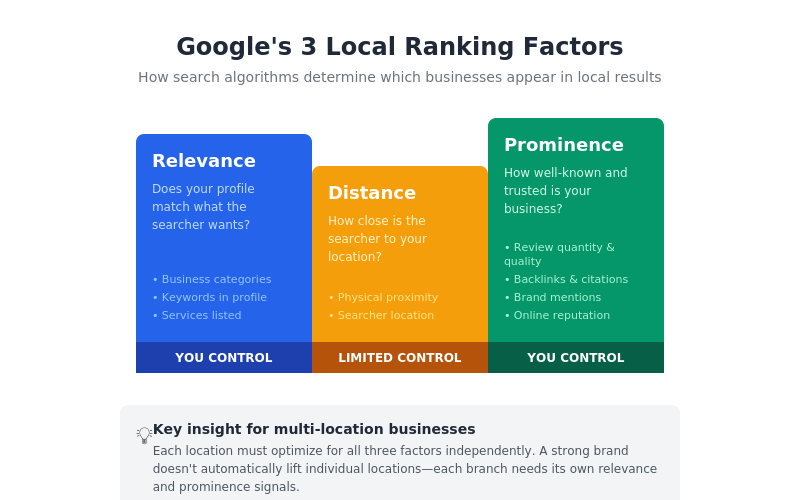
Google's official documentation breaks down local search rankings into three factors: relevance (does your profile match what someone's searching for?), distance (how close is the searcher?), and prominence (how well-known is this business based on links, customer reviews, and overall web presence?). For multi-location businesses, every single location needs to optimize for all three. Independently. While still looking like one cohesive brand. That's harder than it sounds.
The numbers tell the story. SOCi's Local Visibility Index found that fully-optimized multi-location brands nearly doubled their online visibility in Google's 3-pack (65.7%) compared to average performers (33.4%). And that gap matters because Google/Ipsos research shows 76% of smartphone local searchers visit a business within 24 hours, with 28% of those searches ending in a purchase.
Here's what makes this complicated: BrightLocal's consumer research found that 91% of consumers say local branch online reviews shape their perception of the entire brand. One badly-managed location can drag down how your target audience views every other location you operate. Multi-location SEO protects online reputation as much as it drives revenue.
The 9-step framework for multi-location SEO success
Scaling SEO across dozens or hundreds of locations requires systems. What works for a single storefront falls apart when you're managing 50, 200, or 1,000 locations. This local SEO strategy framework gives you the structure to execute consistently, but fair warning: the devil is in the implementation details, and those details vary wildly by industry.
Step 1: Audit your current local presence
Start by documenting everything. Every physical location with its address, phone number, and business hours. Every Google Business Profile tied to your brand, including ones you didn't create (Google often auto-generates business listings, sometimes with wrong information). Duplicates. Unauthorized profiles from former franchisees. Verification status across the board.
Then establish baselines. Where do you currently rank in local search results? How much organic traffic hits each location page? What's your review count and average rating per location? How accurate are your citations across local directories? Without these numbers, you can't measure whether your marketing efforts actually work.
| Audit component | What to document | Why it matters |
|---|---|---|
| GBP listings | Verification status, completeness score, last update date | Unverified or incomplete profiles underperform significantly |
| NAP consistency | Variations in name, address, phone across directories | Inconsistencies create entity confusion for search algorithms |
| Review health | Count, recency, average rating, response rate | Reviews comprise approximately 15-17% of local ranking factors |
| Location pages | URL structure, unique content, schema implementation | Duplicate content triggers ranking suppression |
Step 2: Develop a scalable site architecture
Website structure matters more than most businesses realize. The goal: let each location build its own visibility without cannibalizing siblings.
The cleanest approach uses a hub-and-spoke URL pattern. Your location hub lives at yourdomain.com/locations/. Individual locations sit at yourdomain.com/locations/city-state/. Service pages specific to a business location go one level deeper: yourdomain.com/locations/city-state/service/. What goes on each location page? Unique local content (not copy-paste templates), an embedded Google Map, complete NAP details, testimonials from local customers, staff bios with photos, and service descriptions written for that specific market.
Wiideman SEO consultancy's research found something striking: hyperlocal content lifted rankings by 107% compared to templated pages. The effort of creating unique content pays off. But here's what most guides won't mention: that 107% lift came from pages with genuinely differentiated content, not pages where someone swapped city names and added a local photo.
Step 3: Claim and optimize Google Business Profiles for every location
GBP signals dominate local pack rankings. Every physical location needs its own Google My Business profile, fully optimized. That means using your exact legal business name consistently, selecting the most specific primary category available, adding all relevant secondary categories, filling out complete service lists with descriptions, uploading quality photos of your exterior, interior, team, and products, and keeping business hours accurate (including holidays).
Why does completeness matter so much? Research shows that 86% of GBP views come from "discovery" searches in Google search, not direct brand searches. Most potential customers finding your listing have never heard of you. A thin, incomplete profile with missing business information loses them instantly.
One common mistake: treating GBP optimization as a one-time project. Profiles need ongoing maintenance. Hours change. Services evolve. Quarterly audits catch drift before it costs visibility.
Step 4: Ensure NAP consistency across all citations
NAP consistency sounds tedious. It is. But this is where most multi-location SEO campaigns quietly fail.
When your business shows up as "Smith & Associates" on Google but "Smith and Associates LLC" on Yelp and "Smith Associates Inc." on Facebook, search algorithms can't confidently verify you're a real, legitimate business. They hedge by suppressing your rankings. So why do 73% of businesses still have citation errors? Because nobody owns the problem. Marketing assumes operations handles it. Operations assumes IT handles it. And the inconsistencies compound.
Common culprits include business name variations (Inc., LLC, abbreviations that differ across platforms), address format inconsistencies (Street vs. St., Suite vs. #), phone number formatting differences, old addresses from past relocations, and disconnected contact information nobody updated.
Industry analysis confirms the scope: 73% of businesses have at least one discrepancy across their top citations. That's enough to trigger entity ambiguity and cost you rankings. One franchise client ignored this for two years. When they finally audited, they found 47 variations of their business name across directories. Fixing it took six months.
| Tier 1 (essential) | Tier 2 (important) | Tier 3 (industry-specific) |
|---|---|---|
| Google Business Profile | Apple Maps | Industry directories |
| Bing Places | Yelp | Professional associations |
| Facebook Business | Yellow Pages | Regional chambers of commerce |
| Data aggregators | BBB | Niche review platforms |
Step 5: Create unique, localized content for each location
Copy-paste content is the silent killer of multi-location SEO. Businesses create one location page, swap the city name 50 times, and wonder why nothing ranks. Google sees those pages as near-duplicates and can't determine which one deserves visibility. Usually the answer becomes "none of them."
What actually works? Reference local landmarks, neighbourhoods, and local community quirks. Address regional climate or seasonal issues your services solve. Highlight the specific team members at that location. Feature testimonials from customers in that area, by name. Discuss local regulations or requirements unique to the market. Write about local events you participate in.
Aim for 60% or more relevant content unique to each location page. Yes, that takes work. The alternative is pages that don't rank.
Step 6: Implement structured data markup at scale
Schema markup tells search engines exactly how your brand relates to its individual locations. (Side note: Google's documentation on LocalBusiness schema is frustratingly vague about what's required versus recommended, which is why implementations vary so much in quality.)
Required types include LocalBusiness schema on every location page, Organization schema on your corporate pages, BreadcrumbList for navigation, and service-specific schema where relevant.
Each LocalBusiness implementation needs complete data: business name, street address, geographic coordinates, phone number, website URL, operating hours, SEO services offered, and accepted payment methods. Partial implementations underperform. Does schema markup actually move search rankings directly? The data suggests the effect is indirect, helping Google understand entity relationships rather than providing a direct ranking boost. But that understanding matters for multi-location businesses where brand-location relationships are complex.
Step 7: Build a systematic review generation and management program
Reviews pull double duty. They're a ranking factor (accounting for roughly 15-17% of local pack signals according to industry research) and a conversion factor. The metrics that matter: total review count, velocity (how consistently new reviews arrive), recency (reviews from the past 90 days carry extra weight), average star rating (68% of consumers won't consider businesses below 4 stars), and response rate.
Building a scalable system means requesting positive reviews 24-48 hours after service, training location staff on why user experience directly impacts their visibility, setting response protocols that require replies within 24-48 hours, and monitoring sentiment to catch operational problems before they become reputation problems.
Interestingly, some 2025 research found diminishing returns on review quantity past 150 reviews, while SOCi's data suggests volume still correlates with rankings regardless of count. The truth probably depends on industry and market size. Competitive urban markets seem to weigh recency more heavily than total count.
Step 8: Develop location-specific link building strategies
For multi-location businesses, the most valuable links come from locally-relevant sources. Think local news coverage, chamber of commerce memberships, community event sponsorships, partnerships with complementary local businesses, professional association memberships, university or school partnerships, and nonprofit involvement.
What works about localized link building: Geographic relevance signals strengthen. Community relationships generate referrals beyond SEO. Editorial links from real local sources survive algorithm updates.
What's difficult: It requires market-by-market effort and keyword research for each location. The approach doesn't scale the way national link campaigns do. And results vary wildly depending on market size and available opportunities. A location in Austin has dozens of local publications to pitch. A location in a town of 15,000? Maybe two newspapers and a community blog.
Step 9: Implement location-specific tracking and reporting
Without measurement by location, you're optimizing blind. Essential metrics to track per location: local pack rankings for specific keywords, organic traffic to each location page, GBP insights (calls, direction requests, website clicks), review volume and velocity, citation accuracy scores, and conversion actions like form submissions or calls.
Set baselines before you start optimizing. Define KPIs for each location based on its market opportunity. Build dashboards that let you compare locations. Run quarterly audits to catch issues before they compound.
Common misconceptions
Misconception 1: You can use the same content across all location pages
The temptation makes sense. Creating unique content for 50 or 200 locations takes significant content marketing resources. So businesses template everything, swap city names, and publish.
The results are disappointing. Research shows that uniquely-written hyperlocal content more than doubles rankings compared to templated approaches. Google's guidelines explicitly warn that duplicate content "may suffer" in rankings or get "removed entirely from the Google index." The shortcut costs more in lost visibility than the time it saves.
Misconception 2: One centralized SEO strategy works for all locations
Every location operates in a different competitive environment. Your Denver branch might face brutal competition from established local players. Your Phoenix location might have almost no SEO competition at all. Applying identical budgets and tactics to both wastes money in one market and starves the other of local SEO efforts.
The International Franchise Association emphasizes this point: different locations face different competitors, different state regulations, different seasonal patterns, different customer behaviours. Strategy needs to flex. Some SEOs disagree and argue for standardization, but the case studies consistently favor market-specific adjustments.
Misconception 3: Proximity is the only factor that matters for local rankings
Proximity matters. But it's also a factor you can't control. Businesses often assume poor local rankings are simply fate, that there's nothing to do when a competitor sits closer to the searcher.
That's not how the algorithm works. Google's documentation explicitly states that "our algorithms might decide that a business that's farther away from your location is more likely to have what you're looking for than a business that's closer, and therefore rank it higher." Excellence in relevance and prominence can overcome proximity disadvantages in local search results. Not always, but often enough to make optimization worthwhile.
Why consistent review management drives disproportionate returns
Reviews get overlooked. They feel like a customer service function, not a marketing function. That's a mistake.
BrightLocal found that 91% of consumers say local branch reviews shape how they perceive the entire brand. Not just that specific location. The whole company. Strong reviews at your Chicago branch build trust for your Atlanta branch. Poor reviews in Dallas make potential customers in Seattle hesitate.
This multiplier effect cuts both ways. Every location's review profile either builds or erodes enterprise-wide brand equity.
Recency matters more than most realize. A 2026 Yext study found that in food and dining, reviews less than two weeks old carry the most weight for visibility. The study also found regional variation: businesses in the South and West that don't respond see 30% more ranking drops compared to the Northeast.
Review management isn't a project. It's an ongoing discipline requiring dedicated processes and staff training.
The hidden cost of fragmented location management
Many multi-location businesses let each location manage its own digital presence. The franchisee handles the GBP. The local manager responds to reviews (or doesn't). Location pages get updated whenever someone remembers.
The result? NAP inconsistencies multiply across directories. Brand voice drifts. Best practices stay siloed. Negative reviews sit unanswered for weeks.
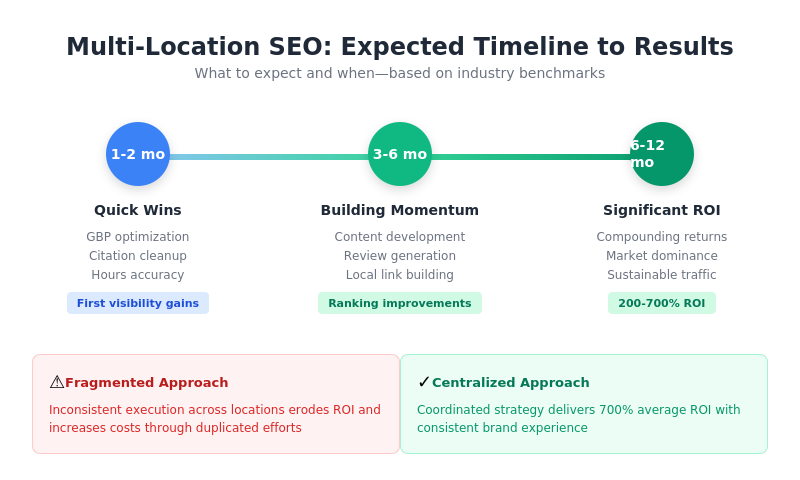
Industry data puts well-executed local SEO performance ROI at around 700% within 6-12 months. But that's well-executed. Fragmentation erodes those returns while increasing labour costs through duplicated efforts across locations.
Centralized systems solve this. Enterprise SEO case studies consistently show centralized coordination outperforming fragmented approaches. One multi-location restoration company with 180+ locations generated 89,422 leads in a single year after centralizing, an average of 497 leads per location.
Real-world examples and case studies
Multi-location healthcare network
A regional healthcare network struggled with inconsistent online presence across its clinic locations. Some had complete GBP profiles. Others were barely claimed. Location pages ranged from detailed to nonexistent.
The fix included systematic GBP optimization across all facilities, location page development with unique provider bios and patient testimonials, and comprehensive citation cleanup. Result: 32% increase in organic traffic to location pages. That traffic converted into appointment bookings.
Enterprise retail chain
A national retailer with hundreds of locations discovered a basic problem: many branches displayed incorrect holiday business hours. Customers showed up to closed stores. Complaints piled up. Visibility dropped during peak shopping periods.
The solution was straightforward but operationally demanding: audit every location, update hours across all platforms, implement data synchronization to prevent future drift. Local pack placements improved within ten days. Basic accuracy fixes produced fast, measurable ranking gains. The lesson? Sometimes the unsexy fundamentals matter more than advanced tactics.
Multi-location orthopedic practice group
An orthopedic practice with multiple locations partnered with an enterprise SEO agency for comprehensive local optimization. The scope included GBP optimization, location-specific landing pages, and structured review generation.
Within one month: 69.8% increase in organic traffic and 61.4% increase in new website users.
Frequently asked questions
How long does it take to see results from multi-location SEO?
The short answer: it depends. Basic optimizations like completing GBP profiles and fixing citation errors typically show results in 30-60 days. Deeper work (content development, review building, link acquisition) usually takes 3-6 months before ranking improvements materialize. Significant ROI tends to emerge at the 6-12 month mark.
Should each location have its own website or use location pages on a central domain?
For most businesses, location pages on a central domain work best. The parent domain's authority flows down to location pages, and unified structure makes management practical. Separate websites can work for franchises with truly independent ownership, but coordination becomes harder.
How do we prevent cannibalization between location pages targeting similar keywords?
Cannibalization happens when multiple pages chase the same local keywords and Google can't tell which to rank. Prevention means clear geographic targeting in content, schema markup that establishes location relationships, and service area definitions that create natural boundaries. Target location-modified keywords ("plumber Chicago") rather than generic terms ("plumber").
What's the difference between multi-location SEO and franchise SEO?
Multi-location SEO covers any business with multiple physical locations: corporate-owned chains, healthcare networks, professional services firms. Franchise SEO specifically addresses franchisor-franchisee dynamics, including brand consistency enforcement, franchisee autonomy, and how marketing responsibilities get distributed. The technical tactics overlap heavily. Governance and implementation differ.
How much should a multi-location business budget for local SEO?
Budget scales with location count and competitive intensity. Most enterprises spend $5,000 to $25,000 monthly on coordinated multi-location SEO services. Large or global brands sometimes invest $50,000 to $100,000+ per month. These investments typically return 200-500%+ ROI within the first year, with some industries seeing returns as high as 700%.


