



Table of contents
Key Takeaways
- PPC advertising offers immediate visibility in search results, with 97% of legal consumers using search engines to find attorneys, making paid search essential for competitive client acquisition in today's digital-first marketplace.
- Legal PPC requires higher budgets than most industries due to average costs per lead of $111-132, but delivers strong ROI when properly managed, with the average return of $2 for every $1 spent on Google Ads.
- Quality Score optimization often matters more than budget increases, as higher scores can reduce costs per click by 50% or more while improving ad positions, effectively doubling lead generation capacity without additional spend.
- Successful lawyer PPC campaigns demand practice area-specific strategies—personal injury requires different approaches than family law, estate planning, or criminal defense—with targeting, messaging, and conversion paths tailored to each service.
- Conversion tracking that extends beyond initial lead capture to consultation scheduling and client retention provides the data needed for algorithmic optimization and accurate ROI measurement, separating high-performing campaigns from costly failures.
- Professional PPC management typically justifies its cost through performance improvements that offset fees, particularly for firms lacking in-house expertise in the complex technical, strategic, and ongoing optimization requirements of effective legal advertising campaigns.
What Is PPC for Lawyers?
Pay-per-click advertising for law firms is a digital marketing strategy where attorneys bid on keywords to display search ads at the top of search engine results. You pay only when potential clients click those ads.
Unlike traditional advertising where firms pay for exposure regardless of engagement, PPC operates on a performance-based model that directly connects ad spend to measurable client interactions. The legal services industry has seen dramatic shifts in client acquisition over the past decade, and the numbers tell a striking story. According to FindLaw's 2024 U.S. Consumer Legal Needs Survey, 97% of respondents who contacted an attorney used search engines to find legal representation, up from just 67% in 2023. That's a 30-point jump in a single year.
For mid-market and enterprise law firms, PPC advertising offers immediate visibility in an increasingly competitive landscape. Organic search engine optimization delivers long-term value, but PPC campaigns can position your firm at the top of search results within hours of launch. This speed-to-market advantage works especially well for firms entering new practice areas, expanding to new geographic markets, or competing against established competitors with stronger organic rankings.
Here's what most firms don't realize: the economics of lawyer PPC campaigns differ significantly from other industries. LocaliQ's 2024 legal search advertising benchmarks reveal that attorneys face an average cost per click of $9.21, with conversion rates averaging 7% and cost per lead reaching $111.05. These numbers reflect both the high value of legal clients and the intense competition for visibility in legal search results.
Building an Effective Law Firm PPC Strategy
Successful attorney Google Ads campaigns require strategic planning across five critical dimensions: keyword selection, geographic targeting, budget allocation, competitive positioning, and conversion tracking.
Keyword Strategy for Legal PPC
Legal keyword selection demands precision and thorough keyword research. Broad keywords like "lawyer" or "attorney" attract unqualified traffic at premium prices. Hyper-specific long-tail keywords deliver higher conversion rates at lower costs. Most effective legal PPC campaigns incorporate three keyword categories.
High-intent commercial keywords indicate immediate legal need: "hire DUI attorney," "personal injury lawyer consultation," or "file bankruptcy attorney." These keywords command premium CPCs but convert at significantly higher rates because searchers have already decided to engage legal counsel. Location-modified keywords add geographic qualifiers like "Chicago employment lawyer" or "divorce attorney near me," which reduces competition while attracting locally relevant traffic. iLawyer Marketing's 2024 consumer research found that 82% of legal consumers prefer attorneys within 60 minutes of their location, so location-based targeting isn't optional.
Then there are practice area-specific long-tail keywords. Phrases like "what to do after workplace discrimination" or "how much does bankruptcy cost" attract earlier-stage researchers who aren't ready to hire yet. These keywords convert at lower rates, but they offer opportunities to capture potential clients before competitors reach them.
Use tools like Google Keyword Planner to identify relevant keywords for your target audience and analyze competition levels before building your ad campaigns.
| Keyword Type | Example | Avg CPC | Conversion Rate | Best Use Case |
|---|---|---|---|---|
| Broad Commercial | "personal injury lawyer" | $75-150 | 5-8% | Maximum reach with large budgets |
| Location + Practice | "Miami car accident attorney" | $50-100 | 8-12% | Local firms with defined service areas |
| Long-Tail Informational | "average settlement for rear-end collision Florida" | $15-40 | 2-5% | Early-stage lead nurturing |
| Competitor Brand | "[Competitor Name] alternative" | $30-75 | 6-10% | Established firms seeking market share |
Geographic Targeting and Budget Optimization
Law firm marketing budgets should align with geographic service areas and practice area profitability. A personal injury firm serving a 50-mile radius requires different targeting than a business litigation practice serving nationwide clients.
Radius targeting varies by practice area. Personal injury and criminal defense firms typically target 15-30 mile radius from office locations, while family law and estate planning can extend to 30-50 miles (a comfortable commute for most clients). Business and commercial litigation often use statewide or regional targeting. Specialized practices like IP or securities law? National targeting focused on major metros makes more sense.
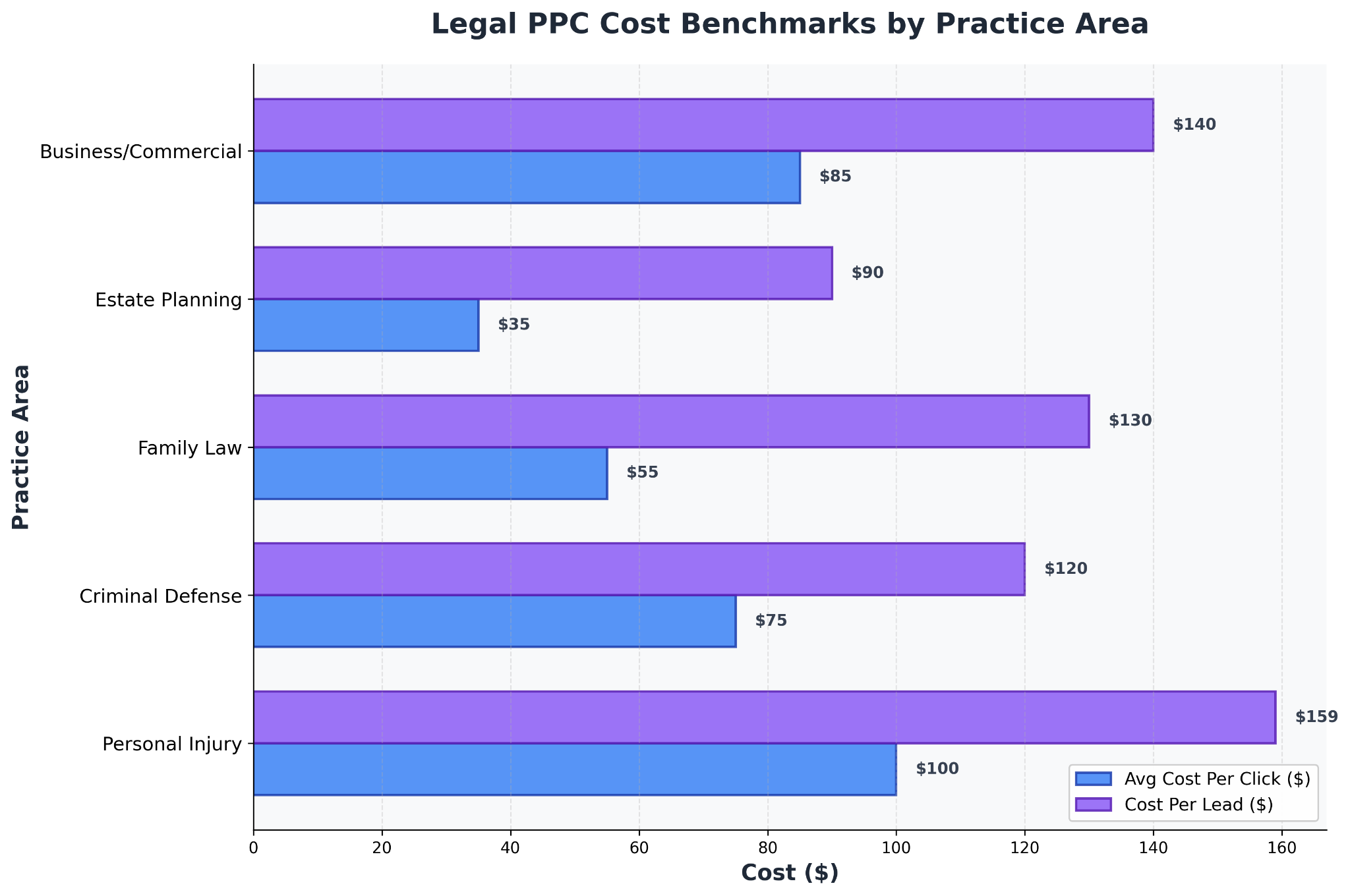
Your marketing budget allocation should reflect both market opportunity and competitive intensity. WordStream's 2025 Google Ads benchmarks show attorneys face the highest cost per lead across all industries at $131.63. Criminal law, bankruptcy, and tax law run even higher... sometimes significantly so.
Note that local service ads operate differently from traditional PPC and may require separate budget considerations for firms targeting hyperlocal markets.
Recommended Monthly Budgets by Practice Area:
| Practice Area | Minimum Monthly Budget | Competitive Market Budget | Rationale |
|---|---|---|---|
| Personal Injury | $8,000-12,000 | $15,000-25,000 | High CPC ($100+), high client value |
| Criminal Defense | $5,000-8,000 | $12,000-20,000 | Urgent need, moderate competition |
| Family Law | $4,000-6,000 | $8,000-15,000 | Local focus, moderate CPC |
| Estate Planning | $2,500-4,000 | $5,000-8,000 | Lower urgency, relationship-building |
| Business/Commercial | $6,000-10,000 | $15,000-30,000 | Complex cases, longer sales cycles |
Common Misconceptions About Legal PPC
Misconception 1: PPC Is Too Expensive for Small Firms
Many solo practitioners and small firms believe PPC advertising requires budgets only large firms can afford. This assumption prevents them from accessing one of the most cost-effective client acquisition channels available.
The numbers tell a different story.
PPC operates on a pay-per-performance model that allows precise budget control. A solo family law practitioner can generate meaningful results with $3,000-4,000 monthly spend by focusing on long-tail keywords, tight geographic targeting, and strategic ad scheduling during peak inquiry hours. Individual click costs in legal services run higher than most industries, but you control exactly how much you spend and when you spend it.
The key lies in understanding client lifetime value. If your average family law client generates $5,000 in revenue and your cost per lead runs $150, you need only a 3% lead-to-client conversion rate to achieve positive ROI. Research from WebFX indicates businesses make $2 for every $1 spent on Google Ads on average (a 200% ROI that holds across industries including legal services).
Misconception 2: Organic SEO Makes PPC Unnecessary
Law firms with strong organic search rankings sometimes question whether PPC provides incremental value. They reason that if they already rank first organically for key terms, paying for ad placement wastes resources.
This logic ignores fundamental search behaviour patterns. Even when a firm ranks first organically, PPC ads appear above organic results. They capture attention from users who preferentially click paid positions. DemandSage's 2025 Google Ads statistics reveal that people who click on Google Ads are 50% more likely to make a purchase than organic visitors, which indicates higher commercial intent among paid search clickers.
And here's the thing: running both SEO and PPC allows firms to dominate search results pages. You occupy multiple positions and reduce competitor visibility. This strategy works especially well for high-value practice areas where client acquisition costs justify premium positioning.
Misconception 3: PPC Delivers Instant Results Without Ongoing Management
Some attorneys view PPC as a "set it and forget it" channel. They expect immediate lead flow without ongoing optimization, launch campaigns, see initial results, then neglect performance monitoring and refinement.
Does this work? Not really.
Look, a successful PPC campaign requires continuous management. Ad performance fluctuates based on competitive bidding, seasonal demand patterns, Quality Score changes, and search algorithm updates. Campaigns left unmanaged suffer from bid inflation, declining ad relevance, and budget waste on underperforming keywords. Professional PPC marketing involves weekly bid adjustments, negative keyword refinement, ad copy testing, landing page optimization, and conversion tracking validation.
LocaliQ's benchmark data shows attorneys saw conversion rates decline 24% year-over-year when campaigns weren't actively optimized. That's a quarter of your leads disappearing simply from neglect.
Why Quality Score Matters More Than Budget
Google's Quality Score system fundamentally impacts law firm PPC performance in ways many attorneys underestimate. This algorithmic assessment evaluates ad relevance, landing page experience, and expected click-through rate. It directly influences both ad position and cost per click.
Quality Score operates on a 1-10 scale. Higher scores earn better ad positions at lower costs. A firm with Quality Score 8 might pay $50 per click for a top position, while a competitor with Quality Score 4 pays $100 for the same placement. Over a campaign spending $10,000 monthly, this difference translates to 200 clicks versus 100 clicks (doubling lead generation potential without increasing budget).
Recent research published on pay-per-click cost-effectiveness found that Google Quality Score appears explicitly in only 15.38% of PPC studies despite its outsized impact on campaign performance. Many advertisers underappreciate this optimization lever, and they're leaving money on the table.
Improving Quality Score requires alignment across three elements. First, ad copy must directly address search intent using language from the keyword itself. Second, landing pages must provide comprehensive information about the specific legal service with prominent intake forms and attorney credentials (generic pages won't cut it). Third, historical performance data must demonstrate that ads attract qualified clicks from users genuinely interested in legal services.
The Hidden Cost of Poor Conversion Tracking

Most law firms track phone calls and contact form submissions from PPC campaigns. Sophisticated measurement goes far deeper. Without proper conversion tracking, firms can't identify which keywords, ads, geographic areas, or device types generate actual clients versus unqualified inquiries.
Consider two scenarios.
Firm A tracks only form submissions, showing 50 leads per month from a $10,000 PPC budget at $200 cost per lead. Firm B implements call tracking, form analytics, and CRM integration, revealing that of 50 leads, only 15 become consultations, and 5 become retained clients. Firm B's true cost per client acquisition runs $2,000, not $200. That's a 10x difference that completely changes ROI calculations.
Advanced conversion tracking involves assigning values to different conversion events. Initial contact might be valued at $50, scheduled consultation at $200, retained client at $5,000. This granular attribution allows algorithm-based smart bidding to optimize toward highest-value conversions rather than simply maximizing lead volume. According to WordStream's 2025 industry benchmarks, conversion rates increased for 65% of industries year-over-year, with the strongest performers leveraging first-party data and value-based bidding. Firms that master conversion tracking gain competitive advantages through predictive modelling (enabling data-driven decisions about practice area expansion and market entry).
Real-World Examples and Case Studies
Personal Injury Law: Dominating High-Competition Markets
A mid-sized personal injury firm in Miami faced intense competition from national firms with substantially larger advertising budgets. Rather than competing head-to-head on broad terms like "car accident lawyer Miami," they implemented a segmented approach targeting specific accident types: rideshare accidents, pedestrian injuries, bicycle accidents, and truck crashes.
By creating dedicated landing pages for each accident type with relevant case results, attorney specializations, and targeted ad copy, they achieved Quality Scores of 8-10 across their ad campaigns. Their average cost per click dropped from $120 to $75. Conversion rates increased from 6% to 11%. The result? They doubled lead generation efficiency. The firm's marketing campaign generated 187 qualified leads over six months from a $72,000 investment in online advertising, converting 31 to retained clients worth $1.8 million in projected fees. The increased website traffic came from highly targeted prospects rather than broad, unqualified searches.
Here's the key insight: accident victims search for specialists, not generalists. "Uber accident attorney" indicates different user intent than "car accident lawyer." It attracts searches from victims with specific circumstances and questions. Landing pages addressing these precise needs with relevant information outperformed generic personal injury pages by substantial margins.
Family Law: Balancing Cost and Conversion in Local Markets
A family law firm serving suburban Atlanta implemented a geographic targeting strategy focused on specific ZIP codes within a 25-mile radius. Rather than broad Atlanta metro targeting, they identified affluent suburbs with demographics matching their ideal client profile: married homeowners aged 35-55 with household incomes above $100,000.
Their campaigns ran on a modified schedule. Ads showed primarily during business hours Monday through Friday when potential clients could consult privately without spouses present (reaching them at the right time for conversion). Weekend and evening ads were paused. This reduced wasted spend while concentrating budget during peak inquiry times.
The practice invested $5,000 monthly in PPC, generating 35-40 leads per month at approximately $125-140 cost per lead. By implementing qualification questions in their intake form ("Do you have minor children?" "Has your spouse filed for divorce?" "What's your approximate household income?"), they identified high-fit prospects immediately. Intake staff prioritized follow-up on qualified leads. The ads prominently featured their phone number with click-to-call functionality for mobile users.
Results showed that 40% of leads became consultations, and 60% of consultations became retained clients (yielding 8-10 new clients monthly). With average client value of $7,500, the campaign generated $60,000-75,000 in monthly revenue from $5,000 ad spend. That's a 12-15x ROI that substantially exceeded their organic lead generation efforts.
Criminal Defense: Maximizing Urgent Need Searches
A criminal defense lawyer in Phoenix built PPC campaigns around the urgent, high-stress nature of criminal charges. Ads emphasized 24/7 availability, immediate consultations, and specific experience with charges like DUI, domestic violence, drug possession, and assault. Ad extensions highlighted the free consultation offer to reduce barriers to contact.
The critical innovation involved mobile-first optimization. Most people search for criminal defense attorneys immediately after arrest or charge, often from smartphones. The campaign prioritized mobile ad formats with click-to-call extensions, simplified forms, and landing pages optimized for small screens.
Call tracking data revealed that 73% of inquiries came via phone rather than web forms. 85% of calls originated from mobile devices. The attorney implemented 24-hour answering service with intake specialists trained to schedule consultations. This captured leads outside business hours when competitors missed calls.
The $4,000 monthly budget generated 60-75 phone inquiries, with 40% becoming consultations and 50% of consultations becoming retained clients. This translated to 12-15 new clients monthly with average fees of $3,500 (producing $42,000-52,500 in revenue from relatively modest ad spend). The campaign's success stemmed from matching marketing to client behaviour: criminal defense searches happen in crisis moments that require immediate response, not days-long research processes.
Frequently Asked Questions
How much should a law firm spend on PPC advertising?
Law firm PPC budgets should be determined by three factors: practice area competition, geographic market size, and target client volume.
Most firms need $3,000-5,000 monthly to generate meaningful results in moderate competition markets. Firms in major metropolitan areas competing for personal injury or criminal defense cases may require $10,000-25,000 monthly.
The key calculation involves working backward from desired client volume. If you need 10 new clients monthly, expect to generate 100-150 leads at 10-15% consultation rates and 50-60% retention rates. Then calculate the budget required to generate that lead volume at your market's average cost per lead.
What's the difference between Google Ads and Local Services Ads for lawyers?
Google Ads operates on a pay-per-click model. You bid on keywords and pay each time someone clicks your ad. Local Services Ads charge per qualified lead (typically phone calls lasting longer than a minimum duration).
Local Services Ads appear above traditional Google Ads with a Google Guaranteed badge after your firm passes background verification and license checks. This builds additional trust with potential clients. Cost per lead for Legal Services Ads typically runs $50-200 depending on practice area and market, compared to $100-150+ cost per lead for traditional PPC campaigns.
Many firms run both simultaneously. Use Local Services Ads for volume, Google Ads for precise targeting and messaging control.
How long does it take to see results from lawyer PPC campaigns?
PPC advertising delivers traffic immediately after launch. But meaningful results? That requires 60-90 days of optimization.
The first 30 days involve gathering performance data, identifying high-performing keywords and ads, eliminating wasteful spend, and refining targeting. Months 2-3 focus on conversion rate optimization through landing page improvements, ad copy refinement, and bid strategy adjustments. Most firms see incremental improvement throughout this period, with stable, predictable performance emerging around month 4.
This contrasts with SEO's 6-12 month timeline, making PPC the faster channel for firms needing immediate lead generation while building organic presence.
Should I manage PPC campaigns in-house or hire an agency?
Most law firms benefit from professional PPC management rather than in-house handling. Unless you have dedicated marketing staff with Google Ads certification and 20+ hours weekly to invest in campaign optimization.
Legal PPC's complexity is real. High costs, intense competition, sophisticated tracking requirements, and continuous optimization needs mean that amateur management often wastes more in inefficient spending than agency fees would cost. Professional management typically runs $1,000-3,000 monthly for smaller firms or 15-20% of ad spend for larger budgets. But experienced managers can improve performance by 30-50% through better Quality Scores, conversion rate optimization, and bid management. That'll easily justify their fees.
What's a good conversion rate for law firm Google Ads?
According to industry benchmarks, attorneys and legal services average 7% conversion rate from click to lead. This varies significantly by practice area. Bankruptcy law and tax law see the highest conversion rates above 13%. Personal injury and general practice run 5-6%.
But here's what matters more: click-to-consultation and consultation-to-client conversion rates.
Well-optimized campaigns should convert 10-20% of leads to consultations and 40-60% of consultations to retained clients. This means that effective legal PPC might generate 100 clicks, 7 form submissions or calls, 1-2 consultations, and 1 client. A final conversion rate of 1% from click to client. You'll find these multi-stage conversions prevent disappointment from the relatively small percentage of clicks that become paying clients. Track these key metrics closely to understand your true campaign performance beyond surface-level click data.


