



Table of contents

Key Takeaways
- OOH advertising delivers measurable business results with the highest recall rates of any media channel, especially as individuals encounter it during their daily routines. Integrate it as a core component of omnichannel strategies rather than treating it as an optional add-on.
- Programmatic DOOH has transformed outdoor advertising into a data-driven, real-time optimizable channel. Leverage DSP platforms to access premium inventory with the same flexibility as digital media buying.
- Contextual triggers and dynamic creative significantly increase relevance and consumer response. Build campaigns that adapt to weather, time, location, and events rather than running static messaging.
- Mobile retargeting extends OOH reach and enables attribution. Implement geofencing around interactive displays and display locations to create sequential messaging that reinforces outdoor exposure through digital touchpoints.
- Measurement capabilities now rival digital channels. Demand brand lift studies, footfall attribution, and cross-channel analytics from OOH partners to prove campaign effectiveness and optimize ongoing performance.
- For complex marketing challenges requiring strategic OOH planning, experienced agencies can provide the vendor relationships, creative expertise, and measurement frameworks that accelerate campaign success.
What Is OOH Advertising?
Out-of-home (OOH) advertising encompasses all paid advertising messages displayed on public outdoor assets, including static billboards, street furniture, transit displays, place-based venue screens, and programmatic digital networks. Unlike other advertising formats that compete for attention within cluttered digital feeds or interrupted content consumption, OOH advertising reaches consumers in real-world environments.
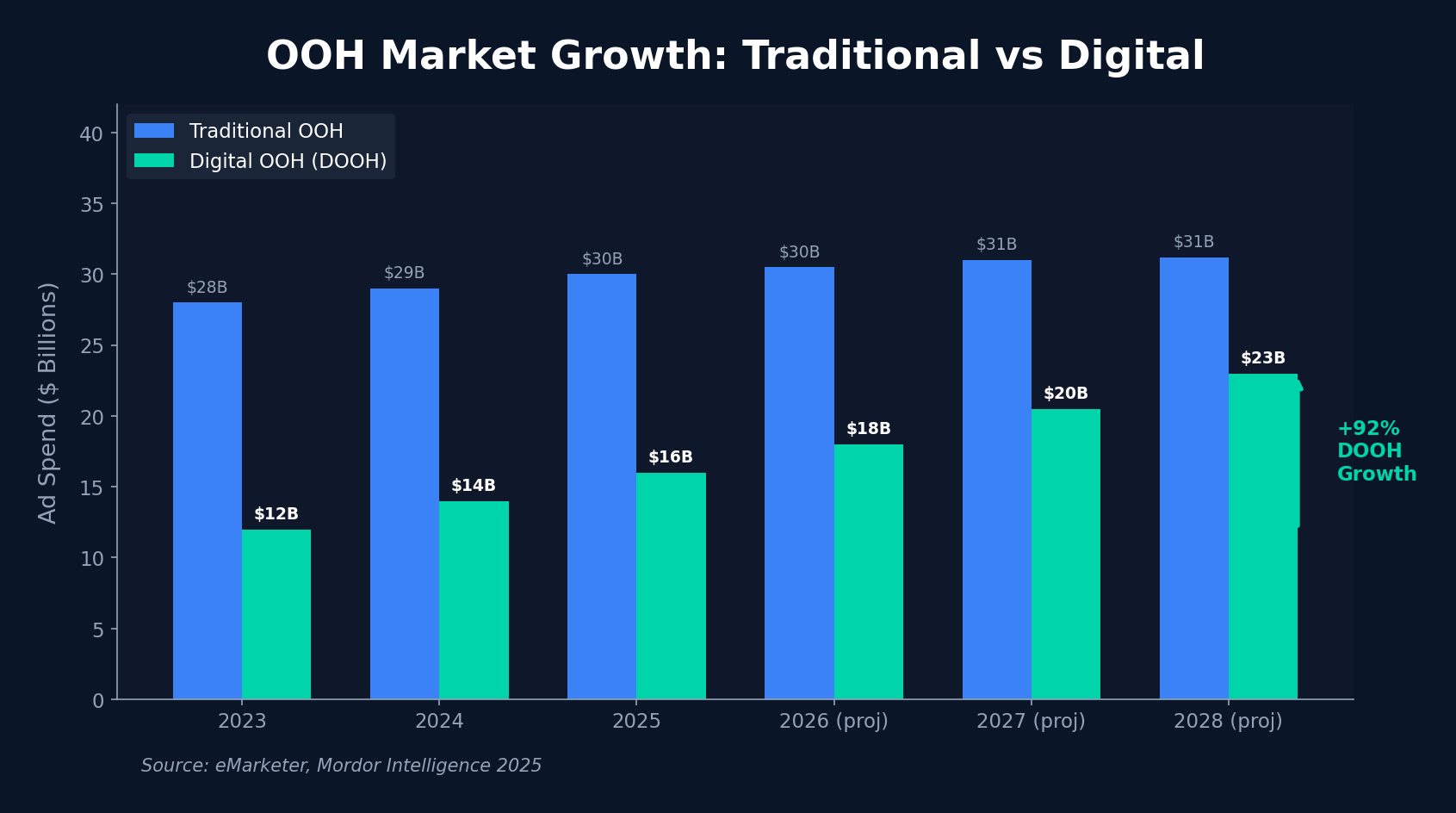
According to research from the Out of Home Advertising Association of America (OAAA), OOH advertising revenue surpassed $9 billion USD in 2024. That's a record high for the medium. The industry continues its evolution beyond traditional static formats, with digital out-of-home now accounting for 34% of total OOH spend (a 7.5% increase from the previous year). Technological advances in programmatic buying, improved measurement capabilities, and the use of data analytics for enhanced insights, alongside the expansion of digital screen networks across transit systems, retail environments, airports, and urban centers have driven this transformation.
For mid-market and enterprise businesses, OOH advertising offers a unique combination of mass reach and contextual relevance that digital channels struggle to replicate. A five-year collaborative study between Clear Channel Outdoor and Kantar demonstrates that OOH outperforms CTV and digital channels in key metrics including ad awareness, brand favorability, brand recognition, and purchase intent. Digital ad performance has plateaued. Consumers increasingly pay for ad-free streaming experiences. OOH has emerged as a critical channel for bridging the gap between performance marketing and brand building.

8 OOH Advertising Strategies for 2026
Developing an effective OOH advertising strategy requires understanding both the foundational principles of outdoor media and the technological capabilities reshaping the industry. The following strategies represent proven approaches for maximizing campaign effectiveness.
Strategy 1: Leverage Programmatic DOOH for Real-Time Optimization
Programmatic digital out-of-home used to be a niche tactical tool. Not anymore. According to StackAdapt research, programmatic DOOH now accounts for 53% of all DOOH campaigns in 2024, an increase of 25 percentage points from the previous year. This shift allows advertisers to buy, adjust, and optimize ad placements dynamically. Impressions get served at the right time and location.
The transition to programmatic buying offers several advantages over traditional direct buys. Advertisers can activate campaigns in as little as one to two days rather than weeks. They can adjust messaging in real-time based on environmental triggers like weather or local events. They can measure performance through integrated analytics dashboards. For mid-market businesses, programmatic platforms have opened access to premium OOH inventory that was previously available only through lengthy negotiation processes with individual media owners.
Implementation approach: Begin by identifying demand-side platforms (DSPs) that offer DOOH inventory alongside other digital channels. Start with a test campaign targeting a specific geographic market before scaling.
Strategy 2: Integrate Contextual Triggers for Dynamic Creative
Modern DOOH platforms enable dynamic creative optimization that adapts messaging based on real-world conditions. According to research from The Harris Poll and OAAA, 81% of consumers find ads with product offers related to current weather conditions highly relevant and useful.
Contextual triggers extend beyond weather. Time of day, local events, traffic conditions, sports scores, even social media trends can all activate different creative. A coffee brand can display iced beverages when temperatures spike and switch to hot drink messaging when conditions turn cold. Retailers can update pricing or promotions instantly across hundreds of screens. The messaging stays relevant instead of going stale.
Contextual Trigger Applications:
| Trigger Type | Example Application | Best Use Cases |
|---|---|---|
| Weather | Umbrella ads when rain is forecast | Retail, QSR, apparel |
| Time of Day | Breakfast menu mornings, dinner menu evenings | Restaurants, food delivery |
| Traffic Conditions | Alternative route suggestions near dealerships | Automotive, navigation apps |
| Local Events | Concert venue promotions during major shows | Entertainment, hospitality |
| Sports Scores | Victory celebration messaging for local teams | Beverages, sports apparel |

Strategy 3: Build Omnichannel Campaigns with Mobile Retargeting
OOH advertising achieves maximum impact when integrated with digital channels. The combination creates seamless customer journeys from awareness to purchase. Research indicates that consumers exposed to OOH ads are 48% more likely to click on subsequent mobile ads. That's the priming effect of outdoor media on digital engagement in action.
The integration works through geofencing technology that captures anonymized device IDs from consumers who pass OOH displays. These audiences can then receive sequential messaging across mobile devices. The campaign's reach extends. Brand messages get reinforced across multiple touchpoints. Vistar Media reports a 243% increase in advertisers using first-party data for DOOH campaigns between 2023 and 2024. Cross-channel integration is getting more sophisticated.
A study cited by Broadsign found that OOH amplifies all major media by more than 90%. It's a force multiplier for existing digital investments, not a standalone channel. For enterprise marketers managing complex media mixes, this amplification effect provides compelling justification for OOH inclusion.
Integration best practices:
- Create geofences of 100-300 meters around DOOH displays for retargeting
- Maintain creative consistency between OOH and digital touchpoints
- Track cross-device conversions using unified measurement platforms
Strategy 4: Prioritize High-Impact Formats and Locations
Digital innovation has expanded OOH options, but strategic placement remains fundamental to campaign success. According to OAAA data, billboards remain the dominant OOH format, with 74.5% of revenues coming from large-format ads in Q1 2025. Within the US market, billboards command 45.3% of total OOH revenue share.
Location selection should align with audience movement patterns and campaign objectives. Mordor Intelligence research notes that airport advertising is projected to expand at a 6.62% CAGR through 2031. Modernization grants and premium passenger demographics are driving this growth. Transit advertising (including bus shelters and rail stations) offers high-frequency exposure to commuting audiences. Place-based media in gyms, doctors' offices, and retail environments provides captive audience attention during extended dwell times.
Format Selection Guide:
| Format | Strengths | Best Applications | Average CPM Range |
|---|---|---|---|
| Digital Billboards | High visibility, dynamic creative | Brand awareness, product launches | $10-$25 |
| Static Billboards | 24/7 exposure, lower cost | Local businesses, directional messaging | $2-$9 |
| Transit (Bus/Rail) | High frequency, commuter reach | App promotions, retail | $3-$12 |
| Airport Displays | Affluent audience, extended dwell | Luxury brands, B2B, travel | $15-$35 |
| Place-Based (Retail) | Purchase-point proximity | CPG, promotions, retail media | $5-$15 |
Strategy 5: Implement Robust Measurement and Attribution
The perception that OOH advertising is unmeasurable has become outdated. Advanced measurement tools now enable advertisers to track DOOH performance with precision comparable to digital channels. Nielsen research commissioned by OAAA found that nearly two-thirds of DOOH viewers have engaged in at least one measured action after seeing a digital billboard. These actions include website visits, online searches, store visits, and social media engagement.
Modern OOH measurement employs multiple methodologies. Mobile location data tracks footfall attribution by correlating device exposure to OOH displays with subsequent store visits. Brand lift studies survey consumers within geo-fenced campaign zones to measure changes in awareness, favorability, and purchase intent between exposed and control groups. Media mix modelling (MMM) quantifies how OOH contributions interact with other channels to drive overall marketing performance.
Measurement Approaches:
| Method | What It Measures | Best For |
|---|---|---|
| Footfall Attribution | Store visits from OOH-exposed consumers | Retail, QSR, dealerships |
| Brand Lift Studies | Awareness, favorability, intent changes | Brand campaigns, launches |
| Mobile Retargeting Conversion | Digital actions following OOH exposure | E-commerce, app installs |
| Media Mix Modelling | OOH contribution to overall marketing ROI | Enterprise media planning |
| QR Code / URL Tracking | Direct response actions | Promotional campaigns |
Strategy 6: Optimize Creative for Outdoor Viewing Conditions
Effective OOH creative differs fundamentally from digital or print advertising due to viewing context. Consumers encounter outdoor ads while in motion, often at a distance, with limited attention windows. Research from EMC Outdoor indicates that OOH achieves the highest percentage of consumer recall at 86%, outperforming all other media channels. But only when creative is designed for the medium's unique requirements.
The seven-word rule remains foundational. If your message cannot be communicated in seven words or fewer, it likely needs simplification. Bold, high-contrast visuals capture attention from distance. Simple compositions prevent cognitive overload during brief exposure windows. Brand elements should be prominently featured, as recognition drives the recall advantage OOH provides.
For digital OOH, motion and animation increase attention capture, but restraint is essential. Subtle movement draws the eye without becoming distracting or annoying to viewers who may encounter the same display repeatedly. Dynamic elements should enhance rather than complicate the core message.
Creative Best Practices:
Effective Elements:
- Single, focused message per execution
- High-contrast color combinations
- Bold typography readable from distance
- Prominent brand identification
- Simple, uncluttered compositions
Common Pitfalls:
- Excessive text requiring extended reading time
- Complex imagery that loses clarity at scale
- Weak brand presence buried in design elements
- Multiple competing calls to action
- Reliance on fine detail visible only up close
Strategy 7: Align Campaign Timing with Audience Behaviour
Strategic dayparting and seasonal planning significantly impact OOH campaign performance. Research from Demand Local shows that OOH campaigns using strategic dayparting achieve 11.19% conversion rates versus 6.30% without targeting optimization. That's a nearly 80% improvement from timing alone.
Programmatic DOOH enables precise scheduling that aligns messaging with audience receptivity. Morning commute hours favor coffee and breakfast messaging. Lunch periods suit restaurant and food delivery promotions. Evening commutes align with entertainment and dining options.
Strategy 8: Scale Strategically Across Markets
Enterprise OOH campaigns require systematic market prioritization based on audience concentration, competitive presence, and business objectives. The OAAA's 2024 MegaBrands report reveals that leading advertisers including Apple, McDonald's, Amazon, and Coca-Cola maintain consistent OOH presence across major markets while tailoring creative and format selection to local conditions.
Market expansion should follow a test-and-scale model. Begin with concentrated investment in priority markets where measurement can establish baseline performance metrics. Once effective approaches are identified, expand while maintaining the creative and targeting frameworks that drove initial success.
Common Misconceptions About OOH Advertising
Despite OOH's proven effectiveness, several persistent misconceptions prevent marketers from fully leveraging the channel. Understanding the reality behind these myths enables more informed media planning decisions.
Misconception 1: OOH Advertising Is Too Expensive for Most Businesses
Many marketers assume OOH requires Super Bowl-level budgets, reserving it for global brands with unlimited resources. Research from Billups demonstrates otherwise. The average CPM for OOH ranges between $2 and $9, making it one of the most cost-efficient media channels available. For context, a $6.5 million Super Bowl ad investment could instead place OOH advertising across all 50 top US markets, generating over one billion impressions at a CPM of approximately $5.40.
The perception of high cost often stems from confusion between premium placements (Times Square, major highway bulletins) and the broader OOH landscape. Street furniture, transit advertising, and place-based media offer entry points accessible to small and mid-sized businesses.
Misconception 2: OOH Cannot Be Accurately Measured
The historical challenge of OOH measurement has been largely resolved through technology advances. Today's measurement ecosystem includes mobile location data for footfall attribution, geo-fenced survey distribution for brand lift studies, and integration with digital analytics platforms. Screenverse notes that advanced measurement tools now enable advertisers to track DOOH performance with rigour comparable to digital campaigns.
OOH measurement differs from digital's click-based attribution models. Rather than tracking individual user journeys, OOH measurement focuses on aggregate exposure and subsequent behaviour changes. This approach actually aligns more closely with how advertising influence works through cumulative brand impressions.
Misconception 3: OOH Campaigns Take Months to Launch
Traditional OOH required lengthy planning cycles involving vendor research, negotiation, and creative production. Modern programmatic platforms have compressed timelines dramatically. Despite this reality, AdQuick research found that 80% of advertisers believe OOH takes longer to launch than other media channels. Only 2% recognize that campaigns can launch in under a week.
Digital OOH campaigns can launch within 24-48 hours through programmatic platforms. Creative changes get implemented in real-time. Even static OOH has become more agile, with production timelines shortened through improved logistics. The key is working with platforms designed for speed rather than relying on legacy processes.

Real-World Examples and Case Studies
Examining how leading brands deploy OOH advertising reveals the strategic principles driving successful campaigns.
Apple: Sustained Investment in Premium Placements
Apple has maintained the top position in OAAA's MegaBrands report for three consecutive years. The technology giant's "Shot on iPhone" campaign exemplifies effective OOH creative: user-generated photography displayed at scale, with minimal text and prominent brand identification. By featuring real customer content, Apple transforms billboards into authentic testimonials that feel more engaging than traditional advertising.
Apple's approach emphasizes quality over quantity. They select premium placements that align with brand positioning rather than pursuing maximum geographic coverage.
McDonald's: Contextual Creative at Scale
McDonald's ranks among the top OOH advertisers globally. The brand leverages the medium's strengths for directional messaging and time-sensitive promotions that drive results. Their directional DOOH campaigns in Paris used visual representations of French fries as wayfinding signs, guiding consumers toward nearby locations through creative that was simultaneously functional and memorable. By focusing on proximity-based messaging, McDonald's converts OOH impressions into restaurant visits.
Spotify: Data-Driven Personalization
Spotify's annual "Wrapped" campaigns have set new standards for data-driven OOH creative. By leveraging listener data to create personalized and humorous messages, Spotify generates earned media alongside paid impressions. The campaigns' shareability drives social amplification that extends reach beyond physical display viewers. It's a clear example of how OOH can drive digital engagement when creative is designed for conversation.
Frequently Asked Questions
What is the difference between traditional OOH and digital OOH (DOOH)?
Traditional OOH encompasses static formats including printed billboards, posters, and transit cards that display fixed creative for extended periods. Digital OOH uses electronic displays (LED screens, projection systems, and interactive kiosks) that can rotate multiple advertisements and update content dynamically. DOOH enables real-time creative changes, programmatic buying, and data-driven targeting that static formats cannot provide. Currently, traditional formats account for approximately 66% of OOH spending, though DOOH share is projected to approach 44% by 2030 according to industry forecasts.
How do I determine the right OOH formats for my campaign?
Format selection should align with campaign objectives, target audience behaviour, and budget constraints. Brand awareness campaigns benefit from large-format billboards with high visibility and reach. Consideration-stage campaigns may leverage transit and street furniture for frequency among commuting audiences. Retail and restaurant promotions often prioritize place-based media near purchase points. Start by mapping your target audience's daily journey (where they live, work, commute, and shop) then select formats that intercept these movement patterns at strategic points.
What budget should I allocate to OOH advertising?
Budget allocation depends on market scope, campaign duration, and format mix. Entry-level market tests can begin with $10,000-$25,000 monthly for meaningful presence in a single market. Mid-market regional campaigns typically range from $50,000-$150,000 monthly. The key metric is CPM efficiency. With average OOH CPMs between $2-$9, budgets generate significantly more impressions than comparable digital or broadcast investments.
How quickly can an OOH campaign be launched?
Digital OOH campaigns can launch within 24-48 hours through programmatic platforms. Creative changes get implemented in real-time. Static OOH requires longer lead times for creative production and physical installation in the physical world, typically 2-4 weeks depending on format and market availability. Hybrid approaches (launching with available digital inventory while static placements are produced) can provide immediate market presence while building toward full campaign deployment.
How do I measure ROI from OOH advertising?
Effective OOH measurement combines multiple methodologies. Footfall attribution tracks store visits from OOH-exposed devices. Brand lift studies survey exposed versus control audiences to measure awareness and intent changes. Website traffic and vehicle traffic can be tracked through dedicated URLs, QR codes, or vanity search terms. Media mix modelling quantifies OOH's contribution alongside other channels.


