



Table of contents

Key Takeaways
- OOH advertising continues growing, with U.S. spending exceeding $9 billion in 2024 and digital formats now accounting for 34% of total spend. It's a proven channel for brand building and consumer engagement.
- The most effective outdoor campaigns create value exchange through interactive experiences, sensory engagement, or emotional resonance rather than passive brand messaging.
- Contextual relevance drives OOH effectiveness, with research showing 93% purchase completion rates among consumers who visit businesses after seeing directional DOOH ads.
- AR-enhanced campaigns deliver 300% higher engagement rates than traditional formats. The medium is evolving toward interactive experiences.
- Successful OOH campaigns increasingly integrate with digital channels, using social media amplification, QR codes, and mobile engagement to extend reach beyond physical placements.
- Working with experienced outdoor advertising specialists helps ensure optimal placement selection, creative development, and measurement frameworks for campaigns of any scale.
What is OOH advertising?
Out-of-home (OOH) advertising encompasses any visual advertising media that reaches consumers outside their homes. This includes billboards, transit displays, street furniture, digital screens, and place-based media. The channel has shifted dramatically since the early 2000s, moving from static paper billboards to sophisticated digital out-of-home (DOOH) installations that leverage real-time data, augmented reality, and programmatic buying.
According to research conducted by The Harris Poll on behalf of the Out of Home Advertising Association of America (OAAA), 73% of consumers view DOOH ads favorably. That's a significant gap over television at 50% and social media advertising. And 76% of recent DOOH ad viewers reported taking action after seeing an ad, which points to the medium's ability to drive measurable consumer behaviour.
For mid-market and enterprise businesses, OOH advertising works well for building brand awareness, driving foot traffic, and creating memorable experiences that digital channels struggle to match. Online advertising can be blocked, skipped, or ignored. Outdoor advertising? It commands attention in public spaces where consumers are already engaged with their environment.
The OOH advertising landscape: market growth and spending trends
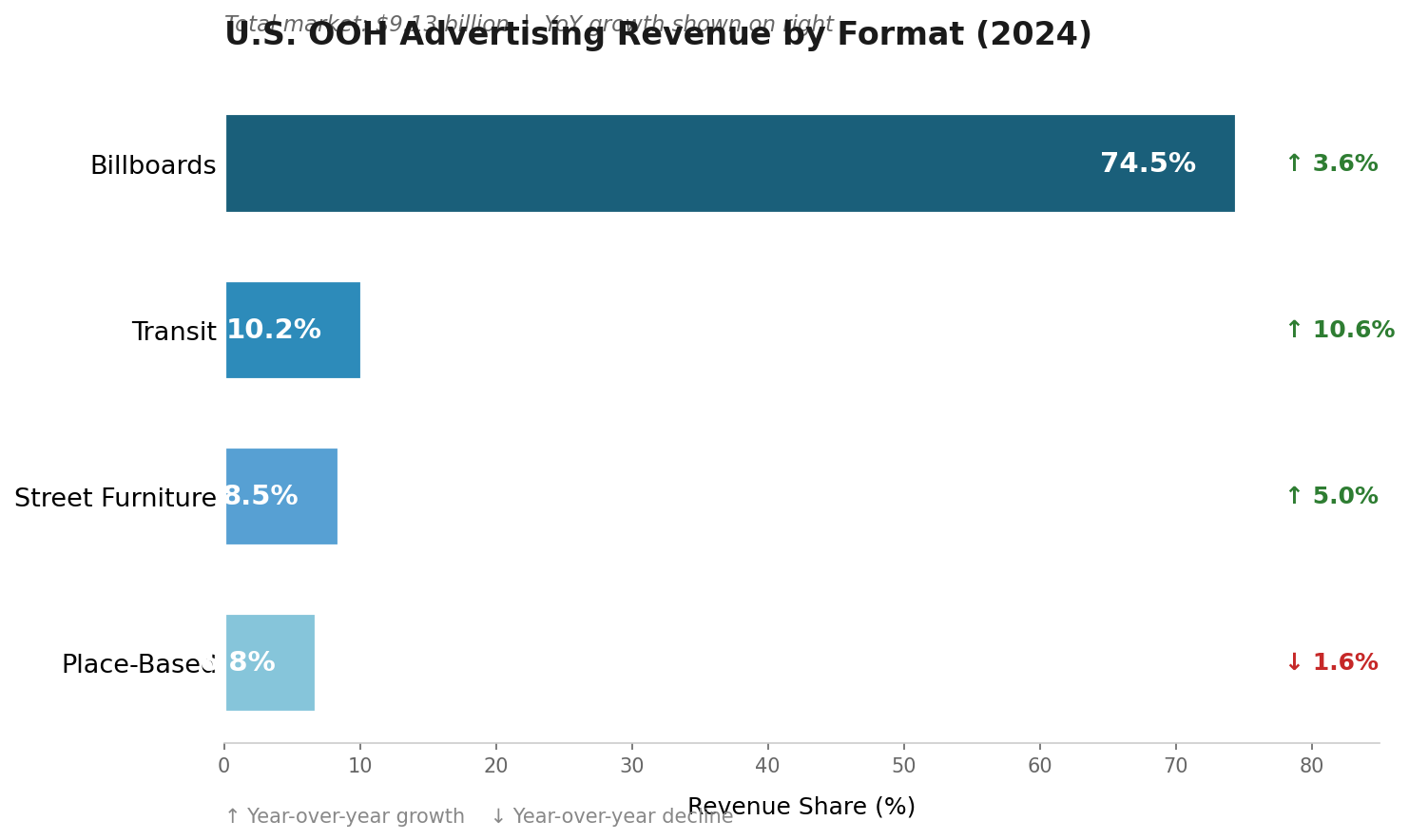
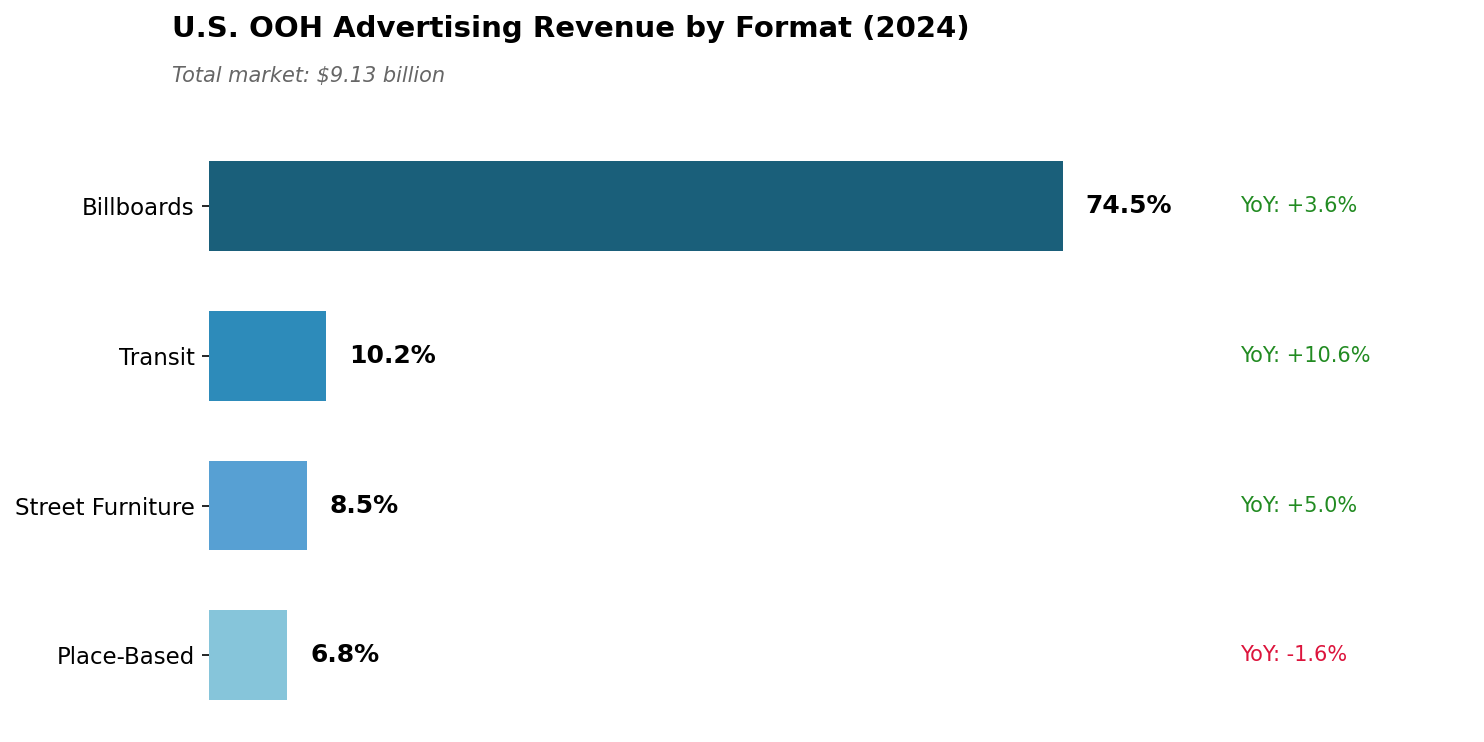
The outdoor advertising industry hit a milestone in 2024. U.S. OOH ad spending reached $9.13 billion, a 4.5% year-over-year increase and the first time the industry crossed the $9 billion threshold. Digital OOH now accounts for 34% of total spend. Advertisers want flexibility. They want data-driven campaigns. DOOH delivers both.
| OOH Format | Revenue Share (2024) | YoY Growth |
|---|---|---|
| Billboards | 74.5% | +3.6% |
| Transit | 10.2% | +10.6% |
| Street Furniture | 8.5% | +5.0% |
| Place-Based | 6.8% | -1.6% |
The top OOH advertisers span diverse industries, with Apple, McDonald's, Amazon, and Coca-Cola leading spending. Tech and direct-to-consumer brands now represent 25% of the top 100 OOH advertisers, a shift from traditional broad-reach branding toward performance-focused marketing.
So what are the trade-offs? OOH advertising offers high visibility and unavoidable presence in public spaces, along with strong brand recall compared to digital advertising. Brands can target specific geographic areas and demographics while integrating campaigns with digital and mobile channels. Consumers also tend to trust OOH as a traditional medium.
But there are drawbacks. Premium placements carry higher upfront costs compared to digital advertising. Targeting precision lags behind online advertising. Measurement remains challenging (though programmatic DOOH is closing that gap). And weather can affect visibility.
Common misconceptions about OOH advertising
Misconception 1: OOH is only for big brands with massive budgets
Premium placements like Times Square command significant investment. True. But OOH advertising offers options across budget levels. Transit advertising, street furniture, and regional billboards provide accessible entry points. Programmatic DOOH has further democratized the medium by enabling flexible campaign lengths and real-time optimization. Mid-market businesses can participate effectively.
Misconception 2: OOH can't be measured or tracked
Modern OOH measurement has evolved dramatically. Research shows that 51% of consumers who noticed directional DOOH ads subsequently visited the advertised business. Of those visitors, 93% completed a purchase. Mobile device tracking, foot traffic analysis, and programmatic attribution now provide detailed campaign performance data.
Misconception 3: Digital advertising has made OOH obsolete
The opposite is happening. A five-year collaboration between Clear Channel Outdoor and Kantar proved that OOH outperforms CTV and digital channels in ad awareness, brand favorability, and purchase intent. Digital ad performance has plateaued. Audiences pay for ad-free streaming. OOH fills gaps that other channels can't address.
Why location context drives OOH effectiveness
The physical placement of outdoor advertising creates inherent relevance that digital advertising struggles to replicate. When consumers encounter brand messaging in specific environments (near retail locations, at transit hubs, in entertainment districts) the contextual alignment strengthens message reception and action intent.
Research from The Harris Poll demonstrates that 86% of consumers rate ads featuring special grocery deals as useful when encountered in relevant contexts, while 84% feel the same about restaurant deals. That contextual relevance translates directly to conversion rates.
The "dwell time" advantage further distinguishes OOH from digital channels. Consumers stuck in traffic, waiting for public transport, or walking past street furniture have limited alternative content to consume. OOH benefits from these extended exposure periods. A 2023 study by Ocean NeuroScience showed that consumers are 2.5 times more aware of OOH media compared to digital ads.
Why does this matter? Digital environments have trained consumers to ignore banner spaces and scroll past sponsored content. Physical advertising spaces haven't triggered the same learned avoidance. The brain treats outdoor advertising differently than digital ads.
The emerging role of augmented reality in OOH
Augmented reality is changing OOH from a passive viewing medium to an interactive experience platform. AR-enhanced OOH campaigns now achieve engagement rates 300% higher than traditional formats, with interaction rates exceeding 30% in prime locations.
Markerless AR technology has removed friction from the user experience. GPS and visual recognition systems enable automatic content activation without QR code scanning. This matters because each additional activation step typically reduces participation by around 20%.
Industry data shows AR campaigns can increase dwell time from just a few seconds to over a minute on average. 5G networks are expanding. WebAR technology is reducing app-download friction. AR billboards are becoming standard rather than experimental. The AR advertising market is expected to reach $8 billion by 2025.
20 OOH advertising examples that delivered results
1. Coca-Cola's Playable Billboard (Times Square)
Coca-Cola transformed a massive Times Square billboard into an interactive gaming experience in April 2024. The Playable Billboard invited passersby to compete in a retro-style video game where Coca-Cola bottles replaced bats, hitting a ball back and forth. Two players could compete to reach 10 points first using their smartphones to control the action. The campaign emerged from Coca-Cola's recognition that engaging Gen Z audiences requires creating memorable experiences rather than passive viewing. Entertainment in exchange for brand interaction.
2. McDonald's Scented Billboards (Netherlands)
McDonald's Amsterdam, working with TBWA\NEBOKO, deployed billboards that diffused the actual scent of french fries in April 2024. The blank red and yellow billboards contained hidden compartments storing actual fries, heated by internal ventilation systems to project the aroma within a five-meter radius. No text. No explicit branding beyond the iconic colours. Just the smell of fries. The sensory approach created immediate cravings and drove foot traffic to nearby locations.
3. British Airways "Windows" Campaign
British Airways and Uncommon Creative Studio launched a minimalist OOH series featuring 11 close-cropped photographs of passengers looking out airplane windows. The campaign ran across 324 strategic locations including Edinburgh, Cardiff, Manchester, and Piccadilly Circus.
The brilliance lay in what the campaign didn't include. No taglines. Minimal logo visibility. Zero promotional messaging. As Uncommon's co-founder noted, "Only truly iconic brands can say less." The campaign won multiple international awards.
4. Spotify Wrapped Global Billboard Takeover
Spotify's annual Wrapped campaign extended beyond digital with creative OOH installations worldwide. In Atlanta, a park fountain featured a mini-yacht with a billboard promoting rapper Lil Yachty. In Underground Atlanta, an extra-long billboard celebrated Ice Spice's adlib "Gra" becoming the "Word of the Year." Users could share their personal listening data on iconic billboards in Times Square, Piccadilly Circus, and other global locations. Individual data became a public celebration.
5. Netflix "Squid Game 2" Immersive Activations
Netflix's promotion of Squid Game Season 2 included bus shelter activations in Oslo's Aker Brygge that transformed shelters into guarded game zones. The iconic masked guards stood watch over passengers. Physical advertising blended with experiential marketing. The campaign drew 68 million viewers within three days of the show's December 2024 premiere.
6. Coca-Cola "Recycle Me" Crushed Logos
Coca-Cola's "Recycle Me" campaign featured distorted versions of its iconic logo created by physically crushing cans. The campaign launched globally in April 2024, achieving 140 million impressions in its first week and winning the Grand Prix in Print & Publishing at the 2024 Cannes Lions International Festival of Creativity. Every logo used corresponded to a real crushed can.
7. Apple "Made on iPad" (Paris Olympics)
Apple pulled off a clever move during the Paris 2024 Olympics without requiring official sponsorship. The campaign featured 23 quirky illustrations by French artist Simon Landrein across Paris and Marseille billboards, depicting stretchy "athletes" in everyday activities with athletic themes. The subtle approach avoided direct Olympic references while clearly capitalizing on the sporting context. No sponsorship fee required. Brands can benefit from major events through creative alignment rather than expensive partnerships.
8. Decathlon's IT Outage Response
When a global IT outage hit in July 2024, Decathlon launched a DOOH campaign within 24 hours mimicking Microsoft's blue screen of death with the message "Outage? Get outside." The campaign included 50% off outdoor gear promotions and QR codes directing customers to online shopping. Real-time marketing at its best. Millions of Canadians saw it during the crisis.
9. Nike "Winning Isn't for Everyone" (Olympics)
Nike's 2024 Olympics campaign utilized AI-powered, real-time billboard updates that tracked Olympic times and adjusted messaging in response to live results. When Sha'Carri Richardson won gold in the 100m, Nike's billboards updated within minutes. The campaign kept messaging fresh throughout the Games and showed what programmatic DOOH can do when paired with live events.
10. H&M Times Square Charli XCX Concert
Fashion retailer H&M staged a surprise pop-up concert by Charli XCX at Times Square in November 2024, announced only 30 minutes beforehand on social media. H&M coordinated a synchronized billboard takeover where every giant screen in Times Square displayed visuals counting down to the event and livestreamed the performance. Thousands showed up. The campaign celebrated the reopening of H&M's flagship store.
11. Sony x Olivia Rodrigo Headphones Takeover
Sony's 2024 Times Square takeover promoting headphones with Olivia Rodrigo achieved impressive metrics: brand favorability increased by 11%, purchase intent rose 18%, and ad recall reached 59% (significantly above industry benchmarks). The campaign transformed commutes into music-themed visual experiences.
12. Nike Hollywood Sign Dodgers Tribute
After the Los Angeles Dodgers won the World Series, Nike illuminated the letter "D" in the Hollywood sign in Dodger blue. The landmark became a victory billboard. Paired with the viral "Roll Call" ad listing the team roster under "Just Do It," the campaign created a city-wide celebration.
13. The Ordinary "No Model" Billboards
The Ordinary took a different approach to beauty advertising by rejecting traditional approaches entirely. The campaign featured product shots without models, beauty claims, or aspirational imagery. Just clinical, straightforward presentations that aligned with the brand's scientific positioning.
14. Specsavers Van Stunt
Specsavers created an installation where a branded van appeared "stuck" on a pillar. A humorous, self-aware moment that instantly connected with the brand's "Should've gone to Specsavers" tagline. The stunt earned coverage in The Guardian, Daily Mail, and across social media. Over 2 million organic impressions in the first 48 hours.
15. Canva Waterloo Station Creative Tension Series
Canva transformed the area around Waterloo Station into a playground for marketing truths, with billboards leaning into client/agency creative tension. One read "Make the logo bigger" with an absurdly oversized Canva logo. Another showed a design with "Can we try it in blue?" scrawled across it. The series laughed at the chaos of feedback loops with knowing smiles. Creative professionals loved it.
16. Tim Tam Upside-Down Billboards (UK)
When expanding to the UK market, Australia's Tim Tam chocolate biscuit flipped its billboards upside down. The brand leaned directly into its "Down Under" identity. The playful twist gave audiences something unexpected enough to make them stop and look twice. It tapped into the brain's instinct to refocus on anomalies.
17. IKEA "Here Comes the Sun" Dynamic Mirror
IKEA launched a campaign in Stockholm in June 2024 featuring a billboard with a GPS-controlled mirror that tracked the sun's position throughout the day, reflecting sunlight onto shaded outdoor seating areas at cafés. Swedish summers are notoriously short on sunshine. The installation gave café-goers extra warmth while putting IKEA's outdoor furniture in the spotlight. Clever problem-solving, Swedish style.
18. KitKat "Phone Break" Cannes Grand Prix Winner
VML Czechia's "Phone Break" campaign won the Outdoor Grand Prix at Cannes with a ridiculously simple concept: swap phones for KitKat bars in familiar public settings like waiting for a bus or standing in line. The judges called it "deceptively simple but perfectly executed." The campaign reinforced the "Have a Break" messaging with modern relevance.
19. Kiehl's Alpine Ski Resort Takeover
Premium skincare brand Kiehl's took OOH to 8,000 feet above sea level in Austria's Hochzillertal-Kaltenbach ski region during the 2024/25 season. The campaign integrated extra-large billboards, ski-lift posters, a pop-up store, and influencer collaboration to position the brand as essential skincare for adventure seekers. Context matched the product perfectly. Cold, dry mountain air plus skincare messaging equals relevance.
20. Cluely Times Square Anti-Advertising
AI assistant startup Cluely took an opposite approach to Times Square advertising. Their DOOH activation featured stark white backgrounds with plain black text: "hi i'm roy im 21 this was very expensive pls buy my thing." The campaign stood out by refusing to compete visually with everything around it. Instantly shareable. Sometimes less really is more.
Frequently asked questions
What makes OOH advertising effective compared to digital channels?
OOH advertising offers unavoidable visibility in public spaces. Brand impressions can't be skipped, blocked, or scrolled past. Research consistently shows higher brand recall for OOH compared to digital advertising, and the medium benefits from extended exposure times. There's also less ad clutter in physical environments than online.
How much does billboard advertising cost?
It depends. Premium placements like Times Square can exceed $1 million monthly, but that's the extreme end. Regional static billboards often start around $750-2,500 monthly. Digital billboards typically cost more than static options but offer flexibility to rotate multiple advertisers and adjust creative in real-time. Location, format, and duration all affect pricing.
What is programmatic DOOH and why does it matter?
Programmatic digital out-of-home enables automated buying of outdoor advertising inventory using data-driven targeting. Brands can adjust messaging based on factors like time of day, weather conditions, and audience demographics. The category has grown fast: programmatic DOOH spending is forecasted to reach 30% of total digital OOH spend by 2025, up from just 3% in 2019.
How do brands measure OOH campaign success?
Modern OOH measurement combines mobile device tracking, foot traffic analysis, brand lift studies, and purchase data. Advertisers can track store visits from consumers exposed to campaigns, measure changes in search behaviour, and attribute sales to specific placements using location-based technologies. It's not perfect, but it's gotten much better.
What industries see the best results from OOH advertising?
Quick-service restaurants, retail, automotive, entertainment, and consumer packaged goods consistently deliver strong OOH results. These categories benefit from broad consumer appeal and location-based purchasing patterns. Legal services was actually the fastest-growing OOH category in 2024, with a 16% increase in spend. Healthcare and hospitality also showed significant growth.


