



Table of contents
Key Takeaways
- Research target markets thoroughly before launching campaigns; platform preferences, competitive landscape, regulatory requirements, and consumer behaviour in the local language vary dramatically across regions.
- Invest in native keyword research rather than translation; localized keywords that match actual search behaviour consistently outperform technically correct translations
- Structure campaigns by market rather than just language to maintain performance visibility, budget control, and appropriate geographic targeting
- Allocate sufficient budget for statistically meaningful testing; inconclusive data leads to poor strategic decisions about market opportunity
- Consider whether internal capability, agency partnerships, or hybrid models best serve your international expansion goals based on target market complexity and business volume
What Is International PPC?
International PPC (pay-per-click) advertising refers to paid search campaigns specifically designed to reach audiences in multiple countries and language markets, making it an essential aspect of digital marketing. Unlike domestic PPC, which targets a single market with consistent language and cultural norms, international PPC requires businesses to navigate diverse search engines, linguistic variations, regulatory frameworks, and consumer behaviours.
According to DataReportal's analysis of Statista Market Insights data, global advertising spend reached approximately $1.1 trillion in 2024, with digital channels accounting for 72.7% of worldwide ad investment across diverse markets. This represents a 50% increase since 2019, with digital advertising responsible for the vast majority of that growth. For businesses seeking international expansion, this shift represents both an enormous opportunity and a complex strategic challenge.
The distinction between international PPC ads and simply running ads in multiple countries lies in the depth of localization. Effective multilingual PPC campaigns go beyond translation to address search intent, cultural context, platform preferences, and regional regulations. Organizations that approach global PPC campaigns with a dedicated, research-driven methodology consistently outperform those that simply duplicate domestic campaigns and translate ad copy.
9 Strategies for International PPC Success
Strategy 1: Conduct Market-Specific Platform Research
One of the most critical mistakes businesses make when launching cross-border PPC campaigns is assuming Google dominates everywhere. While Google holds approximately 90% of the global search engine market according to StatCounter GlobalStats, regional variations create dramatically different advertising landscapes, affecting the entire campaign's effectiveness.
| Region/Country | Dominant Search Engine | Market Share | Secondary Engine |
|---|---|---|---|
| Global | ~90% | Bing (~4%) | |
| China | Baidu | ~54% | Bing (~13%) |
| Russia | Yandex | ~70% | Google (~23%) |
| South Korea | ~51% | Naver (~42%) | |
| Japan | ~77% | Yahoo Japan (~15%) | |
| United States | Google Ads Transparency Center | ~85% | Bing (~9%) |
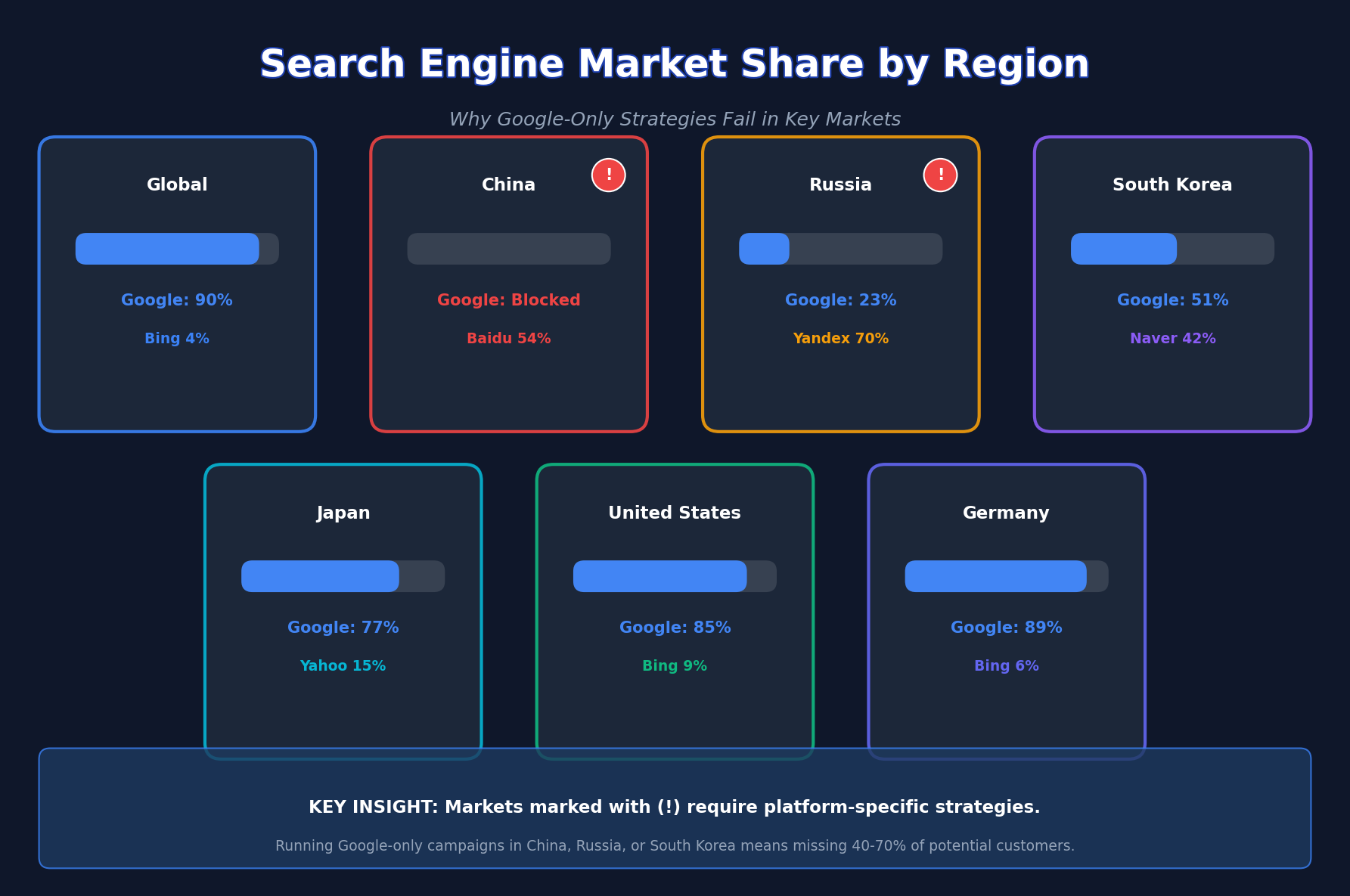
In China, Google remains largely inaccessible due to regulatory restrictions, making Baidu the essential platform for reaching Chinese consumers. Yandex dominates Russia's search landscape with approximately 70% market share, while Naver maintains strong competition with Google in South Korea at roughly 42% market share.
Each platform operates differently in terms of matching types, segmentation, bidding strategies, and ad formats. What does this mean practically? Businesses entering these markets must build platform-specific expertise or partner with specialists who understand local search ecosystems.
Strategy 2: Invest in Native Keyword Research (Not Translation)
Direct translation of keywords represents one of the most expensive mistakes in international paid advertising. Translation alone fails. Localized keyword research reveals that negative keywords should be considered, as direct translations often miss how locals actually search, leading to wasted ad spend on terms nobody uses.
According to research cited by AccuraCast, CSA Research reports that localization increases engagement by up to 86%, contributing to brand awareness, but only when keywords reflect how locals actually search, not how phrases translate linguistically.
Consider practical examples of this principle in action. "Cheap flights" translates technically to "billets d'avion pas chers" in French, but French users more commonly search "vols pas chers." Bidding on the grammatically correct translation means missing significant search volume. Similarly, "Best lawyers London" might translate to "migliori avvocati" in Italian, but Italian searchers often use "studio legale rinomato" (a completely different search phrase that reflects local professional terminology). Even transactional intent varies: "Order pizza" in English maps to "commande pizza" in French technically, but "livraison pizza" (pizza delivery) performs significantly better because it matches actual user behaviour. Consider offering a free trial option to attract more users.
Effective multilingual keyword research requires using native speakers or professional translators who understand search behaviour, not just linguistics. Teams should leverage tools like Google Keyword Planner, Semrush, and platform-specific research tools such as Yandex Wordstat, Baidu Keyword Planner, and Naver Keyword Tool. Improving ad placements is crucial, and analyzing competitor campaigns using Google Ads Transparency Reports and Meta Ad Library provides additional insight, and testing keywords with local search pattern data before committing significant budget prevents costly mistakes.
Strategy 3: Prioritize Localization Over Translation
The CSA Research "Can't Read, Won't Buy" study, surveying 8,709 consumers across 29 countries, found that 76% of online shoppers prefer purchasing products with information in their native language, while 40% will never buy from websites in other languages. Tools like Google Translate can help with translating basic phrases, but even when content quality is lower, 65% of users still prefer websites in their native language over higher-quality English alternatives.
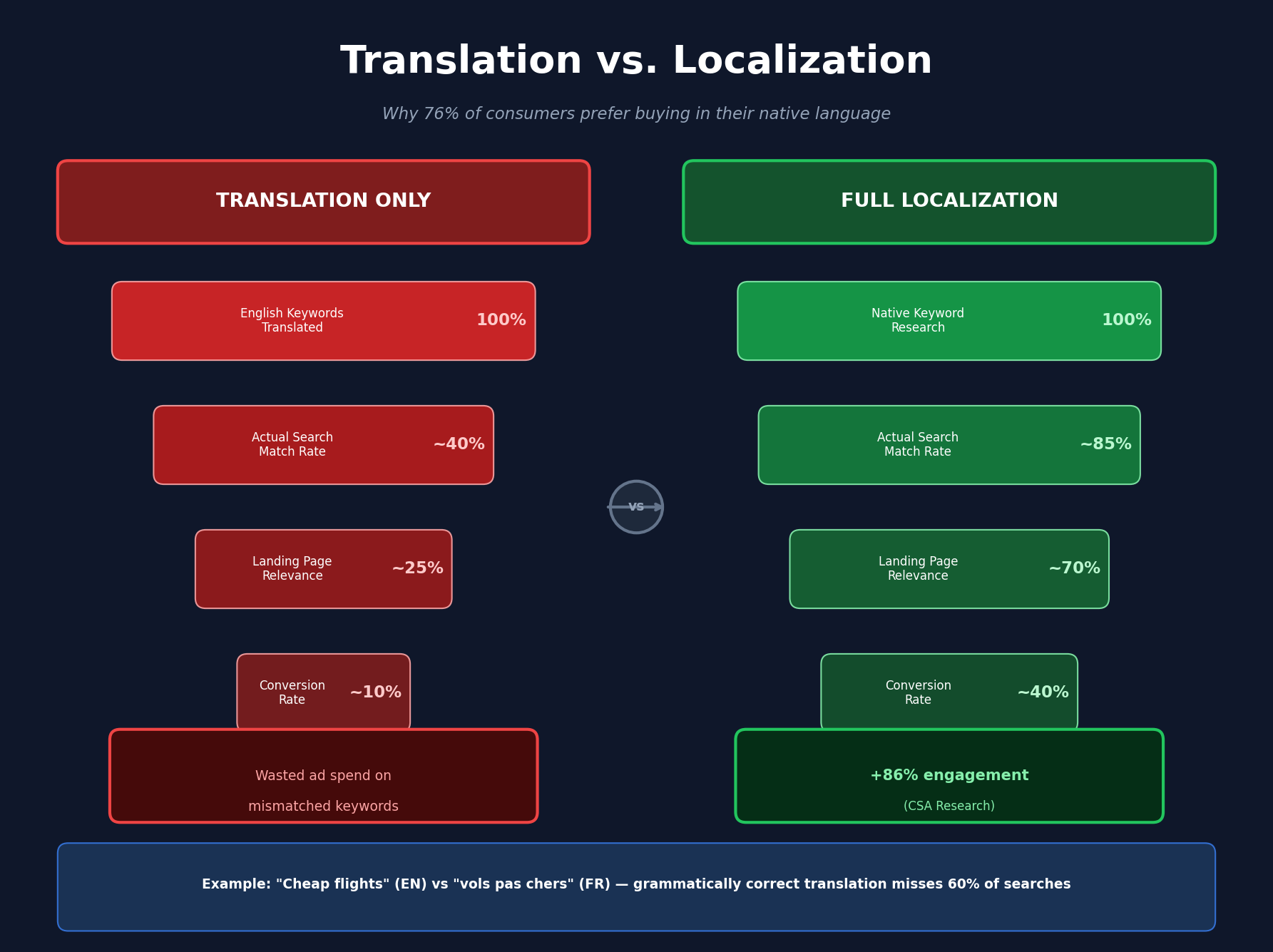
This research underscores that localization extends far beyond text translation.
Language, tone, and color psychology vary across cultures in ways that directly affect campaign performance. German audiences often respond negatively to aggressive calls-to-action, while US Hispanic audiences engage more when ads incorporate cultural elements. Apple's 2024 Thailand advertisement drew significant backlash for portraying the country in ways locals considered outdated and unflattering, forcing Apple to pull the YouTube video after 5 million views. That kind of misstep doesn't just waste ad spend; it damages brand perception for years.
Visual localization matters equally. Images, models, settings, and design aesthetics should reflect local preferences because what reads as aspirational in one market may appear foreign or disconnected in another. Users who click localized ads and land on English-language pages experience friction that dramatically reduces conversion rates, so every touchpoint (from ad to landing page to checkout) requires consistent localization.
Advertising regulations also vary significantly by country. The European Union's GDPR affects data collection and targeting, China's advertising laws prohibit certain claims, and Brazil, Germany, and other markets have specific requirements for financial and health-related advertising.
Strategy 4: Structure Campaigns by Market, Not Just Language
A common structural mistake in global PPC campaigns involves organizing campaigns purely by language rather than market. Spanish speakers in Spain, Mexico, Argentina, and the United States represent four distinct markets with different search behaviours, economic conditions, competitive landscapes, and cultural contexts. Treating them as one audience because they share a language guarantees underperformance.
The recommended campaign structure separates campaigns for each target country or regional market, with language-specific ad groups within each market campaign, dedicated landing pages matching the language and cultural context of each campaign, and market-specific budget allocation based on opportunity size and competitive dynamics.
This structure enables accurate geographic targeting aligned with language settings, clear performance attribution by market, flexible budget reallocation based on regional performance, and A/B testing of messaging variations appropriate to each cultural context.
Organizations running Performance Max or other automated campaign types should still segment by market to maintain performance visibility and budget control across regions.
Strategy 5: Adapt Bidding Strategies to Local Competition
Cost-per-click varies dramatically across global markets. According to Reboot Online's analysis of PPC statistics, Amazon Ads CPC ranges from $0.03 per click in India to $0.55 in the United States, an 18x difference. Similar variations exist across Google Ads, with legal industry keywords commanding averages as high as $8.67 CPC in competitive markets.
| Factor | Impact on CPC |
|---|---|
| Market maturity | More mature digital markets typically have higher competition and CPCs |
| Industry vertical | Legal, insurance, and finance keywords command premiums globally |
| Currency and purchasing power | Markets with lower purchasing power often have lower CPCs but also lower conversion values |
| Platform competition | Markets with multiple strong platforms (e.g., South Korea) may offer arbitrage opportunities |
| Seasonal variations | Local holidays, shopping seasons, and cultural events create temporary CPC fluctuations |
Here's a contrarian insight that challenges conventional wisdom: lower CPCs in emerging markets don't necessarily mean better ROI. Many advertisers chase low-CPC markets expecting easy wins, but conversion rates, payment completion rates, and customer lifetime values often tell a different story. A $0.50 click in Brazil that converts at 1% with a 60% payment completion rate often underperforms a $2.00 click in Germany that converts at 4% with 95% payment completion. The math only works when you model the full funnel, not just the front-end metrics.
Strategy 6: Optimize for Mobile-First Markets
Mobile advertising now represents approximately 65% of digital ad spend globally, according to DataReportal's analysis. However, mobile dominance varies significantly by region, with emerging markets often showing even higher mobile-first behaviour.
Users in markets with slower average internet speeds require aggressively optimized page load times since Google's Core Web Vitals standards apply globally, but practical performance expectations vary. Responsive search ads, mobile-optimized display ads, and video formats designed for mobile viewing perform better in mobile-dominant markets.
Mobile commerce in many Asian markets relies on platform-specific payment systems (WeChat Pay, Alipay, LINE Pay) rather than credit cards. Landing pages must support locally preferred payment methods or risk losing customers at the final step. In markets where mobile apps dominate commerce, particularly Southeast Asia and China, app-based advertising through platforms like Baidu's in-app network or LINE's advertising system may outperform traditional search entirely.
Strategy 7: Implement Robust Conversion Tracking Across Markets
International campaign optimization requires accurate conversion tracking across markets, currencies, and platforms. Many organizations underestimate this challenge.
Teams need to configure Google Analytics and platform pixels with proper cross-domain and cross-currency tracking, set up conversion value tracking in a common currency for accurate ROAS comparison, and implement server-side tracking where browser-based tracking faces limitations. They must also account for different conversion windows appropriate to each market's buying cycle and establish attribution models that work across multiple platforms and touchpoints.
According to The State of PPC Global Report 2024, attribution difficulties and cross-channel reporting represent top challenges in managing multi-channel PPC campaigns. Organizations operating internationally face these challenges multiplied across markets. Without accurate tracking, comparing performance across markets, allocating budgets effectively, or optimizing campaigns based on actual business outcomes becomes impossible.
Strategy 8: Account for Time Zones and Local Business Hours
International campaigns operate 24/7, but consumer behaviour follows local patterns. Ad scheduling optimization requires understanding when target audiences search, when they convert, and when customer service can support inquiries.
Performance analysis by hour and day for each market separately reveals patterns that global averages miss entirely. Dayparting should align with local business hours and peak shopping times, while accounting for whether products require customer support. Local holidays, business customs, and cultural practices all affect online behaviour in ways that catch unprepared advertisers off guard.
Markets also have different weekly patterns. Friday shopping behaviour in the United States differs from shopping patterns in Middle Eastern countries where weekends fall on different days. Religious observances, national holidays, and local customs all affect when consumers engage with advertising. Running the same schedule globally leaves money on the table.
Strategy 9: Build Local Partnerships and Expertise
Organizations consistently succeeding in international PPC typically leverage some combination of local expertise through agencies, consultants, or in-house team members with regional knowledge. The complexity of operating across multiple platforms, languages, regulations, and cultural contexts often exceeds what centralized teams can manage effectively.
Consider the case of a UK-based retailer that expanded into Germany and France. By partnering with local agencies who understood regional search behaviour and could create properly localized campaigns (not just translated ones), they achieved a 40% increase in conversions within three months. The cost of the agency partnership was offset within the first six weeks by improved campaign efficiency.
Building local capability can take several forms: partnering with regional agencies who specialize in specific markets, hiring native speakers with PPC expertise for priority markets, engaging translation and localization specialists who understand search marketing, building relationships with platform representatives in target markets, or participating in local industry events and communities to stay current on regional trends. The right approach depends on your volume, budget, and strategic priorities.
Common Misconceptions About International PPC
Misconception 1: "Translation is sufficient for multilingual campaigns"
Translation addresses only the surface layer of localization. Search behaviour, cultural context, competitive dynamics, and platform requirements all demand market-specific adaptation. Research consistently shows that translated campaigns underperform localized campaigns, sometimes dramatically. The CSA Research finding that localization increases engagement by up to 86% reflects the compound benefit of getting multiple localization elements right (not just language, but keywords, cultural tone, visuals, and user experience).
Misconception 2: "Google Ads skills transfer directly to international markets"
While Google Ads fundamentals apply broadly, platform-specific expertise matters significantly in markets where alternative search engines dominate. Baidu, Yandex, and Naver have different interfaces, bidding systems, ad formats, and optimization levers. Organizations that assume Google knowledge transfers directly often struggle in these markets or miss opportunities entirely. Even within Google Ads, market-specific best practices vary based on local competition, consumer behaviour, and regulatory requirements.
Misconception 3: "Lower CPCs in emerging markets mean easier profitability"
Lower CPCs in developing markets often correlate with lower conversion values, different payment infrastructure challenges, and higher fraud rates that affect attracting potential customers. According to Juniper Research data cited by DesignRush, advertisers lost $84 billion to ad fraud in 2023, representing 22% of global ad spend. Fraud rates vary significantly by market, with some emerging regions presenting higher risk. Profitability analysis must account for actual revenue potential, payment processing costs, fraud losses, and operational overhead, not just front-end advertising costs.
Real-World Examples and Case Studies
ASOS: Localization-Driven International Expansion
ASOS, the UK-based online fashion retailer, built its international presence through comprehensive localization of websites for different regions. This included translating content, offering local payment methods, and providing region-specific promotions. By making shopping more accessible and culturally relevant to customers in various countries, ASOS successfully expanded from its UK base to serve customers in over 200 markets.
The company's approach demonstrates how fashion brands can scale internationally by treating each market as distinct rather than simply extending a domestic operation. Key elements included local currency pricing, region-appropriate shipping options, and marketing adapted to local fashion preferences and shopping seasons.
Coca-Cola's "Share a Coke" Campaign
Coca-Cola's "Share a Coke" campaign, which replaced the brand logo with popular local names on bottles and cans, demonstrates effective cross-cultural marketing at scale. Launched initially in Australia in 2011, the campaign adapted to each market by using locally popular names and cultural references.
The campaign's success across more than 80 countries illustrates how a core concept can scale internationally while allowing for local adaptation. In China, the campaign used popular nicknames and terms of endearment rather than personal names, reflecting cultural preferences around personalization and relationships.
McDonald's Global Consistency with Local Adaptation
McDonald's "I'm Lovin' It" campaign, running since 2003, exemplifies balancing global brand consistency with local market adaptation. While maintaining the consistent slogan and core brand identity, McDonald's allows regional markets to adapt advertising content to reflect local tastes, preferences, and cultural nuances.
In India, campaigns feature vegetarian menu options and Bollywood celebrities. In Japan, limited-time offerings reflect local flavor preferences. This approach (global framework with local execution) provides a model for how international advertising can maintain brand integrity while resonating with diverse audiences.
Frequently Asked Questions
What budget should I allocate to test a new international market with PPC?
Test budgets vary based on market size, competition, and conversion value, but most organizations find that 60-90 days of data collection at statistically significant volume provides actionable insights. In practice, this often means allocating $3,000-$10,000 for initial testing in major markets, with smaller budgets appropriate for lower-volume or lower-CPC regions. The key is collecting enough conversion data to evaluate performance accurately, generally a minimum of 30-50 conversions per campaign before making strategic decisions.
How do I choose between hiring an international PPC agency versus building in-house capability?
The decision depends on your volume of international business, number of target markets, and internal expertise. Organizations targeting one or two priority markets with significant volume often benefit from building in-house capability with native speakers. Those targeting many markets simultaneously or testing multiple regions typically find agency partnerships more practical initially. Hybrid models (internal strategy and oversight with agency execution) work well for organizations scaling internationally.
Should I use automated bidding for international campaigns?
Automated bidding can work effectively for international campaigns once sufficient conversion data exists in each market. Google's Smart Bidding and similar tools require adequate conversion volume to optimize effectively, generally 30+ conversions per month minimum, with more stable performance at higher volumes. New market tests often benefit from manual CPC bidding initially to control costs while gathering data, transitioning to automated strategies as performance patterns become clear.
How do I handle currency fluctuations affecting international PPC performance?
Currency fluctuations affect both advertising costs (when paying in local currencies) and revenue attribution (when comparing across markets). Best practices include setting budgets in your base currency with regular review cadence, tracking performance in both local and base currencies, and adjusting ROAS targets to account for currency-driven margin changes. Organizations with significant international volume often implement automated alerts for major currency movements that might affect campaign economics.
What's the minimum viable localization for testing a new market?
At minimum, effective market tests require localized landing pages in the target language, keywords researched natively (not translated), and ad copy reviewed by native speakers. Machine translation alone typically produces poor results. For genuine market testing (as opposed to simply validating that search volume exists), organizations should plan for professional localization of key landing pages and ad copy, native keyword research, and proper conversion tracking. Cutting these corners often produces inconclusive results that neither validate nor invalidate market opportunity.
International PPC offers substantial growth opportunities for organizations willing to invest in proper market research, localization, and ongoing optimization. The complexity involved often makes professional guidance valuable, particularly when entering markets with distinct platforms, languages, or regulatory frameworks.


