



Table of contents
Key Takeaways
- Influencer rates vary dramatically by platform: Instagram averages $364 per collaboration, TikTok around $350, and YouTube commands $675 due to higher production demands.
- UGC creators charge $150–$300 per video on average, with pricing based on deliverables rather than follower count.
- Micro-influencers (10K–100K followers) deliver the strongest ROI, with engagement rates of 6.15–6.76% compared to 1–2% for larger accounts.
- The average return on influencer marketing is $5.78 for every $1 spent, with top campaigns achieving $18–$20 returns.
- LinkedIn creators command 2–5x higher rates than Instagram for equivalent follower counts due to B2B premium positioning.
- Academic research confirms smaller creators consistently outperform celebrity endorsements on ROI metrics—consider diversified micro-influencer portfolios for performance-focused campaigns.
What Are Content Creator Costs?
Content creator costs refer to the fees brands pay creators to produce and distribute promotional content. These costs encompass everything from social media influencers posting sponsored content to freelance videographers producing UGC assets for paid advertising, which may require different skill sets.
The creator economy has fundamentally transformed how brands approach marketing. Goldman Sachs Research projects the creator economy will reach $480 billion by 2027, nearly doubling from $250 billion in 2024. That's not a typo. The shift from traditional advertising toward authentic creator partnerships is accelerating faster than most marketing teams anticipated.
Academic research confirms the strategic importance of this shift. A 2024 meta-analysis published in the Journal of the Academy of Marketing Science synthesizing 1,531 effect sizes from 251 peer-reviewed papers found that influencer marketing significantly impacts consumer behaviour and decision-making, with follower characteristics and post attributes serving as key antecedents for both purchase intention and actual purchase behaviour.
Understanding content creator pricing requires distinguishing between two fundamentally different models. Influencer marketing rates, including influencer fees, are determined primarily by audience reach, engagement metrics, and the social media platform associated with the creator. UGC creator rates focus on deliverables (the actual content produced) rather than distribution. A creator with 500 followers might charge the same as one with 50,000 if they're producing content for brand-owned channels rather than posting to their own audience.
The Influencer Marketing Hub's 2025 Benchmark Report found that the global influencer marketing industry reached $32.55 billion in 2025. That's 35.63% year-over-year growth. This isn't speculative spending. Brands are seeing measurable returns that justify continued investment.
Regulatory frameworks have also matured alongside the industry. The Federal Trade Commission's Endorsement Guides, revised in 2023, require clear and conspicuous disclosure of material connections between brands and endorsers, including financial relationships, free products, or family connections. Both brands and creators can face liability for non-compliance, making disclosure requirements a critical consideration in any creator partnership.
Content Creator Pricing by Platform
Platform choice matters. A lot.
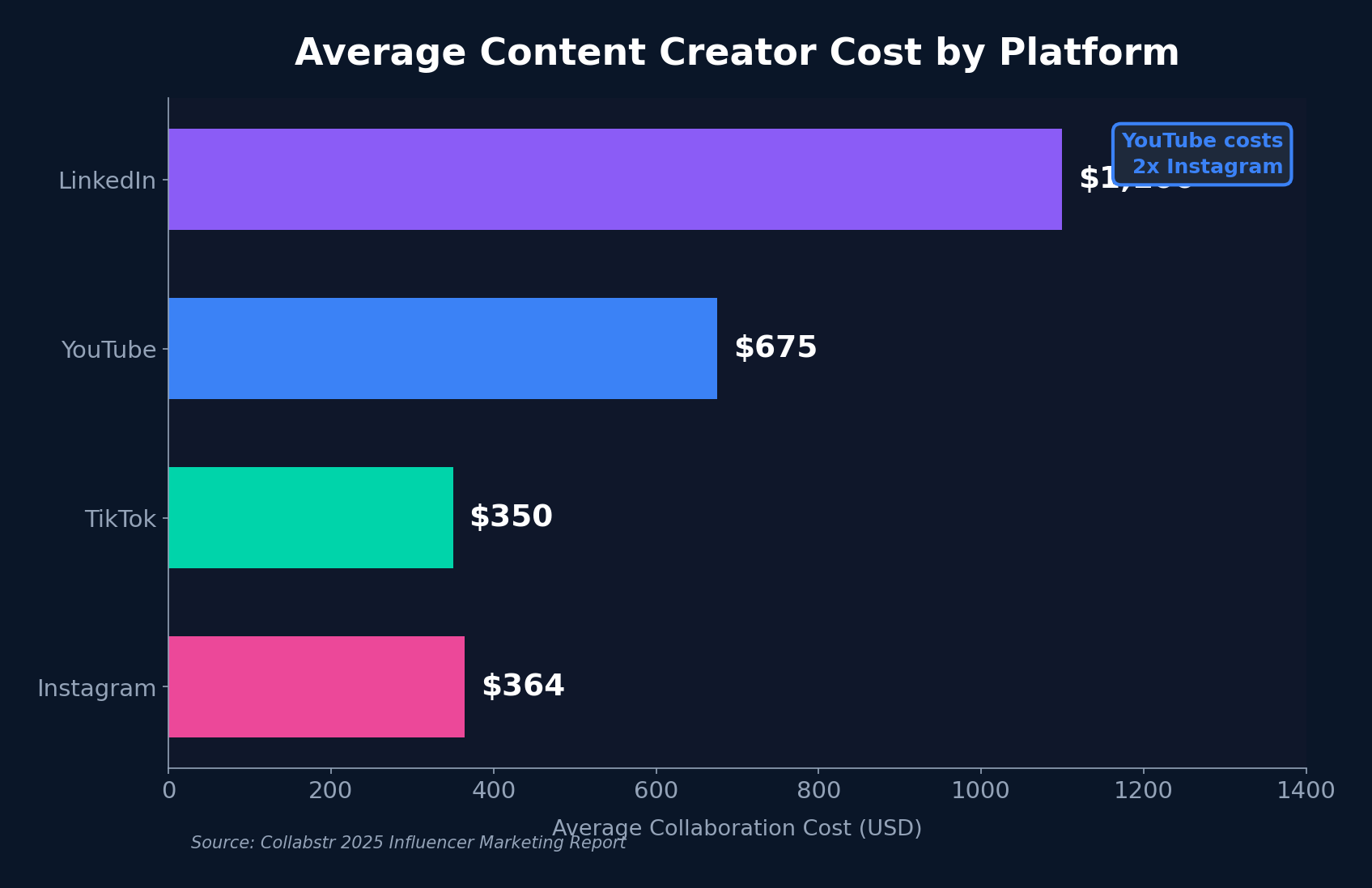
Each platform has distinct content formats, audience expectations, and production requirements that influence creator rates. The same creator might charge $200 on TikTok and $2,000 on YouTube for comparable effort levels.
Instagram Creator Rates
Instagram remains the dominant platform for influencer marketing, with 57% of brands citing it as their preferred channel. The platform's versatility across Reels, Stories, carousels, and static posts creates a wide pricing spectrum.
| Creator Tier | Follower Range | Rate Per Post |
|---|---|---|
| Nano | 1K–10K | $40–$150 |
| Micro | 10K–100K | $80–$350 |
| Mid-Tier | 100K–500K | $350–$2,500 |
| Macro | 500K–1M | $2,500–$10,000 |
| Mega/Celebrity | 1M+ | $10,000–$100,000+ |
Source: inBeat Agency
Instagram Reels command approximately 32% higher rates than standard TikTok videos. Why? The platform's algorithm favors Reels for organic reach, making that format more valuable to brands. The average collaboration cost on Instagram sits around $364, though this varies substantially by niche and engagement quality.
TikTok Creator Rates
Here's where things get interesting.
TikTok was the most downloaded mobile video app worldwide in 2024, surpassing 825 million downloads. Despite massive reach potential, TikTok rates often run lower than Instagram because short-form content requires less production time.
| Creator Tier | Follower Range | Rate Per Post |
|---|---|---|
| Nano | 1K–10K | $25–$125 |
| Micro | 10K–100K | $125–$1,200 |
| Mid-Tier | 100K–500K | $1,200–$5,000 |
| Macro | 500K–1M | $5,000–$15,000 |
| Mega | 1M+ | $15,000–$50,000+ |
TikTok's engagement rates significantly outperform other platforms. Nano-influencers on TikTok achieve an average engagement rate of 10.3%, compared to 1.73% on Instagram for the same tier. That's a 6x difference.
And the purchase influence is remarkable. 78% of TikTok users have bought a product after seeing it in an influencer's video. Nearly 4 in 5 users. This combination of high engagement and purchase intent makes TikTok particularly cost-effective for conversion-focused campaigns.
YouTube Creator Rates
Why does YouTube command premium rates? Production demands.
Long-form video requires research, scripting, filming, and editing. That's a fundamentally different workload than a 30-second TikTok. Creators price accordingly.
| Creator Tier | Subscriber Range | Rate Per Integration |
|---|---|---|
| Nano | 1K–10K | $1,000–$2,500 |
| Micro | 10K–100K | $2,500–$9,000 |
| Mid-Tier | 100K–500K | $9,000–$25,000 |
| Macro | 500K–1M | $25,000–$50,000 |
| Mega | 1M+ | $50,000–$500,000+ |
The average YouTube collaboration costs $675. Nearly double Instagram's average. YouTube sponsorships typically involve either integrated mentions within broader content or dedicated videos entirely focused on the sponsor's product. Dedicated videos command 2–3x the rate of integrations.
LinkedIn Creator Rates
The B2B influencer marketing agency Creator Match has paid out over $1 million to LinkedIn creators in recent months. LinkedIn is no longer an afterthought.
Data from Favikon analyzing 136 LinkedIn influencers found that rates ranged from $10 to $7,500 per post, with the majority (81%) falling between $200 and $2,000.
LinkedIn creators command 2–5x higher rates than Instagram for equivalent follower counts. A LinkedIn influencer with 50,000 followers might earn $3,000–$8,000 per post. Do the same followers count on Instagram? $1,500–$3,000. B2B audiences and professional positioning justify the premium.
UGC Creator Pricing
User-generated content creators operate on a fundamentally different pricing model. UGC creators produce successful influencer marketing content for brands to use on their own channels. As a result, content creation costs are determined by the deliverables, not reach, as they're not posting to their personal audience.
Average UGC Rates
The average price for a single UGC video sits around $190–$212, though the median rate of $150 gives a more accurate picture of what most creators charge. Entry-level UGC creators typically fall in the $50–$150 range, while established creators with strong portfolios command $300–$500+ before licensing fees.
| Experience Level | Rate Per Video | Notes |
|---|---|---|
| Entry-Level | $50–$150 | Simple cuts, minimal editing |
| Mid-Level | $150–$300 | Stronger production value |
| Established | $300–$500+ | Proven track record, advanced editing |
| Premium | $500–$1,000+ | High-end production, niche expertise |
Source: Influee, Billo
UGC Pricing Variables
Base rates represent only part of the total cost. Several add-ons can significantly increase the final price.
Usage Rights are where costs escalate quickly. Standard deals typically include organic posting only. Extended usage for paid advertising adds 30–50% to the base rate. Perpetual rights can add 100–150%.
Whitelisting/Spark Ads means running ads through the creator's handle for platforms like TikTok Spark Ads or Meta Partnership Ads. This typically adds approximately 30% per month.
Raw Footage is increasingly requested. Brands wanting unedited footage for their own editing teams, including Instagram Story content, pay an additional 30–50% of base rate.
Hook Variations for A/B testing add $25–$75 per variation. Multiple opening hooks let brands test what resonates.
Rush Delivery commands 25–50% premiums. Tight timelines cost more.
Bundles typically offer 10–25% discounts versus one-off assets. A package of five videos might cost $850 compared to $200+ each purchased individually.
Freelance Content Creation Rates
Beyond social media influencers and UGC creators, brands frequently hire freelance content creators for specific deliverables like blog posts, photography, and video production.
Written Content Rates
Freelance writers typically charge per word, per hour, or per project. Payscale data shows US-based freelance writers earn varying rates based on experience:
| Experience Level | Hourly Rate | Per-Word Rate |
|---|---|---|
| Beginner (<1 year) | $19–$25 | $0.05–$0.15 |
| Early-Career (1–4 years) | $25–$35 | $0.10–$0.30 |
| Intermediate (5–9 years) | $35–$50 | $0.25–$0.50 |
| Expert (10+ years) | $50–$100+ | $0.50–$1.00+ |
Blog posts typically range from $200–$750 for 1,000 words in US and UK markets. Technical content, SEO-optimized articles, and industry-specific expertise command premium rates.
Video Production Rates
Freelance video editors cluster in three primary ranges, according to the 2025 Salary & Rates Survey from Cutjamm:
| Editor Level | Hourly Rate | Project Rate (Short) | Project Rate (Medium) |
|---|---|---|---|
| Entry-Level | $20–$35 | $100–$500 | $500–$1,500 |
| Mid-Level | $40–$80 | $500–$1,500 | $1,500–$5,000 |
| Senior | $100–$150+ | $1,500–$5,000 | $5,000–$15,000+ |
Full video production (including filming, not just editing) runs $1,500–$7,000 per video for most small business projects.
Factors That Influence Content Creator Pricing
Multiple variables beyond follower count determine what creators charge.
Engagement Rate
Engagement quality increasingly matters more than raw follower numbers. Creators with high engagement can charge premium rates because they convert better. The Collabstr 2025 report notes that audience quality has become the new pricing standard. Brands prioritize engagement rates and authentic connections over raw follower counts.
Niche and Industry
Certain industries command higher rates due to audience value and regulatory complexity. Beauty, tech, and wellness brands typically have larger content budgets. Finance and healthcare content requires compliance expertise, which justifies premium pricing. Fashion influencers command 20–40% higher rates than general lifestyle creators.
Geographic Location
US and Western European creators generally charge higher rates due to labour costs and demand concentration. But the global nature of social media and social media content creation has somewhat narrowed this gap, particularly for UGC services where content quality matters more than the creator's location.
Content Complexity
Production requirements significantly impact pricing. Audience size in terms of production can significantly affect costs as well, depending on the content type. A talking-head testimonial costs less than a polished commercial with multiple locations, wardrobe changes, and advanced editing. The same creator might charge $150 for a simple unboxing and $500 for a scripted, multi-scene production. Big difference.
Exclusivity and Usage Rights
Exclusivity clauses prevent creators from working with competitors in their social media management efforts. These add substantial premiums. A well-defined content strategy around category exclusivity for 90 days might add 25–50% to base rates. Full exclusivity (no competing brand work at all) can double or triple costs.
Common Misconceptions About Creator Pricing
Misconception 1: Higher Follower Count Always Means Better Results
Not true.
Micro-influencers consistently outperform larger accounts on engagement and cost-efficiency. Later's 2025 Influencer Marketing Report found that 73% of brands prefer micro and mid-tier influencers who offer stronger engagement-to-cost ratios. Nano-influencers achieve median CPMs of $119 versus $300+ for macro-influencers, with engagement rates of 6.15–6.76% compared to 1–2% for larger accounts.
Misconception 2: UGC and Influencer Marketing Are the Same Thing
They're not. At all.
UGC creators produce content for brand-owned channels. They don't need large followings because they're not posting to their audience. Influencer marketing pays for distribution to the creator's audience. A UGC video costs $150–$300. The same creator posting that content to their 100K followers might charge $500–$2,000. These are fundamentally different services with different pricing logic.
Misconception 3: Creator Marketing Can't Be Measured
This was true five years ago. Not anymore.
Sprout Social's 2025 research shows 83% of marketers report that sponsored influencer content generates more conversions than brand organic posts. UTM tracking, unique discount codes, and platform-native analytics make attribution increasingly precise. The average ROI of $5.78 per dollar spent isn't a guess. It's measured.
Why Smaller Creators Consistently Outperform Celebrity Endorsements
The assumption that bigger audiences deliver better results doesn't hold up under empirical scrutiny.
Research from Baylor University's Keller Center analyzing direct-to-consumer campaigns found that nano and micro-influencers demonstrated better ROI than larger counterparts, with nano-influencers showing higher revenue per follower. The study used propensity score matching to isolate the effect of influencer size from other variables, confirming that closer audience connections translate to higher conversion rates.
A peer-reviewed study published in the Journal of Business Research examining Instagram engagement patterns found that smaller influencers cultivate stronger personal relationships with followers, leading to higher engagement that persists even as content volume increases. The researchers demonstrated that including visual content amplifies this effect, but the strength depends on audience size—with smaller audiences responding more favorably.
The practical implication for brands: a diversified portfolio of 20 micro-influencers at $500 each often outperforms a single $10,000 macro-influencer post. The math favors reach fragmentation when engagement quality is prioritized over raw impression counts. Marketing teams increasingly allocate 40% or more of influencer budgets specifically to the micro-tier, treating smaller creators as performance channels rather than awareness plays.
[IMAGE 6: ROI comparison chart - micro-influencer portfolio (20 creators x $500 = $10K) vs single macro-influencer ($10K) showing engagement and conversion metrics]
The Attribution Problem: Why Most Brands Undervalue Creator Content
Despite strong aggregate ROI data, many organizations struggle to accurately measure creator marketing effectiveness—and this measurement gap systematically understates true returns.
The 2024 meta-analysis in the Journal of the Academy of Marketing Science noted that structural friction in attribution persists across the influencer marketing industry, with researchers finding significant differences between transactional outcomes (actual purchases and sales) and non-transactional outcomes (attitudes and engagement). Most measurement frameworks capture only immediate, trackable conversions while missing the compounding effects of brand awareness, consideration-stage influence, and social proof that accumulate over time.
A comprehensive literature review published in ScienceDirect covering 93 articles and 108 studies identified 56 distinct predictors of influencer marketing effectiveness, confirming that single-metric attribution models capture only a fraction of creator content's true value. The research found that customer engagement and purchase intention—the two most commonly measured outcomes—are influenced by different predictor sets, meaning campaigns optimized for one metric may underperform on the other.
The strategic implication: brands using last-click attribution or single-channel tracking likely undercount creator ROI by 30–50%. Organizations that implement multi-touch attribution models and longer measurement windows consistently report higher returns than those using simplified tracking approaches.
Calculating ROI on Content Creator Spend
The business case for creator marketing rests on demonstrable returns.
Average Returns by Campaign Type
Influencer Marketing Hub's 2025 data shows influencer marketing delivers an average of $5.78 for every $1 spent. Top-performing campaigns achieve $18–$20 returns. When compared head-to-head with traditional digital advertising, influencer marketing generates 11 times the ROI.
[IMAGE 7: ROI comparison infographic - Influencer Marketing $5.78 average ROI (up to $18-$20 for top campaigns) vs Traditional Digital Advertising benchmark]
These returns vary by objective. E-commerce brands with strong attribution and a clear understanding of their target audience often see 6–10x returns on conversion-focused influencer marketing strategies campaigns. B2B awareness campaigns typically show 3–5x ROI. The key is defining what "return" means before launching: direct sales, leads, content assets, or awareness. Then tracking consistently.
Consumer Purchase Behaviour
The purchase influence of creator content validates these returns. Sprout Social's 2024 Influencer Marketing Report found that 86% of consumers make a purchase inspired by an influencer at least once per year. Nearly half (49%) make influencer-driven purchases daily, weekly, or monthly.
What drives purchases? Genuine reviews (64% of consumers cite this) and discount codes (55%). This suggests optimal creator briefs should emphasize authentic product experiences over polished advertising.
Real-World Examples and Case Studies
Gymshark: From Garage Startup to Billion-Dollar Valuation
Gymshark's trajectory provides quantifiable proof of influencer marketing's potential as a primary growth engine.
Founded in 2012 by 19-year-old Ben Francis with minimal capital, Gymshark pioneered long-term influencer relationships in the fitness apparel space. Rather than pursuing traditional advertising, Francis sent free apparel to fitness YouTubers he admired—a low-cost move that sparked genuine endorsements from creators who actually used the products.
The results speak for themselves. Gymshark achieved an Instagram advertising ROI of 6.6x in its first year, with early influencer partnerships driving 40% of sales. By 2013, daily revenue reached £30,000 within 30 minutes of website relaunches following major influencer activations. The company achieved "unicorn" status (£1 billion+ valuation) by 2020—without significant external funding—and reached a $1.45 billion valuation with revenue exceeding $608 million.
The key differentiator: Gymshark treated creators as long-term partners rather than transactional endorsers, involving them in product development, exclusive collection launches, and community events. Collaborations with influencers like Whitney Simmons and Nikki Blackketter sold out rapidly, with some campaigns boosting sales over 200% compared to non-influencer periods.
[IMAGE 8: Gymshark case study visual - timeline showing growth from $500K (2012) to $1.45B valuation (2020) with key milestones]
Daniel Wellington: Micro-Influencer Strategy at Scale
Daniel Wellington demonstrates how micro-influencer networks can outperform traditional celebrity endorsements.
Starting with just $15,000 in 2011, founder Filip Tysander recognized that the combined reach of many smaller influencers could exceed the impact of single celebrity partnerships—at a fraction of the cost. The brand sent free watches to influencers across Instagram, requiring only a branded hashtag and the freedom to photograph the product however they chose.
The outcome: Daniel Wellington sold over 6 million watches and generated $230 million in revenue by 2017, with the brand becoming the most-mentioned company in Instagram sponsored posts using the #ad hashtag. The hashtag #danielwellington has accumulated over 2.4 million Instagram posts and 166 million TikTok views. This success was achieved without venture capital funding—influencer-generated revenue funded subsequent growth entirely.
The scalable insight: Daniel Wellington's approach worked because micro-influencers produced content that appeared less commercial than traditional advertising, creating authentic social proof at scale. The brand repurposed user-generated content across product pages, social profiles, and paid advertising, extracting maximum value from each creator relationship.
Blueland: Micro-Influencer Campaign Driving 13x ROI
Eco-friendly cleaning brand Blueland illustrates how micro-influencer campaigns translate directly to measurable e-commerce performance.
Following a successful Shark Tank appearance, Blueland activated 211 micro-influencers who created branded content, boosted social media visibility, and drove traffic to Amazon product listings. By gifting products rather than paying fees, the brand maintained cost efficiency while generating authentic reviews and social proof.
Campaign results over three months: Amazon seller rank improved 6.3x (from #36,000+ to approximately #5,800 in its category), influencers generated 247,000+ impressions with 4.6% engagement rates, and monthly Amazon unit sales grew 4.7x—adding $129,000+ in revenue. The total campaign achieved a 13x return on investment after accounting for platform fees and product costs.
Budgeting Frameworks for Different Business Sizes
[IMAGE 9: Budget allocation framework - three tiers showing Startup/Small Business, Mid-Market, and Enterprise with recommended budget ranges and allocation percentages]
Startup/Small Business ($1,000–$5,000/month)
Focus on nano and micro-influencers for the best engagement-to-cost ratio in performance marketing. A budget of $2,500 monthly might fund 10–15 nano-influencer posts or 5–8 pieces of UGC content, aligned with your campaign goals. Prioritize one or two platforms rather than spreading thin. Consider product seeding (gifting) to supplement paid partnerships.
Mid-Market ($5,000–$25,000/month)
Blend micro-influencers for engagement with select mid-tier creators for reach. Allocate 60–70% to ongoing creator partnerships and 30–40% to content licensing and amplification, using relevant case studies as benchmarks and keeping influencer pricing in mind. Build an always-on program rather than sporadic campaigns. Consistency compounds.
Enterprise ($25,000–$100,000+/month)
Layer creator tiers strategically: mega-influencers for awareness, micro-influencers for engagement, and UGC creators for ad creative as part of your marketing strategy. Invest in measurement infrastructure and platform tools, taking into account the number of followers for each influencer tier. Consider long-term ambassador relationships, which typically offer 20–40% discounts versus one-off posts.
Frequently Asked Questions
How much should I pay a content creator for a single Instagram post?
Rates vary dramatically by follower count and engagement. Nano-influencers (1K–10K followers) typically charge $40–$150 per post, while micro-influencers (10K–100K) range from $80–$350. The average Instagram collaboration costs around $364. Always evaluate engagement rates alongside follower counts. A creator with 20K highly-engaged followers may deliver better results than one with 100K passive followers.
What's the difference between UGC creator rates and influencer rates?
UGC creators charge for content production ($150–$300 per video average), while influencers charge for distribution to their audience. A UGC creator produces content for your brand to post. An influencer posts to their followers. The same person might charge $200 for a UGC video and $1,000 to post that video to their 50K followers.
Which platform offers the best ROI for influencer marketing?
TikTok currently delivers strong ROI potential due to high engagement rates and purchase influence. 78% of users have bought products after seeing creator content. But "best" depends on the audience. B2B brands see better returns on LinkedIn. Instagram offers versatility across formats. YouTube drives consideration for high-involvement purchases. Match platform choice to where customers spend time.
How do I know if a content creator's rates are fair?
Request their engagement rate (should be 2–5%+ for Instagram, higher for TikTok), audience demographics, and past campaign examples with results. Use pricing calculators from platforms like Collabstr or GRIN to benchmark. Compare CPM (cost per thousand impressions) across potential partners. Similar reach should yield similar CPMs.
Should I pay content creators per post or set up retainer agreements?
Retainer agreements typically offer 20–40% discounts versus one-off posts and provide consistency in content output. But per-post arrangements let brands test creator fit before committing. Start with 2–3 test posts, then propose retainers with creators who perform well. Long-term partnerships also tend to produce more authentic content as creators genuinely learn the product.


