



Table of contents
Key takeaways
- Start with proper technical foundations: 9:16 vertical video, safe zone compliance, and 1080x1920 resolution set the baseline for deliverable, professional ads.
- Invest in the hook. The first 1-3 seconds determine whether users engage or scroll, making attention-capture the highest-leverage creative investment.
- Embrace platform-native content styles that prioritize authenticity over polish. User-generated content approaches consistently outperform traditional advertising aesthetics.
- Build systematic testing processes that isolate variables, gather statistically significant data, and inform iterative creative development.
- Consider partnering with specialized performance marketing agencies that can provide platform expertise, creative resources, and optimization capabilities to accelerate results.
What are Instagram Reels ads?
Instagram Reels ads are full-screen, vertical video advertisements that appear between organic Reels content as users scroll through the Reels tab, Explore page, and main feed. Meta launched this format as a direct response to TikTok's dominance in short-form video. Reels advertising has become the fastest-growing ad format.
The numbers tell the story. According to Sensor Tower data reported by CNBC, more than half of all ads on Instagram now run on Reels as of 2025, up from 35% in 2024. That's a dramatic shift in just twelve months, reflecting both advertiser demand and Meta's algorithmic prioritization of short-form video content, which allows for fresh content creation. During Meta's October 2025 earnings call, Mark Zuckerberg confirmed that Reels now accounts for 50% or more of all time spent on Instagram, with video watch time increasing 20% year-over-year.
For mid-market and enterprise businesses, this shift represents both an opportunity and an imperative.
The Metricool Social Media Study 2025 found that Instagram Reels deliver 52% more views and 34% more interactions on average compared to other content formats. Organizations that delay adoption risk falling behind competitors who are already capturing lower customer acquisition costs and higher engagement rates through this channel.

Step 1: Establish your campaign foundation in Meta Ads Manager
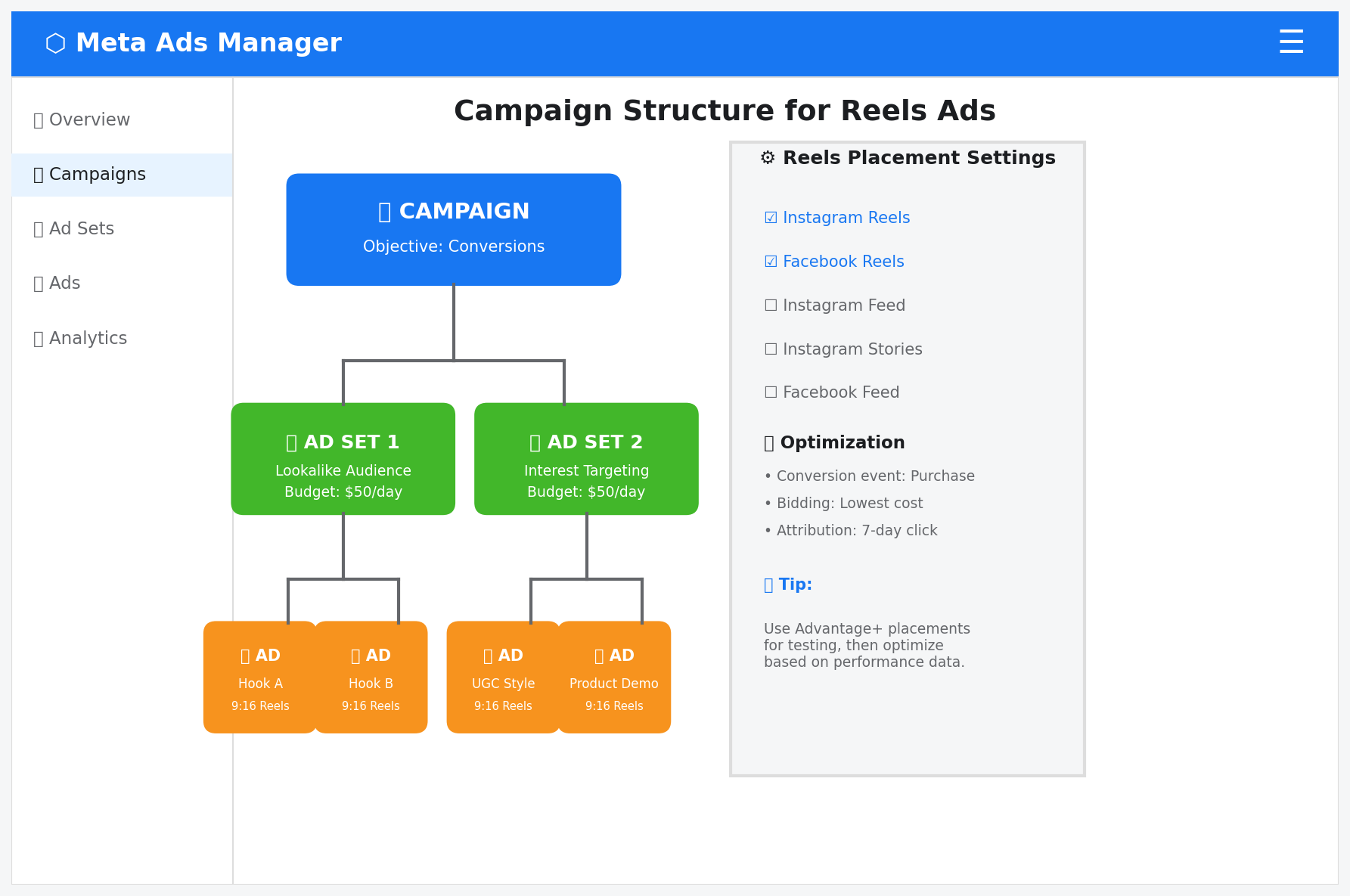
Creating effective Reels advertising begins with proper campaign architecture in Meta Ads Manager. The platform's structure (campaigns, ad sets, and ads) requires strategic decisions at each level that include key elements which directly impact performance.
Campaign objective selection
Your campaign objective determines how Meta's algorithm optimizes delivery. For Reels ads, the most effective objectives typically fall into two categories.
Awareness and reach objectives work when brand visibility is the goal. Research from Toluna's analysis commissioned by Meta found that specific creative techniques in Instagram Reels ads are associated with 1.7x higher likelihood of ranking in the top 20% for purchase intent when brands state their case within the first five seconds.
Conversion and sales objectives drive direct response. Meta's internal data shows that incorporating Reels creative into direct response campaigns leads to an average 88% increase in successful conversions, with a 51% reduction in cost per conversion for lower-funnel events such as purchases.
Budget allocation considerations
| Budget Approach | Best For | Considerations |
|---|---|---|
| Daily Budget | Testing and optimization | More control over daily spend, easier to pause |
| Lifetime Budget | Predictable campaigns | Algorithm optimizes delivery across time period |
| Advantage Campaign Budget | Multiple ad sets | Automatic allocation to best performers |
For organizations new to Reels advertising, starting with daily budgets between $50-100 allows sufficient data collection while limiting initial risk. According to WebFX's 2026 Meta Marketing Benchmarks, the average CPM for Instagram campaigns is approximately $7.47, with Reels placements often delivering lower costs than feed placements.
Step 2: Master technical specifications for Reels ads
Technical specifications directly impact ad delivery and performance. Get them wrong and your ads may be rejected outright. Get them partially wrong and your ads display suboptimally, reducing effectiveness and wasting budget.
Video specifications
The fundamental technical requirements for Instagram Reels ads are non-negotiable. Aspect ratio must be 9:16 (full vertical) for Reels placement. Resolution should be minimum 500 x 888 pixels, though 1080 x 1920 pixels is recommended for optimal quality. Video length can range from 0-15 minutes, but 15-30 seconds performs best for ads. File type should be MP4 or MOV with H.264 compression, and maximum file size is 4GB. For audio, sound-on is strongly encouraged, using stereo AAC compression at 128kbps or higher.
Safe zone requirements
Critical content must remain within designated safe zones to avoid being obscured by Instagram's interface elements. Leave 14% (approximately 250 pixels) at the top free of essential text or branding. Leave 20% (approximately 340 pixels) at the bottom free to avoid overlap with profile icons and call-to-action buttons. Your center safe area is 1080 x 1420 pixels for critical messaging.
Get this wrong and your call-to-action disappears.
According to Sprout Social's 2025 ad specifications guide, failing to respect safe zones is one of the most common reasons Reels ads underperform. Viewers simply can't see the key message or call-to-action.
Text and copy limits
| Element | Character Limit | Visibility Notes |
|---|---|---|
| Primary Text | 125 characters recommended | Only ~72 characters visible before truncation in Reels |
| Headline | 40 characters | May not display in all placements |
| Hashtags | 30 maximum | Use sparingly; 3-5 relevant hashtags typically optimal |
Step 3: Design scroll-stopping creative
Creative quality is the single most significant factor determining Reels ad performance. Full stop. Research consistently shows that native-feeling content outperforms traditional advertising approaches in the short-form video environment, and the margin isn't close.
The hook: Capturing attention in seconds
Users make split-second decisions about whether to continue watching or scroll past. You have about three seconds. Maybe less.
According to Hashmeta's analysis of Reels ad performance, Reels with strong opening hooks see 64% better completion rates.

The most effective hooks share common traits. Movement works because anything that disrupts the static scroll catches attention. Direct questions ("Want to know why your ads aren't converting?") pull viewers in. Showing the result before the explanation creates curiosity that keeps people watching. Pattern interrupts work too, though they're harder to execute: think unexpected visual cuts, surprising juxtapositions, or moments that make viewers think "wait, what?"
Sound-on creative strategy
Unlike many social media environments where sound-off viewing dominates, Reels users typically watch with sound enabled. Meta's updated Reels Ads guide emphasizes that audio (whether music, voiceover, or sound effects) significantly impacts performance.
Use trending sounds from Meta's royalty-free Sound Collection to increase relevance. Include voiceover that delivers the core message for viewers who do watch without sound. And always add on-screen captions that reinforce the audio message for accessibility.
Content formats that convert
The Loopex Digital 2026 Instagram Reels Statistics report found that after watching a product video on Instagram, approximately 48% of users take a follow-up action such as searching for more details or visiting a website. Certain content formats consistently drive these actions.
User-generated content (UGC) style ads that appear as authentic user content rather than polished commercials generate up to 4x higher engagement, according to industry benchmarks. This approach builds trust while feeling native to the platform. Before-and-after demonstrations work particularly well for products with visible results, providing immediate proof of value. Beauty and skincare brands especially excel with this approach. Tutorial and how-to content provides genuine value while showcasing products, balancing entertainment with conversion objectives.
Step 4: Implement strategic targeting
Meta's targeting capabilities allow precise audience definition, but the most effective Reels campaigns often balance specificity with algorithmic optimization. Over-targeting can hurt you just as much as under-targeting.
Core targeting approaches
Custom Audiences let you upload customer lists, target website visitors, or engage users who have previously interacted with your content. Custom audiences from existing customers typically produce the highest conversion rates but offer limited scale.
Lookalike Audiences use Meta's algorithm to identify users who share characteristics with your best customers. For Reels ads, creating lookalikes based on video viewers or purchasers often outperforms lookalikes from broader engagement metrics.
Interest and Behaviour Targeting layers demographic targeting with interests relevant to your product or service. Be careful here: avoid over-narrowing, because giving the algorithm room to optimize often produces better results.
Demographic considerations for Reels
Understanding who engages with Reels content helps inform targeting decisions. According to Limelight Digital's 2026 statistics compilation, 31.7% of Instagram Reels users are aged 18-34, the largest single age group. Gen Z drives 21% of all Reels views globally. Users aged 18-24 show the highest engagement rates. The platform has a nearly balanced gender split: 47.8% male, 46.7% female.
Advantage+ and automated targeting
Meta's Advantage+ placement optimization uses AI to distribute ads across placements for optimal performance. For advertisers new to Reels, starting with Advantage+ while monitoring placement-level performance provides a data-informed baseline before making manual placement decisions.
Step 5: Optimize bidding and placement strategy
Strategic bidding and placement decisions directly impact campaign efficiency and scalability.
Bidding strategy selection
| Strategy | Best Use Case | Risk Level |
|---|---|---|
| Lowest Cost | Maximum conversions within budget | Low (algorithm manages bids) |
| Cost Cap | Predictable cost per result | Medium (may limit delivery) |
| Bid Cap | Strict cost control | Higher (requires accurate bid knowledge) |
| Target ROAS | Revenue optimization | Requires conversion value data |
For most advertisers, beginning with Lowest Cost allows the algorithm to learn while gathering performance data. Once baseline metrics are established, more advanced strategies like Cost Cap can maintain efficiency while scaling.
Placement optimization
While Advantage+ placements often produce strong aggregate results, understanding placement-specific performance informs creative development and budget allocation. Cool Nerds Marketing's 2025 analysis notes that Reels ads typically carry lower CPM and CPC than feed placements while maintaining strong interaction rates for brand-lift and awareness objectives. Their data shows Instagram CPM ranges from $7-12 depending on audience and objective, CPC ranges from $0.40-$1.50+ depending on industry and targeting, and Reels placements often outperform Feed for cost efficiency.
Scheduling considerations
Campaign scheduling should align with when your target audience is most active on the platform. Industry benchmarks suggest dining and tourism perform best Wednesday 11 AM–3 PM, finance content peaks Wednesday 11 AM–2 PM and Friday 11 AM–4 PM, and general engagement tends to be highest during lunch hours and evening commute times.
These are starting points. Your own analytics will reveal patterns specific to your audience.
Step 6: Launch, monitor, and iterate
Successful Reels campaigns require active management, particularly during the initial learning phase when Meta's algorithm is optimizing delivery.
The learning phase
When a new ad set launches, Meta enters a "learning phase" where the system explores different audiences and placements to optimize delivery. During this period, expect higher CPAs and less stable results. Avoid making significant changes that reset learning. Allow approximately 50 conversion events before evaluating performance, and ensure your budget supports reaching this threshold within one week.
Key performance indicators for Reels ads
Monitor these metrics to assess campaign health and identify optimization opportunities.
For video metrics, track ThruPlay rate (percentage of users who watch 15+ seconds or to completion), average watch time (indicator of creative engagement quality), and hook rate (percentage of users still watching at 3 seconds).
For conversion metrics, track click-through rate (Loopex Digital reports that Reels generate 41% higher CTR to brand websites compared to static ads), conversion rate (percentage of clickers who complete desired action), and cost per acquisition (total cost divided by conversions).
For efficiency metrics, track return on ad spend (revenue generated per dollar spent) and cost per thousand impressions (benchmark against industry averages).
A/B testing framework
Systematic testing improves performance over time. Effective Reels ad testing isolates single variables: creative testing compares different hooks, formats, or messaging approaches; audience testing compares performance across different targeting approaches; placement testing evaluates Reels-specific versus cross-placement performance.
Run tests until you achieve statistical significance (typically 1,000+ impressions per variant minimum) before drawing conclusions.
Step 7: Scale winning campaigns
Once you identify high-performing combinations of creative, audience, and placement, scaling requires balancing growth with efficiency maintenance.
Vertical scaling
Increasing the budget on winning ad sets is the most straightforward scaling approach. Increase budgets by no more than 20% every 48-72 hours to maintain learning stability. Monitor CPAs closely during scaling because efficiency often decreases at higher spend levels. Maintain creative freshness by introducing new variations before fatigue sets in.
Horizontal scaling
Expanding to new audiences or creative variations extends reach while diversifying risk. Create new ad sets targeting adjacent audiences. Develop new creative concepts that apply winning elements to fresh approaches. Test new geographic markets or demographic segments.
Creative refresh cadence
Ad fatigue occurs when the same users see creative repeatedly, causing declining performance. Plan to refresh creative every 2-4 weeks depending on audience size and frequency. Maintain a library of approved creative variations for rapid deployment. Monitor frequency metrics to identify fatigue before performance declines significantly.
Common misconceptions
Misconception 1: Shorter is always better for Reels ads
Conventional wisdom suggests shorter content performs universally better. The data tells a more nuanced story.
According to Loopex Digital's 2026 analysis, Reels between 60-90 seconds actually receive the highest engagement and view rates, challenging the assumption that under-15-second content is always optimal. The key is matching length to content complexity and audience expectations. Tutorial content may warrant longer formats, while direct product showcases can succeed in 15 seconds.
Misconception 2: Reels ads only work for B2C and consumer brands
Many B2B marketers assume Reels are irrelevant for their audiences. This underestimates the platform's reach and versatility.
Decision-makers are still consumers outside work hours. Educational content, thought leadership, and even complex service explanations can succeed in the Reels format. The same research indicates that Reels influence buying decisions across both consumer and B2B markets.
Misconception 3: High production value is essential for Reels success
Quality matters. But authenticity often outperforms polish in the Reels environment.
User-generated content style ads (even those shot on smartphones) frequently outperform professionally produced commercials. The platform's culture values relatability and genuine connection over cinematic production. Focus on compelling hooks, clear messaging, and native-feeling content rather than expensive production.
Real-world examples and case studies
Frankly Beauty: Reels-first strategy transformation
Cosmetics brand Frankly added short Reels ads to their existing image-focused campaigns, following Meta's creative best practices for the format. According to Meta case studies compiled by Landingi, the brand achieved 43% more purchases and a 38% increase in return on ad spend compared to image-only campaigns.
Their approach emphasized full-screen 9:16 videos, on-screen safe zones, and attention-grabbing openings that highlighted clean formulas and practical beauty applications. The takeaway: sometimes the simplest format change (image to video) drives the biggest results.
Wanderlust Travel: Driving bookings through Reels
A travel company leveraged Instagram Reels to showcase destination experiences and travel packages. By linking Reels to dedicated landing pages with clear calls-to-action and "Book Now" buttons, they reported a 50% increase in bookings and 40% increase in revenue within six months of implementing their Reels strategy.
Their success came from combining informative destination content with direct conversion pathways. Inspiration meets action.
Fragrance Foundation Germany: Creator partnership results
The Fragrance Foundation partnered with three Instagram creators for their DUFTSTARS awards campaign. Using branded Reels ads featuring creators sharing memories associated with nominated perfumes, they reached 6 million people and achieved a 1.8-point lift for consumers willing to vote for their favorite perfumes, according to Meta Lift brand study measurements.
This case demonstrates the power of authentic creator partnerships in driving awareness objectives.
Frequently asked questions
How much do Instagram Reels ads cost?
Instagram Reels ad costs vary based on objective, targeting, and competition. According to 2025-2026 benchmarks, typical CPM ranges from $4.29-$12, while CPC falls between $0.40-$3.35 depending on placement and industry. Reels placements generally deliver lower costs than feed placements while maintaining strong engagement rates. Budget minimums start around $1 per day, but most advertisers need $50-100 daily to gather meaningful performance data during testing phases.
What video length works best for Reels ads?
Instagram supports Reels up to 3 minutes for organic content and 15 minutes for ads. That said, performance data suggests shorter formats typically work best for advertising. Most top-performing Reels ads fall in the 15-30 second range, though content between 60-90 seconds shows strong engagement for more complex messaging. The key is matching length to message complexity. Never pad content to hit a target duration.
Should I use separate creative for Reels versus other placements?
Yes, whenever possible. Reels require vertical 9:16 creative that feels native to the platform, while feed placements work better with square or 4:5 formats. Beyond aspect ratio, the creative approach differs: Reels audiences expect entertainment-first ad content with quick hooks and authentic presentation, while feed audiences may respond to more traditional advertising approaches. Meta's Placement Asset Customization feature allows you to specify different creative for each placement within a single ad.
How do I measure success for Reels advertising campaigns?
Success metrics depend on campaign objectives. For awareness campaigns, focus on reach, impressions, video views, and ThruPlay rates. For consideration, track click-through rate, landing page views, and engagement. For conversion campaigns, monitor purchases, leads, cost per acquisition, and return on ad spend. Meta's brand lift studies can measure harder-to-quantify metrics like ad recall, brand awareness, and purchase intent through randomized control trials comparing exposed and unexposed audiences.
Can I repurpose TikTok content for Instagram Reels ads?
Technically, yes. Practically, be careful.
Instagram's algorithm penalizes content with visible TikTok watermarks, reducing distribution and potentially increasing costs. If repurposing, remove all watermarks and ensure the content feels native to Instagram. Better practice is creating platform-specific versions that respect each platform's unique culture and audience expectations, even if the core concept remains consistent.


