



Table of contents
Key Takeaways
- A brand redesign is a strategic investment, not merely a visual update—approach it with clear business objectives and comprehensive research into customer perceptions before making any changes.
- Watch for key indicators signaling the need for change: misalignment between your brand and business reality, competitive pressure, audience evolution, mergers, or reputation challenges requiring transformation.
- Protect emotional equity by identifying which brand elements carry significant weight with customers and stakeholders; preserve what works while evolving what has become a liability.
- Allocate realistic timelines and budgets: comprehensive rebrands typically require 12-18 months and meaningful investment, while focused refreshes can complete faster with proportionally smaller budgets.
- Measure success through multiple dimensions—awareness, perception, engagement, and financial performance—and commit to long-term tracking rather than expecting immediate results.
- Consider partnering with experienced branding professionals who can provide objective assessment, strategic guidance, and proven methodologies while ensuring your internal team remains deeply involved throughout the process.
What is a brand redesign?
A brand redesign is the strategic process of significantly modifying your company's visual identity, messaging, and market positioning to better reflect your current business reality and future aspirations. Unlike a simple logo redesign, a comprehensive brand redesign encompasses everything from your visual identity system (logos, color palettes, typography, and imagery) to your brand voice, tone of voice, messaging architecture, and overall market positioning. The goal is to create a new brand identity that aligns with your evolved business model and resonates with your target audience.
According to research in the Journal of Brand Management, a strong brand identity must comprise unique identity elements such as logos, colours, or characters that distinguish it from competitors and facilitate recognition and purchase. These brand assets serve as the visual shorthand that helps customers identify and connect with your company in a crowded marketplace.
For mid-market and enterprise businesses, understanding the distinction between a brand refresh and a complete rebrand is critical. A partial rebrand or refresh involves targeted updates to existing visual elements while maintaining core brand equity. A complete overhaul represents something more fundamental: a transformation that may include a name change, new positioning, and an entirely new visual identity. Research indicates that 74% of S&P 100 companies have rebranded within their first seven years of operation. Even the most successful organizations recognize the need to give their brand's identity new life through periodic evolution.
Strong brands consistently demonstrate superior financial performance. McKinsey's research on business branding confirms that companies with brands that are perceived as strong generate higher EBIT margins than others. Your brand image is a strategic business asset that directly impacts your bottom line and market share.
When to consider a brand redesign
The decision to rebrand should never be arbitrary. It must respond to an objective diagnosis of your current brand's performance and alignment with business objectives. Whether a successful brand refresh or complete rebrand is the right move depends on your specific situation.
Brand refresh vs. full rebrand
| Factor | Brand Refresh | Full Rebrand |
|---|---|---|
| Scope of Change | Selective updates to visual elements | Complete overhaul including positioning |
| Timeline | 3-6 months typically | 12-18 months on average |
| Investment Level | 5-10% of marketing budget | 10-20% of marketing budget or more |
| Core Identity | Maintained | May fundamentally change |
| Risk Level | Lower, preserves brand equity | Higher, potential customer confusion |
| Best For | Modernizing dated visuals, expanding markets | Mergers, repositioning, reputation recovery |
Critical indicators that signal the need for change
When your offerings have substantially changed, your brand should reflect this transformation. Your old brand may no longer represent your current business model or strategic direction. McKinsey's own 2019 rebrand exemplified this principle. Over half of their work for clients now resides in areas that didn't exist as little as five years ago, which drove them to update their visual identity and pursue a new look.
Mergers and acquisitions almost always trigger rebranding conversations. Research shows that 69% of brands acquired by S&P 100 companies rebrand within the first seven years, with 40% doing so within the first year. When separate entities combine, the original branding typically fails to represent the new identity, culture, or scope of operations. A new name and new branding often become necessary to signal the new direction to stakeholders.
What about competitive pressure? If your brand feels generic or indistinguishable from competitors, you're losing ground in the market. Strong brands create differentiation that justifies premium pricing and builds customer loyalty. And when your customer demographics evolve or you're trying to attract a new audience and new customers, your brand must resonate with these target markets without alienating existing customers.
Following a crisis or persistent negative perceptions, a strategic rebrand can help distance your company from past issues and signal genuine organizational transformation.

Weighing the decision
A rebrand can realign how customers perceive you with what you actually deliver today. It creates opportunities to re-engage existing customers while attracting a new audience, and it signals to stakeholders and investors that you're evolving. Done well, it can justify premium pricing and expand your target market.
The risks, though. Significant investment of time, resources, and organizational focus. Potential to alienate loyal customers who feel emotionally connected to your current branding. Years of brand recognition can evaporate if the transition stumbles. And implementation demands coordination across every touchpoint, which is harder than most companies anticipate going in. A rebranding effort is a powerful tool for transformation, but only when the rebranding strategy aligns with your broader business strategy.
Common misconceptions about brand redesign
Misconception 1: Rebranding is primarily about creating a new logo
A logo does not a brand make. Yet this remains one of the most persistent myths: that a rebrand centers on visual changes alone.
Successful rebranding goes far deeper. It's a strategic initiative that aligns your new visual identity with organizational strategy, core values, and customer expectations. Companies that treat it as a design exercise often end up replacing their old logo with a shiny new one while the same underlying problems persist. A true rebranding project requires rethinking your entire marketing strategy, not just your design trends.
Misconception 2: Strong brands don't need to rebrand
Even heritage brands with decades of equity undertake periodic refreshes to stay relevant with market trends. Coca-Cola, despite never changing their core brand pillars, has updated their brand identity system 12 times in 121 years of business. The most enduring brands understand that staying relevant requires evolution. But these are typically successful brand refreshes rather than revolutionary overhauls, with core elements preserved.
Misconception 3: Rebranding will immediately boost sales
Brand-building delivers superior long-term returns compared to short-term marketing activation. But expecting immediate revenue spikes from a new brand reflects a fundamental misunderstanding of how branding works. The effects on sales are cumulative.
According to industry analysis, 40% of rebrand efforts fail to deliver positive ROI. Why? Often because organizations expected instant results rather than committing to the long-term journey. A successful rebrand requires patience and sustained investment in your new brand identity.
Why emotional equity often outweighs visual aesthetics
The most costly rebranding mistakes stem from underestimating the emotional connections customers have formed with existing brand elements. Before rushing toward a new look, understand what you might lose.
When Tropicana redesigned their packaging in 2009, removing their iconic orange-with-a-straw imagery, they learned this lesson the hard way. The result: a $30 million revenue loss in the first month alone. Sales declined 20%, forcing them to revert to the original design within just 36 days. The new branding wasn't objectively worse. It just severed connections customers had built with the old brand.
This phenomenon isn't unique to consumer products. Research from the Journal of Brand Management examining logo reception at Aalto University found that new logos initially face resistance before becoming sources of positive brand associations. The study demonstrated how logos become anchored in corporate identity over time, creating bonds that can't be casually severed.
What does this mean for business leaders? The first step before any visual changes is research. Figure out which elements of your current brand carry emotional weight with customers, employees, and stakeholders. The goal isn't preservation for its own sake. It's knowing what actually matters versus what can safely evolve.
Survey data backs this up: 60% of consumers avoid companies with unappealing logo designs, even if they have good reviews. But "appealing" doesn't mean "new." It means appropriate, recognizable, and emotionally resonant.
The satisficing trap
Here's something that doesn't get discussed enough: many rebrands fail not because they're poorly executed, but because they're solving the wrong problem.
The conventional wisdom says "if it ain't broke, don't fix it." But that framing misses the point. Brands don't break suddenly. They erode. By the time the erosion becomes obvious, you're not doing a strategic rebrand anymore. You're doing damage control.
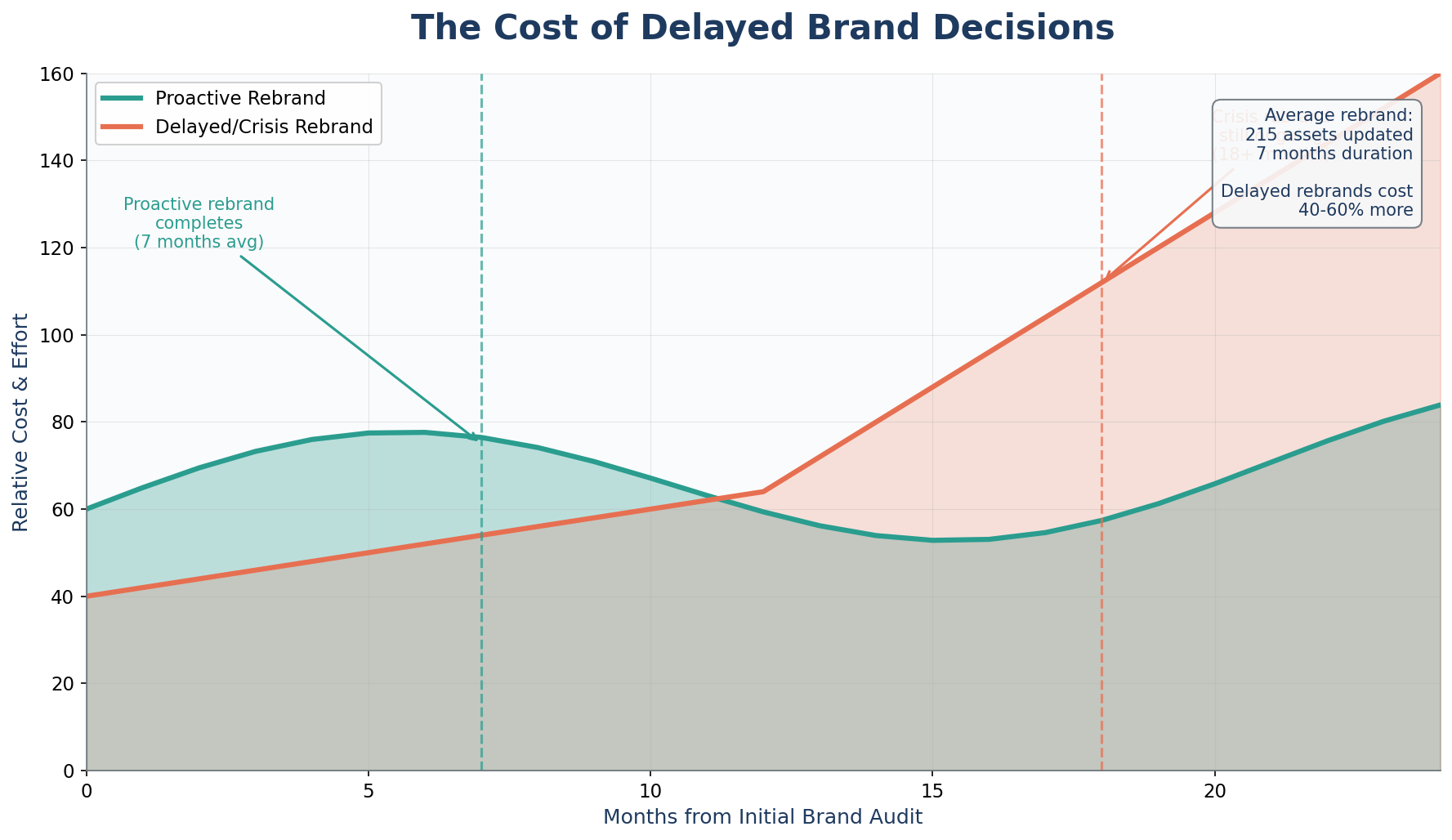
Organizations often postpone brand redesign decisions because the investment seems daunting or the timing never feels right. This delay has its own costs.
A brand that no longer reflects business reality creates friction at every customer touchpoint. Your sales team struggles to articulate value propositions that don't align with dated marketing materials. New employees can't understand or embody a brand identity that feels disconnected from what the company actually does. Recruiting suffers when talented candidates see your brand as outdated.
Research indicates the average rebrand involves updating 215 brand assets and lasts seven months from initial discussions to rollout. This timeline expands significantly when organizations wait until their brand has deteriorated substantially.
For companies considering public offerings, acquisitions, or major market expansion, brand perception directly impacts valuation. 82% of investors want the companies they invest in to have a strong brand. Waiting until it's a critical step often means paying more for worse outcomes.
Proactive brand management costs less than crisis-driven overhauls. Organizations that run regular brand audits and plan evolutionary updates maintain relevance without the disruption of emergency rebranding. The next step after reading this? Audit your current brand against your business strategy and see where the gaps are.
Real-world examples and case studies
Burberry: from counterfeit magnet to digital luxury pioneer
In the early 2000s, Burberry faced a critical challenge. Despite over a century of heritage, their iconic check pattern had become associated with counterfeits and unflattering cultural associations. The brand image and luxury positioning were severely compromised.
Under CEO Angela Ahrendts and Chief Creative Officer Christopher Bailey, Burberry executed a turnaround that took nearly a decade. They didn't abandon their heritage. Instead, they reinterpreted it for contemporary audiences and went all-in on digital innovation. Revenue crossed £1.2 billion in 2009, a first for the company.
What made this successful rebrand work? They tightened control over licensing to protect brand value. They partnered with influential figures to reshape perception. And they became pioneers in luxury digital marketing through livestreamed fashion shows and social media engagement. The strategic direction was clear: honour heritage while embracing new channels.
Old Spice: the grandfather problem
Old Spice faced what many legacy brands experience: their core customer base was aging out while younger consumers associated the old brand with their grandfathers. The challenge went beyond visuals. It was a fundamental perception problem requiring a new direction.
Their 2010 "The Man Your Man Could Smell Like" campaign completely reimagined how the brand communicated. Humor, digital engagement, a distinctly younger sensibility. Old Spice saw results quickly. Just six months after launching the rebrand, sales were up 125% year over year. The right move was abandoning their old target audience to pursue new customers who could sustain the brand for decades.
Mailchimp: subtle evolution done right
While Tropicana, Gap, and other failed rebrands get all the attention, Mailchimp's 2018 refresh offers a different lesson. They kept their quirky mascot Freddie but refined the illustration style, introduced their signature "banana yellow" as a dominant color, and expanded their visual language to work across new product categories.
The interesting part: they did user testing that revealed customers had stronger emotional attachment to Freddie than to the Mailchimp name itself. So they doubled down on the mascot while modernizing everything around it. No dramatic unveiling, no customer backlash. Sometimes the best rebrands are the ones nobody complains about.
Frequently asked questions
How often should a company consider rebranding or refreshing their brand identity?
Every three to five years for an audit; every seven to ten for a significant refresh. But honestly, it depends on your industry. Tech companies often refresh more frequently than, say, law firms.
What is the typical timeline and budget for a brand redesign project?
The average rebranding process takes 12 to 18 months for comprehensive initiatives. Focused refreshes can be completed in three to six months. Budget varies significantly based on organization size and scope: smaller businesses may invest between $30,000-$50,000, mid-market companies typically spend $60,000-$80,000, while enterprise organizations with global operations often invest $100,000-$250,000 or more. And that's just the creative work. Implementation costs (signage, packaging, digital assets, training) often equal or exceed the strategy and design investment.
How can companies measure the ROI of a rebranding initiative?
Track brand awareness, customer acquisition costs, pricing power, and employee retention before and after. The catch: meaningful ROI takes 12-24 months to show up. Most companies measure too early and draw the wrong conclusions.
What are the biggest risks to avoid during a brand redesign?
Changing too many elements at once. Research indicates that most businesses lose between 20% and 40% of their customer base during poorly executed rebrands, and 68% never recover their original market position. Other common mistakes: skipping customer research, poor internal alignment, and launching during organizational instability.
Should we handle rebranding internally or engage external partners?
It depends on scope and internal capabilities, but here's the honest answer: most companies overestimate their ability to see their own brand clearly. You're too close to it. A branding agency or external partners bring pattern recognition from dozens of rebranding projects and the ability to tell leadership things internal teams can't. That said, agencies that don't deeply involve your team produce work that doesn't stick. The internal team knows the culture, the customer relationships, the operational constraints. Skip the "hand it off and wait for the big reveal" approach. The best outcomes come from genuine collaboration where external expertise meets internal knowledge.


