



Table of contents
Key Takeaways
- Allocate B2B PPC budgets strategically across platforms: 35-45% Google Ads for high-intent capture, 25-35% LinkedIn for decision-maker targeting, 15-20% Microsoft Bing for cost-efficient reach, and 5-10% Meta for volume generation
- Structure campaigns by funnel stage and buyer persona, using dedicated ad groups for awareness, consideration, and decision-stage keywords to improve quality scores and message relevance while focusing on the desired action, utilizing tools like Google Keyword Planner for effective targeting.
- Prioritize lead quality over volume by implementing CRM integrations that track conversions through the complete sales cycle, so you can optimize landing page optimization toward actual revenue rather than form submissions.
- Test and iterate continuously using A/B testing for ad creative, landing pages, and audience targeting; B2B optimization requires longer measurement windows that reflect extended sales cycles
- Consider engaging specialized B2B PPC expertise when internal resources lack platform-specific knowledge, as proper campaign architecture and ongoing optimization significantly impact returns
What Is B2B PPC?
B2B pay-per-click advertising is a digital marketing model where businesses pay publishers each time their advertisement receives a click from potential business customers. The target audience differs completely from consumer campaigns. B2B PPC focuses on decision-makers, procurement managers, and executives within organizations seeking products or services to solve business challenges.

According to Gartner's B2B buying journey research, today's B2B purchasing process follows a nonlinear path that more closely resembles a set of distinct buying jobs rather than a traditional funnel aimed at attracting new customers. B2B buyers, including businesses of all sizes, spend only 17% of their total buying time in direct contact with potential vendors. That means approximately 80% of the journey happens through digital research channels, including paid search results.
For mid-market and enterprise businesses, B2B PPC campaigns capture high-intent prospects actively searching for solutions. The average B2B marketing budget now allocates 42% to search advertising and 27% to social advertising according to Digital Bloom's 2025 B2B PPC research. Marketers now recognize that paid search reaches qualified buyers throughout their decision-making process, leading to better results. And with B2B purchasing committees averaging 10 unique decision-maker functions and deals often exceeding $250,000, strategic PPC positioning ensures your solution appears precisely when stakeholders conduct critical research.
The B2B PPC Platform Landscape: Strategic Selection
Selecting the right advertising platforms fundamentally shapes campaign performance.
Each major platform offers distinct advantages for B2B advertisers. Understanding these differences enables strategic budget allocation that most competitors overlook.
Platform Comparison for B2B Campaigns
| Platform | Avg. CPC | Avg. CPL | ROI | Best Use Case |
|---|---|---|---|---|
| Google Ads | $5.34 (non-branded) | $48.96 | ~200% | High-intent search capture |
| Microsoft Bing | $1.54 | $41.44 | 253% | Cost-efficient reach |
| LinkedIn Ads | $8-12 | $75-120 | 150-180% | Decision-maker targeting |
| Meta Ads | $1.50-3.00 | $16.95 | Variable | Volume generation |
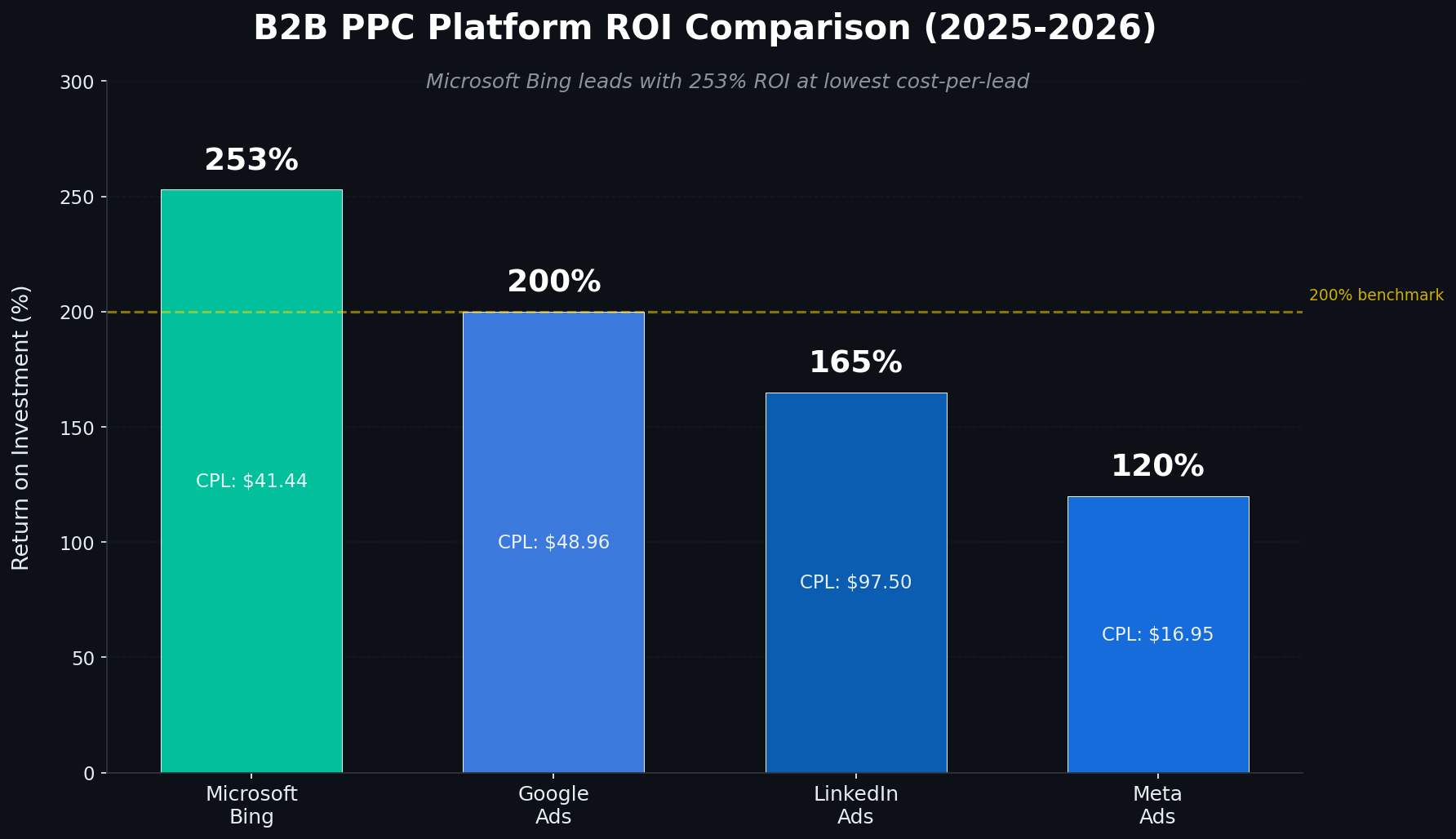
Google Ads and display ads remain the cornerstone of most B2B paid advertising strategies. The platform captures high-intent buyers actively searching for solutions, with WordStream's 2025 benchmarks showing the average click-through rate for search ads across all industries reached 6.42%. That continues an upward trend from previous years. For B2B specifically, the platform delivers reliable ROI with strong conversion performance, though CPCs continue rising annually.
Microsoft Bing Ads emerges as the unexpected ROI leader according to recent benchmark data. The platform offers exceptional cost efficiency through lower competition, professional audience composition, and reduced CPCs averaging $1.54. Bing's audience skews toward higher household incomes and desktop usage patterns typical of business research. B2B conversion rates run 15-20% higher on desktop versus mobile.
Here's something most B2B marketers miss: Bing isn't just a cheaper alternative to Google. It's often the better platform for reaching senior decision-makers who use Microsoft products throughout their workday. These buyers conduct research on Edge browsers with Bing defaults, and they're typically further along in their careers (and budgets) than the average Google searcher.
LinkedIn Ads provides unmatched professional targeting capabilities. The platform commands premium pricing, but it enables precise audience segmentation by job title, company size, industry, and seniority level. Research indicates LinkedIn-generated leads in B2B achieve 32% higher closure rates when reaching the opportunity phase. That justifies higher upfront costs for enterprise sales cycles.
Budget Allocation by Sales Cycle Length
The optimal platform mix depends significantly on your typical sales cycle duration, including the choice of specific keywords for advertisements:
| Sales Cycle | Google Ads | LinkedIn Ads | Bing Ads | Meta Ads |
|---|---|---|---|---|
| Under 3 months | 55-65% | 20-30% | 10-15% | 5-10% |
| 3-6 months | 45-50% | 30-35% | 15-20% | 5% |
| Over 6 months | 30-40% | 40-50% | 15-20% | 5% |
Enterprise sales with complex buying committees and extended evaluation periods benefit from LinkedIn's sustained influence capabilities. Shorter transactional sales leverage Google's immediate intent capture instead.
Building Effective B2B PPC Campaigns
Successful B2B paid advertising campaigns require methodical structure, strategic keyword selection, and compelling creative elements that resonate with business buyers.
Keyword Strategy for Business Buyers
B2B keyword research differs substantially from consumer-focused approaches.
Business buyers search using technical terminology, specific problem statements, and comparison queries that indicate evaluation-stage intent. They don't search "best software" the way consumers might search "best running shoes." They search "SOC 2 compliant vendor management platform" or "ERP implementation timeline manufacturing."
High-Intent Keyword Categories with precise targeting:
- Solution-specific terms: "enterprise CRM software," "industrial automation systems"
- Problem-aware queries: "reduce procurement costs," "improve supply chain visibility"
- Comparison searches: "[Competitor] alternative," "best [solution category] for [industry]"
- Technical specifications: "SOC 2 compliant data management," "ISO 9001 certified manufacturer"
Research from 6sense's 2025 Buyer Experience Report reveals that 94% of buying groups rank their vendor shortlist before initiating sales contact. The vendor ranked first wins approximately 80% of deals. This makes capturing early search visibility essential for inclusion on initial consideration lists.
Campaign Structure Best Practices
Organizing campaigns effectively improves quality scores, reduces wasted spend, and enables granular optimization, providing valuable insights into campaign performance:
Funnel-Stage Segmentation:
- Awareness campaigns targeting broad industry terms and educational content
- Consideration marketing campaigns focusing on solution comparison and feature queries.
- Decision campaigns capturing branded searches and high-intent conversion terms
Account-Based Campaign Architecture:
- Dedicated campaigns for target account lists using customer match features
- Industry-vertical campaigns with tailored messaging and landing pages
- Geographic campaigns when serving specific regional markets
Ad Creative That Converts B2B Buyers
B2B ad copy must balance professional credibility with compelling value propositions. Research indicates that video ads with specific calls-to-action like "Get Started" or "Request Demo" achieve twice the click-through rates of vague CTAs like "Click Here."
Clear next-step CTAs appropriate to the funnel stage, with targeted ad campaigns in mind.
- Specific outcome statements: "Reduce procurement cycle time by 40%"
- Credibility signals: Industry certifications, client logos, performance metrics
- Professional language matching buyer vocabulary and pain points
- Clear next-step CTAs appropriate to funnel stage
LinkedIn research shows ad copy mentioning direct business benefits improves engagement by 23%. And campaigns integrated with advanced analytics achieve 40% better optimization over time.
Common Misconceptions
Misconception 1: B2B PPC Is Too Expensive to Generate Positive ROI
Many organizations hesitate to invest in B2B PPC due to higher cost-per-click rates compared to B2C advertising. But this perspective overlooks the fundamental economics of business transactions. B2B CPCs average $1.16 to $8.86 depending on industry and keyword competitiveness, making it crucial to attract potential customers and drive website traffic effectively. The average B2B deal value far exceeds these acquisition costs.
Consider the math. Firebrand's 2024 B2B Google Ads benchmarks show SaaS companies experience higher CPCs precisely because their recurring revenue contracts justify aggressive bidding. When a qualified lead represents a potential lifetime value of $50,000 or more, moving them through the sales funnel can justify a $200-500 cost-per-lead that delivers exceptional returns. The key lies in proper attribution and tracking through the full sales cycle, not just initial form submissions.
Misconception 2: Google Ads Is the Only Platform Worth Investing In
Google dominates search advertising with 90% market share. But concentrating budgets exclusively on a single platform limits reach and increases costs through heightened competition.
Microsoft Bing's smaller advertiser base creates less auction competition. The result? Lower minimum bids and higher ad positions for equivalent spending. B2B service providers report consistent top-3 positions on Bing for keywords achieving only positions 5-8 on Google despite identical quality scores.
LinkedIn's share of B2B digital marketing budgets has grown from 31.3% to 37.6% over the past year according to Factors.ai research. Measurement capabilities have improved. Marketers now recognize the platform's unique decision-maker access. Diversified platform strategies outperform single-channel approaches when properly coordinated.
Misconception 3: More Leads Always Means Better Campaign Performance
Lead volume metrics can be dangerously misleading for B2B advertisers.
Meta Ads may deliver high lead volume, but research indicates MQL-to-SQL conversion rates of just 5-10%. Most leads never progress to sales qualification. LinkedIn Ads achieves 14-18% MQL-to-SQL conversion rates through superior audience targeting.
The strategic focus should be on lead quality and downstream metrics: opportunity creation, pipeline contribution, and ultimately closed revenue. Organizations optimizing solely for cost-per-lead often discover they've filled their CRM with contacts who will never convert. That wastes both advertising spend and sales team resources.
Real-World Examples and Case Studies
Workshop Digital: Industrial Manufacturing Success
An industrial manufacturing company working with Workshop Digital achieved remarkable results through refined paid search targeting and CRM integration. By creating a data-driven funnel focused on quality conversations rather than click volume, the campaign generated 35% more leads at a cost-per-lead 24% below target, utilizing a valuable email list and resources like white papers to engage potential clients.
The approach involved developing a custom Salesforce process to pass Google click IDs through the entire customer journey from lead to closed deal, leveraging tools within Google search. This enabled offline conversion tracking that optimized for actual revenue rather than form submissions, aligned with key performance indicators (KPIs).
One result stands out. A company clicked a Google PPC ad and submitted an initial RFQ for approximately $47,000. Two days later, they submitted a follow-up quote request for $1.6 million worth of products. The campaign earned Search Engine Land's "Best B2B Search Marketing Initiative" award and doubled the previous year's PPC-attributed revenue within the first two quarters, all while effectively competing with organic search results and encouraging users to provide their contact information.
Global Touchscreen Technology Provider: Multi-Channel Optimization
A global leader in touchscreen technology partnered with Midsummer Agency to address declining lead quality from Google, Bing, and LinkedIn campaigns, including paid social ads and PPC accounts. The strategic overhaul resulted in 77% improvement in lead quality and 50% reduction in cost-per-acquisition.
The approach restructured campaigns across platforms using a coordinated full-funnel strategy rather than treating each channel independently. Google and Bing focused on high-intent search capture. LinkedIn targeted specific stakeholders at enterprise accounts, experimenting with different ad formats to optimize outreach. Integrated HubSpot tracking and Google Analytics enabled cross-channel attribution showing how initial LinkedIn touchpoints influenced later search conversions.
B2B SaaS: Scaling Through Strategic PPC
A B2B SaaS company struggling with customer acquisition through paid channels implemented comprehensive campaign restructuring. Key changes included switching from broad match to phrase and exact match keywords, segmenting campaigns by funnel stage and buyer persona, and using CRM data to refine negative keyword lists to reach the right keywords and the right people at the right time.
According to Growleads, the results included 30% reduction in acquisition costs within 60 days, doubled trial conversion rates, and enhanced pipeline visibility through improved attribution.
LinkedIn Lead Gen forms achieved 13% conversion rates compared to 2.35% for standard landing pages. Seamless CRM integration streamlined lead management and improved sales follow-up times.
Frequently Asked Questions
What is a good conversion rate for B2B PPC campaigns?
The average conversion rate for Google Ads search campaigns in 2024-2025 reached 6.69% across all industries. For B2B specifically, conversion rates vary significantly by industry and funnel stage. Rates climb higher when using lead generation forms on landing pages and tracking appropriate conversion actions to achieve the best results in this form of digital advertising. B2B tech companies report 1.4-4.2% conversion rates depending on offer type and audience targeting. Free trial offers typically outperform demo requests.
How much should B2B companies budget for PPC advertising?
B2B PPC agency monthly budgets typically range from $500 to $10,000 depending on company size and marketing strategy objectives. Small to medium businesses often allocate $1,000 to $5,000 monthly for Google paid search campaigns specifically. Enterprise organizations may invest significantly more. The average yearly cost for B2B PPC falls between $115,000 and $122,000. Research suggests starting with at least $8,000 monthly if running both Google and LinkedIn campaigns effectively. Budget allocation varies based on sales cycle length and target audience characteristics.
How do B2B and B2C PPC strategies differ?
B2B PPC requires longer attribution windows that reflect extended sales cycles averaging 10 months. It requires targeting of multiple stakeholders within buying committees of 6-10 decision-makers, including users on mobile devices. Additionally, it requires keywords focused on technical specifications and business outcomes rather than emotional appeals to meet marketing goals. B2B conversion actions typically involve demo requests, content downloads, and contact forms rather than immediate purchases. Landing pages must provide substantial educational content addressing specific business challenges. Remarketing sequences need to sustain engagement over months rather than days.
Should B2B companies use Performance Max campaigns?
Performance Max campaigns can support B2B advertising but require careful implementation. The format enables targeting across multiple channels with reduced hands-on management. That offers reach and efficiency benefits.
But B2B advertisers should ensure robust conversion tracking that captures qualified leads rather than any form submission. They should set appropriate audience signals that reflect ideal customer profiles. And they should maintain realistic expectations for longer sales cycles. Some B2B marketers report success using Performance Max for brand awareness while maintaining separate search campaigns for high-intent conversion capture.
How do you measure B2B PPC success beyond leads?
Effective B2B PPC measurement requires tracking metrics through the full customer journey: marketing qualified leads (MQLs), sales qualified leads (SQLs), opportunities created, pipeline value influenced, and ultimately closed revenue attributed to paid channels at every stage of the funnel. Calculating customer lifetime value against customer acquisition cost reveals true campaign profitability. Advanced attribution models showing how initial paid touchpoints influence later organic or direct conversions provide a comprehensive performance understanding to enhance user experience. Many organizations implement CRM integrations that pass click IDs through the sales process to connect advertising spend directly with closed deals.


