



Table of contents
Key Takeaways
- Establish a clear Entity Home on your website that serves as the canonical source of truth about your organization, containing explicit statements about identity, location, leadership, and offerings that other sources can corroborate.
- Implement Organization schema markup using JSON-LD format, including sameAs properties that link to your official social profiles, Wikidata entry, and other authoritative references that anchor your entity across the web.
- Build systematic corroboration by ensuring consistent, accurate information about your brand appears across high-authority platforms including directories, industry associations, press coverage, and professional databases.
- Secure and maintain your Wikidata entry with verifiable claims supported by independent sources, providing a structured knowledge base record that feeds directly into Google's Knowledge Graph and AI systems.
- Prioritize NAP consistency across all online citations, understanding that even minor formatting variations can fragment the signals search engines use to verify and consolidate entity information.
- For organizations seeking to establish a comprehensive Knowledge Graph presence and ongoing entity management, working with specialists who understand the technical and strategic approach dimensions of entity SEO can accelerate results and avoid common implementation pitfalls.
What Is Knowledge Graph Optimization? A Primer
Knowledge graph optimization is the strategic process of establishing and enhancing your brand's presence within Google's Knowledge Graph. This vast database contains interconnected facts about people, places, organizations, and concepts. First introduced by Google in 2012, the Knowledge Graph marked a fundamental shift in how search engines understand queries. Google moved from matching keywords to recognizing real-world entities and the relationships between them.
When Google recognizes your brand as a verified entity, it gains confidence in presenting information about your organization across its entire ecosystem. Search results. Knowledge Panels. AI Overviews. Voice search responses. Emerging AI-powered discovery systems. The Knowledge Graph essentially determines what Google believes to be true about your company, using a process of corroboration to verify facts from multiple authoritative sources across the web.
For mid-market and enterprise businesses, knowledge graph optimization has become essential infrastructure. Research from Data World found that large language models grounded in knowledge graphs achieve 300% higher accuracy compared to those relying solely on unstructured data. As search evolves toward entity-based understanding and AI-driven discovery, organizations that fail to establish clear entity recognition risk being misrepresented, overlooked, or conflated with competitors.
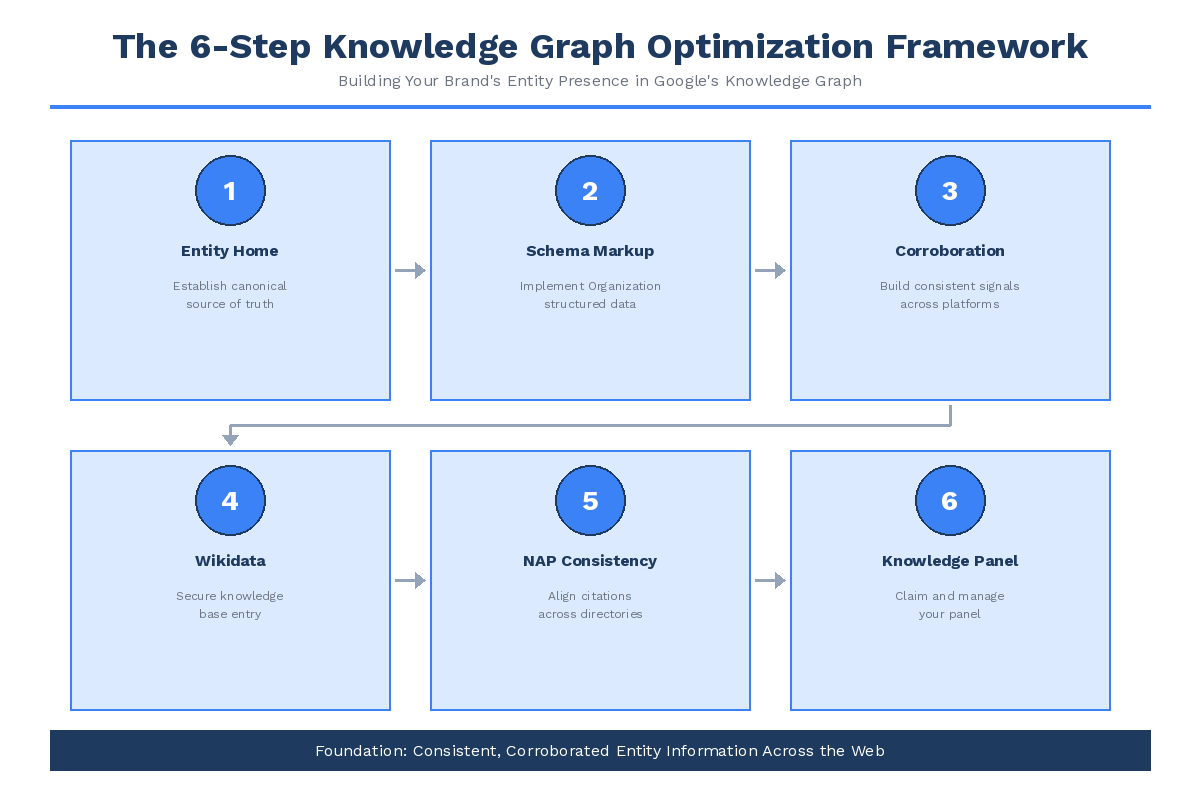
The 6-Step Framework for Knowledge Graph Optimization
Establishing your brand within Google's Knowledge Graph requires a systematic approach that addresses how search engines verify, understand, and present entity information. The following framework provides actionable tactics that build upon each other to create a comprehensive entity presence.
Step 1: Establish Your Entity Home
Your Entity Home serves as the canonical source of truth about your brand online. Typically your website's About page or a dedicated page, it clearly defines who you are, what you do, and the relationships that define your organization. Google needs a single, authoritative starting point from which it can begin understanding your entity.
The Entity Home must contain explicit statements about your organization's identity: official name, founding date, headquarters location, industry classification, key personnel, and primary offerings. Present these facts in clear, unambiguous language that search engines can easily parse and verify against other sources. All other online mentions should corroborate what appears here.
| Entity Home Element | Purpose | Implementation |
|---|---|---|
| Official Name | Establishes canonical brand identity | Use exact legal or trade name consistently |
| Founded Date | Anchors entity in time | Include year of establishment |
| Headquarters | Geographic grounding | Provide full address with city, region, country |
| Industry/Sector | Classification context | State primary business category clearly |
| Key Leadership | Human association | Name CEO, founders, or principals |
| Official Website | Digital anchor point | Confirm as authoritative domain |
Step 2: Implement Organization Schema Markup
Structured data using Schema.org vocabulary provides explicit signals to search engines about the entities on your pages. According to Google Search Central, structured data helps search engines understand the meaning of a page by providing explicit clues through standardized markup.
Organization schema should be implemented on your homepage and About page using JSON-LD format, which Google recommends for its ease of maintenance and separation from page content. The markup should include your official organization name, logo, founding date, address, contact information, and sameAs properties linking to official social profiles and authoritative knowledge base entries.
The essential properties to include are: name (your official business name), legalName (registered legal entity name if different), url (official website address), logo (path to official logo image), foundingDate (year of establishment), address (full physical address using PostalAddress schema), contactPoint (customer service or main contact details), and sameAs (array of URLs for social profiles, Wikidata, and Wikipedia).
Industry data indicates that approximately 72.6% of pages ranking on the first page of Google use schema markup. Yet only about 30% of websites overall have implemented this foundational optimization. That gap represents a significant opportunity.
Step 3: Build Entity Corroboration Across Authoritative Sources
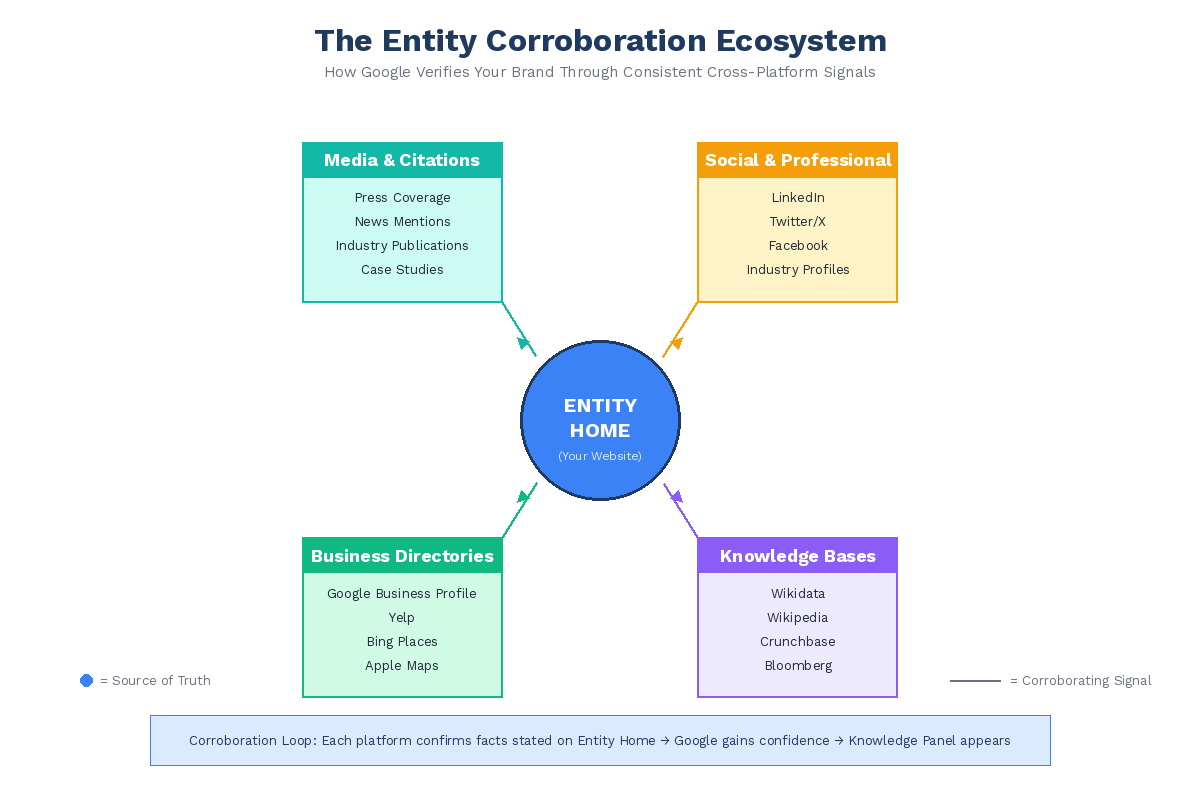
Google uses a process of corroboration to build confidence about the facts it associates with an entity. Entity corroboration occurs when search engine algorithms process information about a specific entity and verify it against multiple trusted, authoritative sources. The more consistent information Google finds across independent sources, the more confident it becomes in displaying that information.
In practice, Step 3 is where most optimization efforts stall. Teams implement schema markup and build an Entity Home, then assume Google will figure out the rest. It won't.
A strong corroboration strategy requires systematically ensuring that the facts stated on your Entity Home are accurately replicated across high-authority platforms. Business directories, industry associations, press coverage, professional profiles, and authoritative databases all play a role. Each mention should present consistent information using the same formats, spellings, and details.
Where should you focus your corroboration efforts? Start with Google Business Profile for organizations with physical locations. LinkedIn Company Page comes next, followed by Crunchbase or Bloomberg profiles for companies seeking investor visibility. Industry association memberships add credibility within your sector. Wikipedia and Wikidata entries matter if your organization meets notability thresholds. And don't overlook major press coverage, media mentions, and professional directory listings.
Some practitioners describe the ideal state as a "self-confirming loop of corroboration," where multiple independent sources all point back to and confirm the same facts about your entity. That consistency builds the algorithmic confidence necessary for Google to present your information with authority.
Step 4: Secure Your Wikidata Entry
Wikidata serves as a critical node in the semantic web, feeding information directly into Google's Knowledge Graph and other AI systems. It's also the most underutilized tool in entity SEO. Most brands skip it entirely, which is a mistake. Unlike Wikipedia, which has strict notability requirements, Wikidata allows most legitimate business entities to create entries if they can demonstrate verifiable information backed by reliable sources.
Each Wikidata entry receives a unique QID (such as Q42 for Douglas Adams) that serves as a universal identifier across multiple platforms and languages. By establishing and maintaining an accurate Wikidata entry, you provide Google with a structured, machine-readable record of your entity that can be cross-referenced and verified.
Creating a Wikidata entry involves adding structured claims about your organization: instance of (type of entity), inception date, headquarters location, official website, founder, CEO, industry, and sameAs identifiers linking to authoritative sources. Support these claims with citations from independent, verifiable sources such as press coverage, official filings, or authoritative directories.
Before creating a new entry, search thoroughly to avoid duplicates. Add reliable source citations for every claim you make. Link to your official website and social profiles. If you operate internationally, include multilingual labels. Connect to related entities like parent companies, subsidiaries, and founders. And maintain the entry over time as information changes. Wikidata entries that go stale lose their value.
Step 5: Achieve NAP Consistency Across Citations
For organizations with physical locations, Name, Address, and Phone number (NAP) consistency is fundamental to local entity recognition. According to industry research, citations consistently rank among the top five local ranking factors for both the Local Pack and organic search results. Google cross-references NAP data across directories and platforms to verify legitimacy, and inconsistencies can severely weaken entity recognition.
NAP consistency extends beyond simply listing correct information. Your business name, address format, and phone number must match exactly across all online citations. Even minor variations create problems. Yes, "Street" versus "St." actually matters. It sounds pedantic, but algorithms don't infer intent the way humans do. Including or omitting suite numbers creates fragmentation. The most common mistake we see? Organizations update their Google Business Profile after a move but forget about the 47 other directory listings created over the years.
Claim and fully optimize your Google Business Profile first, ensuring all information matches your website and other authoritative sources. Then systematically claim listings on major directories: Yelp, Bing Places, Apple Maps, and industry-specific platforms. Industry guidance suggests that 40-60 high-quality citations on relevant, authoritative platforms typically outperform hundreds of inconsistent directory listings.
Step 6: Claim and Manage Your Knowledge Panel
Once Google recognizes your brand as an entity in its Knowledge Graph, a Knowledge Panel may appear when users search for your brand name. Claiming your Knowledge Panel establishes you as the official representative of that entity. It allows you to suggest changes and ensures no one else can claim control.
To claim your Knowledge Panel, search for your brand name on Google and look for the "Claim this Knowledge Panel" link at the bottom of the panel. Google will require verification through connected accounts such as Google Search Console, YouTube, or official social media profiles. Fair warning: the verification process can be frustrating. Google's system sometimes rejects legitimate claims on the first attempt. Once verified, you gain the ability to suggest edits to information displayed and prioritize your feedback in Google's review process.
But claiming the panel is only the beginning. Ongoing management involves monitoring the information displayed, suggesting corrections when inaccuracies appear, and continuously building the corroborating signals that strengthen Google's confidence in your entity information. The Knowledge Panel serves as your brand's digital business card in search results. Customers, partners, and investors researching your organization see it first.
Common Misconceptions
Misconception 1: Schema Markup Directly Improves Rankings
Many organizations believe that implementing structured data will automatically boost their search rankings. It won't. Google's John Mueller confirmed that structured data does not directly influence rankings as a ranking factor. However, its impact on user engagement through rich results is significant, creating an indirect effect on visibility and performance.
The real value of schema markup lies elsewhere. It helps search engines understand your content accurately, enables eligibility for rich results that increase click-through rates, and provides the semantic foundation that AI systems use to process and present your information. Case studies demonstrate measurable impact: Rotten Tomatoes saw a 25% increase in click-through rates after implementing structured data, while Food Network experienced a 35% increase in site visits after updating pages with search functionality markup.
Misconception 2: Wikipedia Is Required for Knowledge Graph Inclusion
While having a Wikipedia article significantly increases the likelihood of Knowledge Panel generation, it is not a prerequisite for Knowledge Graph inclusion. Google draws from numerous authoritative sources beyond Wikipedia: Wikidata, official company websites, verified business profiles, and authoritative third-party databases.
Organizations without Wikipedia articles can still establish strong entity presence. Comprehensive structured data implementation, Wikidata entries, consistent NAP citations, authoritative press coverage, and professional directory listings all contribute. The key is providing sufficient corroborating signals from independent, trusted sources that allow Google to confidently identify and understand your entity.
Misconception 3: Knowledge Graph Optimization Is a One-Time Project
Entity optimization requires ongoing attention. It's not a single implementation effort. After auditing hundreds of brand SERPs, the pattern is clear: organizations that treat this as a one-time project inevitably watch their Knowledge Panel accuracy degrade within 12-18 months. Google's understanding of your brand evolves based on the signals it continuously collects from across the web. Outdated information, inconsistent updates, or competitor activity can erode your entity presence over time.
Effective knowledge graph optimization includes regular audits of NAP consistency, monitoring Knowledge Panel accuracy, maintaining Wikidata entries as information changes, and continuously building authoritative corroboration through ongoing public relations and content efforts. Organizations that treat this as ongoing infrastructure maintenance achieve more stable and comprehensive entity recognition than those approaching it as a one-time project.
Why Semantic Accuracy Matters More Than Keyword Volume
The evolution toward entity-based search fundamentally changes how visibility is achieved online. According to Search Engine Land, Google's Multitask Unified Model (MUM) and AI Overviews system now generate search results based increasingly on relationships and entity understanding. Keyword matching still matters. But brands must be understood as authoritative entities to appear in AI summaries and semantic search results.
The implications for content strategy are significant. Organizations must ensure that their entity is clearly defined, properly contextualized, and consistently represented across the digital ecosystem. Every piece of content either contributes to or detracts from Google's overall understanding of what your brand is, what it does, and why it should be trusted.
Research from Semrush found that visitors arriving from AI-powered results convert more than four times as often as traditional organic traffic. That conversion advantage makes entity clarity directly relevant to business outcomes. Semantic SEO connects to measurable revenue impact.
The Hidden Cost of Fragmented Entity Signals
For organizations operating across multiple markets, languages, or business units, fragmented entity signals present a particular challenge. What happens when your German, French, and English websites describe your business differently? Or when subsidiaries present inconsistent information about parent company relationships? You risk fragmenting your Knowledge Graph presence entirely.
Global marketing teams must ensure that Google can connect all regional versions to the same entity. Use hreflang tags correctly to signal language and regional versions. Translate structured data for each market. Maintain consistent brand descriptions across languages while adapting appropriately for local context.
The cost of fragmentation extends beyond search visibility. When Google cannot confidently associate related business entities, each regional presence competes independently. Consolidated authority disappears. Merger and acquisition activity presents similar challenges. Deliberate entity consolidation strategies become necessary to transfer and unify Knowledge Graph equity.
Organizations with complex corporate structures should map their entity relationships explicitly through both structured data and consistent authoritative mentions. Parent-subsidiary connections, brand portfolios, and organizational hierarchies all need clear definition. Google needs to understand how different business entities relate to one another.
Real-World Examples and Case Studies
Brightview Senior Living: Entity Linking at Scale
Brightview Senior Living, operating more than 47 communities across multiple markets, implemented a comprehensive entity linking strategy to scale SEO performance. Their approach shifted from keyword-first optimization to entity-first optimization. They focused on identifying the entities that defined each location and service offering, then linked them to authoritative definitions to eliminate ambiguity.
On each community page, Brightview explicitly defined location entities and linked them to authoritative sources using sameAs properties connecting to Wikipedia, Wikidata, and Google's Knowledge Graph. This resolved issues such as differentiating Phoenix, Maryland from Phoenix, Arizona. Search engines knew exactly which location the content referenced.
The results were clear. As AI Overviews reshaped search results and many brands saw click-through rates decline, Brightview's CTR remained strong relative to benchmarks. Clear entity definitions helped search engines and AI models surface their content accurately even as the search landscape shifted. The Brightview approach should be the default playbook for any multi-location business.
London School of Economics: Wikidata Integration
Research published about the London School of Economics demonstrated the traffic impact of Wikidata integration. Researchers integrated all theses produced at the institution into Wikidata without making corresponding Wikipedia edits. Within six months, they observed a 47% increase in downloads and a doubling of referral traffic from Wikipedia to their archives.
This case study shows how Wikidata's structured data feeds into the broader Wikipedia ecosystem and search engines, even without direct Wikipedia article creation. For academic institutions and organizations with substantial content libraries, Wikidata integration offers a scalable approach to improving discoverability across knowledge-based platforms.
Frequently Asked Questions
How long does it take to appear in Google's Knowledge Graph?
Timeline varies based on existing online presence and corroborating signal consistency. Organizations with strong press coverage may see Knowledge Panel generation within weeks of implementing comprehensive optimization. Brands building from minimal starting points typically require three to six months of consistent effort before achieving Knowledge Graph recognition.
Can small businesses benefit from knowledge graph optimization?
While Knowledge Panels most commonly appear for nationally recognized brands, foundational practices benefit businesses of all sizes. Consistent NAP citations, Google Business Profile optimization, and structured data implementation strengthen entity recognition that improves local search performance, even without triggering a formal Knowledge Panel.
What happens if my Knowledge Panel displays incorrect information?
Once you claim your panel, you can suggest edits through the "Suggest an edit" option. Google reviews changes and implements them if verifiable against authoritative sources. The most effective long-term solution involves correcting information at authoritative source sites that Google references.
How does knowledge graph optimization affect AI search visibility?
AI-powered search systems increasingly rely on structured data and knowledge graph information from a variety of sources to generate responses. Organizations with clear entity definitions and strong corroborating signals are more likely to be accurately cited in AI-generated answers. Fragmented entities signal risk misrepresentation or omission from AI-driven discovery.
Should I hire an agency for knowledge graph optimization?
Foundational elements like Google Business Profile optimization and Google My Business basic schema markup can often be managed internally. Complex implementations involving enterprise-scale structured data and Wikidata management may benefit from specialized expertise in entity optimization rather than general SEO services.


