



Table of contents
Key Takeaways
- Always obtain explicit, documented permission before using user-generated content commercially. Public posting does not grant commercial use rights, and attribution alone does not substitute for proper licensing.
- Develop comprehensive UGC policies and licensing templates that address usage scope, duration, territorial limitations, exclusivity, and compensation to protect your organization and establish clear expectations with content creators.
- Maintain meticulous records of all permissions obtained, including screenshots, correspondence, and formal agreements, to demonstrate compliance in the event of disputes.
- Stay current with evolving regulatory requirements, particularly FTC endorsement guidelines and international privacy regulations like GDPR, which impose specific disclosure and consent obligations on UGC use.
- Consider implementing dedicated UGC rights management platforms to streamline permission workflows, track license terms, and ensure systematic compliance across large-scale content programs. The investment typically pays dividends through reduced legal risk and operational efficiency.
What Are UGC Usage Rights?
User-generated content usage rights encompass the legal permissions and licenses required for brands to repurpose content created by individuals who are not directly employed by the company. This content includes social media posts, product reviews, photos, videos, testimonials, and other creative work consumers produce about a brand or its products.
The fundamental principle governing UGC is straightforward: if you did not create the content, you do not automatically own the ads usage rights to use it commercially. Full stop.
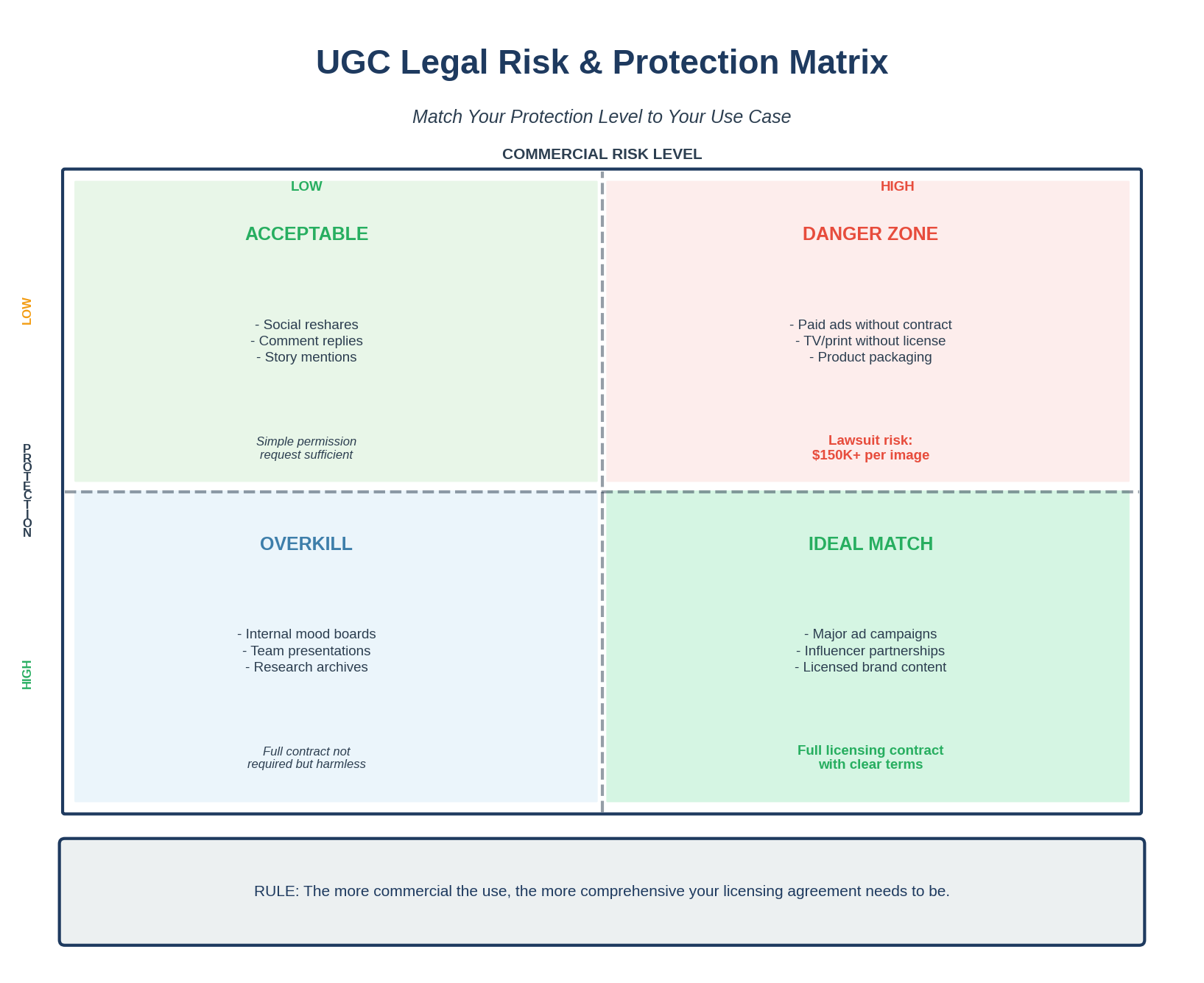
According to the U.S. Copyright Office, copyright protection automatically attaches to original works of authorship the moment they are fixed in a tangible medium of expression. What does this mean in practice? When a customer posts a photo featuring your product on Instagram, they immediately and automatically own the copyright to that image. It doesn't matter if your brand or product appears prominently. The rights belong to them. Using that content without permission constitutes copyright infringement, potentially exposing your organization to statutory damages of up to $150,000 per work for willful infringement under U.S. law.
That's not a typo. $150,000 per image.
For mid-market and enterprise businesses, understanding UGC usage rights represents a critical operational and legal imperative. The global UGC platform market, valued at approximately $9.85 billion in 2025, is projected to reach $35.44 billion by 2030, reflecting a compound annual growth rate of 29.2% according to Mordor Intelligence. This explosive growth underscores how central user-generated content has become to modern marketing strategies. And consequently, how essential proper rights management has become to sustainable business operations.
The Legal Framework Governing UGC Rights
Understanding the legal landscape surrounding user-generated content requires familiarity with several intersecting regulatory frameworks. These regulations collectively establish the boundaries within which brands must operate when leveraging consumer-created content.
Copyright Law and Intellectual Property Fundamentals
Copyright law forms the bedrock of UGC rights management. In the United States, the Copyright Act of 1976 grants creators exclusive rights to reproduce, distribute, display, and create derivative works from their original content. These rights exist automatically. No registration is required for protection, though registration does provide additional legal benefits including the ability to seek statutory damages and attorney's fees in infringement actions, which helps to maintain a positive reputation for the creators.
The Digital Millennium Copyright Act (DMCA), enacted in 1998, provides important safe harbor provisions for platforms hosting user-generated content. Under Section 512(c), platforms that respond expeditiously to takedown notices for allegedly infringing content can avoid direct liability for infringement committed by their users. But here's the catch: these protections apply primarily to hosting platforms, not to brands that actively appropriate and repurpose UGC for marketing purposes. Platforms get protection. Brands using the content often don't, highlighting the need for effective rights management features to safeguard their use of UGC.
FTC Endorsement Guidelines and Disclosure Requirements
The Federal Trade Commission's Endorsement Guides, substantially revised in June 2023, establish critical requirements for transparency when brands use UGC in marketing to build brand trust. Any material connection between a brand and an endorser (including payment, free products, discounts, or other valuable consideration) must be disclosed clearly and conspicuously.
The FTC defines "clear and conspicuous" disclosures as those that are "difficult to miss and easily understandable by ordinary consumers." In August 2024, the FTC finalized additional rules banning the creation or sale of fake reviews, including those generated by AI. Violations can result in fines up to $51,744 per incident related to organic usage rights.
| Requirement | Description | Consequence of Non-Compliance |
|---|---|---|
| Disclosure of Material Connections | Any payment, free product, or other benefit must be disclosed. Legal issues often arise from failure to disclose. | Civil penalties up to $51,744 per violation |
| Clear and Conspicuous Placement | Disclosures must be difficult to miss and easily understood | FTC enforcement action, injunctions |
| Honest Representations | Endorsers cannot make claims they haven't personally verified | Liability for both brand and endorser |
| Platform-Specific Compliance | Built-in disclosure tools alone may not suffice | Required supplemental disclosures |
International Considerations: GDPR and Global Privacy Laws
For organizations operating internationally, the European Union's General Data Protection Regulation (GDPR) adds another layer of complexity to UGC content rights management. Under GDPR, user-generated content that contains personal data (including identifiable images of individuals) triggers specific consent requirements.
According to GDPR.eu, consent must be "freely given, specific, informed and unambiguous" and demonstrated through a "clear affirmative action." Silence doesn't count. Pre-ticked boxes don't count. Organizations collecting UGC from EU residents must implement consent mechanisms with clear terms that comply with these stringent requirements, maintain records of consent obtained, and provide mechanisms for individuals to withdraw consent easily.
Types of UGC Licensing Agreements
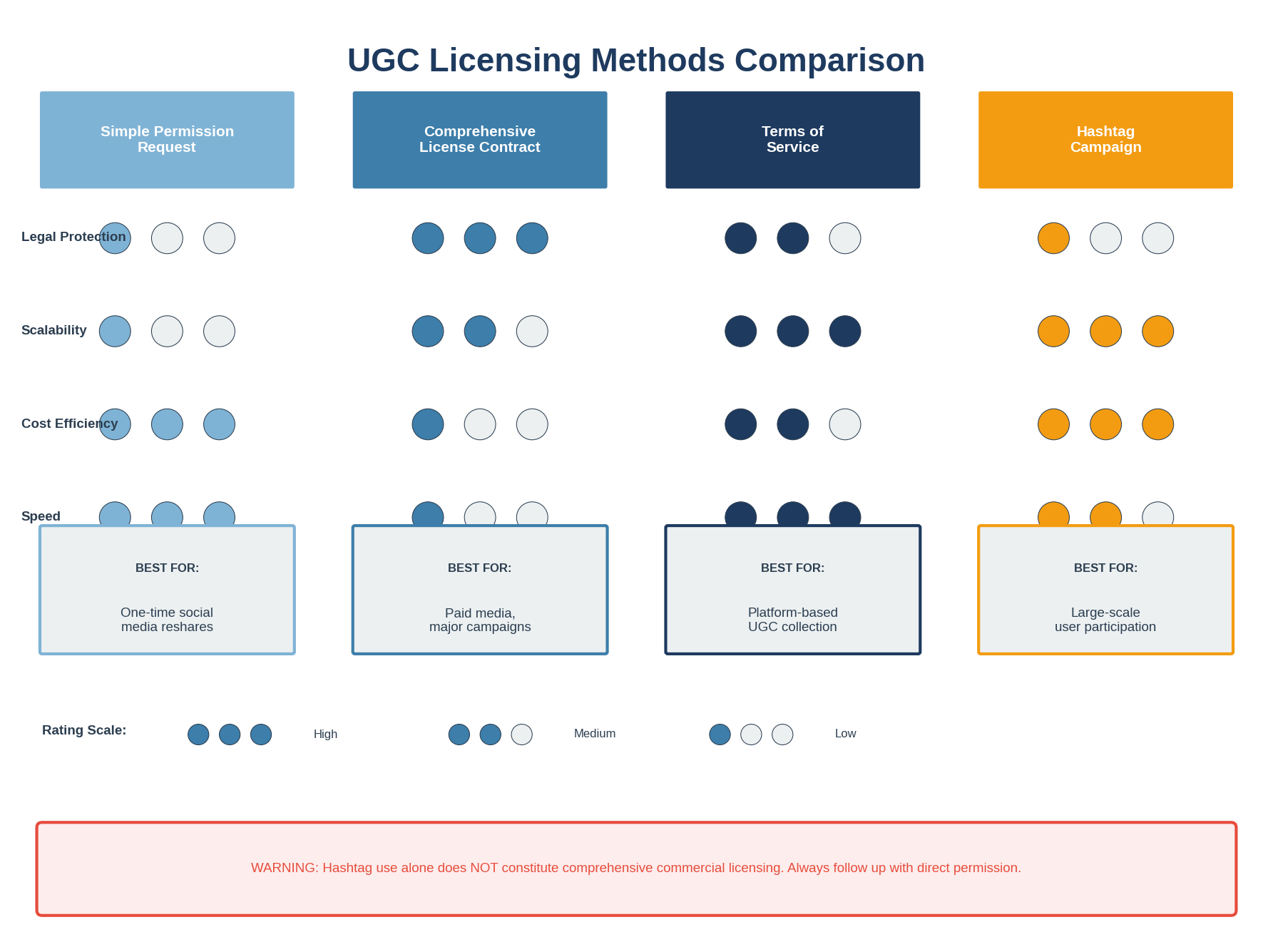
Securing proper usage rights for user-generated content involves selecting the appropriate licensing mechanism for proper UGC rights management for your specific use case. The right approach depends on several factors: the content's intended use, duration of use, geographic scope, and the relationship between your brand and the content creator.
Simple Permission Requests
For one-time or limited uses of organic UGC, a simple permission request for a piece of content may suffice. This approach involves reaching out directly to the content creator, explaining how you intend to use their content, and obtaining written confirmation of their consent. Many brands accomplish this through social media direct messages or comments requesting permission.
Simple permission requests work well when you need low cost and minimal administrative burden for single uses, when you want to preserve authentic relationships with content creators who feel valued, and when your use case is limited to social media resharing or modest promotional purposes. However, this approach has limitations. It may not provide sufficient legal protection for extensive commercial use, it lacks specificity regarding duration, exclusivity, and permitted modifications. For large-volume UGC campaigns, utilizing a tool like a chrome extension could enhance the management process and improve scalability.
Comprehensive Licensing Contracts
For substantial marketing campaigns, paid media placements, or ongoing content relationships, comprehensive written licensing agreements provide superior legal protection. These contracts explicitly define the scope of rights granted, permitted uses, duration, geographic territories, compensation terms, exclusivity provisions, and the type of consent required.
A robust UGC licensing agreement should include several essential elements: identification of the specific content being licensed, a clear grant of rights specifying exactly how the content may be used, the duration of the license, any territorial restrictions, whether the license is exclusive or non-exclusive, compensation terms if applicable, warranties from the licensor confirming they own the content and have authority to grant the license, and indemnification provisions protecting the brand against third-party claims, especially considering the regulations surrounding intellectual property rights.
Terms of Service Provisions
Many brands incorporate UGC licensing provisions directly into their terms of service or terms and conditions. When users create accounts, participate in hashtag campaigns, or submit content through official brand channels, they agree to terms that may include a license grant allowing the brand to use submitted content for marketing purposes, which can significantly impact brand reputation.
This approach offers efficiency at scale but requires careful drafting to ensure enforceability in email campaigns. Courts have occasionally found terms of service provisions unenforceable. When? When they are not sufficiently prominent, when users are not required to affirmatively accept them, or when the terms are deemed unconscionable.
Hashtag Campaign Licensing
Hashtag campaigns represent a hybrid approach where brands encourage content creation using a branded hashtag, with terms indicating that use of the hashtag constitutes consent to potential brand use of the content across social channels. This mechanism has become increasingly common but carries legal nuances.
Best practices for hashtag campaign licensing include creating clear, publicly accessible terms explaining how content may be used, following up with individual permission requests before featuring specific content prominently, and adhering to legal requirements by avoiding assumptions that hashtag use alone constitutes comprehensive commercial licensing. A hashtag is not a contract.
Step-by-Step Process for Acquiring UGC Usage Rights
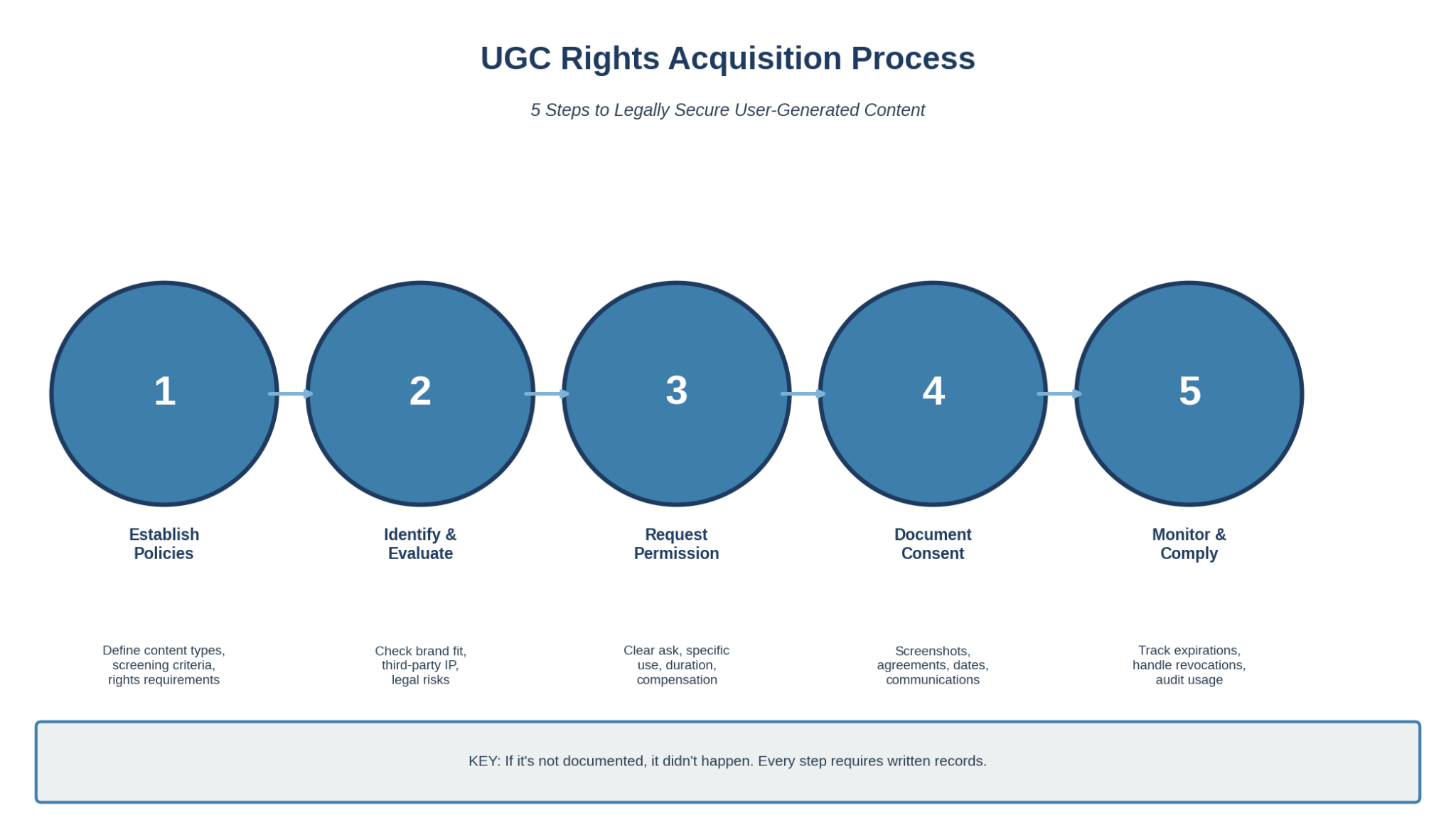
Implementing a systematic approach to UGC rights acquisition protects your organization while enabling effective leverage of authentic consumer content.
Step 1: Establish Clear Policies and Terms
Before soliciting or collecting UGC, develop comprehensive policies governing how user content will be collected, evaluated, and used. Your policies should address what types of content you will accept, how content will be screened for appropriateness and legal compliance, what rights you require from content creators, how you will obtain and document consent, and how long you will retain content after the initial period and associated permissions.
Step 2: Identify and Evaluate Content
When organic UGC appears or campaign content is submitted, evaluate it for potential use. Consider brand alignment and content quality, presence of third-party intellectual property (visible logos, copyrighted music, or trademarked elements), the creator's profile and audience, potential legal or reputational risks, and whether any individuals other than the creator appear in the content. That last point matters more than many brands realize.
Step 3: Request Permission Transparently
Contact content creators with clear, professional permission requests. Effective requests explain who you are and your role, specifically how you intend to use the content, the duration and geographic scope of intended use, any compensation being offered, and how the creator will be credited. Be direct. Be specific. Don't bury the ask.
Step 4: Document Consent Systematically
Maintain meticulous records of all permissions obtained. Documentation should include screenshots of the original content, copies of permission requests sent, creator responses granting permission, any formal agreements executed, and dates and communication channels for all interactions. If it's not documented, it didn't happen.
Step 5: Implement Ongoing Compliance Monitoring
UGC rights management requires ongoing attention, especially concerning organic use rights. Establish processes to track license expirations, respond promptly if creators request content removal, ensure disclosures remain compliant with evolving regulations, and audit content usage against granted permissions. This isn't a one-and-done task.
Common Misconceptions About UGC Legal Rights
Several persistent myths about user-generated content rights create legal exposure for organizations that act on these misunderstandings.
Misconception 1: Tagging or Mentioning Your Brand Grants Permission
Wrong. When consumers tag your brand or mention your products in social media posts, they are not granting you permission to use their content commercially. The tag or mention simply identifies your brand in their content. The copyright and associated rights remain entirely with the creator. This misunderstanding has led to numerous legal disputes, including cases where brands faced significant liability for reposting tagged content without explicit permission.
Misconception 2: Public Posts Are Fair Game
Public doesn't mean free. The fact that content is publicly visible on social media platforms does not place it in the public domain or grant permission for commercial use. Public accessibility relates to who can view the content, not who owns rights to it. Platform terms of service may grant the platform itself certain license rights, but these licenses typically do not extend to third parties who wish to use the content for their own commercial purposes.
Misconception 3: Attribution Eliminates the Need for Permission
Crediting the original creator is courteous and often appropriate, but it does not substitute for obtaining proper permission. Attribution addresses the creator's moral rights (their right to be recognized as the author) but does not address their economic rights to control commercial exploitation of their work. Here's the irony: providing credit while using content without permission may actually strengthen a creator's infringement claim by demonstrating your awareness of the content's source.
Real-World Examples and Case Studies
GoPro: Building a Brand on Licensed UGC
GoPro has built its marketing strategy around user-generated content, featuring customer-created action footage prominently across its channels. The company's approach combines clear submission guidelines with comprehensive licensing terms. When users submit content through GoPro's official channels or participate in GoPro Awards program, they agree to detailed terms granting GoPro extensive rights to use the content while retaining their own ownership.
GoPro's success demonstrates that effective UGC programs require upfront investment in legal infrastructure but pay dividends through authentic content that resonates with audiences while minimizing legal risk. They did the work early. It's paying off now.
The Daniel Morel Case: A Cautionary Tale
The legal dispute between photographer Daniel Morel and Agence France-Presse (AFP) and Getty Images illustrates the serious consequences of improper UGC use. Morel posted photographs from the 2010 Haiti earthquake on Twitter. News organizations obtained and distributed these images without his permission, assuming that posting them publicly made them available for commercial use.
They were wrong. Morel sued and won. The jury awarded him $1.2 million in statutory damages. AFP and Getty had to write substantial checks for what started as a retweet. The court rejected arguments that Twitter's terms of service granted third parties rights to the images, establishing important precedent that social media posting does not constitute a waiver of copyright protection.
Frequently Asked Questions
How much do UGC usage rights typically cost?
Costs for UGC licensing vary significantly based on the creator's following, content quality, intended use scope, and exclusivity requirements. Micro-influencers and everyday consumers often grant permission for free or in exchange for brand exposure. Established content creators may charge anywhere from $100 to several thousand dollars depending on the project scope. Enterprise brands typically budget between $50 and $500 per piece of licensed UGC for standard marketing use, with rates increasing substantially for paid media placement or exclusive rights.
Can I use customer reviews without permission?
Customer reviews occupy a nuanced legal position. Reviews submitted directly to your website or through official channels are typically governed by your terms of service, which should include a license grant for the review content. But reviews posted on third-party platforms like Google, Yelp, or Amazon belong to the reviewers, and using them in your marketing requires appropriate permission. Screenshots of reviews must not misrepresent the content or context, and you should verify you have rights to any reviewer profile images or names you display.
What happens if someone revokes permission after I've used their content?
The implications of permission revocation depend on the terms under which permission was originally granted. If you obtained a time-limited license that has not yet expired, you may generally continue using the content through the license term. But if permission was granted informally without a defined term, or if your agreement includes provisions for early termination, you should remove the content promptly upon revocation request. Maintaining goodwill with content creators and avoiding potential disputes generally makes prompt compliance advisable even when not strictly legally required.
Do I need separate permission for different marketing channels?
Yes. Permissions should specify the channels and contexts where content may be used. Permission to share content on Instagram does not automatically extend to using that same content in television advertisements, email marketing, or product packaging. Comprehensive licensing agreements should enumerate all intended use channels, and you should return to creators for additional permission when expanding use beyond originally contemplated channels.
How do AI-generated content and synthetic media affect UGC rights?
The intersection of AI and UGC presents emerging legal questions. If AI tools are used to modify or enhance user-generated content, questions arise regarding whether the resulting work constitutes a derivative work requiring additional permissions. The FTC's 2024 rules explicitly prohibit AI-generated fake reviews, and brands must ensure any AI involvement in UGC creation or modification is disclosed appropriately. As AI capabilities expand, organizations should anticipate evolving regulations and establish clear policies addressing AI use in their UGC programs.
Web Tonic works across SEO and paid search, and you can book a consultation to talk through your own plan.


