



Table of contents
Key Takeaways
- Budget $150-$300 per video for quality UGC from mid-level creators, adding 30-100% for comprehensive usage rights and any add-on services your campaigns require
- Test across creator tiers rather than defaulting to cheapest or most expensive options. Optimal price-to-performance ratios vary by campaign objective and product category
- Negotiate bundles of 3+ videos for 10-25% savings while generating more creative variations for performance testing
- Secure proper usage rights upfront to avoid costly renegotiations when content performs well and you want to extend deployment timelines or platforms
- Consider building long-term creator relationships that reduce per-project costs while improving content consistency and brand understanding. Starting with platform-mediated projects provides protection while evaluating creator fit
What Are UGC Rates?
User-generated content (UGC content) rates refer to the fees brands pay creators to produce authentic-looking content for use in marketing campaigns, advertisements, and social media. Unlike traditional influencer marketing, where you're paying for access to an audience, UGC pricing centers on deliverables: the actual videos, photos, and creative assets brands receive.
This difference changes how you budget. With influencers, follower count drives the price. With UGC? Follower count barely matters.
Research from Collabstr's 2025 Influencer Marketing Report shows brands spent around $202 per influencer collaboration in 2025. But UGC operates on different principles. When content never gets posted to a creator's channels, their audience size becomes irrelevant. What matters is production complexity, usage rights, and deliverable specifications.
The Grand View Research Creator Economy Market Report valued the global creator economy at $205.25 billion in 2024, projecting it to reach $1.34 trillion by 2033 at a compound annual growth rate of 23.3%. This growth has professionalized UGC pricing considerably. Where creators once accepted free products in exchange for content, the market now operates with established rate cards, standardized add-ons, and negotiated usage terms.
For mid-market and enterprise brands, understanding UGC rates helps you build sustainable content production systems that scale. One well-performing UGC video can generate millions in attributed revenue. Overpaying for content that flops? That's budget you could have spent testing additional creative angles.
2026 UGC Pricing Benchmarks by Creator Experience Level
The UGC creator market has stratified into clear tiers based on experience, portfolio quality, and production capabilities. Understanding these tiers helps brands match their content needs with appropriate creator partnerships.
Base Rate Benchmarks by Experience Level
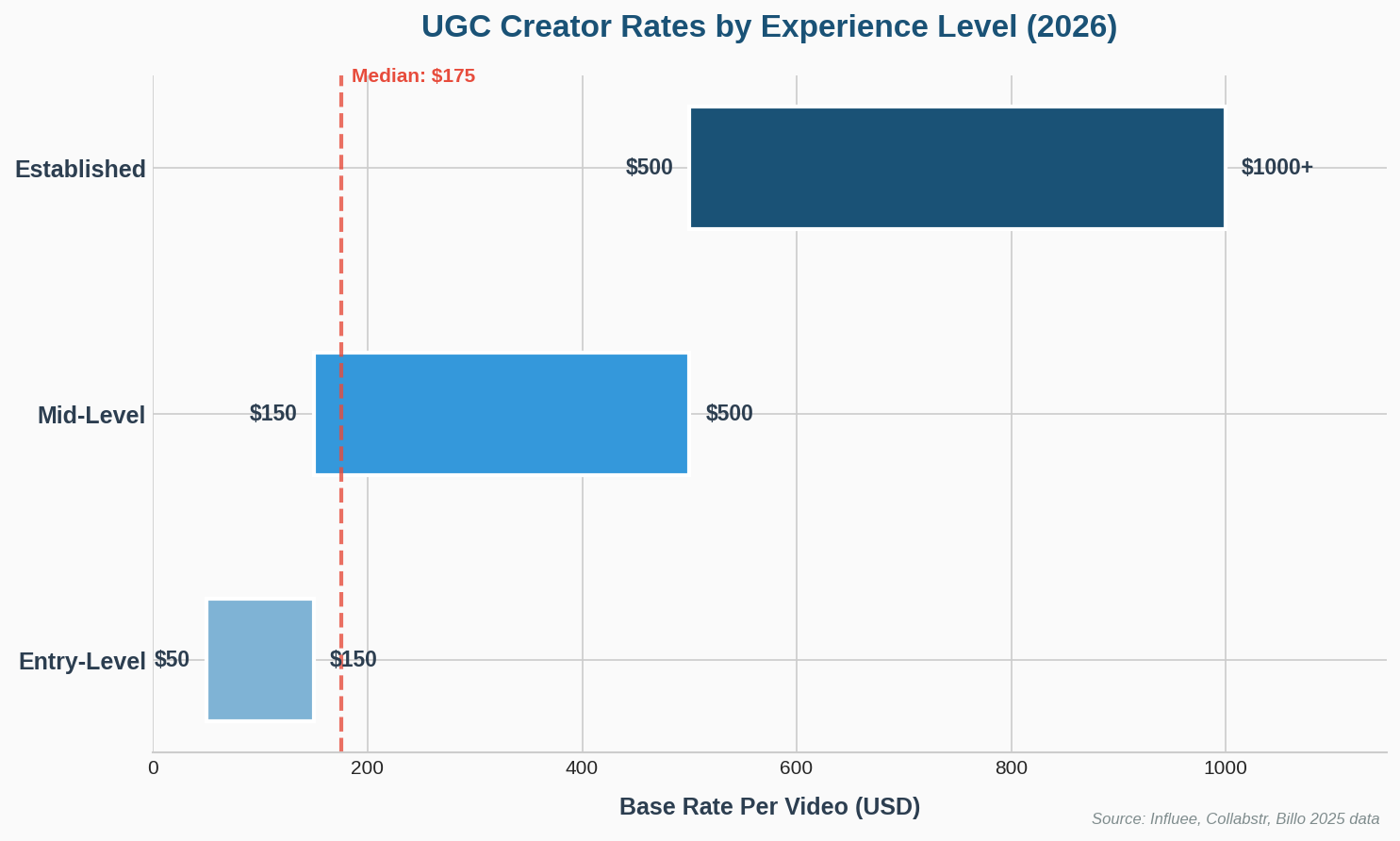
| Creator Tier | Base Rate Per Video | Typical Deliverables | Best For |
|---|---|---|---|
| Entry-Level | $50-$150 | Simple talking-head videos, basic product showcases | Volume testing, initial creative concepts |
| Mid-Level | $150-$500 | Polished edits, scripted content, multiple angles | Primary ad creative, campaign hero content |
| Established | $500-$1,000+ | Complex productions, advanced storytelling, proven performance track records | Influee's 2025 UGC pricing analysis found the average UGC rate for a single UGC video falls between $150 and $212, with a median rate around $175. That median figure gives you a more reliable benchmark than averages, which get skewed by high-end creators commanding premium rates. Additionally, it's important to note that average UGC rates can vary depending on the platform and type of content. |
Influee's 2025 UGC pricing analysis found the average price for a single UGC video falls between $150 and $212, with a median rate around $175. That median figure gives you a more reliable benchmark than averages, which get skewed by high-end creators commanding premium rates.
Entry-level creators typically produce content with minimal editing requirements. Think direct-to-camera testimonials, simple unboxing videos, straightforward product demonstrations. These creators often accept lower rates while building their portfolios, which makes them useful for brands running high-volume creative tests where quantity of variations matters more than production polish.
Mid-level creators bring stronger production value: thoughtful scripting, b-roll footage, professional lighting, editing capabilities that make content feel native to platform feeds. For most brand campaigns, this tier hits the sweet spot. You get cost efficiency paired with content quality that actually performs in paid media environments.
Established creators command premium rates because they've developed systematic approaches to content creation. They understand what performs across different platforms and industries. And they often deliver first-draft content that requires minimal revisions. For brands where creative quality directly impacts conversion rates, these higher upfront costs frequently pay dividends through improved ad performance.
Platform-Specific Rate Variations
Content format and platform requirements significantly impact pricing. A 15-second TikTok video requires different production time than a 60-second YouTube testimonial, and rates reflect these differences.
| Platform | Typical Rate Range | Notes |
|---|---|---|
| TikTok | $25-$350 | Shorter formats, overall rate trending audio integration, platform-native editing |
| Instagram Reels | $30-$400 | Slightly higher polish expectations, feed and story considerations |
| Instagram Stories | $25-$150 | 24-hour lifespan often means lower rates for similar production effort |
| YouTube (Long-form) | $200-$1,000+ | Extended runtime, higher editing requirements, different audience expectations |
| YouTube Shorts | $30-$200 | Similar to TikTok pricing, vertical format |
| Lower production time, but quality photography skills are still required. Twitter pricing tends to be lower due to the fast nature of tweets. | $25-$200 | Lower production time, but quality photography skills still required |
Billo's 2025 rate analysis notes that Collabstr's marketplace data shows creator-posted collaborations (where creators publish to their own channels) average significantly higher: approximately $364 for Instagram, $350 for TikTok, and $675 for YouTube. When purchasing deliverables-only UGC without posting requirements, rates drop substantially because brands aren't paying for audience access.
The Hidden Costs: Usage Rights, Add-Ons, and Fees
Base rates tell only part of the UGC pricing story. The true cost of a UGC project often increases 30-100% once usage rights and additional services are factored in.

Usage Rights Structure
Usage rights determine where, how long, and in what context brands can deploy UGC to enhance brand awareness. Standard organic use for 6-12 months is often included in base rates, but paid media usage, extended timelines, and cross-platform distribution typically require additional fees.
Standard Usage (Often Included):
- Organic posting on brand social channels
- Website display
- Email marketing
- 6-12 month standard license
Extended Usage Add-Ons:
- Paid media usage: +30-50% of base rate
- Extended timeline (12+ months): +30-50% of base rate
- Perpetual/in-perpetuity rights: +100-150% of base rate
The math adds up quickly. A $200 base-rate video with 12-month paid media usage rights and perpetual organic rights could cost $360-$500 total. Nearly double the initial quote.
Whitelisting and Spark Ads
Running paid advertisements through a creator's social media account (known as whitelisting or Spark Ads on TikTok) carries ongoing monthly fees separate from content production. PPC.io's 2026 UGC pricing research shows whitelisting typically costs 30-100% of the base content rate per month of access.
This capability lets brands leverage the creator's handle and audience trust signals within advertisements, often improving performance metrics compared to ads run from brand accounts. But the recurring cost structure means long-term whitelisting campaigns require ongoing budget allocation beyond initial content production.
Common Add-Ons in Practice
Hook and CTA variations typically run $50+ per variation, letting you A/B test different opening hooks or closing calls-to-action. Raw footage access (unedited clips for internal editing) usually adds 30-50% of the base rate. Rush delivery under 48-72 hours? Expect a 25-50% premium.
One DTC skincare brand we've seen ran into this exact scenario: they budgeted $3,000 for 15 UGC videos at $200 each. By the time they added paid media usage rights, three hook variations per video, and raw footage access, their actual spend hit $5,400. The content performed well enough to justify it, but the budget surprise created internal friction that better planning would have avoided.
Most creators include 1-2 revision rounds in their base rate. Additional revisions typically cost $25-$75 per round.
Bundle Economics
Purchasing multiple videos in a single project typically reduces per-video costs by 10-25%. Industry data from Influee suggests that five-video bundles commonly offer around 19% savings compared to purchasing videos individually.
For brands running performance marketing campaigns, bundles make strategic sense beyond cost savings. Testing multiple creative angles, hooks, and formats simultaneously provides faster learning about what resonates with target audiences. A five-video bundle at $850 ($170 per video) delivers more actionable data than a single $200 video, even though total spend is higher.
Common Misconceptions About UGC Pricing
Misconception 1: Follower Count Determines UGC Rates
When purchasing deliverables-only UGC (content not posted to the creator's channels), follower count becomes largely irrelevant to fair pricing. A creator with 500 followers who produces exceptional content deserves similar compensation to a creator with 50,000 followers producing the same quality and format.
The confusion stems from conflating UGC with traditional influencer marketing, where audience size directly impacts value. UGC pricing should reflect production complexity, creator expertise, and usage rights. Not vanity metrics. Brands overpaying for high-follower creators on deliverables-only projects waste budget that could fund additional creative testing.
The exception: when creators post content to their own channels as part of the partnership, follower count legitimately factors into pricing because brands receive both content deliverables and audience exposure.
Misconception 2: Cheaper Creators Always Deliver Better ROI
The lowest-cost option rarely produces the best return on investment. Entry-level creators charging $50-$100 per video may lack the scripting ability, editing skills, or platform intuition that mid-level creators bring to projects.
A $150 video that performs poorly in paid media costs far more than a $300 video that generates positive ROAS. Content quality directly impacts click-through rates, watch time, and conversion metrics. Those are the factors that determine actual campaign economics.
Smart brands test across price tiers rather than defaulting to the cheapest available option. Some campaigns perform best with raw, low-production content. Others require polished storytelling. Only testing reveals which approach works for specific products and audiences.
Misconception 3: UGC Replaces Professional Production
UGC complements professional content. It doesn't eliminate the need for it. Bazaarvoice research shows 93% of marketers report that UGC outperforms traditional branded content, but this statistic reflects performance in specific contexts as one of the key factors (typically direct-response advertising on social platforms).
Brand films, high-production commercials, and polished brand imagery still serve essential purposes in building brand equity and supporting full-funnel marketing strategies. UGC excels at direct response and authenticity-driven messaging. It's less suited for prestige positioning or complex narrative storytelling.
The most effective content strategies layer multiple content types, deploying UGC for performance marketing while maintaining professional production for brand-building initiatives.
Real-World Examples and Case Studies
GoPro: Building a UGC Empire
GoPro has transformed customer-created content into a core pillar of its marketing strategy. The #GoPro hashtag has accumulated over 50 million posts, with users sharing adventure footage captured on GoPro cameras across extreme sports, travel, wildlife encounters, and everyday moments.
Rather than paying for this content upfront, GoPro runs ongoing programs like "Photo of the Day" that feature exceptional user submissions on official channels and marketing materials. Continuous content flow at minimal marginal cost. Plus passionate community engagement.
The strategy works because GoPro's products naturally inspire creation. Customers purchase cameras specifically to capture and share experiences. For brands in similar categories (experiential products, lifestyle goods, travel), organic UGC solicitation can dramatically reduce content production costs while improving authenticity.
Glossier: Community-Driven Growth
Beauty brand Glossier built substantial early growth almost entirely on user-generated content, prioritizing customer reviews and social media posts over expensive advertising campaigns. The company encourages customers to share makeup looks and skincare routines using branded hashtags like #GlossierIRL, then reposts this content to official channels.
Industry case studies show Glossier attributes approximately 70% of their sales to word-of-mouth marketing, with UGC serving as a primary driver of that organic reach. Customers became brand advocates. Customer acquisition costs stayed manageable during critical growth phases.
This model proves especially effective for direct-to-consumer brands where product experience is highly visual and personal. Skincare routines, makeup application, beauty transformations, and UGC services provide natural UGC opportunities that feel authentic to audiences evaluating purchases.
Airbnb: Trust Through Traveller Stories
Airbnb's marketing relies heavily on user-generated photos and stories from actual travellers, showcasing the unique experiences available through their platform rather than generic property listings. Their Instagram feed features real guest content, creating social proof that influences potential bookers.
The platform has built programs encouraging travellers to share experiences, including campaigns around travelling with pets and discovering local neighbourhoods. This UGC-centric approach has contributed to Airbnb growing to over 5 million Instagram followers in recent years while maintaining authenticity that distinguishes them from traditional hotel marketing.
Frequently Asked Questions
How much should I budget for a UGC campaign in 2026?
Starting budgets of $2,000-$5,000 let new-to-UGC brands test 10-20 content pieces from 3-5 different creators, emphasizing the importance of budgeting. Enough variation to identify winning approaches while limiting financial exposure. Mature UGC programs at mid-market companies typically allocate $10,000-$50,000+ monthly for budgeting, though this varies significantly by industry and marketing strategy.
Should I work directly with creators or use a UGC platform?
Both approaches have merit. Platforms like Collabstr and Billo provide creator discovery, escrow payment protection, and project management features that reduce operational overhead. But they add commission fees based on the type of content. Direct relationships with proven creators often produce better rates and more collaborative partnerships for brands running consistent programs, though they require more internal management capacity.
How do I know if I'm being overcharged?
Compare quotes against the benchmark ranges in this guide, factoring in all included elements: base content production, revision rounds, usage rights, and add-on services. Rates significantly above market ranges may be justified by exceptional portfolios or specialized expertise that can command higher rates. Ask for specific explanations. Rates well below market norms may signal inexperience or quality concerns worth investigating.
Do I need contracts for UGC creator partnerships?
Always. Written agreements should specify deliverables, timelines, revision policies, usage rights, payment terms, and intellectual property ownership. The FTC's revised Endorsement Guides from 2023 also require clear transparency and disclosure when content involves material connections between brands and creators. Contracts should address disclosure requirements explicitly, including how disclosures must appear in video content rather than just caption text.
What's the difference between UGC creators and influencers?
UGC creators produce content for brands to use on brand-owned channels without necessarily posting to their own audiences. Influencers create and distribute content to their followers, with brands paying for both content and audience access. The pricing models differ: UGC rates focus on deliverables and production value, while influencer pricing rates incorporate audience size and engagement metrics.


