



Table of contents
How we vet every listicle
Every agency featured on Web Tonic passes our 84-point editorial review before a single listicle goes live. This is how we vet each pick:
Verified client outcomes: We require real case studies with measurable KPIs — revenue, ROAS, CPA, retention — tied to the exact category being ranked. No cherry-picked wins, no unverifiable numbers.
Independent reputation: We cross-check Clutch, Google, G2, and Trustpilot ratings, and screen for review-bombing or suspicious patterns. Only operators with a consistent, verifiable track record make the cut.
Beyond that, every listing goes through a quarterly re-audit. We check 84 criteria across 6 pillars to make sure it still holds up — here are some of the checks we run:
Key Takeaways
- The median landing page conversion rate across industries sits at 6.6%, but top performers consistently achieve 10% or higher through systematic optimization. Specialized agencies help close that gap.
- Mobile traffic dominates landing page visits (82%+), yet mobile conversion rates trail desktop by 8% or more. This presents a massive optimization opportunity for businesses that invest in mobile-first design.
- Companies with 40+ landing pages generate 12 times more leads than those with five or fewer. Scalable landing page production is a competitive advantage that agencies enable.
- Every dollar invested in user experience design returns an average of $100. Landing page optimization ranks among the highest-ROI marketing investments available.
- Mid-market and enterprise organizations lacking internal conversion optimization expertise typically see faster results and better returns from specialized landing page agencies than from building capabilities in-house.
What Are Landing Page Design Agencies?
Landing page design agencies build web pages that turn website visitors into leads and customers. That's their entire focus. Unlike general web design companies, these conversion optimization agencies work exclusively on single-purpose pages designed to drive one specific action, whether that's capturing email addresses, generating demo requests, or completing purchases.

According to research from Forrester, every dollar invested in user experience design yields an average return of $100, representing a 9,900% ROI. That number alone explains why mid-market and enterprise businesses increasingly turn to specialized lead page designers rather than attempting to build conversion-focused pages in-house.
The science of landing page optimization combines behavioural psychology, data analysis, A/B testing methodology, and conversion rate optimization (CRO) principles that most marketing teams lack the bandwidth to master. And for mid-market and enterprise organizations, partnering with a professional conversion rate optimization agency means gaining access to specialists who've optimized thousands of pages across industries. It also means tapping into proprietary testing frameworks refined through hundreds of campaigns, plus the ability to scale landing page production rapidly without straining internal resources. As McKinsey & Company notes, companies prioritizing UX design experience 32% higher revenue growth and 56% higher total returns to shareholders compared to competitors who underinvest in these capabilities.
How to Evaluate Landing Page Design Agencies
Selecting the right CRO agency requires examining several critical factors. Not all landing page companies deliver equal results. The difference between a mediocre agency and one with a proven track record can translate to hundreds of thousands of dollars in lost or gained revenue.
Key Evaluation Criteria
| Factor | What to Look For | Red Flags |
|---|---|---|
| Conversion Focus | Documented lift percentages, A/B testing methodology, data-driven approach | Emphasis on aesthetics over performance metrics |
| Industry Experience | Case studies in your vertical, understanding of your user journey | Generic portfolio with no relevant examples |
| Testing Infrastructure | Established analytics tools, multivariate testing, statistical significance standards | No mention of testing or "we design it right the first time" claims |
| Pricing Transparency | Clear deliverables, scope definitions, measurable results | Vague quotes, hidden fees, unclear revision policies |
| Strategic Capability | UX research, conversion research, customer behaviour analysis | Jump straight to design without strategy phase |
According to McKinsey's client research, targeted digital marketing programs that include optimized landing pages can boost email marketing conversions by 25% and on-site conversions by 60%, with overall marketing ROI rising nearly 30%. These benchmarks provide useful reference points when evaluating agency capabilities and setting performance expectations.
Pricing Tiers and What They Include
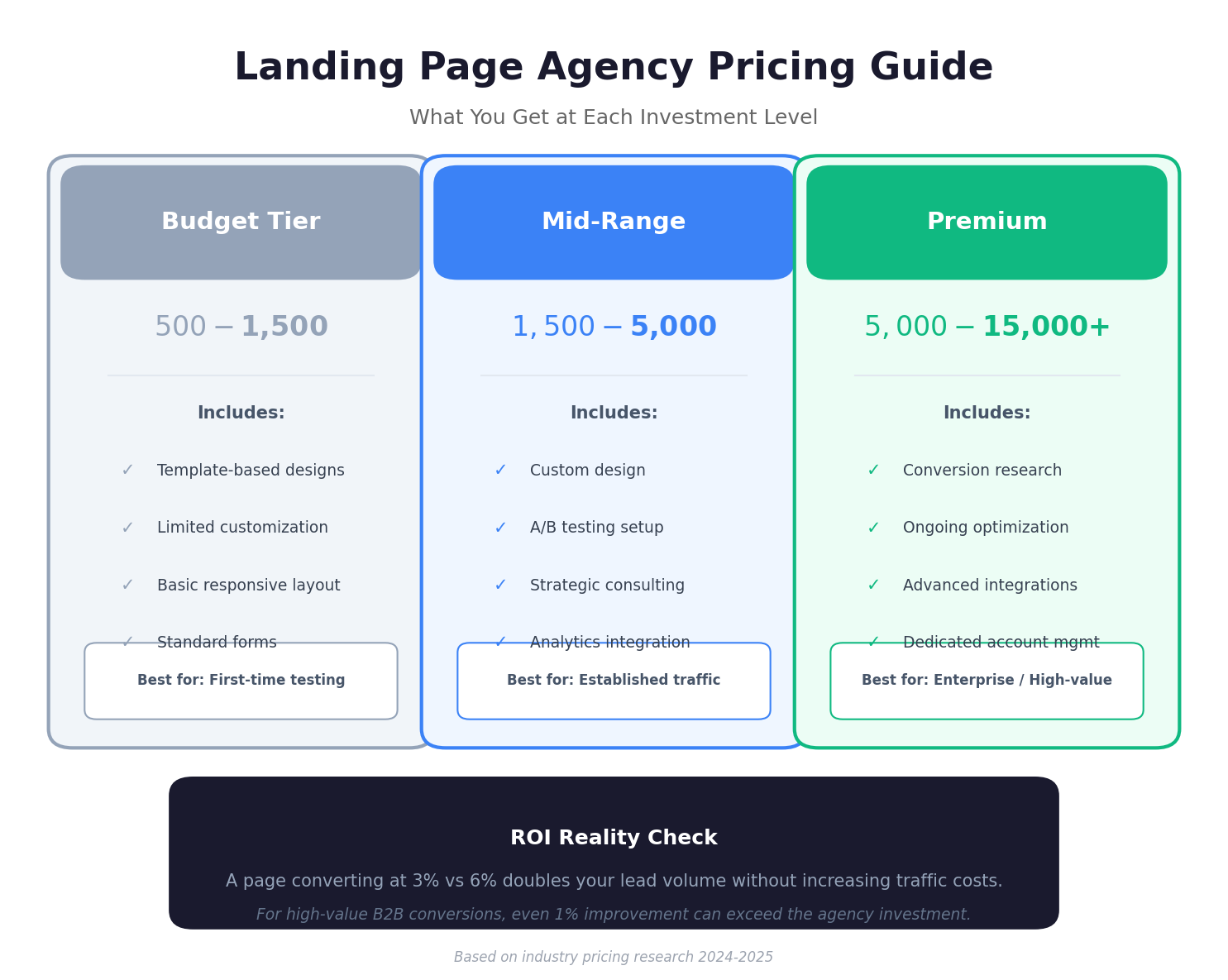
Budget Tier ($500-$1,500): Template-based designs with limited customization. Best for businesses testing landing pages for the first time or running low-budget campaigns.
Mid-Range Tier ($1,500-$5,000): Custom designs with conversion optimization, A/B testing setup, and strategic consulting. Appropriate for companies with established organic traffic looking to improve performance.
Premium Tier ($5,000-$15,000+): Comprehensive conversion research, custom design and development, ongoing optimization, advanced tools, and dedicated account management. Ideal for enterprise organizations with high-value conversions.
Pros of Working with Specialized Agencies:
- Access to CRO experts with cross-industry optimization experience
- Established testing frameworks that reduce time-to-optimization
- Scalability without expanding internal headcount
- Fresh perspectives on tired messaging and design approaches
Cons of Working with Specialized Agencies:
- Higher upfront costs compared to DIY solutions
- Potential communication gaps during project execution
- Dependency on external partners for time-sensitive updates
- Variable quality across the agency landscape
Common Misconceptions
Misconception 1: Beautiful Design Equals High Conversions
Many businesses assume that visually stunning landing pages automatically generate more qualified leads. Not true. Research from Unbounce's Conversion Benchmark Report analyzing 41,000 landing pages found that pages with simpler, more focused designs consistently outperformed visually complex alternatives.
Forrester research confirms this finding, noting that well-designed user interfaces can boost conversion rates by up to 200%. Some UX improvements reach 400%. But these gains come from usability and best practices, not visual complexity.
Experienced landing page agencies get this. They prioritize conversion mechanics over design awards, using data to guide every creative decision rather than subjective opinions about what "looks good."
Misconception 2: One Great Landing Page Solves Everything
Businesses often believe they need a single "perfect" landing page when research indicates the opposite approach works better. Companies with 40 or more landing pages generate 12 times more leads than those with five or fewer, according to industry benchmarks.
Why? Each target audience segment, traffic source, and campaign objective benefits from tailored messaging and design. McKinsey's research on personalization reinforces this approach, finding that companies excelling at personalization drive 40% more revenue from those activities than average performers.
The best landing page agencies don't just build one-off designs. They build systems for rapid page creation and testing. They help clients develop landing page ecosystems that address multiple buyer personas and conversion objectives at once, aligning each page with specific needs along the sales funnel.
Misconception 3: Agency Work Ends at Launch
The assumption that landing pages are "set and forget" assets costs companies dearly. According to industry benchmarks, only 17% of marketers actively A/B test their landing pages, despite companies that test regularly achieving 37% higher conversion rates.
BCG research indicates that leading companies successfully using AI and data-driven optimization follow the rule of putting 10% of resources into algorithms, 20% into technology and data, and 70% into people and processes. Optimization isn't a one-time project. It's ongoing.
CRO design agencies that know what they're doing build ongoing optimization into their service model. Launch is just the starting point for continuous marketing efforts.
Why Mobile Optimization Determines Landing Page Success
Despite mobile devices driving over 82% of landing page traffic according to Unbounce's research, mobile conversion rates consistently lag desktop performance by 8% or more. Massive mobile traffic combined with lower conversion rates. That gap is where the money is.
The mobile conversion gap stems from multiple factors: smaller screens demand ruthless prioritization of content, touch interfaces require larger tap targets and simplified forms, and slower mobile connections punish unoptimized page loads. Research indicates that pages loading in under 3 seconds convert exponentially better than slower alternatives, with every additional second of load time costing approximately 7% in conversions.
According to McKinsey, companies that implement Google Analytics and real-time tracking with mobile optimization typically see a 10-15% reduction in customer acquisition costs and a 15-20% increase in conversion rates compared to competitors using traditional approaches.
Elite landing page agencies design mobile-first, recognizing that the constraints of mobile actually improve desktop experiences. They test form functionality on actual devices rather than desktop simulators, optimize images and code for speed without sacrificing visual impact, and design thumb-friendly interfaces that reduce friction for on-the-go users.
This mobile-first philosophy extends beyond responsive design into fundamental rethinking of the conversion path. Smart CRO agencies recognize that mobile users often research on phones but convert later on desktop. So they build remarketing strategies and cross-device tracking implementations that capture value no matter where the final conversion happens.
The Hidden Cost of Internal Landing Page Development
Organizations often underestimate the true cost of building landing pages internally. Agency fees appear as clear line items. But internal development costs stay hidden across multiple budgets: designer salaries, developer time, project management overhead, opportunity costs of delayed campaigns, and the efficiency losses from teams working outside their core competencies.
According to McKinsey research, 15-20% of marketing spend can be recovered through better marketing ROI efforts, including more effective marketing strategies for landing pages. Global marketing spend exceeds $1 trillion annually (1-2% of global GDP), so even modest efficiency improvements add up fast.
When internal teams lack conversion optimization expertise, they often produce pages that look professional but don't perform. Revenue gets delayed. Paid media investment gets wasted driving traffic to underperforming assets. Lead generation suffers, and online sales stall.
The calculation shifts further when considering opportunity cost. Internal teams building landing pages aren't working on other high-value projects. Deloitte research shows that 81% of organizations use productivity as the prime measure of digital transformation ROI, and respondents with a more holistic mindset are 20% more likely to attribute medium-to-high enterprise value to their digital investments.
For most organizations, finding the right CRO partner and outsourcing landing page production to specialists allows internal resources to focus on strategic initiatives where institutional knowledge provides irreplaceable value. This analysis doesn't suggest agencies are universally superior to internal teams. Organizations with high landing page volume, established testing cultures, and dedicated conversion optimization specialists may find internal production more cost-effective. But most mid-market companies lack the scale to justify full-time landing page specialists, so agency partnerships tend to be the more economical choice.
Real-World Examples and Case Studies
Zola's Landing Page Transformation
Wedding planning platform Zola worked with conversion specialists to develop over 300 landing pages tailored to specific audience segments. Rather than relying on generic pages, they created targeted experiences for Pinterest users interested in wedding websites, couples exploring registry options based on home décor preferences, and numerous other micro-segments through user research.
The results? Conversion rate improvements ranging from 5% to 20% across these new landing pages compared to their previous website pages. Zola then took insights from the top-performing pages and incorporated them into their main homepage design, pushing the optimization benefits beyond paid campaigns to support sustainable growth.
Truckers Report Iterative Testing Success
The Truckers Report, a job board serving the trucking industry, engaged CRO specialists for a comprehensive landing page optimization project. Through six rounds of iterative testing (refining responsive design, content presentation, and visual elements), they achieved a conversion rate 79.3% better than their original page.
This case shows that landing page optimization is a marathon rather than a sprint. Each testing round provided insights that informed subsequent experiments, with cumulative gains far exceeding what any single test could achieve. The team discovered that moving the email field to the last position in the form (after easier drop-down selections) increased opt-ins by 44.7%. The psychology behind it? Commitment and consistency, a principle identified by behavioural researcher Robert Cialdini. This kind of CRO strategy based on customer behaviour research separates agencies with a track record from those without.
ClickMechanic Hero Section Optimization
UK auto repair marketplace ClickMechanic used heatmap analysis to discover that the vast majority of website visitors never scrolled beyond the hero section. Rather than redesigning the entire page, they focused optimization efforts exclusively on above-the-fold content, placing their quote form prominently within the hero section to prompt the desired action.
This focused approach produced a 15% increase in conversions while significantly reducing design and development costs compared to a full page redesign. It's a good example of how data-driven agencies find high-impact opportunities without overcomplicating things.
Frequently Asked Questions
What's the average cost of hiring a landing page design agency?
Pricing ranges from $500 for template-based designs to $15,000+ for comprehensive conversion rate optimization services. Most mid-market businesses invest between $2,000 and $5,000 per landing page when working with specialized agencies. That typically covers CRO strategy, custom design, development, and initial A/B testing setup.
How long until a landing page agency delivers results?
Initial delivery usually takes 2-4 weeks depending on complexity and revision cycles. But measurable results from conversion optimization? Those require 4-8 weeks of testing after launch to gather statistically significant data. Be skeptical of agencies promising instant results or "guaranteed" conversion rates. Real optimization takes time and data.
What's the difference between a landing page agency and a general web design firm?
Landing page agencies specialize exclusively in conversion-focused single-page experiences. They bring deep expertise in A/B testing, conversion psychology, and performance optimization. General web design firms handle broader website projects but typically lack the specialized testing infrastructure and conversion expertise that dedicated landing page companies build through years of focused practice. A true CRO partner focuses on business goals and measurable outcomes.
Should I hire an agency or use a landing page builder tool?
It depends on your traffic volume, technical capabilities, and conversion value. DIY builders work well for businesses testing initial campaigns with limited budgets. But companies with established traffic and high-value conversions typically see better ROI from agency partnerships. Agencies bring strategic expertise and optimization experience that templates can't replicate. They also handle social media landing pages and coordinate with broader marketing strategies.
How do I measure the ROI of landing page agency services?
Compare conversion rates before and after agency engagement, then factor in lead value and customer lifetime value. A page converting at 3% versus 6% doubles lead volume without increasing traffic costs. For high-value B2B conversions, even modest percentage improvements can translate to substantial revenue gains that quickly exceed the agency investment.
Web Tonic works across SEO and paid search, and you can book a consultation to talk through your own plan.


