



Table of contents
Key Takeaways
- TikTok hooks capture attention within one to three seconds and serve as the primary determinant of algorithmic distribution; videos with strong three-second retention receive 2.2 times more views than those with weak openings.
- Effective hooks combine psychological triggers including pattern interruption, curiosity gaps, and social proof to create immediate engagement that signals quality to the platform's recommendation system.
- Emotional content, particularly videos triggering happiness and surprise, achieves the highest engagement rates, with research showing 58% of viral TikTok videos evoke positive emotions.
- Smaller accounts often achieve higher engagement rates than large accounts because TikTok's For You Page algorithm prioritizes content quality over follower count, creating opportunities for businesses without established audiences.
- Production value matters less than authenticity and hook strength; brands like Duolingo demonstrate that personality-driven content with strong hooks outperforms polished corporate messaging.
- For businesses seeking to maximize TikTok performance, working with experienced content strategists can accelerate learning curves and help identify the hook formulas that resonate with specific target audiences.
What are TikTok hooks?
Three seconds. That's the window you have to stop someone from scrolling past your content.
A TikTok hook is the opening moment of a video designed to capture viewer attention before they swipe away. In short-form video, hooks determine whether your content gets distributed or dies in obscurity. The platform's algorithm watches what happens in those first moments and makes rapid decisions about who else should see your video.TikTok Hook Ideas: 50+ Attention-Grabbing Openings That Stop the Scroll
What are TikTok hooks? A primer
Three seconds. That's the window you have to stop someone from scrolling past your content.
A TikTok hook is the opening moment of a video designed to capture viewer attention before they swipe away. In short-form video, hooks determine whether your content gets distributed or dies in obscurity. The platform's algorithm watches what happens in those first moments and makes rapid decisions about who else should see your video.
Research published in Frontiers in Public Health explains this through the uses and gratifications framework—people use media to satisfy specific needs, and TikTok users specifically crave novelty (Montag et al., Frontiers in Public Health). The algorithm delivers novel content outside users' immediate social networks, which means your hook needs to signal "this is different" within seconds.
For mid-market and enterprise businesses, this matters more than most realize. TikTok maintains a 2.50% engagement rate—five times higher than Instagram's 0.50% (Emplicit). But the platform interprets early drop-off as a quality signal. Lose viewers in the first three seconds and the algorithm buries your content, regardless of how strong the rest of the video might be.
50+ viral TikTok opening formulas that work
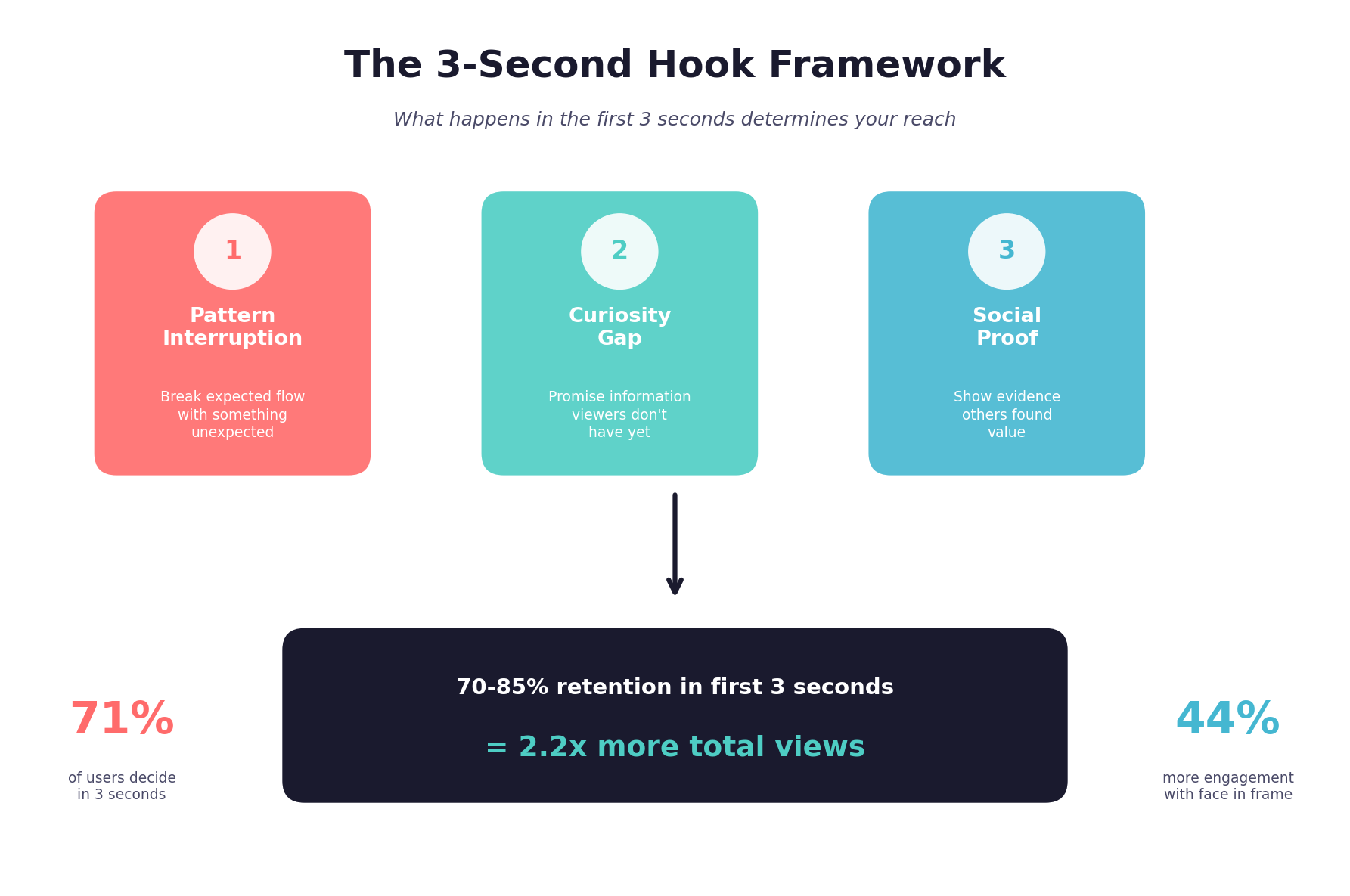
What separates hooks that capture attention from those that get scrolled past? Three psychological mechanisms working together.
Pattern interruption exploits how human brains notice anything breaking expected flow. Scroll through dozens of similar videos and something visually or verbally unexpected creates a pause response. Curiosity gaps create tension by promising information the viewer doesn't have yet—brains dislike unresolved questions. Social proof triggers attention when evidence suggests others found something valuable.
Research from Baylor University published in Cyberpsychology, Behaviour, and Social Networking found that TikTok's combination of perceived effortlessness, accurate recommendations, and surprising content variety creates powerful engagement patterns (Baylor University).
| Psychological Trigger | How It Works | Example Hook |
|---|---|---|
| Pattern Interruption | Breaks expected visual or verbal flow | Starting mid-action or with unusual visuals |
| Curiosity Gap | Creates unresolved question | "The one mistake that killed my business..." |
| Social Proof | Signals others found value | "Why 10 million people are doing this wrong..." |
Question hooks that pull viewers in
Questions work by engaging the viewer's brain in problem-solving mode. The most effective ones target a specific frustration or knowledge gap.
"Want to know the real reason why [common problem] keeps happening?" opens a curiosity gap that demands resolution. "What if I told you everything you know about [topic] is wrong?" creates cognitive dissonance. "Why are [large number] people suddenly doing [unusual thing]?" adds social proof to the curiosity trigger.
Other high-performers include "Have you ever wondered why [surprising fact]?" and "Can you guess what [unexpected group] knows about [topic] that you don't?" Same principle across all of these: they promise specific information the viewer wants but doesn't have.
Bold statements that stop the scroll
Declarative sentences challenging conventional wisdom force viewers to pause and evaluate. "Stop doing [common practice] immediately" triggers loss aversion. "[Common advice] is actually destroying your [result]" creates cognitive dissonance between what viewers believe and what you're claiming.
"I tested [popular method] for 30 days and the results were shocking" combines personal narrative with a curiosity gap. "Everything your [authority figure] told you about [topic] is outdated" challenges existing beliefs. "The [industry] doesn't want you to know this" implies insider knowledge worth uncovering.
The key: make claims surprising enough to demand attention but credible enough to earn continued watching.
Story hooks and narrative openings
Starting mid-story creates immediate engagement because viewers want context and resolution. "I was about to [action] when something unexpected happened..." drops viewers into unresolved tension. "This is the story of how I [transformation]" promises a journey worth following.
"Nobody warned me about [thing], and here's what happened" combines personal stakes with curiosity. "I made the biggest mistake of my career, and this is what I learned" signals vulnerability and valuable lessons. "The moment I realized [insight] was when..." promises a specific revelation.
Why do these work? Humans are wired for narrative. An incomplete story creates psychological discomfort that can only be resolved by watching.
Tutorial hooks that promise specific value
Tutorial hooks establish immediate value through specificity. Vague promises fail. Concrete outcomes capture interest.
"Here's how to [specific outcome] in under [short time]" works because it quantifies both the benefit and the investment required. "The [number]-step process that [desirable result]" promises a clear framework. "Do this instead of [common approach]" positions your method against the status quo.
"Watch me [demonstrate skill] in real time" adds proof to the promise. "This is the only tutorial you'll ever need for [task]" makes a bold completeness claim. "Here's the method that took me from [starting point] to [result]" adds transformation narrative to practical instruction. This type of content works especially well for life hacks and educational content where viewers want quick, actionable takeaways.
Social proof and authority hooks
Numbers and external validation establish credibility instantly. "[Number] people asked me about this, so here's the answer" implies demand. "After [impressive number] of [experience], this is what I know" signals expertise through volume.
"The strategy that helped [number] people achieve [result]" provides social proof through outcomes. "[Number]% of people get this wrong" creates an in-group/out-group dynamic where viewers want to be among those who know better.
"After working with [number] clients, here's the pattern I noticed" combines expertise with pattern recognition—viewers want to learn what took someone else extensive experience to discover.
Urgency and warning hooks
Warning hooks activate loss aversion. People are more motivated to avoid losses than achieve equivalent gains.
"You need to stop doing [thing] before [consequence]" implies imminent harm from current behaviour. "If you're not doing [action], you're already behind" creates competitive anxiety. "Three signs that [bad outcome] is about to happen" promises diagnostic value.
"This [thing] is about to change forever, and most people aren't ready" combines urgency with insider knowledge. Use these responsibly—the content must deliver on the promised urgency or viewers learn to distrust your hooks.
Relatable and emotional hooks
Emotional hooks create connection by articulating feelings viewers recognize in themselves. Research from Semrush found that 58% of viral videos trigger happiness, with surprise as the second most effective emotion (PR Daily).
"This is for everyone who's ever felt [relatable emotion] about [situation]" signals tribal belonging. "POV: You finally figured out [common frustration]" creates shared experience. "Things they don't tell you about [experience/role]" promises insider knowledge about something the viewer cares about.
"The [topic] struggle is real" validates frustrations. "Who else remembers when [nostalgic reference]?" triggers emotional memory and community identification.
What works about structured hook formulas: They reduce creative decision fatigue, enable systematic testing, create consistency across team members, and speed up content creation without sacrificing effectiveness.
The risk: Over-reliance makes content feel formulaic. Formulas are starting points, not scripts.
Common misconceptions
Viral hooks require expensive production
Many businesses assume effective TikTok content requires professional videography, lighting, and editing. This prevents them from starting or leads to over-produced content that feels wrong on the platform.
The algorithm doesn't prioritize production value over engagement metrics. Research from Baylor University found that TikTok's engagement power comes from perceived effortlessness and surprising content variety, not polish (Baylor University). The platform's technological affordances increase engagement by increasing perceived effortlessness and serendipity. Authentic content beats production quality every time.
You need to follow every trend
Businesses exhaust themselves chasing every trending TikTok sound, dance challenge, or format, believing trend participation is the only path to visibility. This leads to burnout and content that feels forced.
Sustainable success comes from intersection, not imitation. Duolingo's social media success came from creating a distinctive brand character that selectively engaged with popular trends in ways that felt genuine—not from participating in everything. The brand's TikTok following grew from dormant to over 16 million followers by maintaining consistent personality rather than constant trend-chasing (Rival IQ).
Longer videos cannot succeed
The association between TikTok and ultra-short content leads content creators to believe videos over 30 seconds will fail automatically. This limits content depth and storytelling potential.
The data says otherwise. Metricool's 2024 TikTok Study reveals that the ideal maximum video length for views is actually between two and five minutes (Metricool). Short videos maintain higher completion rates, but longer videos that hook viewers in the first three seconds often accumulate more total views. Longer videos require stronger hooks because they ask for more viewer investment upfront.
Why the first frame satisfies the algorithm more than total watch time
Traditional video metrics emphasize total watch time as the primary success indicator. TikTok's algorithm operates differently.
The platform assesses hook retention separately from total video retention. The distribution engine prioritizes videos that prevent early drop-off, treating the first three seconds as a distinct metric that determines whether content reaches a wider audience at all. A systematic review published in PMC examining TikTok's engagement mechanisms found that the platform maintains superior engagement compared to competitors, receiving twice as many comments per post (PMC, Systematic Review). This advantage stems from algorithm-driven content discovery that rewards strong opening moments.
Videos maintaining 70% to 85% retention in the first three seconds receive 2.2 times more total views than videos with lower initial retention (TTS Vibes). Strong initial retention signals to the algorithm that content deserves testing with larger audiences. Each successful test unlocks a progressively larger distribution. Weak initial retention terminates this process before meaningful reach accumulates.
Resources invested in the first three seconds generate disproportionate returns compared to equivalent investment in later portions. That's the core insight here. Creators who use their face in the first two seconds see engagement increase by 44% (Zebracat). Human faces capture attention in ways text or objects cannot match.
The hidden advantage smaller accounts have
Conventional marketing wisdom suggests larger follower counts provide inherent distribution advantages. TikTok's algorithm challenges this assumption.
A systematic review examining TikTok content patterns found that the platform's engagement mechanisms differ fundamentally from follower-based social media platforms (SAGE Journals). The For You Page algorithm recommends content based on predicted user interest rather than follower relationships.
The numbers are striking. Accounts with fewer than 100,000 followers achieve an average engagement rate of 7.50%—more than double the 2.88% rate of mega-accounts with over 10 million followers (Emplicit). TikTok influencers with between 1,000 and 10,000 followers often exceed 10% engagement. Accounts with fewer followers receive more than 75% of impressions from the For You feed (Metricool).
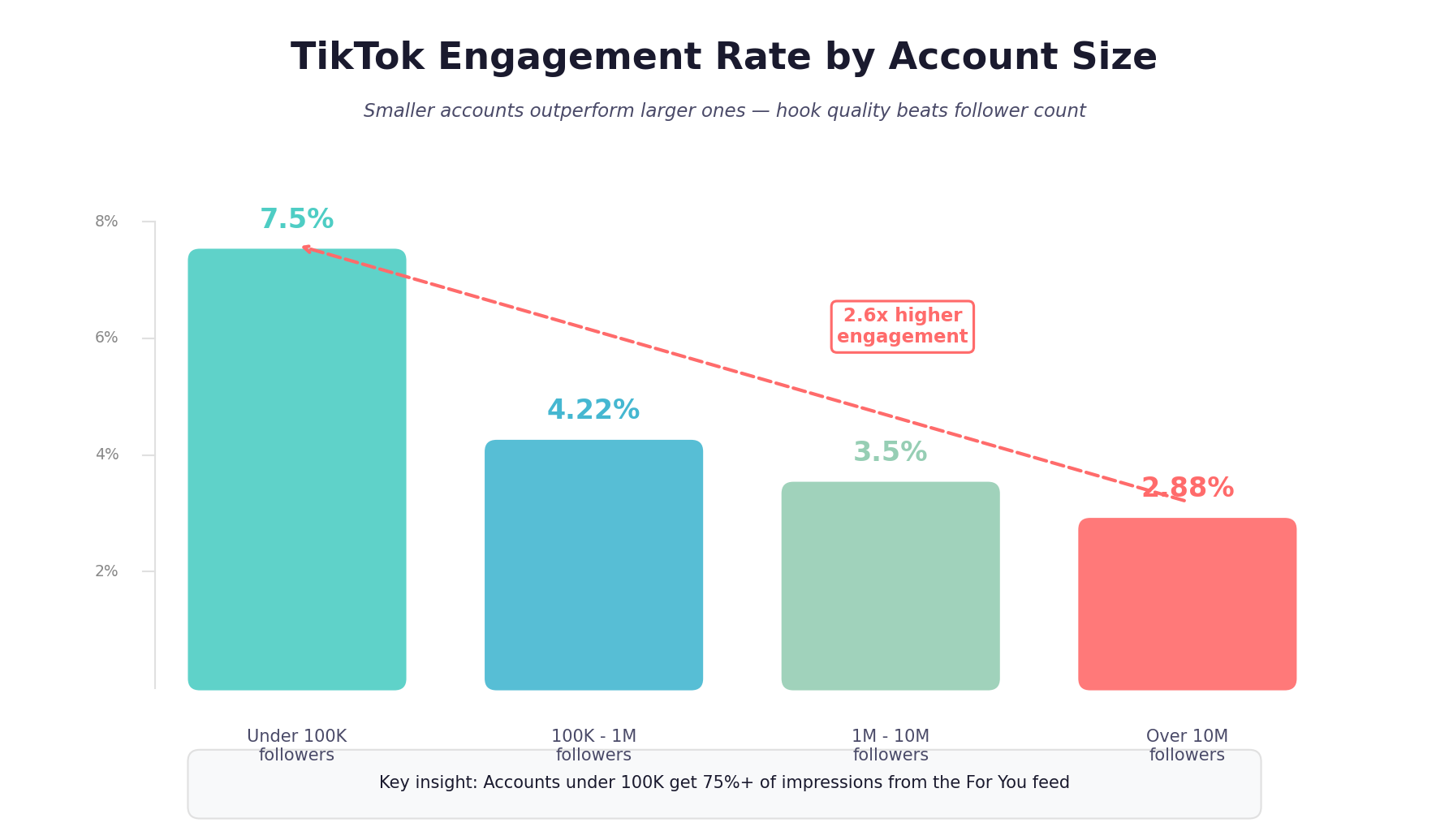
Hook quality matters more than existing audience size. A small TikTok account with excellent hooks can achieve broader distribution than a large account with weak opening moments. This makes TikTok valuable for market entry and brand awareness campaigns where established presence doesn't exist yet.
Real-world examples
Duolingo
Duolingo's TikTok strategy nails this approach. The company turned a language-learning app into one of the platform's most-followed brands by recognizing that audiences respond to authentic content rather than polished corporate messaging.
Their hook strategy combines pattern interruption with character-driven storytelling. The green owl mascot, Duo, appears in scenarios ranging from playful to mildly threatening. What's the unexpected situation this time? That question keeps viewers watching. During Zaria Parvez's time managing the account, Duolingo's worldwide monthly active users grew from 37 million to 116.7 million (Technical.ly).
The 2025 "Death of Duo" campaign showed how this works in practice. The dramatic video announcing Duo had "died" after being ignored by users generated millions of views within hours. The hook combined shock, humor, and self-aware commentary on the app's notorious notification system—all communicated within the first second.
Chipotle
Chipotle established early TikTok presence by capitalizing on organic brand mentions rather than creating traditional advertising. Their hooks invited participation rather than broadcasting messages.
The #LidFlipChallenge worked because it was simple. An employee executing a satisfying bowl-lid flip immediately communicated the challenge premise while triggering pattern interruption. The #GuacDance challenge used an immediately recognizable sound and visual pattern that communicated participation instructions within seconds. Both became viral content that spread far beyond Chipotle's own account.
Since joining TikTok in 2018, Chipotle has gained more than 1.3 million followers and 20.7 million likes across over 100 videos (TikTok for Business). The approach worked because hooks were designed for engagement, not impression.
Frequently asked questions
How long should a TikTok hook be?
One to three seconds. That's it. Research indicates approximately 71% of TikTok users make their watch-or-scroll decision within this window, and the hook's effect should extend through the first 15 seconds where maintaining 60% or higher retention indicates continued algorithmic promotion potential.
Do hooks work differently for business accounts versus personal accounts?
Not fundamentally. Business accounts achieve around 7.8% engagement rates on TikTok, competitive but requiring strategic optimization. The psychology behind effective hooks remains consistent across account types. The difference is that business accounts need to balance brand messaging with authenticity—hooks that establish personality and value simultaneously perform best, which takes more intentional planning than personal accounts typically require.
Should I use trending sounds in my hooks?
They can help, but they're not magic. Trending sounds boost initial visibility because the algorithm associates them with current user interest, and more than half of successful TikTok videos include music within the first three seconds. But sound selection should support rather than replace a strong visual and verbal hook. A trending sound paired with a weak opening still underperforms compared to an effective hook using original audio.
How do I know if my hook is working?
Check your analytics. TikTok provides retention graphs showing exactly where viewers drop off. Look at the curve at the three-second and fifteen-second marks specifically. If more than 30% of viewers leave before three seconds, your hook needs work. Compare retention patterns across your videos to identify which hook styles resonate with your specific audience.
Can I reuse hooks that worked in previous videos?
Yes. Successful hook formulas can be adapted and repeated with variations, and many top TikTok creators develop signature opening styles that audiences recognize and anticipate. Vary the specific content while maintaining structural elements that drive retention, and track performance over time to identify when a hook formula shows diminishing returns.
Web Tonic works across SEO, paid search and paid social, and you can book a consultation to talk through your own plan.


