



Table of contents

Key Takeaways
- Successful celebrity brands solve genuine market problems rather than relying on founder recognition alone to enhance their brand presence. SKIMS identified real gaps in inclusive sizing and skin tone options that established competitors ignored. That foundation made everything else possible.
- Multi-tiered influencer strategies combining celebrity partnerships with micro-influencer collaborations create sustainable marketing momentum without proportional budget increases. The system matters more than any individual partnership.
- Scarcity marketing works best when positioned as community moments rather than artificial limitations. Rapid sell-outs become marketing narratives driving future demand. Customers who participate feel membership in something exclusive.
- DTC-first approaches eventually require omnichannel expansion. Physical retail enables product experiences digital channels cannot replicate. The most successful brands recognize when to evolve.
- Strategic partnerships with established brands like Nike and Fendi accelerate category expansion while providing credibility that organic growth cannot achieve quickly. The Nike announcement alone added $6.7 billion to market value.
- Systematic strategy execution matters more than any single marketing channel. The SKIMS playbook demonstrates that even in celebrity-founded brands, the fundamentals drive long-term success.
What Is the SKIMS Marketing Strategy?
SKIMS did not just ride Kim Kardashian's fame to a $5 billion valuation. The brand built something competitors couldn't easily copy: a DTC strategy combining real product innovation with cultural timing and community building, all while enhancing her personal brand.
Founded in 2019 by Kardashian and Swedish entrepreneur Jens Grede, SKIMS grew from a shapewear startup to global apparel empire in six years. That's fast. But the speed obscures what actually made it work: solving problems that Spanx and Victoria's Secret had ignored for decades.
Grand View Research values the global shapewear market at $2.73 billion in 2024, with projected 8.0% CAGR growth through 2030. SKIMS captured outsized share by addressing pain points established players dismissed: limited skin tone options, restrictive size ranges, and designs that prioritized appearance over comfort. These weren't minor complaints. They were deal-breakers for millions of potential customers who had simply stopped buying shapewear altogether.
What makes the SKIMS approach worth studying? It shows how authentic problem-solving, combined with smart digital marketing and cultural timing, can disrupt established industries. Celebrity helps. But celebrity alone explains very little.
The Core Pillars of SKIMS' Brand Strategy
Product Innovation and Inclusive Design
SKIMS differentiated through genuine product innovation, not marketing spin. The brand offers sizes from XXS to 5XL and shapewear in over ten skin tones, from "sand" to "onyx." That commitment extends to adaptive clothing for people with limited mobility.
Here's how SKIMS stacks up against traditional competitors:
| Strategic Element | SKIMS Approach | Traditional Competitors |
|---|---|---|
| Size Range | XXS to 5XL | Limited selection |
| Skin Tones | 10+ options | 3-4 standard shades |
| Adaptive Features | Included | Rarely available |
| Price Point | Premium accessible | Either luxury or budget |
| Design Philosophy | Comfort-first | Compression-focused |
The founding story matters here. Kardashian spent years cutting and dyeing shapewear to match her skin tone. That frustration resonated with millions of women facing the same problem. When a founder can say "I built this because nothing else worked for me," customers listen differently than when they hear "our market research indicated an opportunity."
Multi-Tiered Influencer Ecosystem
SKIMS runs a three-tier influencer strategy that creates sustainable momentum without depending entirely on celebrity endorsements.
At the top, celebrity partnerships with Kate Moss, Tyra Banks, Paris Hilton, Sabrina Carpenter, and Lana Del Rey generate awareness and media coverage. These names position SKIMS alongside established fashion houses while keeping the brand accessible.
The middle tier consists of mid-tier creators with 100,000 to 1 million followers. They sustain visibility between major campaigns through authentic product demonstrations and styling content. Their posts feel less like ads because, frankly, they often aren't ads in the traditional sense.
The foundation is micro-influencers and user-generated content. SKIMS' influencer program is open to anyone, with over 50% of collaborations involving nano and micro-influencers. The constant stream of real customer content builds community trust in ways polished campaigns cannot.
This structure has tradeoffs. It reduces dependency on any single celebrity and creates constant content flow without proportional budget increases. But it also requires sophisticated coordination. Brand messaging can dilute if curation slips. Relationship management becomes a permanent overhead cost. The payoff is authentic social proof at scale.

Common Misconceptions About Celebrity Brand Success
Misconception 1: Celebrity Fame Guarantees Brand Success
It doesn't. Research from the Journal of Student Research shows businesses face significant failure rates regardless of founder status. About 20% of new businesses fail within two years. That climbs to 45% at five years and 65% at ten. Celebrity founders face these same challenges plus unique vulnerabilities tied to public perception.
Kardashian herself experienced failures before SKIMS. The Kardashian Kard, a prepaid debit card, terminated within one month of launch. The difference with SKIMS? It was built on genuine product innovation and market gap identification. Name recognition opened doors. The product kept people inside.
Misconception 2: SKIMS Succeeds Because of Kardashian's Instagram Following
Kardashian has 370+ million Instagram followers. That's significant reach. But attributing SKIMS' success solely to social media presence misses the point. Many celebrity brands with comparable followings have failed spectacularly.
NielsenIQ research found celebrity beauty brands collectively achieved $1.1 billion in sales with 57.8% growth. But success concentrated among brands with genuine product quality and authentic founder involvement, not just promotional reach.
SKIMS invested in operational excellence, supply chain management, and product development that would succeed without celebrity association. CEO Jens Grede brings extensive experience from co-founding Frame denim. The business fundamentals work independently of who owns it.
Misconception 3: DTC Brands Don't Need Physical Retail
SKIMS started digital-native but recognized the limitations. The company opened its first permanent store in Georgetown in 2024, followed by Miami, Austin, and a Fifth Avenue flagship. Today it operates 18 U.S. stores with expansion planned through 2026, including Regent Street in London and Dubai.
Why the shift? McKinsey research shows successful DTC brands typically transition toward omnichannel strategies as they scale. Physical retail enables experiences digital channels cannot replicate. For intimate apparel, fit and feel drive purchase decisions. You can't try on shapewear through a screen.
Deloitte research adds another angle: DTC brands face growing profitability challenges in digital-only models, with customer acquisition costs up 25-40% across platforms. Physical retail provides an alternative acquisition channel that often proves more cost-effective than digital advertising while creating touchpoints that drive online purchases.
Why Scarcity Marketing Creates Community Rather Than Frustration
Most scarcity tactics alienate consumers. SKIMS transformed limited availability into community-building moments.
The brand's product drops generate social media conversations extending far beyond the purchase window. When products sell out rapidly, customers share their experiences. The wins. The frustrations. The near-misses. That creates brand visibility without additional marketing spend.
A 2024 meta-analysis in Social Media + Society reviewed 39 experiments and found credibility matters more than celebrity status in driving purchase decisions. SKIMS leverages both. Kardashian provides initial visibility. User-generated content from real customers supplies the credibility that converts interest into purchases. Each drop generates content that promotes the next. The cycle sustains itself.
The tactical elements matter. Limited-edition drops with countdown timers on Instagram Stories create collective anticipation. TikTok restock alerts generate urgency while providing genuine value. When Kardashian posts a quick selfie with "Back now, but not for long," availability feels like insider information rather than marketing manipulation.
When sell-outs occur, fan reactions serve dual purposes. "Finally grabbed my size!" validates demand authenticity. "Sold out before I could even click" creates FOMO driving future engagement. Both reactions benefit the brand.
The SKIMS x Fendi collaboration shows this at scale. November 2021 launch. $1 million in sales within the first minute. Over 300,000 people on the waitlist. Products ranged from $100 shapewear to $4,200 leather dresses. The sell-out velocity became the marketing narrative. Proof of desirability that drove demand for subsequent releases.
In Q1 2024 alone, SKIMS received 456,000 repeat purchases, doubled from 2023. Scarcity tactics, properly executed, drive loyalty rather than alienation. Customers who successfully purchase during limited drops feel membership in an exclusive community.
The Hidden Architecture Behind "Effortless" Brand Building
SKIMS' social media presence looks spontaneous. It isn't.
The company maintains consistent posting schedules across Instagram, TikTok, Twitter, and Facebook. Content calendars align with cultural moments and product launches. Nothing random about it.
Hashtag strategy encourages organic content creation. Tags like #skimshaul prompts customers to share unboxing experiences, which SKIMS reposts. Customer content becomes brand marketing. Customers feel recognized and valued. Both sides win.
Timing maximizes cultural relevance. Major launches coincide with heightened audience attention. The 2020 Velour Tracksuit campaign with Paris Hilton capitalized on Y2K nostalgia already dominating feeds. The Kate Moss Cotton Collection aligned with minimalist aesthetics trending across platforms. Each campaign enters conversations already happening rather than trying to create attention from scratch.
Email marketing runs at about five messages weekly, announcing drops, restocks, and collaborations. The cadence maintains presence without overwhelming production demands because much content references user-generated material and limited availability updates.
Real-World Examples and Case Studies
The Nike Partnership: NikeSkims
February 2025. Nike announced a "long-term" partnership with SKIMS to create NikeSkims, targeting female athletes and athleisure consumers. The announcement added $6.7 billion to Nike's market value as shares rose 6.2%.
That's $6.7 billion. From one announcement.
The partnership addresses strategic needs for both companies. About 40% of Nike customers are women, yet apparel represents only 28% of brand revenue. Lululemon, Alo Yoga, and Vuori have captured female consumers Nike couldn't reach. NikeSkims provides an accelerated path to this demographic without rebuilding brand positioning from scratch.
For SKIMS, the partnership opens Nike's manufacturing capabilities, athletic credibility, and distribution infrastructure. The U.S. activewear market is valued at $213 billion. That's massive expansion potential beyond shapewear and loungewear.
The September 2025 launch featured seven collections and 58 silhouettes with over 10,000 possible outfit combinations. Hero styles include a double-strap scoop bra, footsie legging, mini short, long-sleeve wrap top, side-snap sweatpants, and oversize track jacket. Nike's Dri-Fit technology blends with SKIMS' compression and fit expertise.
Marketing featured more than 50 athletes: Serena Williams, Sha'Carri Richardson, Jordan Chiles, Chloe Kim, Nelly Korda. A debut film, "Bodies at Work," directed by Janicza Bravo, positioned the launch as a cultural moment rather than a product announcement.
Team USA Olympics Partnership
SKIMS served as official loungewear partner for Team USA at Tokyo 2020, Beijing 2022, and Paris 2024. A first for a shapewear brand.
This partnership elevated SKIMS from a celebrity venture to a legitimate athletic apparel brand. Dressing Olympians in loungewear and undergarments associated the products with peak physical performance while maintaining accessibility for everyday consumers. It also generated extensive press coverage without traditional advertising spend.
NBA, WNBA, and USA Basketball Partnership
October 2023. SKIMS became the official underwear partner for the NBA, WNBA, and USA Basketball. Men now represent 32.4% of SKIMS social media mentions and 25% of website traffic.
The men's category launch entered a $5.7 billion market with partnerships providing immediate legitimacy that new entrants typically spend years building. Athletes like Neymar Jr. and Nick Bosa appeared in campaigns, bringing their fanbases along and proving SKIMS could move beyond its origins as women's shapewear.
Frequently Asked Questions
How did SKIMS achieve a $5 billion valuation in just six years?
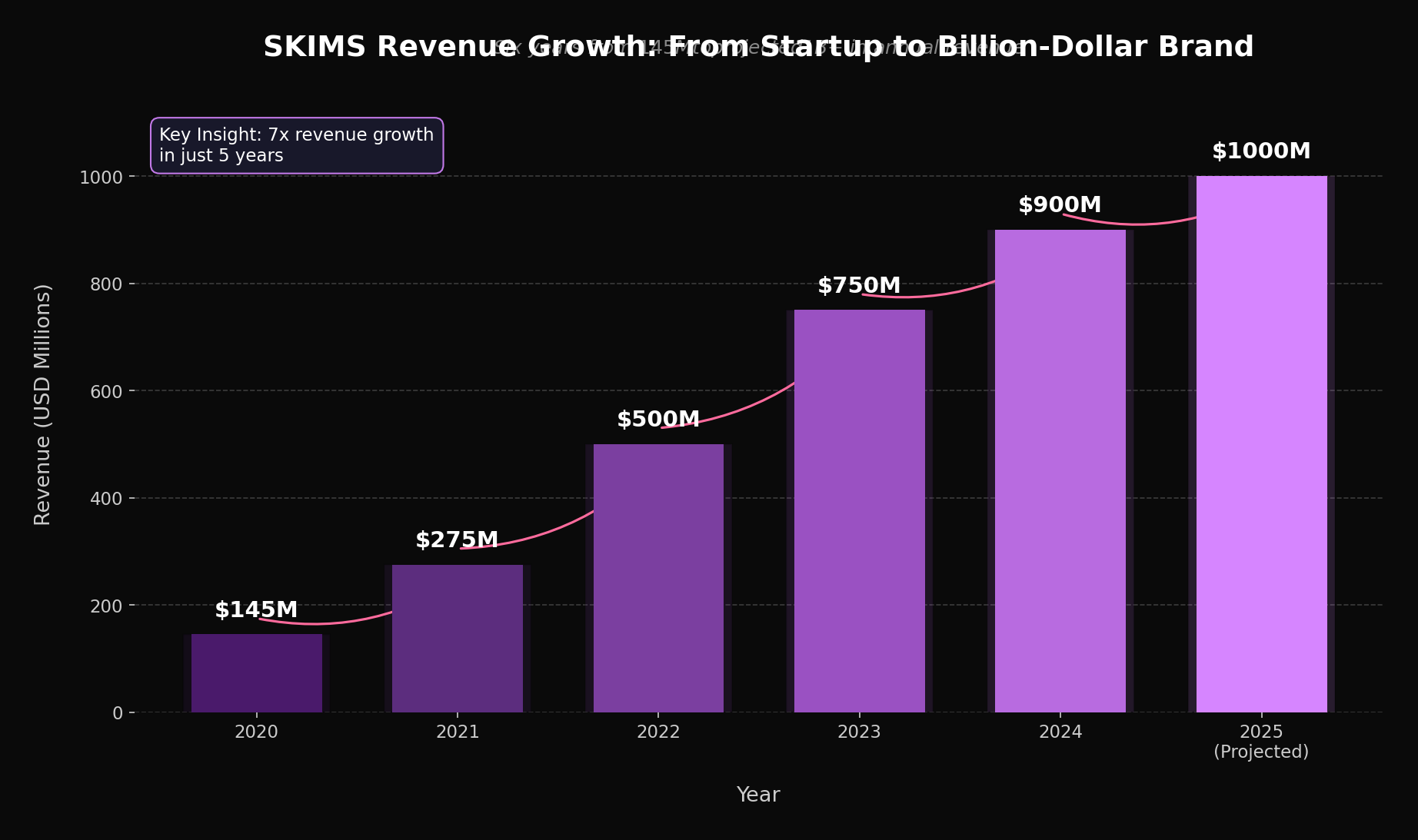
SKIMS reached a $5 billion valuation in November 2025 after raising $225 million led by Goldman Sachs Alternatives. The company projects over $1 billion in net sales for 2025, up from roughly $750 million in 2023 and $500 million in 2022. Growth came from expanding beyond shapewear into loungewear, swimwear, men's basics, and activewear through NikeSkims, combined with international expansion and physical retail partnerships rollout.
What makes SKIMS different from other celebrity brands that failed?
SKIMS addressed genuine market gaps rather than applying a celebrity name to existing products. The brand launched with differentiated offerings (inclusive sizing, diverse skin tones, comfort-focused design) that resonated with Gen Z and that competitors weren't providing. Professional management through CEO Jens Grede and institutional investors including Goldman Sachs, Wellington Management, and Thrive Capital brought operational expertise beyond celebrity influence.
How does SKIMS use social media differently than traditional brands?
SKIMS treats social media as a two-way community platform rather than a broadcast channel. The brand reposts customer content, responds to comments, and creates campaigns designed for participation rather than passive consumption, leveraging viral moments to enhance engagement. Over 50% of influencer collaborations involve nano and micro-influencers providing authentic endorsements. Social audience has grown roughly 10% every six months, reaching over 7 million followers across platforms.
Can mid-market businesses replicate SKIMS' marketing strategy without celebrity founders?
Yes. The fundamental elements work without celebrity founders at the right time: authentic problem-solving, inclusive design, multi-tiered influencer relationships, scarcity-driven launches, community-focused social media. The key is identifying genuine market gaps and building systematic approaches to influencer partnerships and user-generated content. Research shows credibility matters more than celebrity status in driving purchase decisions, especially when it comes to launching new products. Consistent quality and authentic brand voice can substitute for founder fame.
What role does product quality play in SKIMS' marketing success?
Product quality enables marketing success rather than merely supporting it. Commitment to comfort, fit, and durability generates organic word-of-mouth and fosters brand loyalty through user-generated content that paid advertising cannot replicate. Customer communities on Reddit actively discuss sizing, fabric quality, and fit recommendations, and body positivity. The brand achieved net profits of approximately $190 million in 2023, indicating pricing power that only quality products can sustain.


