



Table of contents
Key Takeaways
- Meme marketing requires cultural fluency and rapid operational response capabilities, not just creative talent—build approval processes that enable participation within hours rather than days.
- Success varies dramatically by brand positioning and audience; evaluate fit before committing resources and develop approaches appropriate to your industry context.
- Balance virality with business objectives—engaging content that fails to communicate brand messages or drive conversions represents wasted investment regardless of reach.
- Authenticity signals matter more than production quality in meme formats; develop distinct creative guidelines that enable participation without undermining brand standards.
- Long-term investment in social media capabilities generates cumulative brand equity that individual campaigns cannot achieve; treat meme marketing as an ongoing strategic capability rather than a tactical experiment.
- Organizations struggling to develop internal meme marketing capabilities may benefit from partnering with specialized agencies that combine cultural expertise with strategic marketing discipline.
What is meme marketing?
Meme marketing refers to the strategic use of internet memes (culturally relevant images, videos, or text formats that spread rapidly through social sharing) as a component of brand communication and advertising campaigns. Unlike traditional ads that interrupt consumer attention, meme marketing embeds brand messages within content formats that audiences actively seek out and share across social media platforms.
The academic foundation for understanding meme marketing draws from biologist Richard Dawkins' original concept of "memes" as units of cultural transmission, introduced in his 1976 work The Selfish Gene. In the digital context, researchers at the Journal of Marketing have documented how internet memes function as "cultural artifacts that gain meaning through collective participation." This makes them particularly valuable for brands seeking genuine connections with digitally-native audiences through pop culture and internet culture references.
For mid-market and enterprise businesses, meme marketing opens real opportunities to increase organic reach and reduce paid media dependency. According to research from McKinsey & Company, brands that successfully engage customers through culturally relevant content see up to 23% higher customer lifetime value compared to those relying solely on traditional advertising approaches. But here's what matters: meme marketing isn't simply about posting a funny image. It's about cultural fluency paired with brand integrity.
Building an Effective Meme Marketing Strategy
Successful meme advertising requires more than randomly posting trending content to social feeds. Companies must develop systematic approaches that balance cultural relevance with brand safety and strategic objectives.
Framework for evaluating meme opportunities
| Factor | Low Fit | Medium Fit | High Fit |
|---|---|---|---|
| Brand voice alignment | Forced or awkward connection | Moderate relevance | Natural extension of existing tone |
| Audience overlap | Meme audience doesn't match target demo | Partial overlap | Strong demographic alignment |
| Timing window | Meme is past peak or not yet mainstream | Rising but competitive | Early adoption opportunity |
| Risk profile | High controversy potential | Moderate interpretation variance | Clear, safe meaning |
| Adaptation potential | Requires extensive modification | Some customization needed | Easy brand integration |
Tactical approaches to brand memes
Reactive meme marketing involves monitoring social media trends and quickly adapting popular memes with brand-relevant messaging. This approach requires dedicated social listening tools and rapid creative approval processes. Big brands like Wendy's and Netflix have built entire social media presences around reactive engagement with viral content.
Proactive meme creation involves developing original content designed with viral potential. Riskier, yes. But successful campaigns can establish brands as cultural leaders rather than followers. The challenge? Creating a good meme organic enough to spread while maintaining clear brand attribution.
Community-driven meme marketing leverages user-generated content by encouraging target audiences to create brand's memes themselves. This approach provides higher engagement and reduces content production costs, though it requires careful community management to maintain brand safety.
When weighing the decision to invest in meme marketing, companies should consider both the upside and the risks. On the positive side, production costs run significantly lower than traditional content (low cost is a major advantage), organic engagement increases through social sharing, and the approach works particularly well for reaching younger audiences including Millennials, Gen Z, and increasingly Gen Alpha. Brands also gain opportunities for real-time marketing relevance and a chance to show popular culture awareness.
The downsides deserve equal attention. Memes have a short shelf life (sometimes just days before they feel stale), there's real risk of appearing inauthentic, and misinterpretation can lead to backlash. Once shareable memes spread, controlling the message becomes nearly impossible. And campaigns that work in one market may fall flat internationally.
Common Misconceptions
Misconception 1: Any brand can successfully use meme marketing
Many companies assume that meme marketing works universally across industries and large audiences. It doesn't. Effectiveness varies dramatically based on brand positioning, target demographics, and industry context. A study published in the European Journal of Marketing found that perceived brand authenticity moderates consumer response to humorous content, with established "serious" brands facing backlash when suddenly adopting comedic approaches without gradual positioning shifts.
Financial services, healthcare, and B2B technology companies often struggle with meme marketing because their audiences expect professionalism and expertise signals rather than entertainment. The smarter approach? Select formats that show cultural awareness without undermining core brand attributes.
Misconception 2: Viral meme content always drives business results
The assumption that becoming a viral phenomenon automatically translates to business outcomes represents one of the most costly errors in digital marketing strategy. Research from the Kellogg School of Management indicates that highly shareable content often lacks the persuasive elements necessary for conversion. Content optimized for sharing may sacrifice brand message clarity for entertainment value, resulting in high engagement metrics but minimal sales impact.
Effective meme marketing requires balancing virality with strategic messaging. Content must be entertaining enough to share while maintaining clear brand attribution and call-to-action integration.
Misconception 3: Meme marketing requires minimal planning or resources
The perception that meme marketing represents a "free" or low-effort alternative to traditional advertising significantly underestimates resource requirements. Successful meme marketing demands sophisticated social listening infrastructure, rapid creative development capabilities, legal review processes for fair use and intellectual property considerations, and community management expertise.
Businesses that treat meme marketing as an ad-hoc activity typically produce traditional content that feels forced or arrives after optimal timing windows have closed. The brands most successful with meme advertising have invested in dedicated teams and streamlined approval workflows that enable rapid response to cultural moments.
Why speed satisfies more than perfection
The half-life of internet memes continues shrinking as digital culture accelerates. Research from the Oxford Internet Institute documented that trending topics now peak and decline 40% faster than five years ago, compressing the window for brand participation. This changes everything about how marketing teams must operate.
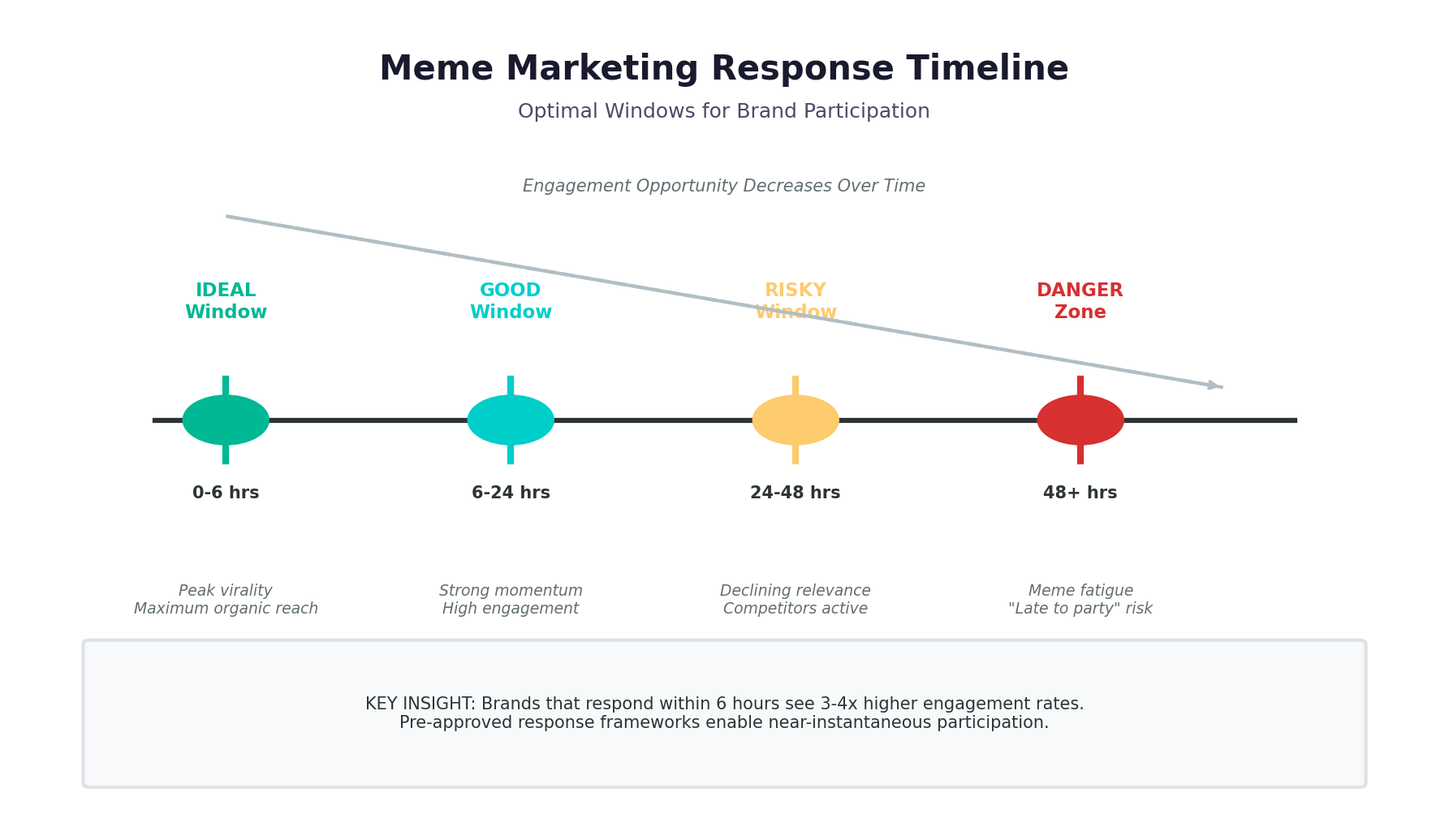
Traditional creative approval processes (often requiring 48-72 hours across multiple stakeholders) render brands incapable of participating in real-time cultural conversations. The most successful meme marketing teams have rebuilt their operational models around speed. Wendy's social media team, frequently cited as a benchmark for reactive engagement, operates with pre-approved response frameworks that enable near-instantaneous participation in trending conversations.
The operational implication extends beyond social media teams to legal, brand, and executive stakeholders. Companies serious about meme marketing must develop trust-based approval systems that empower front-line teams to make rapid decisions within established guardrails rather than requiring individual content approval for each post.
The authenticity paradox: why corporate memes often fail
Counter to conventional marketing logic, higher production values and more sophisticated creative execution often correlate with lower meme engagement. Analysis by Harvard Business Review researchers found that audiences evaluate social media content authenticity based on perceived effort signals. Content that appears "too polished" (like standard marketing graphics) triggers skepticism about corporate manipulation, while content with visible imperfections signals genuine participation in cultural conversation.
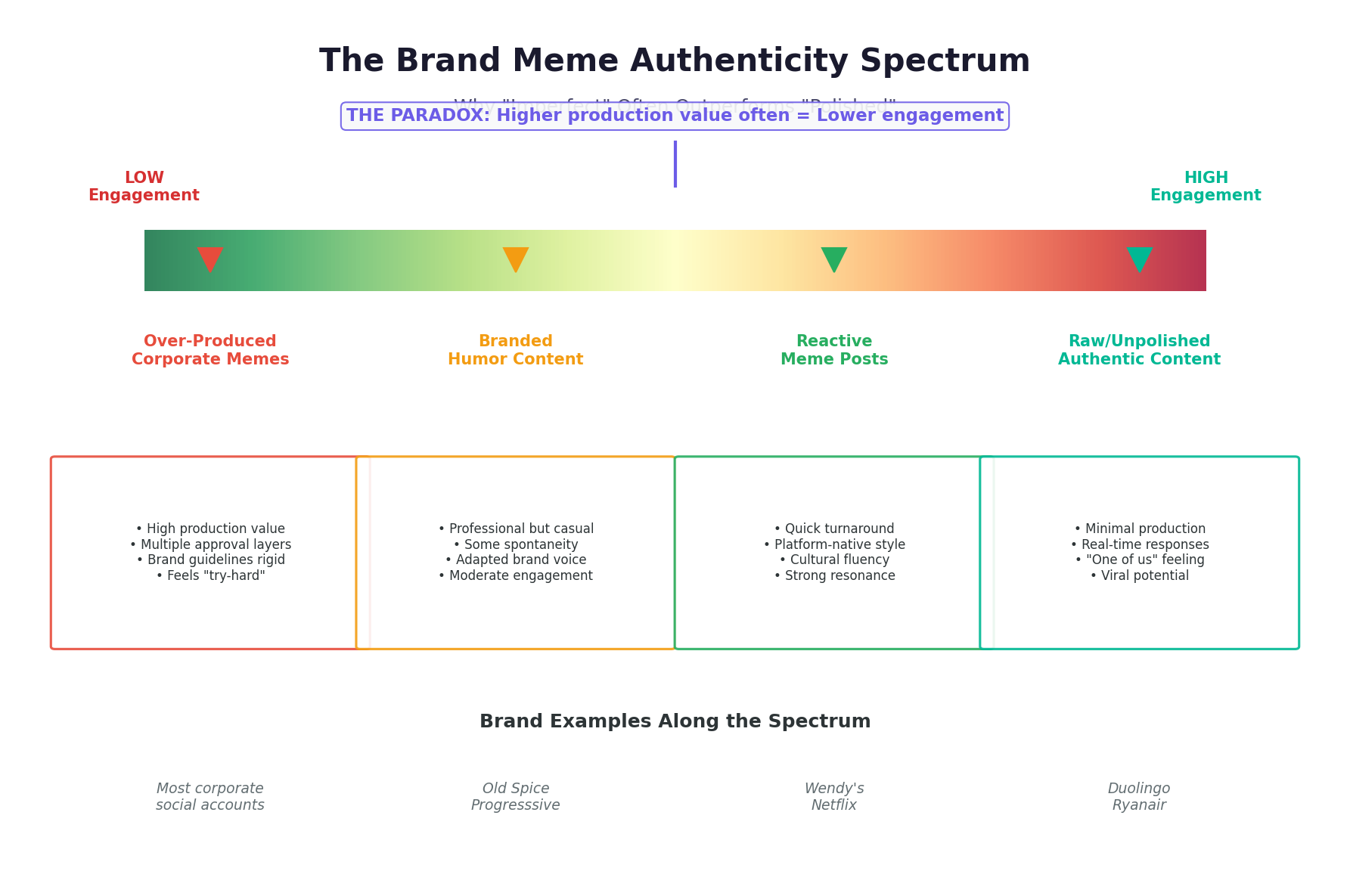
This creates a paradox for enterprise marketers accustomed to brand standards emphasizing visual consistency and professional execution. The answer isn't abandoning brand standards but developing distinct creative guidelines for humorous content that intentionally incorporate elements of informal production aesthetic. Some brands maintain separate visual identities for social content that diverge from their traditional advertising standards, allowing meme participation without diluting premium brand positioning in other channels.
The authenticity requirement also extends to voice and tone. Brands that typically communicate formally must develop distinct social personas that enable conversational engagement using their audience's language without appearing to mock their own shows of traditional positioning.
Real-world meme marketing examples and case studies
Wendy's: The gold standard of reactive engagement
Wendy's transformed its brand perception through aggressive social media engagement beginning in 2017. The fast-food chain's willingness to roast competitors and engage in conversational humor established a new template for corporate social media. Within 18 months of launching their new Twitter voice, Wendy's saw a 49.7% increase in Twitter followers and drove measurable increases in same-store sales during key promotional periods.
The strategic impact extended beyond social metrics. Wendy's reported that their social media transformation correlated with a significant increase in brand awareness among 18-24 year olds, a demographic that had previously shown declining engagement with fast-food advertising through traditional channels.
Netflix: Platform integration with meme culture
Netflix has systematically integrated meme marketing into its content promotion strategy, often using scenes from its own shows as source material for relevant memes. Their "Bird Box" meme campaign in late 2018 generated over 45 million views in the first week without paid promotion, and their social accounts routinely achieve engagement rates 3-4x higher than entertainment industry averages.
This approach proves how content platforms can leverage owned intellectual property for meme creation, maintaining complete control over source material while encouraging social media users to remix and share.
Duolingo: Building brand personality through chaos
The language-learning app Duolingo built significant brand awareness through its deliberately unhinged TikTok presence, featuring its owl mascot in increasingly absurd scenarios. By February 2023, their TikTok account had accumulated over 6.8 million followers and routinely generated 1-5 million views per video. The approach helped drive a 62% increase in daily active users year-over-year.
Duolingo's strategy involved embracing the existing memes about their aggressive push notifications rather than attempting to control brand narrative. Counterintuitive? Absolutely. But it converted potential criticism into an emotional connection and brand affection.
Aviation Gin (Ryan Reynolds): Celebrity-authentic humor
Ryan Reynolds' marketing approach for Aviation Gin exemplifies how celebrity involvement can enable meme marketing authenticity that corporate communications typically struggle to achieve. Their rapid-response campaigns (including a same-week response to Peloton's controversial holiday ad that generated over 8 million views in 48 hours) showed operational agility uncommon in alcohol marketing. Following the Peloton response, Aviation Gin saw a 15% sales spike in December 2019.
The insight here: celebrity ownership functions as an authenticity signal that enables comedic advertising approaches that would face greater skepticism under traditional corporate branding.
Slim Jim: Niche community integration
Slim Jim revitalized its brand through deep integration with gaming and wrestling communities on social media platforms. Under social media manager Andy Hines (known as "Memelord"), the brand's Instagram following grew from 5,000 to over 1.3 million followers between 2018 and 2020.
Their strategy focused on community-specific humor and organic engagement rather than attempting broad appeal, achieving disproportionate real results within passionate subcultures that then spread content to wider audiences.
Ryanair: Self-deprecating value positioning
The budget airline Ryanair developed a distinctive social media presence built on self-deprecating humor about its cost-cutting reputation. Their TikTok account surpassed 2 million followers by 2023, with individual videos regularly exceeding 10 million views. By embracing rather than defending against criticism, Ryanair transformed potential brand weaknesses into engagement opportunities.
Functional positioning and limited emotional differentiation? Doesn't matter. Brands can still develop distinctive voices through meme marketing that acknowledge and play with consumer perceptions.
Denny's: Surrealist brand voice
Denny's Tumblr presence established an unexpectedly surreal and philosophical brand voice for the casual dining chain. At its peak, the account accumulated over 500,000 followers and generated significant earned media coverage for a brand with minimal cultural relevance among younger audiences.
Their success proves that brands can develop entirely new audience relationships through platform-specific content strategies that diverge dramatically from traditional advertising approaches.
Old Spice: Platform-native campaigns
Old Spice's "The Man Your Man Could Smell Like" campaign (launched 2010) and subsequent real-time response initiatives established templates for interactive brand content that anticipated meme marketing dynamics. The campaign generated over 40 million YouTube views in its first week and drove a 107% increase in body wash sales. Their willingness to embrace absurdist humor within premium production values proved that meme marketing principles could apply to traditional advertising formats.
MoonPie: Regional brand revival
MoonPie leveraged social media humor to transform from a regional novelty product to a nationally recognized brand with distinctive personality. Their Twitter account grew from obscurity to over 300,000 engaged followers, and their 2017 total solar eclipse campaign generated over 17,000 retweets and widespread media coverage. Self-aware, nostalgic humor allowed a heritage brand to achieve relevance with younger consumers without abandoning core brand identity.
Chipotle: TikTok-first strategy
Chipotle developed significant Gen Z brand equity through aggressive TikTok investment, including meme-based challenges and content creators partnerships. Their #GuacDance challenge in 2019 generated 250,000 video submissions and 430 million video starts, while driving the highest single-day guacamole sales in company history. Restaurant brands can absolutely leverage platform-specific content strategies to drive measurable business outcomes beyond brand awareness.
Popeyes: Competitive confrontation
Popeyes' chicken sandwich launch in August 2019 achieved viral sensation status partly through strategic engagement with competitor Chick-fil-A. Their "...y'all good?" tweet generated over 325,000 retweets, and the resulting social media attention contributed to selling out the sandwich nationwide within two weeks. Brands can leverage competitive dynamics for meme marketing without appearing desperate or antagonistic.
BarkBox: Community understanding
Pet subscription service BarkBox built brand awareness through deep understanding of dog owner culture on social media. Their Instagram account grew to over 1.8 million followers with engagement rates consistently exceeding industry benchmarks by 200-300%. The content worked because it showed genuine community membership rather than external observation.
Liquid Death: Category disruption through absurdity
Canned water brand Liquid Death built its entire brand identity around meme marketing aesthetics. Founded in 2019, the company reached a $700 million valuation by 2022 largely through social-first marketing with minimal traditional advertising spend. New market entrants can use viral marketing to compete against established players without requiring comparable advertising budgets. They've come a long way from zero brand recognition to cultural phenomenon.
Aldi UK: Competitive personality
Aldi's UK social media presence developed a distinctive personality through playful engagement with larger competitors, particularly their long-running "Cuthbert vs Colin" cake rivalry with Marks & Spencer. The feud generated millions of impressions and significantly earned media coverage. Challenger brands can use meme marketing to achieve attention disproportionate to their market position.
Taco Bell: Consistent cultural engagement
Taco Bell has maintained long-term investment in culturally relevant social content since launching its revamped social strategy in 2012. Their consistent presence has contributed to positioning the brand as a cultural institution among younger consumers, with social engagement rates that consistently outperform QSR category averages. Sustained meme marketing commitment builds cumulative brand equity beyond individual viral moments.
Frequently Asked Questions
What makes meme marketing different from regular social media marketing?
It's about participation versus broadcast. Meme marketing specifically leverages existing cultural references and participates in shared internet humor, while general social media marketing encompasses all traditional content distributed through social platforms. Meme marketing requires cultural fluency and rapid response capabilities that differ from scheduled content strategies. You're joining conversations, not starting them.
How can brands measure the ROI of meme marketing campaigns?
Effective meme marketing measurement requires tracking both engagement metrics (shares, comments, reach) and downstream business indicators like website traffic, branded search volume, and conversion rates. Companies should establish attribution models that connect social engagement to sales funnels while recognizing that meme marketing often contributes to brand building rather than direct response. Many successful practitioners use incrementality testing to isolate meme campaign impact from baseline performance. The tricky part is that brand lift from memes often shows up months later in recall studies and purchase consideration surveys, so short-term ROI calculations can miss the bigger picture.
What industries should avoid meme marketing entirely?
None, really.
Highly regulated sectors (financial services, healthcare, legal services) face additional compliance considerations that may limit participation, but that doesn't mean total avoidance. Companies in these sectors can still engage through more conservative formats that show cultural awareness without regulatory risk. Developing industry-appropriate approaches works better than assuming universal exclusion.
How quickly do brands need to respond to trending memes?
Timing windows vary by meme format and platform but typically range from hours to two-three days for rapidly trending content. Companies that can't participate within 48 hours of peak momentum often find that late engagement generates backlash rather than positive response. Building operational capabilities for rapid response represents the primary requirement for effective meme marketing. You can even use a meme generator to speed up production, though the strategy behind it matters more than the tool.
What are the biggest legal risks in meme marketing?
Primary legal considerations include copyright infringement (using protected images or characters), trademark dilution (associating brands with potentially harmful content), and defamation (content that could be interpreted as attacking competitors or individuals). Brands should establish legal review frameworks that enable rapid clearance for common meme formats while flagging higher-risk content for detailed evaluation. Understanding fair use principles helps, though legal counsel should always review borderline cases.
Web Tonic works across SEO, paid search and paid social, and you can book a consultation to talk through your own plan.


