



Table of contents
Key Takeaways
- Start by clarifying your SEO goals, current performance baseline, and realistic budget before engaging with potential agencies
- Thoroughly vet candidates through case study review, reference checks, and detailed capability conversations to identify partners whose expertise matches your needs
- Watch for red flags including guaranteed rankings, secretive methods, unrealistic timelines, and inflexible contracts that prioritize agency interests over client outcomes
- Structure contracts with clear scope definitions, measurable KPIs, transparent reporting requirements, and fair termination provisions
- Maintain ongoing involvement through regular communication, timely approvals, and quarterly strategy reviews to maximize results from your SEO investment
- Consider consulting with a specialized SEO partner if evaluating options feels overwhelming. The right agency relationship can transform organic search into a significant revenue driver for your business
What Is SEO Outsourcing?
SEO outsourcing is the practice of delegating search engine optimization activities to external specialists, agencies, or consultants rather than handling these functions with internal staff. This approach allows businesses to access specialized expertise in technical audits, content optimization, link building, and ongoing strategy development without the overhead of building an in-house team.
According to the 2024 Deloitte Global Outsourcing Survey, 50% of executives now use outsourced services for front-office capabilities including marketing and digital functions. SEO (which encompasses technical, content, and off-page optimization) is particularly well-suited for external partnerships where agencies maintain dedicated specialists and invest in sophisticated tooling.
Google processes approximately 5.9 million searches every minute. The search landscape evolves constantly with algorithm updates, AI integrations, and shifting user behaviours. For mid-market and enterprise businesses, the decision to outsource SEO often comes down to resource allocation and competitive advantage. Companies that lack dedicated internal SEO resources frequently find themselves falling behind competitors who maintain continuous optimization efforts through agency partnerships.
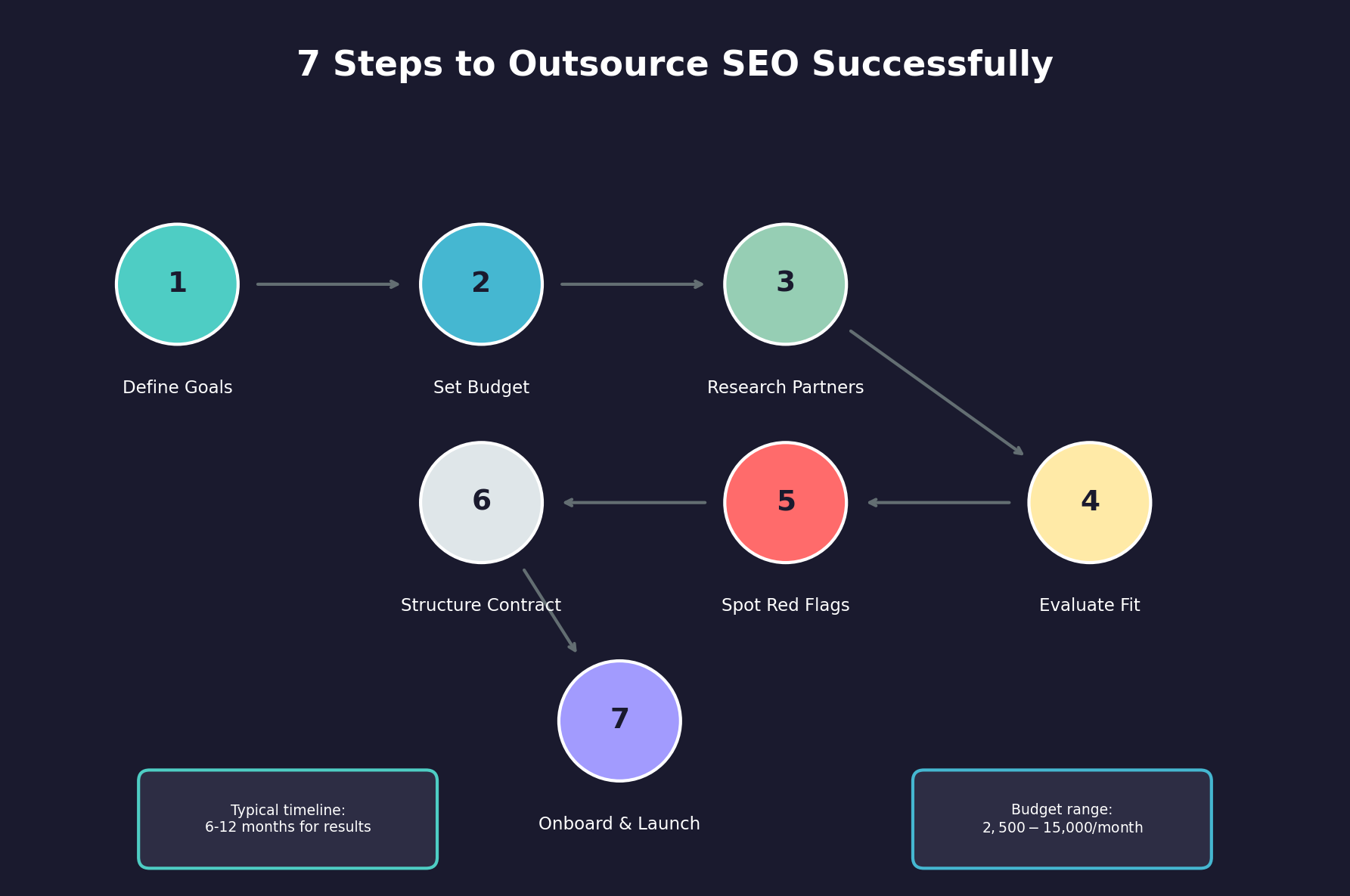
Step 1: Define Your SEO Goals and Current Situation
Before reaching out to any SEO agency, you need clarity on what you're trying to accomplish and where you currently stand. Without this, you risk misaligned expectations and wasted budget on partners who aren't the right fit.
Conduct an Internal Assessment
Document your current organic search performance including keyword rankings, organic traffic trends, conversion rates, and known technical issues. If you lack access to this data, the right agency will help establish proper tracking during onboarding.
Establish Measurable Objectives
Effective SEO goals connect to business outcomes rather than vanity metrics. According to HubSpot's marketing research, SEO leads have a 14.6% close rate compared to just 1.7% for outbound leads. Frame your goals around revenue impact, lead generation, or market share: increasing qualified organic traffic, improving conversion rates, expanding non-branded visibility, or building domain authority for competitive keywords.
Step 2: Determine Your Budget and Engagement Model
SEO outsourcing costs vary significantly based on scope, market competitiveness, and the pricing model you choose. Getting this right matters. Understanding the landscape helps you set realistic expectations and identify agencies operating at the quality tier appropriate for your needs.
Understanding SEO Pricing Structures
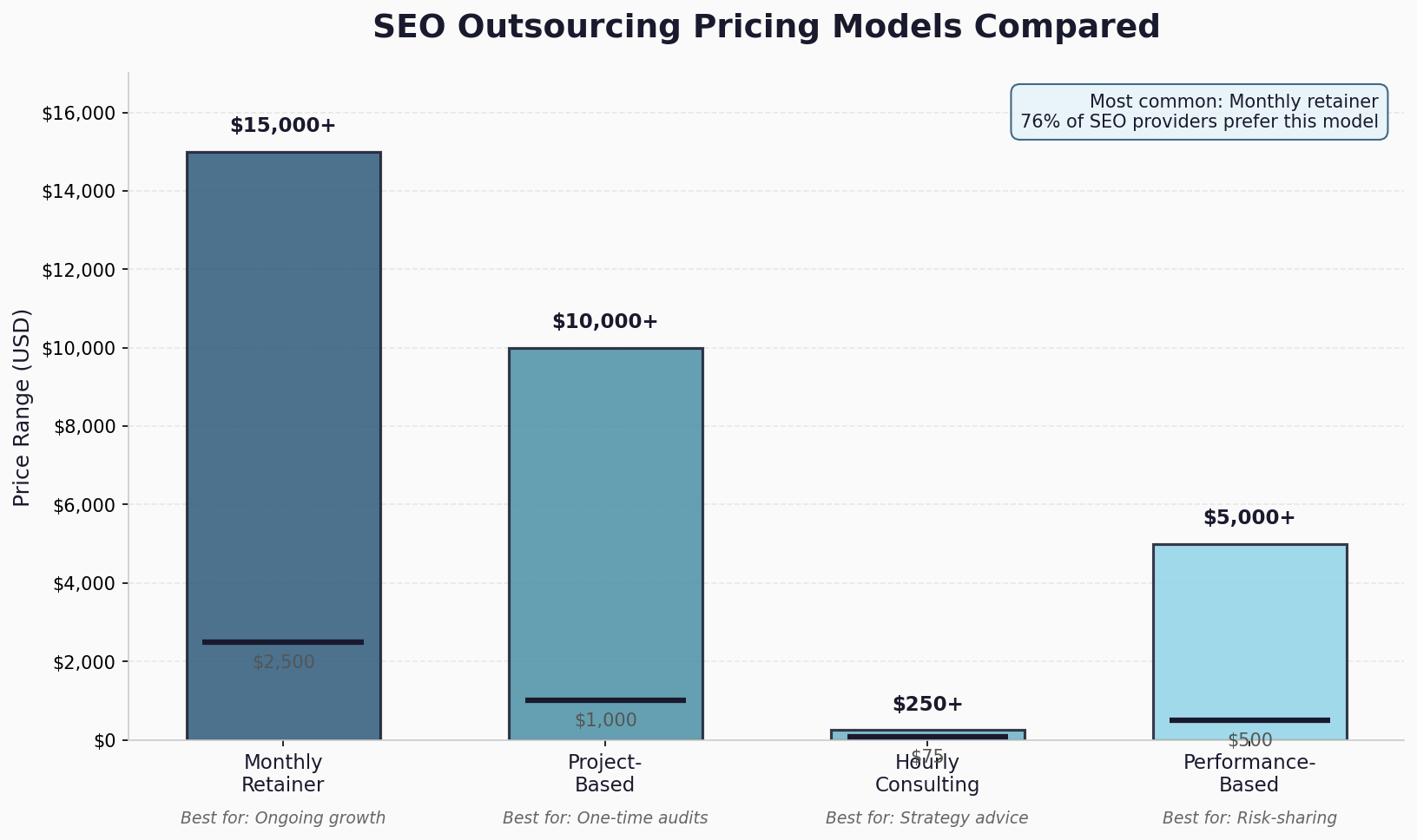
| Pricing Model | Typical Cost Range | Best Suited For |
|---|---|---|
| Monthly Retainer | $2,500–$15,000+ | Ongoing optimization and sustained growth |
| Project-Based | $1,000–$10,000+ | Specific initiatives like audits or migrations |
| Hourly Consulting | $75–$250/hour | Advisory services and strategy guidance |
| Performance-Based | Varies | Risk-sharing arrangements (less common) |
According to industry data, the average cost of SEO services falls between $25 and $199 per hour, with $150 being the most common rate for experienced professionals in North America. Small businesses typically invest $2,500–$4,000 monthly for comprehensive SEO management, while enterprise clients often spend $7,500–$15,000+ for multi-faceted programs covering technical, content, and link building initiatives.
Retainer vs. Project-Based Engagement
Most SEO professionals prefer retainer arrangements because search optimization requires sustained effort over time. Research indicates that 76% of SEO providers prefer retainers as they allow for continuous monitoring, strategic adjustments, and compounding results. SEO efforts typically take 6–12 months to show measurable impact, making month-to-month project work less effective for most businesses.
Project-based pricing works well for discrete needs like technical audits, site migration planning, or initial strategy development. Many agencies offer hybrid models that combine a foundation project in the first one to two months with an ongoing retainer for continued optimization.
Step 3: Research and Shortlist Potential Partners
With clear goals and budget parameters established, you can begin identifying agencies that match your requirements. Effective research goes beyond simple Google searches and involves multiple evaluation criteria.
Where to Find Quality SEO Agencies
Start with industry directories and review platforms like Clutch, UpCity, and G2. These aggregate client reviews and provide verified information about agency capabilities, pricing ranges, and industry specializations. Most include filters for location, budget, and service focus that help narrow your search efficiently.
Referrals from peers in non-competing businesses often yield the most reliable recommendations. Marketing professionals who have direct experience with an agency can provide candid insights about communication quality, results delivery, and working relationship dynamics that public reviews may not capture.
Agency thought leadership serves as a proxy for expertise. Look for agencies that publish substantive content, contribute to industry publications, or present at conferences. According to Search Engine Land's hiring guide, agencies demonstrating thought leadership through speaking engagements and expert content typically deliver stronger results than those without visible industry presence.
Initial Screening Criteria
When evaluating potential partners, assess the following before scheduling discovery calls:
Experience relevance: Review their client portfolio for businesses similar to yours in size, industry, or competitive landscape. Agencies with experience in your sector understand unique challenges and effective strategies specific to your market.
Case study verification: Look for documented results with specific metrics, timelines, and methodologies. Vague claims of "increased traffic" without quantifiable context suggest a lack of systematic tracking or disappointing actual results.
Team composition: Understand who will work on your account. Some agencies assign one specialist to handle over 100 accounts, leaving insufficient time for meaningful attention to any single client.
Step 4: Evaluate Agency Capabilities and Culture Fit
Once you've identified promising candidates, deeper evaluation reveals whether an agency can deliver on their promises and whether the working relationship will function smoothly.
Questions to Ask During Discovery Calls
The questions you ask during initial conversations help distinguish genuinely capable agencies from those that simply present well. Experienced SEO providers welcome detailed questioning.
Key questions to cover:
- How do you develop keyword and content strategies for new clients?
- What's your process for technical audits and prioritizing fixes?
- How do you approach link building, and what tactics do you use?
- Who specifically will work on our account, and what's their experience?
- How many clients does each specialist typically manage?
- Can you share detailed case studies from similar situations?
- What does a typical timeline look like for meaningful results?
Assessing Cultural Alignment
Technical capability matters, but so does working relationship quality. Agencies that involve clients in strategy development, provide education about their methods, and maintain transparent communication typically deliver better long-term results than those operating as black boxes.
During your evaluation, notice how responsive the agency is during the sales process. If they're difficult to reach before you've signed a contract, expect similar challenges after you become a client. The best agencies treat the discovery phase as a mutual evaluation rather than a one-sided sales pitch.
Step 5: Identify Red Flags and Warning Signs
The SEO industry unfortunately includes practitioners who deliver substandard work or employ tactics that can harm your website's long-term performance. Knowing what to avoid protects your investment and prevents costly mistakes.
Critical Warning Signs
Guaranteed rankings: No legitimate SEO professional can guarantee specific ranking positions. As Google's official guidance states, businesses should be wary of SEO firms that guarantee rankings or claim special relationships with Google. Search algorithms consider hundreds of factors beyond any single agency's control, including competitor actions, algorithm updates, and market dynamics.
Secretive methodologies: Credible agencies explain their approaches in understandable terms. When an agency refuses to share details about how they work, citing "trade secrets" or proprietary methods, it often indicates they're using tactics they know clients wouldn't approve of or that won't withstand scrutiny.
Unrealistic timelines: SEO takes time. Promises of dramatic results within 30 days or immediate first-page rankings typically signal black-hat tactics that may produce short-term gains but result in penalties and long-term damage. Legitimate SEO results typically begin appearing within 3–6 months, with more significant improvements visible after 6–12 months.
Lack of transparent reporting: Agencies that only provide automated reports without context or regular strategy discussions aren't delivering the consultative value you're paying for. Quality partners provide detailed reports showing both successes and areas for improvement, along with regular check-ins to discuss performance and strategic adjustments.
Additional Red Flags to Monitor
| Warning Sign | Why It Matters |
|---|---|
| Emphasis on link quantity over quality | Suggests outdated or potentially harmful link schemes |
| No interest in your business goals | Indicates a cookie-cutter approach rather than customized strategy |
| Rigid, inflexible packages | Shows inability to adapt to your specific needs |
| Unusually low pricing | May indicate offshore resources, lack of expertise, or cutting corners |
| Long-term contracts without exit clauses | Prioritizes agency revenue security over client satisfaction |
Step 6: Structure the Contract and Engagement Terms
A well-structured agreement protects both parties and establishes clear expectations for the working relationship. Don't rush through contract review. The terms you agree to will govern the partnership for months or years.
Essential Contract Elements
Scope of services: The agreement should precisely define what's included each month, such as technical audits, content optimization, link building outreach, and reporting. Ambiguous scope definitions lead to disagreements about what work was promised versus delivered. Terms like "ongoing optimization" need specific deliverables attached.
Key performance indicators: Establish how success will be measured and reported. Effective KPIs connect to business outcomes: organic traffic to specific page categories, conversion rates from organic visitors, or ranking positions for priority keyword clusters. Regular reports should avoid contracts that only track vanity metrics like total keywords ranked or raw traffic numbers without context.
Reporting cadence and format: Expect monthly reports at minimum, with strategic review calls to discuss findings and recommendations. The best agencies provide dashboards and insights you can act on, not just data dumps that require interpretation.
Term and termination provisions: Most SEO retainers run for 3–12 months. Shorter terms often don't provide enough time for strategies to show measurable results, while longer commitments require fair exit clauses. Look for reasonable termination provisions, typically 30–60 days' notice, that allow you to exit if the engagement with SEO experts isn't working.
Ownership and intellectual property: You should own all content, technical implementations, and strategic assets created under the retainer. If the contract states the agency retains control after you leave, that's a significant red flag.
Protecting Your Investment
Include provisions that prohibit black-hat tactics explicitly, as part of the scope of work. Specify that the agency must follow search engine guidelines and that any penalties resulting from their work will be addressed at their expense. Request an NDA to protect confidential business information shared during the engagement.
Step 7: Establish Onboarding and Communication Protocols
How an engagement begins often predicts how it will progress. Structured onboarding and clear communication expectations set the foundation for productive long-term collaboration.
Effective Onboarding Practices
Quality agencies follow systematic onboarding that includes access provisioning to analytics platforms, stakeholder interviews to understand business context, baseline audits documenting current performance, and strategy development sessions aligning SEO plans with search engine optimization efforts and business objectives. This foundation phase may take 2–4 weeks for complex sites but pays dividends through better-targeted strategies.
Establishing Communication Rhythm
Define expectations for regular touchpoints before the engagement begins: weekly status updates, monthly performance reports with detailed metrics, quarterly strategy reviews, and ad-hoc channels for urgent questions. The right frequency depends on engagement scope and your internal resources. Discuss preferences upfront to ensure alignment.
Successful SEO partnerships require collaboration from both sides. Be prepared to provide timely approvals, share business context affecting strategy, and maintain open dialogue about performance. According to the Conductor State of SEO Report, 91% of marketers at a digital marketing agency reported that SEO positively impacted website performance and marketing goals in 2024.
Common Misconceptions
Misconception 1: The cheapest option delivers the same results
There's a floor below which SEO services can't deliver meaningful value. Agencies offering comprehensive SEO for $300–500 monthly simply cannot allocate sufficient expert time, quality tools, or content resources to move the needle for competitive keywords, including essential elements like keyword research. These engagements often rely on automated reports, templated recommendations, and minimal actual optimization work.
Think about the math. Experienced specialists with effective SEO tools command meaningful compensation. Enterprise-grade tools carry subscription costs. Quality content creation takes time. When pricing seems too good to be true, one of these components is being shortchanged.
Misconception 2: You can set it and forget it once hired
Outsourcing SEO doesn't mean abdicating involvement entirely. The most successful engagements involve clients who remain engaged partners: providing business context, approving strategies, and offering feedback on results. Agencies work best when they understand your priorities, competitive landscape, and how organic search fits into the benefits of SEO and broader marketing objectives.
SEO strategies also require ongoing refinement based on performance data, algorithm changes, and competitive movements, forming a crucial aspect of a comprehensive digital marketing strategy. Quarterly strategy reviews ensure your program adapts to evolving conditions rather than executing a static plan that may become outdated.
Misconception 3: Rankings are the only metric that matters
While rankings serve as useful leading indicators, they don't directly translate to business value for your target audience. A page ranking first for a low-volume, low-intent keyword may generate less revenue impact than a page ranking fifth for a high-value commercial term. Sophisticated SEO programs focus on traffic quality, engagement metrics, and conversion performance alongside ranking positions.
The rise of AI Overviews, featured snippets, and other SERP features also means traditional ranking positions no longer tell the complete online visibility story. According to Conductor's research, 63% of respondents reported that Google's AI Overviews positively impacted organic traffic, visibility, or rankings since rollout. Optimizing for these new search experiences matters as much as traditional rank tracking.
Real-World Examples and Case Studies
Wildfire: E-Commerce SEO Transformation
Wildfire, an outdoor recreation equipment retailer, partnered with an external SEO agency to address stagnating organic growth and enhance their business growth. By implementing an AI-powered strategy focused on product page optimization and category structure improvements, the company achieved more than 60% increase in revenue from search traffic compared to the previous year, along with significant improvements in conversion rates and average order value.
SaaS Company Technical Turnaround
A B2B SaaS company approached an SEO agency after their new website launch caused significant traffic declines. The agency conducted a comprehensive technical audit, optimized existing content with updated keywords, and developed new content marketing targeting qualified leads. They also extended SEO support to social media profiles and YouTube presence. The engagement recovered lost rankings and established sustainable organic growth.
Frequently Asked Questions
How long does it take to see results from outsourced SEO?
Meaningful SEO results typically take 3–6 months to begin materializing, with substantial improvements visible after 6–12 months. The timeline for achieving faster results depends on current authority, competitive intensity, and implementation speed. Agencies should show leading indicators (improved crawlability, new rankings, growing impressions) before dramatic traffic changes.
Should I hire a freelancer or an agency for SEO services?
Freelancers work well for smaller sites with straightforward needs, offering access to one dedicated expert. Agencies bring teams including strategists, content writers, and technical SEOs, providing broader skills and scalability at higher cost, ultimately leading to better results. Choose based on your budget, site complexity, and management bandwidth.
What should be included in monthly SEO reports?
Comprehensive reports include keyword ranking changes, organic traffic trends by page category, conversion metrics, technical health indicators, completed deliverables, and upcoming recommendations. The best agencies provide actionable insights explaining what numbers mean for your business to achieve the best results.
How do I know if my SEO agency is using ethical practices?
Request detailed explanations of link building, content creation, and technical optimization approaches from your SEO team. Ethical agencies explain tactics in plain language and demonstrate alignment with search engine guidelines. Warning signs include sudden traffic spikes followed by crashes or manual action notifications.
Can I combine outsourced SEO with an in-house team?
Yes, hybrid models have become increasingly common. According to Conductor research, 49% of companies took a hybrid approach in 2024. This works well when internal teams handle content like blog posts and implementation while external specialists provide strategic direction, audits, and specialized services like link building.


