



Table of contents
Key Takeaways
- Begin with a thorough assessment of your current marketing capabilities and gaps to identify which functions will benefit most from external expertise
- Define specific, measurable objectives before engaging agencies—clear goals enable both accountability and meaningful performance evaluation
- Invest significant effort in partner selection, evaluating experience, case studies, cultural fit, and communication style alongside capabilities and pricing
- Negotiate comprehensive service level agreements that establish expectations, metrics, and governance structures protecting both parties
- Maintain active involvement through regular performance reviews, strategic discussions, and open communication rather than treating outsourcing as a hands-off arrangement
- Recognize that successful outsourcing requires ongoing optimization—the best partnerships evolve with your business needs and market conditions
- Consider engaging specialized expertise to guide your outsourcing strategy if the process feels overwhelming or if stakes are particularly high for your organization
What Is Marketing Outsourcing?
It refers to the practice of delegating all or part of your marketing activities to an external agency, consultancy, or specialized service provider rather than handling them internally. This encompasses a broad spectrum of functions including SEO, content creation, paid advertising management, social media marketing, email campaigns, and strategic planning.
The practice has evolved significantly over the past decade. According to Deloitte's 2024 Global Outsourcing Survey, organizations increasingly focus on front-office and core capabilities like sales, marketing, and R&D to unlock incremental value. This marks a shift from the traditional back-office functions that dominated outsourcing decisions historically. The survey found that skilled talent and agility have now joined cost reduction as primary drivers for outsourcing decisions, with only 34% of businesses citing cost savings as their primary motivator compared to 70% in 2020.
That's a dramatic shift in just four years.
For mid-market and enterprise-level businesses, marketing outsourcing presents a strategic opportunity to access expertise that would be prohibitively expensive or difficult to recruit internally. Whether you're a growing company lacking bandwidth for sophisticated campaigns or an established organization seeking specialized skills in emerging channels, outsourced marketing services can bridge capability gaps while allowing internal teams to focus on core business operations.

The 8 Steps to Successful Marketing Outsourcing
Step 1: Assess Your Current Marketing Capabilities and Gaps
Before engaging any external partner, conduct a thorough audit of your existing marketing function. This assessment should identify what's working, what's underperforming, and where critical gaps exist in your capabilities.
Start by documenting your current marketing activities and their outcomes. Evaluate the skills present in your internal team against the demands of your marketing strategy. Consider which functions require specialized expertise that would be difficult or expensive to develop internally (technical SEO, programmatic advertising, or marketing automation implementation are common examples).
During your assessment, you'll want to answer several critical questions: Which marketing channels currently drive the highest ROI? Where are you experiencing the longest delays or bottlenecks? What specialized skills are missing from your internal team? Which activities consume disproportionate time relative to their impact? And perhaps most importantly, what would you accomplish if resource constraints simply disappeared?
This diagnostic work helps you determine which functions to outsource and articulate clear requirements to potential partners.
Step 2: Define Clear Objectives and Success Metrics
Vague goals kill outsourcing relationships. Before approaching agencies, establish specific, measurable objectives for your outsourced marketing activities. These goals should align directly with broader business outcomes rather than vanity metrics.
Effective objectives follow the SMART framework: Specific, Measurable, Achievable, Relevant, and Time-bound. Rather than stating you want to "improve SEO," specify that you want to "increase organic traffic by 40% and generate 150 qualified leads monthly through organic search within 12 months."
| Objective Type | Weak Example | Strong Example |
|---|---|---|
| Lead Generation | "Get more leads" | "Generate 200 MQLs monthly with <$50 cost per lead within Q3" |
| Brand Awareness | "Improve visibility" | "Increase branded search volume by 60% and social following by 10,000 within 6 months" |
| Revenue Impact | "Drive sales" | "Achieve $500,000 in marketing-attributed revenue with 5:1 ROAS by year-end" |
| Content Marketing | "Create more content" | "Publish 12 pillar pages achieving page-one rankings for target keywords within 9 months" |
Documented objectives become the benchmarks against which you'll evaluate agency performance. They also inform the service level agreements you'll negotiate in subsequent steps.
Step 3: Determine Which Marketing Functions to Outsource
Not all marketing functions are equally suited to outsourcing. The decision of what to delegate versus retain internally depends on strategic importance, required institutional knowledge, and the availability of external expertise.
Functions that typically work well with external partners include search engine optimization and technical website optimization, pay-per-click advertising and paid media management, content creation, social media management, marketing automation and email campaign execution, graphic design, and market research. These activities tend to be execution-heavy with established best practices that agencies have refined across dozens of clients.
But some functions often stay better in-house. Brand strategy and positioning decisions, product marketing requiring deep product knowledge, customer relationship management for existing accounts, marketing strategy aligned with confidential business objectives, and internal communications typically benefit from the institutional context that only your team possesses.
According to industry research, digital marketing is outsourced by 34% of small businesses, following accounting (37%) and IT services (37%) as the most commonly outsourced functions. The decision ultimately depends on your specific circumstances, but execution-heavy activities generally make better outsourcing candidates than strategic functions requiring deep organizational context.
Step 4: Establish Your Budget and Pricing Model Expectations
Money matters. And understanding the cost landscape for outsourced marketing services enables informed decision-making and realistic expectation-setting.
Pricing varies significantly based on agency size, geographic location, specialization, and service scope. You'll typically encounter five pricing models in the market. Monthly retainers offer a fixed fee for ongoing services with defined scope, ideal for long-term partnerships with predictable workloads. Project-based pricing works as a one-time fee for specific deliverables like website redesigns, campaign launches, or audits. Hourly rates mean you pay for actual time spent, best suited for consulting, ad-hoc support, or overflow work. Performance-based models tie compensation to results achieved, common in lead generation or paid media with clear attribution. And hybrid arrangements combine retainer fees with performance bonuses, balancing predictability with performance incentives.
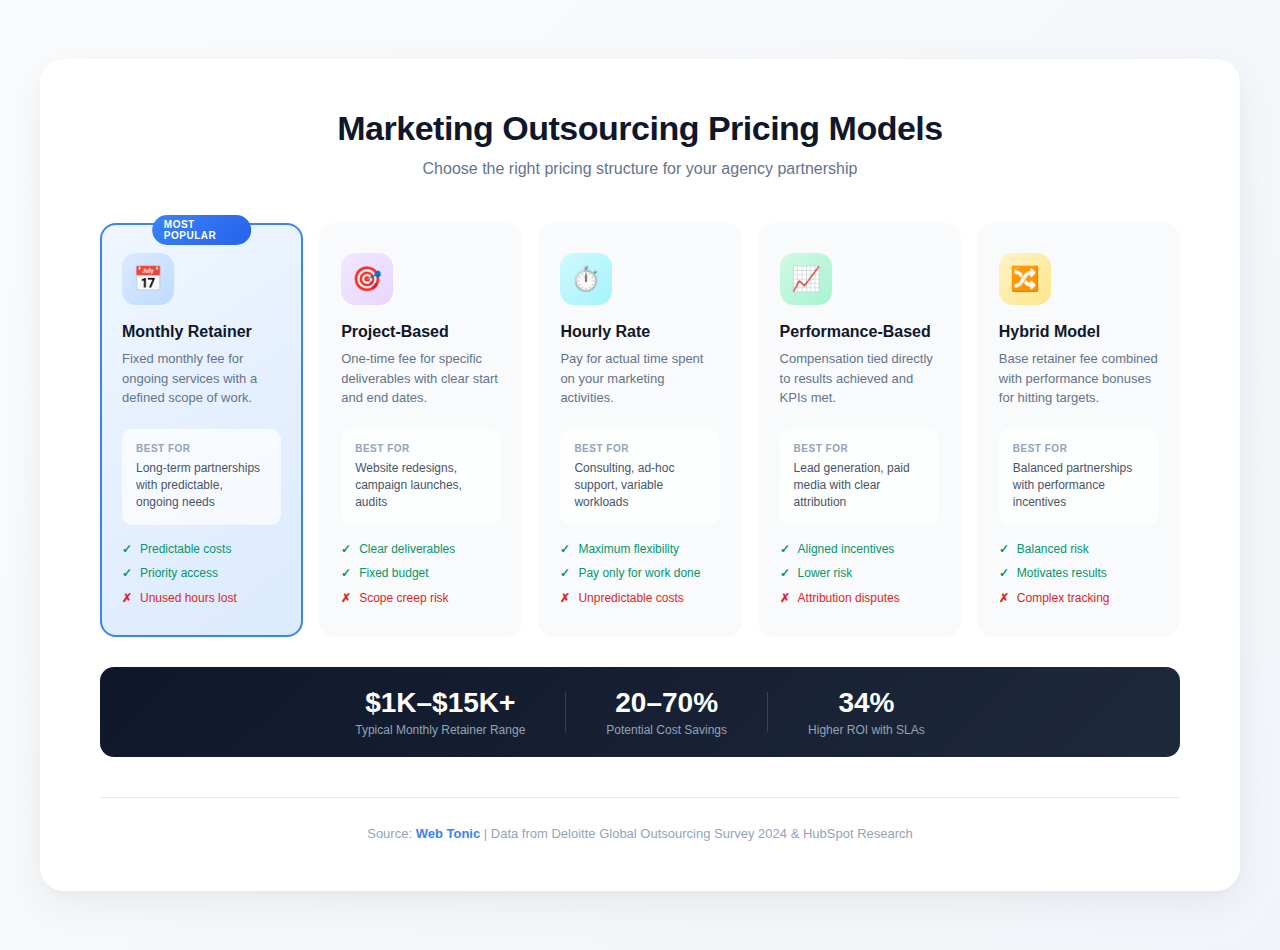
According to industry benchmarks, monthly retainers for outsourced marketing services typically range from $1,000 to $15,000 or more, with full-service agencies commanding higher fees. When comparing costs, factor in the total expense of building equivalent internal capabilities, including salaries, benefits, software subscriptions, training, and management overhead. Research from Deloitte indicates that organizations can save 20% to 70% through outsourcing depending on industry and project complexity, with savings primarily coming from reduced labour costs, lower overhead, and improved efficiency through automation.
Step 5: Vet and Select the Right Marketing Partner
This step will make or break your outsourcing success. A rigorous vetting process minimizes the risk of misalignment and sets the foundation for productive collaboration.
When evaluating potential partners, look for agencies with demonstrated success in your sector who understand your competitive landscape, regulatory constraints, and audience dynamics. Determine whether you need a full-service agency or specialized boutique partners for specific channels. Request documented examples of results achieved for comparable clients, including specific metrics and methodologies. Understand who will actually work on your account daily, their experience levels, and how account management is structured. Assess communication styles, responsiveness, and alignment with your organizational values. Evaluate the tools and platforms they use and their compatibility with your existing systems. And always speak directly with current and former clients about their experiences.
Watch for red flags too. Reluctance to share specific performance data should give you pause. So should overpromising results or guaranteeing rankings (no legitimate SEO agency can guarantee rankings). Lack of clarity on who will handle your account, excessive jargon without substantive explanation, inability to explain their methodology, and high staff turnover all signal potential problems ahead.
Request proposals from multiple agencies to compare approaches, pricing, and strategic thinking. The proposal process itself reveals much about how the agency operates and communicates.
Step 6: Negotiate a Comprehensive Service Level Agreement
A well-structured service level agreement (SLA) protects both parties and creates clarity around expectations, deliverables, and accountability. According to HubSpot research, companies with active SLAs are 34% more likely to experience greater year-over-year ROI than those without agreements in place.
Your SLA should cover scope of work (detailed description of services included and explicit exclusions), deliverables and timelines (specific outputs with corresponding deadlines), performance metrics (KPIs that will be tracked and reported, including targets), reporting cadence (frequency and format of performance reporting), communication protocols (expected response times, meeting schedules, and escalation procedures), revision policies (number of included revisions and process for additional changes), confidentiality terms (protections for proprietary information and data), termination clauses (notice requirements and conditions for ending the engagement), and intellectual property (ownership of created assets and content).
Research indicates that businesses with SLA-defined contracts see a 28% higher satisfaction rate compared to those without formal agreements. Take time to negotiate terms thoroughly. This document becomes your reference point for the entire relationship.
Step 7: Onboard Your Marketing Partner Effectively
The transition period immediately following partner selection significantly impacts long-term success. Effective onboarding establishes the knowledge foundation and working rhythms that will characterize your ongoing relationship.
Don't underestimate this phase.
Your onboarding should cover company history, mission, and competitive positioning along with product or service details, pricing, and differentiation. Share target audience profiles and buyer personas, brand guidelines including voice, tone, and visual standards, and access credentials for relevant platforms and tools. Provide historical marketing data and performance benchmarks, organizational structure and key stakeholder contacts, existing content assets and marketing collateral, and any compliance requirements or industry regulations that affect marketing execution.
Schedule intensive discovery sessions during the first weeks of engagement. The investment in thorough knowledge transfer pays dividends through more relevant, on-brand marketing execution from the outset. Establish regular communication rhythms including weekly check-ins for tactical coordination and monthly strategic reviews for performance assessment. Clear reporting templates and dashboards ensure both parties work from the same information.
Step 8: Monitor Performance and Optimize the Relationship
Outsourcing marketing isn't a set-and-forget arrangement. Ongoing governance ensures the partnership continues delivering value and adapting to changing business needs.
Strong governance means reviewing performance against SLA metrics monthly, conducting quarterly strategic reviews to assess goal alignment, soliciting feedback from internal stakeholders interacting with the agency, documenting learnings and incorporating insights into refined processes, addressing concerns promptly before they escalate, and celebrating successes when they happen. According to Deloitte's research, 30% of organizations face difficulties managing outsourced teams, but clear expectations and regular updates significantly improve collaboration outcomes.
When performance falls short, engage in direct, constructive dialogue focused on solutions rather than blame.
Periodically reassess whether the outsourcing arrangement continues serving your evolving needs. Business growth, strategy shifts, or changing market conditions may warrant adjusting the scope, adding new partners for emerging channels, or even bringing certain functions back in-house.
Common Misconceptions About Marketing Outsourcing
Misconception 1: Outsourcing Means Losing Control Over Your Marketing
Many executives hesitate to outsource marketing because they fear relinquishing control over brand messaging and campaign direction. In practice, well-structured outsourcing relationships enhance rather than diminish control through superior reporting, defined approval workflows, and access to specialized expertise that enables more sophisticated strategies.
When you define approval hierarchies, brand guidelines, and communication protocols within your SLA, you maintain strategic direction while delegating execution. Effective agencies function as extensions of your team, not replacements for your judgment.
Misconception 2: Only Large Enterprises Benefit from Marketing Outsourcing
The perception that outsourcing is exclusively for large corporations with substantial budgets is outdated. According to industry research, over one-third of small businesses outsource at least one business process, with 83% planning to increase or maintain their outsourcing spending. Smaller organizations often benefit proportionally more from outsourcing because they gain access to expertise and capabilities that would be impossible to build internally.
For growing companies, outsourced marketing provides scalability without the commitment and risk of full-time hires. You can access senior-level strategic thinking and specialized execution skills without carrying the overhead during slower periods.
Misconception 3: In-House Marketing Always Delivers Better Quality
The assumption that internal teams inherently produce superior work ignores the advantages external agencies bring. Agencies serve multiple clients across industries, exposing them to diverse challenges and solutions that inform their recommendations for your business. They invest continuously in training, tools, and methodology development because marketing excellence is their core competency.
According to the Fournaise Marketing Group, 90% of marketers aren't trained in marketing performance and ROI measurement. External agencies specializing in performance marketing often bring more rigorous analytical capabilities than generalist internal teams.
The quality comparison depends on specific circumstances, but outsourcing to competent partners frequently delivers equivalent or superior outcomes while freeing internal resources for activities requiring deep organizational knowledge.
Real-World Examples and Case Studies
Premier Radiology: Digital Marketing Strategy Transformation
Premier Radiology, a healthcare services provider, partnered with an external digital marketing agency to develop a comprehensive online strategy. By outsourcing their marketing activities, Premier Radiology was able to focus on their core medical services while leveraging external expertise to enhance their online presence. The collaboration resulted in significant increases in website traffic and patient engagement, demonstrating how healthcare organizations can benefit from specialized marketing partners who understand regulated industry requirements.
Rubbermaid Commercial Products Australia: Integrated SEO and PPC Success
Rubbermaid Commercial Products Australia achieved remarkable results through an integrated marketing approach combining outsourced SEO content with targeted PPC advertising. According to documented case results, this integration delivered a 55% increase in site conversions from combined organic and paid traffic. The partnership enabled higher visibility of blog posts through targeted ads, driving more qualified traffic to high-performing content and demonstrating the synergistic potential of coordinated outsourced marketing services.
Frequently Asked Questions
What marketing functions are most commonly outsourced?
The most commonly outsourced marketing functions include search engine optimization, content creation, social media management, pay-per-click advertising, and email marketing. According to industry data, digital marketing is outsourced by approximately 34% of businesses, with content creation and SEO being particularly popular candidates due to the specialized expertise required for effective execution.
How much does it cost to outsource marketing?
Costs vary significantly based on scope, agency size, and geographic location. Monthly retainers typically range from $1,000 to $15,000 or more for comprehensive services. Project-based engagements may cost anywhere from a few thousand dollars for a specific campaign to six figures for major initiatives like website redesigns or product launches. Companies generally find that outsourcing costs less than building equivalent internal capabilities when factoring in salaries, benefits, tools, and management overhead.
How do I know if my business is ready to outsource marketing?
Your business may be ready for marketing outsourcing if you're experiencing any of these situations: marketing tasks consistently fall behind schedule due to resource constraints, you need specialized skills your team lacks, growth demands exceed your current capacity, or you want to access strategic expertise without full-time hiring commitments. The key readiness indicator is having clear business objectives and the ability to manage an external relationship effectively.
What should I include in a marketing agency contract?
Essential contract elements include detailed scope of work, specific deliverables with timelines, performance metrics and targets, reporting frequency and format, communication protocols, revision policies, confidentiality provisions, intellectual property ownership, payment terms, and termination conditions. According to research, businesses with comprehensive SLAs experience significantly higher satisfaction rates and ROI compared to those with informal arrangements.
How long does it take to see results from outsourced marketing?
Timeline expectations vary by channel and objective. Paid advertising can generate immediate traffic and leads, while SEO typically requires 6-12 months to achieve meaningful organic ranking improvements. Content marketing builds compounding returns over time. When evaluating partners, establish realistic timeline expectations based on the specific services engaged and the competitiveness of your market. Short-term campaigns should show measurable impact within weeks, while long-term strategies require patience and consistent investment.


