



Table of contents
Key Takeaways
- Launching an ICO requires comprehensive preparation across legal, technical, marketing, and operational domains, with 6-12 months of planning being typical for serious projects
- Regulatory compliance is essential: engage securities counsel early to determine token classification and appropriate exemptions before any public communications
- Tokenomics design and whitepaper development deserve significant investment, as these elements receive intense scrutiny from sophisticated investors
- Smart contract security requires professional auditing before mainnet deployment, as vulnerabilities can result in catastrophic fund losses
- Community building and transparent communication drive long-term success more than short-term marketing hype
- Post-ICO execution determines whether your project achieves lasting value, with roadmap delivery and exchange listings being critical milestones
- Consider engaging specialized ICO development and marketing partners to complement internal capabilities, particularly in areas requiring deep blockchain expertise
What Is an ICO?
An Initial Coin Offering is a blockchain-based fundraising mechanism that enables startups and projects to raise capital by issuing and selling digital tokens to investors. Unlike IPOs that distribute company shares, ICOs distribute cryptocurrency tokens that may provide utility within a project's ecosystem or represent value within the blockchain network.
According to research published in the Journal of Corporate Finance, ICO white papers serve as the primary information source for investors, with technical content proving most value-relevant for identifying successful projects. The study analyzed over 5,210 white papers between 2015 and 2021, finding that topics covering blockchain application, network development, and data management received the most attention from successful projects.
The ICO landscape has matured significantly since Bitcoin's emergence. The U.S. Securities and Exchange Commission (SEC) has established clear frameworks for evaluating token offerings, with the SEC's Framework for Investment Contract Analysis providing guidance on when digital assets qualify as securities. This regulatory clarity, combined with lessons learned from the 2017-2018 market cycle, has created a more structured environment for legitimate blockchain projects.
For mid-market and enterprise businesses, understanding ICO mechanics is crucial whether you're launching your own token sale or evaluating investment opportunities in the blockchain space. The fundraising model offers distinct advantages: global investor access, automated distribution through smart contracts, and the ability to create tokens with genuine utility within your business ecosystem.
The 10-Step ICO Launch Process
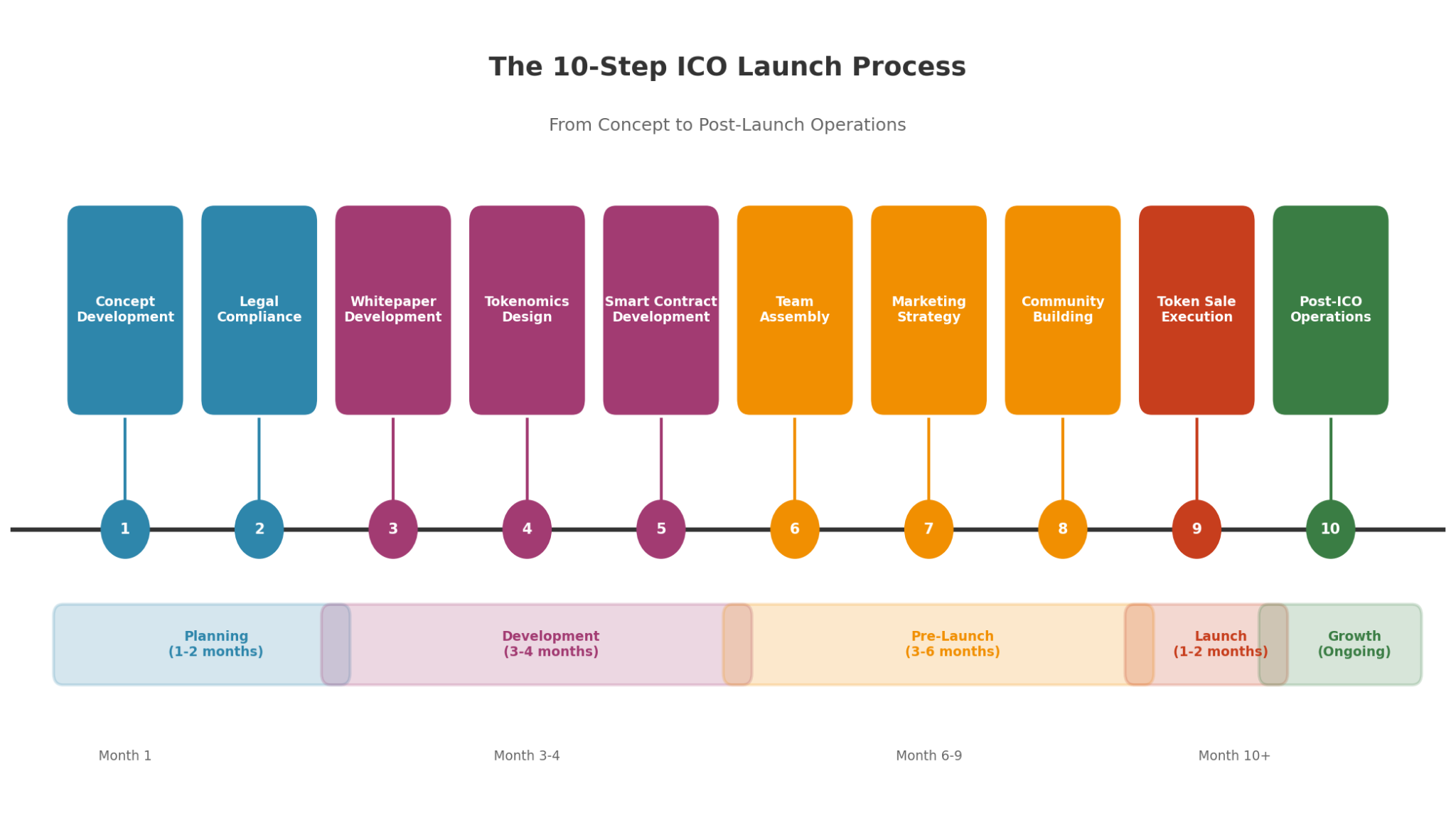
Launching a successful ICO requires methodical planning across multiple disciplines. The following framework provides actionable guidance for each critical phase.
Step 1: Concept Development and Validation
Before writing a single line of code or marketing copy, your ICO needs a foundation built on solving genuine problems. Telegram's TON project raised $1.7 billion yet failed because regulators determined the token lacked clear utility beyond speculation. That's $1.7 billion returned to investors because the concept couldn't withstand scrutiny.
Here's a hard truth: not every project needs a token. If your business model works without blockchain, adding a token won't magically improve it. The projects that succeed solve problems where decentralization provides genuine advantages, whether that's censorship resistance, trustless coordination, or removing intermediary costs.
Define Your Core Value Proposition
Start by answering four questions. What problem does your project solve? This establishes market need, so document specific pain points with evidence. Why does this require blockchain technology? This validates your technical approach, so identify concrete decentralization benefits. Who are your target users? This defines your market segment, requiring detailed user personas. And what existing solutions already exist? This positions you competitively, demanding thorough competitor analysis.
Validate Through Market Research
Successful validation involves direct engagement with potential users and investors. Create surveys, conduct interviews, and participate in blockchain communities to test your assumptions before committing significant resources. Thorough validation reduces the risk of building products nobody wants, provides evidence for whitepaper claims, identifies potential regulatory concerns early, and builds an early community of interested stakeholders. Rushing this phase leads to wasted development resources, investor skepticism from vague value propositions, and regulatory exposure from unclear token utility.
Step 2: Legal Structure and Regulatory Compliance
The regulatory landscape for ICOs has evolved dramatically since the SEC's 2017 DAO Report established that many tokens qualify as securities. According to the SEC's Investor Bulletin on ICOs, virtual tokens may be securities subject to federal securities laws, requiring either registration or exemption qualification.
Understanding the Howey Test
The SEC applies the Supreme Court's Howey Test to determine if a token constitutes a security. Under this framework, an investment contract exists when there is an investment of money, in a common enterprise, with a reasonable expectation of profits, derived primarily from the efforts of others.
Most ICO tokens meet these criteria because investors contribute capital expecting the development team to build value through their efforts. However, truly decentralized networks may escape classification once control disperses and the issuer's role diminishes.
Available Regulatory Exemptions
| Exemption | Maximum Raise | Investor Requirements | General Solicitation |
|---|---|---|---|
| Regulation D 506(b) | Unlimited | Up to 35 non-accredited investors | Not permitted |
| Regulation D 506(c) | Unlimited | Accredited investors only | Permitted |
| Regulation A+ Tier 1 | $20 million | All investors | Permitted |
| Regulation A+ Tier 2 | $75 million | All investors (with limits) | Permitted |
| Regulation S | Unlimited | Non-U.S. investors | Offshore only |
Before launching, engage securities counsel experienced in blockchain, determine token classification (utility vs. security), select appropriate jurisdictions for incorporation, implement KYC/AML procedures for investor verification, and prepare terms and conditions with appropriate risk disclosures.
Step 3: Whitepaper Development
Your whitepaper serves as the central document convincing investors, partners, and potential users of your ICO's merits. Research indicates that the informativeness of whitepaper content significantly predicts ICO success, with technical information proving most value-relevant.
Essential Whitepaper Sections
Your executive summary should be a compelling 2-3 page overview capturing attention and establishing credibility. Include the problem statement, solution overview, market opportunity, and team highlights. The problem and solution section requires detailed analysis of the market pain point and how your blockchain-based solution addresses it. Provide evidence of the problem's significance and your unique approach.
Technology architecture covers technical specifications appropriate for your audience, including consensus mechanisms, smart contract logic, scalability solutions, and security considerations. Tokenomics demands comprehensive coverage of supply, distribution, utility, and value accrual mechanisms. This section receives intense investor scrutiny.
Your roadmap should present a realistic timeline with concrete milestones. Include completed work demonstrating execution capability alongside future development plans. Team and advisors background information matters significantly. Industry patterns suggest that showcasing at least three external advisors increases fundraising probability by approximately 27%. And don't skip risk factors. Transparent disclosure of regulatory, technical, market, and execution risks builds trust and provides legal protection.
Step 4: Tokenomics Design
Token economics determine whether your project can achieve long-term sustainability. Poor tokenomics contributed to the collapse of countless projects during 2018-2019. BitConnect promised 40% monthly returns through its token model before collapsing as a $2.6 billion fraud. The lesson? Unsustainable token economics eventually implode, taking investor funds with them.
Token Allocation Framework
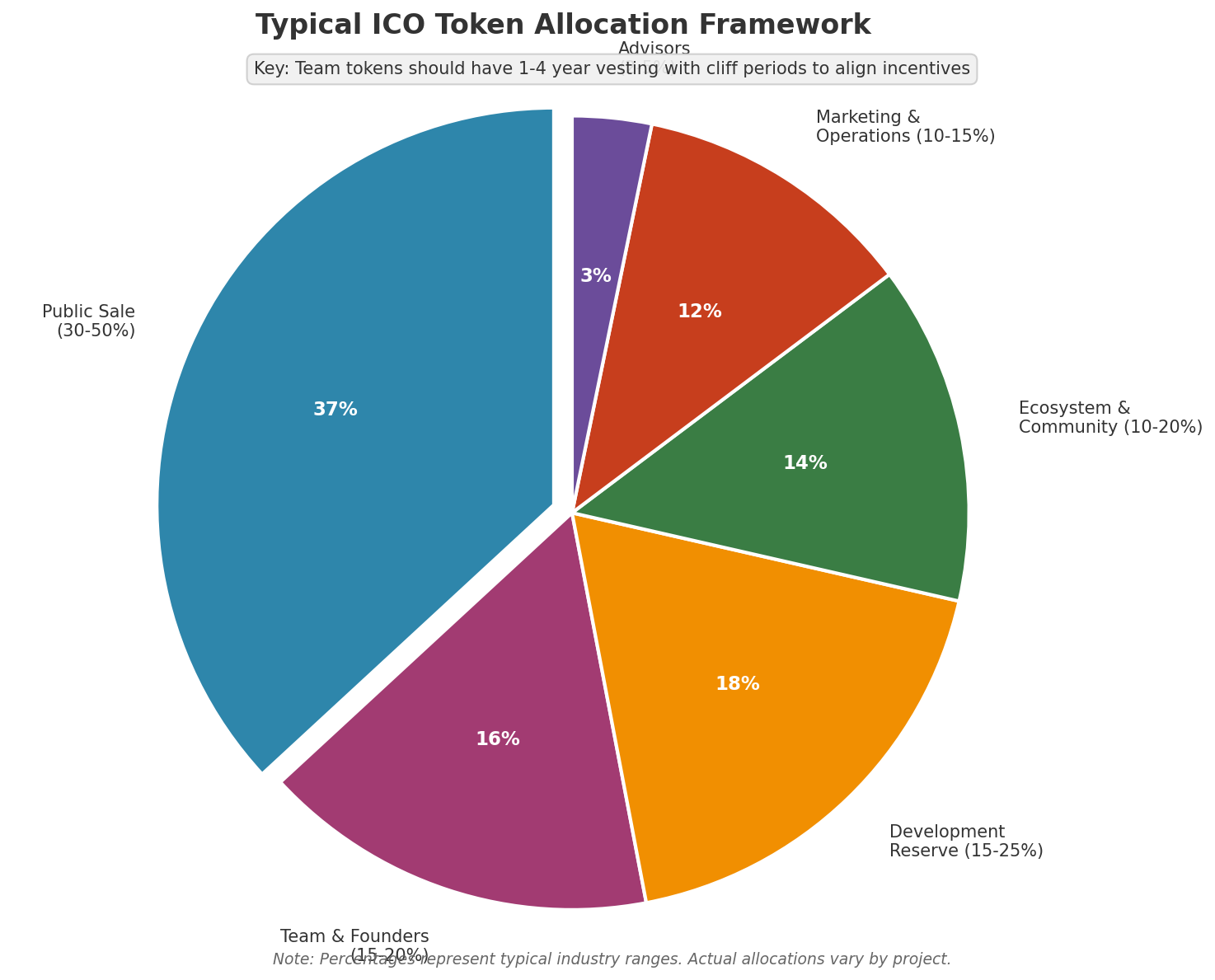
| Allocation Category | Typical Range | Purpose |
|---|---|---|
| Public Sale | 30-50% | Primary fundraising |
| Team and Founders | 15-20% | Long-term incentive alignment |
| Advisors | 2-5% | Expert guidance compensation |
| Development Reserve | 15-25% | Future development funding |
| Marketing and Operations | 10-15% | Growth and sustainability |
| Ecosystem/Community | 10-20% | User incentives and adoption |
Critical Tokenomics Decisions
Define maximum token supply with clear rationale, considering whether supply will be fixed, inflationary, or deflationary through burn mechanisms. Implement vesting periods for team tokens to demonstrate long-term commitment. Industry standard typically involves 1-4 year vesting with cliff periods. Clearly articulate how tokens function within your ecosystem. Strong utility tokens provide access to services, enable governance participation, or facilitate network operations. And consider mechanisms to reduce volatility such as buyback programs, staking incentives, or algorithmic supply adjustments.
Step 5: Smart Contract Development
Smart contract security cannot be an afterthought. The 2016 DAO hack exploited a reentrancy vulnerability and drained $60 million in ETH. That single bug nearly killed Ethereum and forced a controversial hard fork. Your smart contracts will handle real money from real investors.
Ethereum remains the dominant platform for ICO launches, accounting for over 72% of all ICOs. The ERC-20 standard provides standardized functions enabling interoperability across wallets, exchanges, and applications. Leverage battle-tested frameworks like OpenZeppelin rather than building from scratch. These libraries undergo community security audits and implement proven patterns. Implement proper administrative functions with multi-signature requirements for critical operations. Consider proxy patterns for upgradability balanced against decentralization principles. And engage reputable third-party auditors before mainnet deployment, publishing audit reports publicly to demonstrate security commitment.
Step 6: Team Assembly and Advisory Board
Investor confidence correlates strongly with team composition and credentials. Assembling the right expertise across technical, business, and regulatory domains presents genuine difficulty because blockchain talent commands premium compensation and experienced crypto lawyers remain scarce.
Your core team needs several key roles. A CEO or Project Lead handles vision, strategy, and investor relations, requiring industry experience and leadership track record. Your CTO manages technical architecture and development oversight with blockchain development experience. Legal counsel addresses regulatory compliance and documentation with securities law expertise. A CFO handles treasury management and financial planning with cryptocurrency accounting knowledge. And a marketing lead drives community building and communications with crypto marketing experience.
Advisors add credibility and expertise. Target advisors with demonstrated blockchain industry involvement, relevant technical or business expertise, established networks for partnerships and investor introductions, and verifiable track records of successful projects. Clearly define advisor expectations including time commitments, compensation (typically 0.5-2% of tokens with vesting), and specific contributions expected.
Step 7: Marketing Strategy Development
ICO marketing has evolved from hype-driven campaigns to trust-focused strategies emphasizing transparency and genuine community value.
Three to six months before launch, develop educational content establishing thought leadership through blog posts, technical articles, and explainer videos that build organic traffic and credibility. Build social media presence on Twitter, LinkedIn, and crypto-specific platforms, sharing consistent valuable content rather than purely promotional material. Secure coverage in reputable crypto publications like CoinDesk and Cointelegraph, focusing on newsworthy angles rather than paid promotion. Launch Telegram and Discord servers for community discussion, as these channels become primary communication and conversion funnels.
During the launch phase, submit to ICO listing platforms like ICO Drops and CoinGecko where active investors research opportunities. Engage reputable crypto influencers with clear compensation disclosure, prioritizing quality over quantity since a few trusted voices outperform many low-authority promoters. Build email subscriber lists with targeted communications about milestones and token sale updates. Host AMA sessions on Reddit, Telegram, and YouTube to address community questions directly.
Step 8: Community Building
Your community represents both your primary sales funnel and long-term ecosystem foundation.
Telegram serves real-time discussion and announcements through active moderation, regular updates, and AMAs. Discord enables structured community and technical discussion through channel organization and role-based access. Twitter drives news and industry engagement through regular posting and community interaction. Reddit hosts long-form discussion and feedback through genuine participation while avoiding spam.
Bounty and airdrop programs incentivize community participation through token rewards for social media promotion, content creation, bug reporting, or translation services. But structure these carefully. Programs designed poorly attract mercenary participants who dump tokens immediately after receiving them, creating selling pressure at exactly the wrong moment.
Step 9: Token Sale Execution
The actual token sale requires meticulous operational preparation. Technical failures or security incidents during launch can permanently damage project credibility.
Structure your sale with a private or pre-sale offering initial tokens to accredited investors at discounted rates, followed by a public sale open to qualified participants with potential tiered pricing. Set both soft cap (minimum threshold) and hard cap (maximum target). Accept ETH, BTC, and stablecoins, considering fiat options through compliant payment processors to expand accessibility. Load test all systems before launch. Establish clear communication channels and customer support. Implement real-time monitoring with contingency plans for common scenarios.
Step 10: Post-ICO Operations
Success doesn't end with a funded token sale. Post-ICO execution determines whether your project achieves lasting value or joins the majority that fade into obscurity.
Establish secure multi-signature wallets for raised funds immediately. Develop clear policies for fund allocation aligned with whitepaper commitments. Execute token distribution according to published schedules because delays erode community trust rapidly. Pursue listings on reputable exchanges, beginning with decentralized exchanges and smaller centralized platforms before progressing toward major exchanges as trading volume and community demand grow.
Deliver on roadmap commitments with regular milestone updates. Transparent communication about challenges builds more trust than silence followed by missed deadlines. Continue building community value through regular AMAs and updates, governance opportunities for token holders, ecosystem development supporting third-party builders, and responsive support channels.
Common Misconceptions
Misconception 1: Utility Tokens Automatically Avoid Securities Classification
Many ICO issuers believe that labelling their token as a "utility token" automatically exempts them from securities regulations. This is incorrect. According to the SEC, merely calling a token a "utility" token or structuring it to provide some utility does not prevent it from being classified as a security. The substance of the offering, not its label, determines regulatory treatment under the Howey Test.
The SEC evaluates how tokens are marketed, the expectations created for purchasers, and whether the primary motivation is consumptive use or investment returns. A token providing genuine utility within a functioning platform may still be a security if marketed with profit expectations during its ICO phase.
Misconception 2: ICOs Are Dead and Replaced Entirely by IDOs/IEOs
While Initial DEX Offerings (IDOs) and Initial Exchange Offerings (IEOs) have grown in popularity, traditional ICOs remain a significant fundraising mechanism. Data indicates ICOs accounted for 18.4% of all public token sales between 2014 and 2023. The methods coexist, each serving different project needs and investor preferences.
ICOs offer greater control over the fundraising process without exchange gatekeepers, while IEOs and IDOs provide built-in investor access and credibility from platform vetting. Many projects combine approaches, using private ICO rounds followed by public IEO or IDO launches.
Misconception 3: A Great Whitepaper Guarantees ICO Success
While necessary, a compelling whitepaper alone cannot ensure success. Research shows that whitepaper informativeness substantially diminishes after token listing, suggesting execution becomes the primary value driver post-launch. Projects with excellent documentation but poor execution, team conflicts, or market timing issues have failed despite strong whitepapers.
Success requires alignment across multiple factors: viable concept, competent team, solid tokenomics, regulatory compliance, effective marketing, and sustained execution. The whitepaper is necessary but insufficient.
Real-World Examples and Case Studies
Ethereum: The Foundation of ICO Innovation
Ethereum's 2014 ICO raised approximately $18.3 million to fund development of its smart contract platform. Success factors included Vitalik Buterin's technical credibility, a detailed whitepaper, and timing during blockchain's early growth phase. Ethereum's platform subsequently enabled thousands of subsequent ICOs, validating both the technology and fundraising model.
Filecoin: Regulatory-Compliant Institutional Fundraising
Filecoin's 2017 ICO raised over $257 million through a SAFT (Simple Agreement for Future Tokens) structure restricting participation to accredited investors. The approach attracted institutional capital including Andreessen Horowitz and Sequoia. By addressing genuine infrastructure needs with credible technology and regulatory rigour, Filecoin demonstrated viable compliant ICO structures.
EOS: Year-Long Token Sale
EOS raised approximately $4 billion over a year-long ICO from 2017-2018, benefiting from Dan Larimer's credibility from previous successful projects. However, Block.One paid a $24 million SEC settlement for conducting an unregistered securities sale, illustrating that fundraising success doesn't guarantee regulatory compliance.
Centra Tech: A Cautionary Tale
Not all ICOs end well. Centra Tech raised $25 million in 2017 by claiming partnerships with Visa and Mastercard for a crypto debit card. The partnerships were fabricated. Celebrity endorsements from Floyd Mayweather and DJ Khaled amplified the fraud. The founders received prison sentences, and investors lost everything. The lesson? Verify every claim independently before investing.
Frequently Asked Questions
How much does it cost to launch an ICO?
Total ICO launch costs vary significantly based on project complexity, jurisdiction, and marketing ambitions. A basic ICO with minimal marketing might cost $50,000-$100,000, while comprehensive launches with significant legal, development, and marketing investment can exceed $500,000-$1 million. Key cost categories include legal fees (securities counsel, entity formation, compliance procedures), smart contract development and security audits, website and platform development, marketing and community building, and operational expenses during the launch period.
How long does it take to prepare an ICO launch?
Comprehensive ICO preparation typically requires 6-12 months from concept to token sale. This timeline includes concept validation and market research (1-2 months), legal structuring and compliance setup (2-3 months), whitepaper development and tokenomics design (1-2 months), smart contract development and auditing (2-3 months), and pre-launch marketing and community building (3-6 months). Rushing this timeline increases execution risk and regulatory exposure.
What jurisdictions are most favorable for ICO launches?
Popular ICO jurisdictions include Switzerland (through the Swiss Financial Market Supervisory Authority's clear guidance), Singapore (with its supportive regulatory sandbox), Estonia (offering digital-forward business environment), and the British Virgin Islands (for offshore structures). However, jurisdiction selection must account for where your investors reside, as selling to U.S. investors triggers SEC jurisdiction regardless of where your entity is incorporated. Engage legal counsel to evaluate your specific circumstances.
Can existing businesses launch ICOs?
Established businesses can launch ICOs to tokenize services, raise capital for new initiatives, or create ecosystem incentives. The process follows similar steps but benefits from existing brand credibility, customer base, and operational infrastructure. Key considerations include how tokens integrate with existing business operations, impact on current customers and stakeholders, regulatory implications for existing business licenses, and alignment between token economics and business model sustainability.
What happens if an ICO doesn't reach its soft cap?
When an ICO fails to reach its soft cap, best practice dictates returning funds to investors. Smart contracts can automate this process through refund functions triggered when funding thresholds aren't met by deadline. Some projects proceed despite missing soft cap targets, but this approach damages credibility and may indicate insufficient market validation. Transparent communication about the situation and decision-making process remains essential regardless of the chosen path.
Web Tonic works across SEO, paid search and paid social, and you can book a consultation to talk through your own plan.


