



Table of contents
Key Takeaways
- Brand building is a strategic discipline that encompasses purpose, positioning, experience design, and organizational culture.
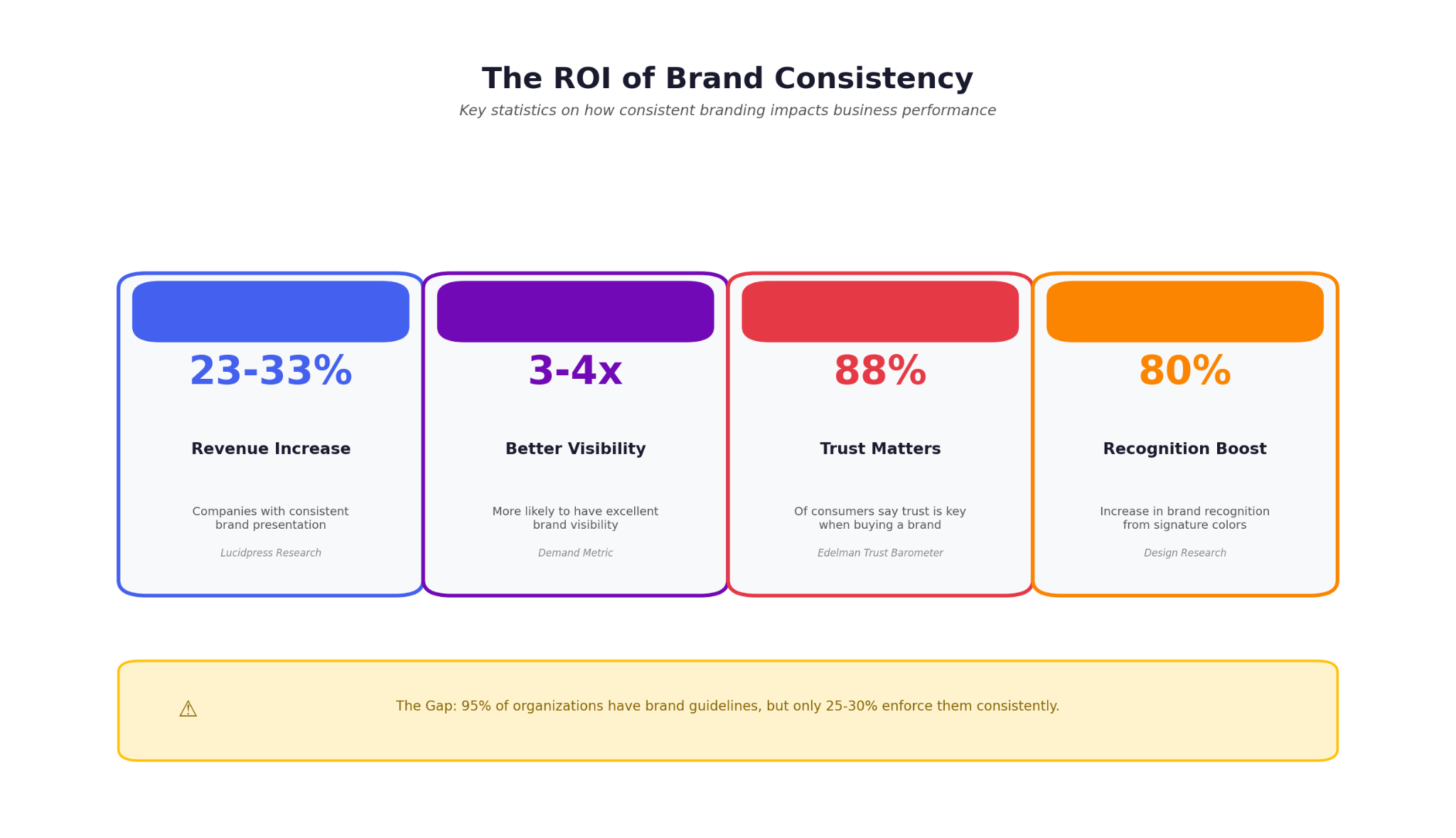
- Companies that maintain consistent brand presentation can achieve revenue increases of 23-33%, according to the Lucidpress State of Brand Consistency Report.
- Trust has become as important as quality and price in purchase decisions, with 88% of consumers globally citing trust as an important consideration when buying a brand.
- Emotional connection and purpose-driven positioning create competitive advantages that feature-based differentiation cannot match, particularly as product capabilities converge across competitors.
- Effective brand building requires sustained investment over years, with research suggesting approximately 60% of marketing budget should support brand building versus 40% for performance marketing.
- Organizations facing competitive pressure or growth plateaus may benefit from engaging specialized brand strategy expertise to ensure their brand assets are working effectively to drive business results.
What Is Brand Building?
Brand building is the strategic process of creating and strengthening a company's brand identity, reputation, and emotional connection with its target audience. It goes far beyond logo design. Every touchpoint where customers interact with your business (brand's visual identity, messaging, customer experience, core values) contributes to how your brand is perceived and remembered.
The Journal of Brand Management describes brand management as a multifaceted field requiring expert strategic thinking, industry-based implementation, and ongoing market research into consumer behaviour patterns. The discipline has evolved significantly over the past two decades. Peer-reviewed studies consistently demonstrate that strong brand equity directly correlates with business performance, brand loyalty, and market valuation.
For mid-market and enterprise-level organizations, understanding how to build a brand affects every aspect of business growth. The Interbrand 2024 Best Global Brands report reveals that the cumulative value of the world's 100 most valuable brands now stands at approximately $3.5 trillion. Yet the same report cautions that companies have missed approximately $3.5 trillion in potential value creation since 2000 by prioritizing short-term performance marketing over long-term brand investment.
That's a lot of money left on the table.
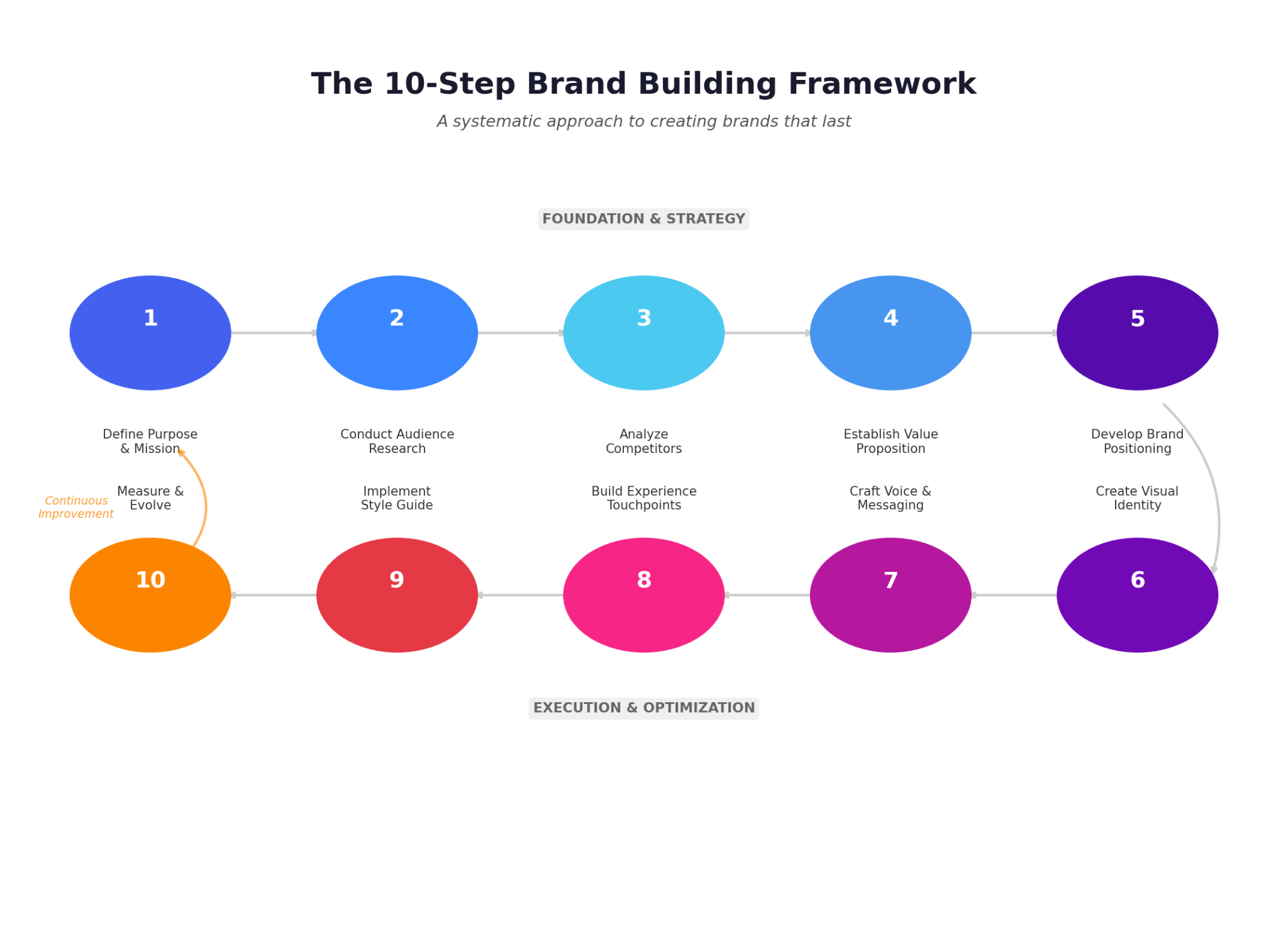
The 10-Step Brand Building Framework
Creating a brand that endures requires methodical execution across interconnected elements. The following framework balances strategic foundations with tactical implementation. Whether you're a small business building from scratch or an enterprise refining your marketing strategy, these steps apply.
Step 1: Define Your Brand Purpose and Mission
The first step in any branding process starts with a clear answer to one question: why does this company exist beyond making money?
Brand purpose establishes the fundamental reason your organization operates and the positive impact it aims to create. You need a core mission statement articulating your reason for being, a long-term vision for the impact you want to achieve, and guiding principles that inform all business decisions. These core values become the foundation of your brand and guide every decision that follows.
Patagonia exemplifies purpose-driven brand building with its mission to "build the best product, cause no unnecessary harm, use business to inspire and implement solutions to the environmental crisis." This purpose permeates every decision, from material sourcing to content marketing campaigns, creating a brand valued at $3 billion that has risen to the top of the sustainable retail industry.
Step 2: Conduct deep audience research
Understanding your target market goes beyond basic demographics.
Effective brand creation requires insights into customer motivations, pain points, aspirations, and decision-making processes. That means building a detailed buyer persona for each segment: demographics (who are they, where do they live, what do they earn), psychographics (what do they value and believe), behavioural patterns (how do they research and purchase), and competitive alternatives (what else are they considering). Use surveys, CRM data analysis, focus groups, interviews, analytics, and journey mapping to build a complete picture of your ideal customer.
The 2023 Edelman Trust Barometer found that 78% of consumers discover things that attract them and build loyalty after the initial purchase. This finding underscores why understanding the full customer journey matters so much for building loyal customers.
Step 3: Analyze the Competitive Landscape
Brand differentiation requires comprehensive knowledge of your competitive environment. In a crowded marketplace, you need to analyze direct competitors and adjacent players who compete for your audience's attention and wallet share. Identify primary, secondary, and indirect competitors. Map their positioning statements and value propositions. Evaluate strengths, weaknesses, and market gaps. Document visual identities and messaging approaches.
Research published by the Harvard Business Review found that the most sustainable competitive advantages come from discovering new points of differentiation that competitors haven't claimed or can't easily replicate.
Step 4: Establish Your Unique Value Proposition
Your value proposition articulates why customers should choose your brand over alternatives. It must be specific, compelling, and defensible through genuine capabilities or commitments. An effective value proposition includes a clear statement of primary benefit, identification of your ideal customer, explanation of differentiation from competitors, and evidence supporting your claims.
A McKinsey analysis on brand strategy emphasizes that protecting and enhancing brand equity in the omnichannel age requires companies to embrace new methods and data sources, including real-time sentiment tracking that can capture brand perception with up to 90% accuracy.
Step 5: Develop Brand Positioning
Brand positioning defines the specific mental space you want to occupy in your target audience's mind. Where do you fit within the competitive landscape? How do you want to be perceived relative to alternatives? Your brand image depends on getting this right.
A useful positioning statement template: For [target audience], [brand name] is the [category] that [key benefit] because [reason to believe].
Different strategies work for different situations. Category leadership suits market pioneers or dominant players (think Google in search). Problem specialization works for companies solving specific pain points (Slack for team communication). Audience focus fits brands serving defined segments (Patagonia for outdoor enthusiasts). Value leadership applies to cost-efficient operators (Costco for value-seeking shoppers). Pick your lane.
Step 6: Create Visual Identity Elements
Your brand's visual identity translates brand strategy into tangible design elements that customers recognize and remember.
Consistency across visual touchpoints builds recognition and trust over time. Core components include logo and logo variations, color scheme (primary and secondary color palette), typography system, photography and illustration style, and iconography. Research from Fuel for Brands indicates that using a signature color can increase brand recognition by up to 80%. And a study by the Design Management Institute revealed that design-driven companies outperform the S&P Index by 219% over ten years. Not a typo. Two hundred nineteen percent.
Step 7: Craft your brand voice and messaging
Brand voice defines how your company communicates across different channels. It should reflect your brand's personality and resonate with your target audience while remaining consistent regardless of medium or message. This is where brand tone becomes critical.
Consider tone (formal vs. casual, serious vs. playful), language complexity (technical vs. accessible), personality traits (confident, empathetic, bold, thoughtful), and communication priorities (educational, inspirational, practical). Your brand story should come through in every piece of content. Develop messaging frameworks that include key messages, proof points, and talking points for different audiences and scenarios. These frameworks ensure consistency while allowing flexibility for context-specific communication.
Step 8: Build Brand Experience Touchpoints
Brand building extends beyond communications to every interaction customers have with your organization.
Map and optimize touchpoints across digital presence (website, apps, social media), physical presence (stores, offices, packaging), communication channels (email, advertising, PR), human interactions (sales, customer service, support), and product or service delivery.
Nike demonstrates comprehensive touchpoint integration through its digital ecosystem. The Nike Run Club and Nike Training Club apps build community, track progress, and maintain brand presence in users' daily lives. The company reports that NikePlus members spend nearly triple the amount per year compared to non-members. Triple. That's the power of integrated brand experience.
Step 9: Implement your brand style guide and governance
A brand style guide documents standards that ensure consistent application across all touchpoints and stakeholders. Effective guidelines balance comprehensive direction with practical usability. They should include brand strategy overview (purpose, positioning, core values), visual identity specifications, voice and messaging standards, application examples and templates, and do's and don'ts with rationale.
Data from the Lucidpress State of Brand Consistency Report shows that consistent branding can increase revenue by up to 33%. But here's the problem: while 95% of organizations have a style guide, only 25-30% actively enforce them. That implementation gap undermines brand building efforts across industries.
Step 10: Measure, learn, and evolve
Brand building is an ongoing process requiring continuous measurement and refinement.
Establish metrics that track both brand health indicators and business outcomes. For awareness, measure aided and unaided recall plus share of voice through brand tracking surveys. For perception, track attribute associations and sentiment via social listening and surveys. For engagement, monitor website traffic and social engagement through analytics platforms. For loyalty, examine repeat purchase rates, NPS, and retention through CRM analysis. For equity, calculate brand value and price premium through financial modelling.
Weighing the investment
Before committing to comprehensive brand development, organizations should understand both the benefits and challenges involved.
On the upside, companies see revenue growth of 23-33% attributed to consistent brand presentation, per Lucidpress research. A strong brand identity can command price premiums that reduce pressure to compete on cost alone. Brand loyalty lowers acquisition costs and increases lifetime value. And competitive differentiation creates barriers to entry for rivals.
On the downside, brand building requires sustained investment over years before full returns materialize. It demands organizational alignment across departments and stakeholders. Results are difficult to measure directly compared to performance marketing metrics. And strategic missteps can damage rather than build equity.
Common Misconceptions
Misconception 1: Brand Building Is Just About Visual Design
Many organizations conflate brand building with logo design and visual identity development. While visual elements matter, they represent only one component of a complete marketing strategy. True brand building encompasses purpose definition, positioning strategy, customer experience design, and organizational culture alignment. Companies that focus exclusively on visual elements often find their brands lack the depth needed to build lasting customer relationships.
Misconception 2: Strong Brands Can Be Built Quickly
The pressure for immediate results has led many companies to underinvest in brand building, favoring short-term performance marketing instead.
Interbrand's analysis reveals that this approach has cost the world's most valuable brands approximately $200 billion in lost revenue opportunity over the past 12 months alone. Good branding takes time. Marketing experts Les Binet and Peter Field's research suggests that the most effective brands dedicate approximately 60% of their marketing budget to brand building and 40% to performance marketing.
Misconception 3: Brand Building Only Matters for B2C Companies
B2B organizations frequently underestimate the importance of brand building, believing that rational purchasing decisions based on features and pricing dominate their markets.
The data tells a different story. Brand Finance reports that the top 100 most valuable B2B brands globally account for $2 trillion in brand value, with Microsoft holding the highest B2B brand value at $137.5 billion. B2B brands shape purchasing decisions through trust, reputation, and perceived expertise.
Why Emotional Connection Outperforms Feature Competition
In markets where product features increasingly converge, emotional differentiation becomes the primary driver of brand preference and pricing power.
Consumers make purchasing decisions based on how brands make them feel. Rational evaluation of features and benefits matters, but it rarely wins the day alone. The 2025 Edelman Trust Barometer Special Report on Brand Trust reveals that 80% of people trust brands they use, more than those who trust business, media, government, NGOs, or their employer. Potential customers today want brands to provide them with a sense of safety, calm, confidence, and inspiration. They seek optimism, education, and even community from the brands they choose.
Nike exemplifies emotional brand building through its consistent focus on aspiration and human achievement. Nike sells the idea of greatness, determination, and overcoming personal limits. The "Dream Crazy" campaign featuring Colin Kaepernick demonstrated Nike's willingness to take a stand on social issues, which strengthened its bond with socially-conscious audiences and drove significant sales growth. This emotional approach creates competitive advantages that feature-based differentiation simply cannot match. When customers connect with a brand's values and purpose, they become loyal customers who remain advocates even when competitors offer similar or superior functional benefits at lower prices.
The Hidden Cost of Brand Inconsistency
While many organizations understand the theoretical importance of brand consistency, few recognize the actual financial impact of inconsistent brand presentation.
The Edelman Trust Barometer research on brand trust demonstrates that trust is now a top-three purchasing consideration (88%), ranking just behind value for money (91%) and quality (89%). When brands present inconsistently, they erode the trust that drives purchasing decisions.
The consequences extend beyond lost trust.
Interbrand's longitudinal analysis found that companies over-investing in short-term performance tactics while neglecting mid-term and long-term brand potential have collectively sacrificed $3.5 trillion in cumulative brand value since 2000. That works out to approximately $200 billion of lost revenue opportunity over the past 12 months alone. Organizations with inconsistent brand presentation are 3-4 times less likely to enjoy excellent brand visibility compared to those presenting their brand consistently. The implementation challenge is significant: while nearly all organizations have brand guidelines, only about one-fourth consistently enforce them. Closing this gap requires treating brand governance as a strategic priority.
Real-World Examples and Case Studies
Apple: Building the World's Most Valuable Brand
Apple has maintained its position as the world's most valuable brand through relentless focus on design excellence, user experience, and ecosystem integration. Interbrand's 2024 ranking values Apple's brand at $488.9 billion. That's almost as much as the cumulative value of every brand ranked #50 through #100.
Apple's brand building approach demonstrates several key principles: investing heavily in design and user experience, building an ecosystem where products work better together, controlling the narrative through consistent messaging and visual identity, and pricing for value rather than competing on cost. The company's deliberate approach to AI development, prioritizing alignment with brand values over rushing to market, is a great example of how strong brands make decisions that protect long-term equity over short-term gains.
Patagonia
A different model entirely.
The outdoor apparel company, now valued at $3 billion, has built its brand around environmental stewardship and corporate responsibility since its founding in 1973. The "Don't Buy This Jacket" campaign discouraged overconsumption. The Worn Wear program encourages customers to repair and reuse gear rather than purchase new products. In 2022, founder Yvon Chouinard committed all company profits toward fighting the climate crisis, declaring "Earth is now our only shareholder." Counterintuitive? Sure. But these purpose-driven decisions have strengthened brand loyalty and brand differentiation. Yale Insights confirms that Patagonia's approach demonstrates how environmental constraints can generate innovation, and that customer loyalty based on shared values creates deeper engagement than loyalty based on product features alone.
Frequently Asked Questions
How long does it take to build a strong brand?
Years. Initial brand strategy and brand's visual identity can be developed in months, but establishing meaningful brand equity and brand loyalty typically takes 3-5 years of consistent execution. The most successful brands view brand building as an ongoing process rather than a project with a defined endpoint.
What is the difference between branding and marketing?
Branding defines who you are as a company: your purpose, core values, brand's personality, and positioning. Marketing encompasses the tactics and channels you use to communicate your brand and drive specific business outcomes. Effective marketing builds upon and reinforces brand strategy, while branding provides the strategic foundation that makes marketing more effective. Think of branding as the "what" and marketing as the "how."
How much should a company invest in brand building?
Research by marketing effectiveness experts Les Binet and Peter Field suggests that optimal allocation dedicates approximately 60% of marketing budget to brand building activities and 40% to performance marketing. But appropriate investment levels vary based on industry, competitive dynamics, and company maturity. Early-stage companies and small businesses may need to invest more heavily in brand building to establish market position.
Can you rebrand without losing existing customer loyalty?
Yes, but it requires careful management. The key is understanding which brand elements your loyal customers value most and ensuring those elements are preserved or thoughtfully evolved. Companies should involve customers in the rebranding process through market research, communicate the reasons for changes transparently, and implement transitions gradually where possible.
What metrics should companies track to measure brand health?
It depends on your goals. Comprehensive brand measurement includes both leading indicators (awareness, perception, engagement) and lagging indicators (loyalty, advocacy, financial outcomes). Key metrics include aided and unaided brand awareness, brand attribute associations, Net Promoter Score, customer retention rates, price premium versus competitors, and brand value calculations. Track these metrics consistently over time to identify trends and measure the impact of brand building investments. Which ones matter most? That's a conversation about your specific business objectives.


