Table of contents
Key Takeaways
- Always disclose material connections prominently and clearly—place disclosures where they cannot be missed, before any "more" button or fold, and use unambiguous language that ordinary consumers understand.
- Supplement platform disclosure tools with manual disclosures in every sponsored post—built-in features like "Paid Partnership" labels are helpful but legally insufficient on their own.
- Ensure all claims are truthful and substantiated—only endorse products you've genuinely used on social media platforms, and never misrepresent results or make claims that cannot be backed by evidence.
- Establish written compliance policies and monitoring processes—brands must provide clear guidance to influencers and document their oversight efforts to demonstrate good faith compliance.
- Stay current with evolving regulations—the August 2024 Consumer Reviews Rule created new enforceable prohibitions with significant penalty authority, and additional regulatory updates are likely as influencer marketing continues to evolve.
- When compliance questions arise, consulting with legal counsel experienced in advertising law can help navigate the nuances of FTC requirements and protect both influencers and brands from costly violations.
What Are FTC Guidelines for Influencers? A Primer
The Federal Trade Commission (FTC) is the U.S. government agency responsible for protecting consumers from deceptive advertising practices. Its Endorsement Guides, most recently revised in June 2023, establish the standards for endorsement practices that influencers must follow when promoting products or services through social media, blogs, podcasts, and other digital platforms.
The core principle is simple. Consumers deserve to know when content they're viewing is paid advertising.
The agency defines an "endorsement" as any advertising message that consumers are likely to believe reflects the opinions, beliefs, findings, or experiences of a party other than the sponsoring advertiser. That definition is broad on purpose. It covers everything from explicit product reviews to something as subtle as tagging a brand in a social media post.
Section 5 of the FTC Act prohibits unfair or deceptive acts in commerce, and influencer marketing falls directly within this scope. When an influencer receives compensation (whether monetary payment, free products, discounts, or other benefits) and promotes a brand without proper disclosure, the FTC considers this deceptive advertising. Why? Because it misleads consumers into believing the endorsement is an unbiased recommendation when it isn't.
For mid-market and enterprise businesses investing in influencer marketing, understanding these regulations isn't optional. The influencer marketing industry reached $34 billion in spending in 2023. With that growth has come intensified regulatory scrutiny, and companies that fail to ensure their influencer partners comply with disclosure requirements face significant legal and reputational risks. Both the brand and the individual influencer can be held liable for violations.
The 6 Essential FTC Compliance Rules for Influencers in 2026
Rule 1: Disclose All Material Connections Clearly and Conspicuously
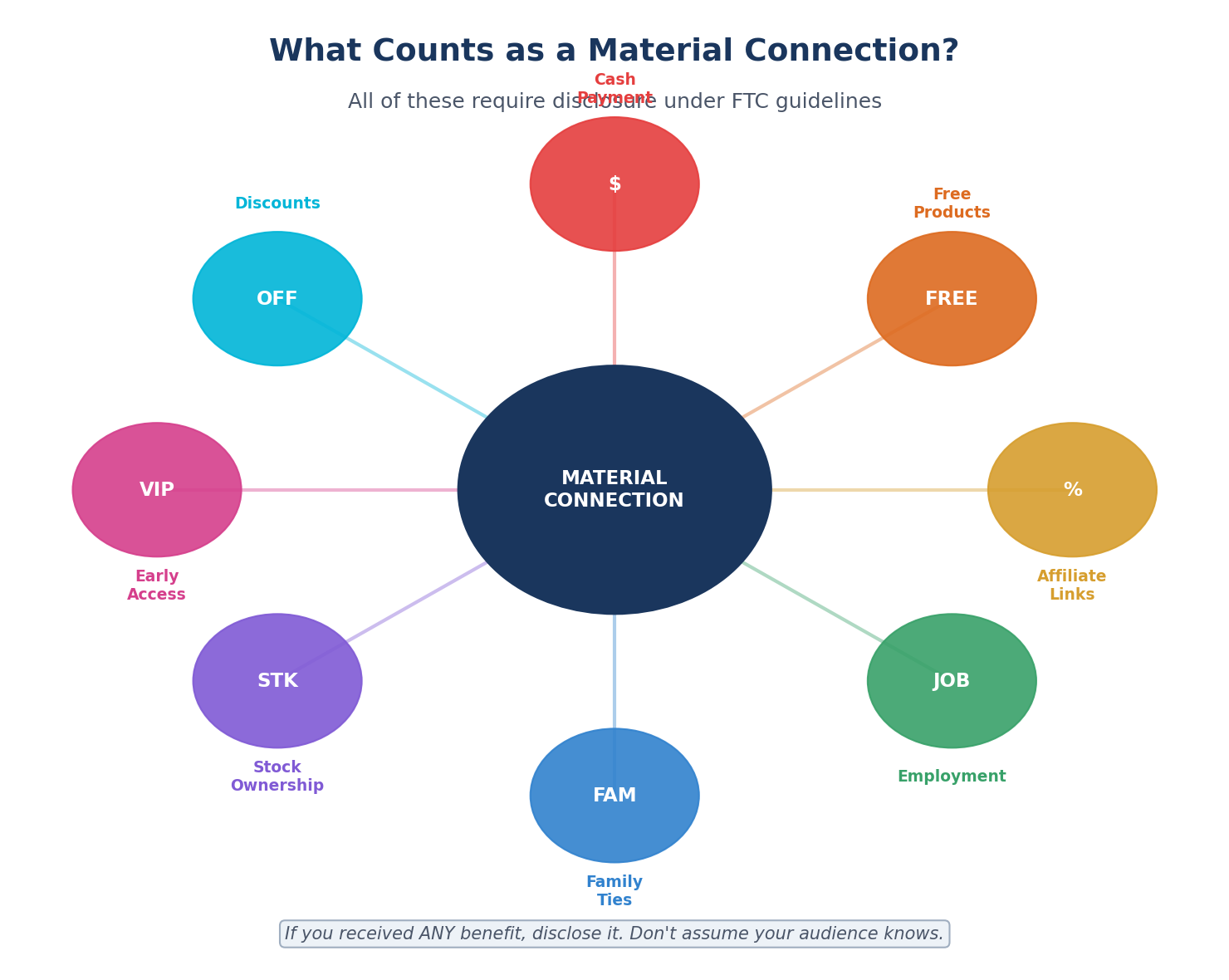
The foundation of FTC compliance is the requirement to disclose any "material connection" between an influencer and a brand. But what counts as a material connection? The FTC's Disclosures 101 for Social Media Influencers defines it more broadly than most creators realize, highlighting the importance of making a good disclosure about their relationship with the brand.
Cash payments are the obvious one. But the list extends far beyond that. Free products count. So do discounts, affiliate commissions, and referral bonuses. Working for a company creates a material connection. Your cousin is the brand manager? Same deal. Even getting early access to a product before its public launch creates a relationship the FTC staff wants disclosed. Stock ownership and investment relationships also qualify.
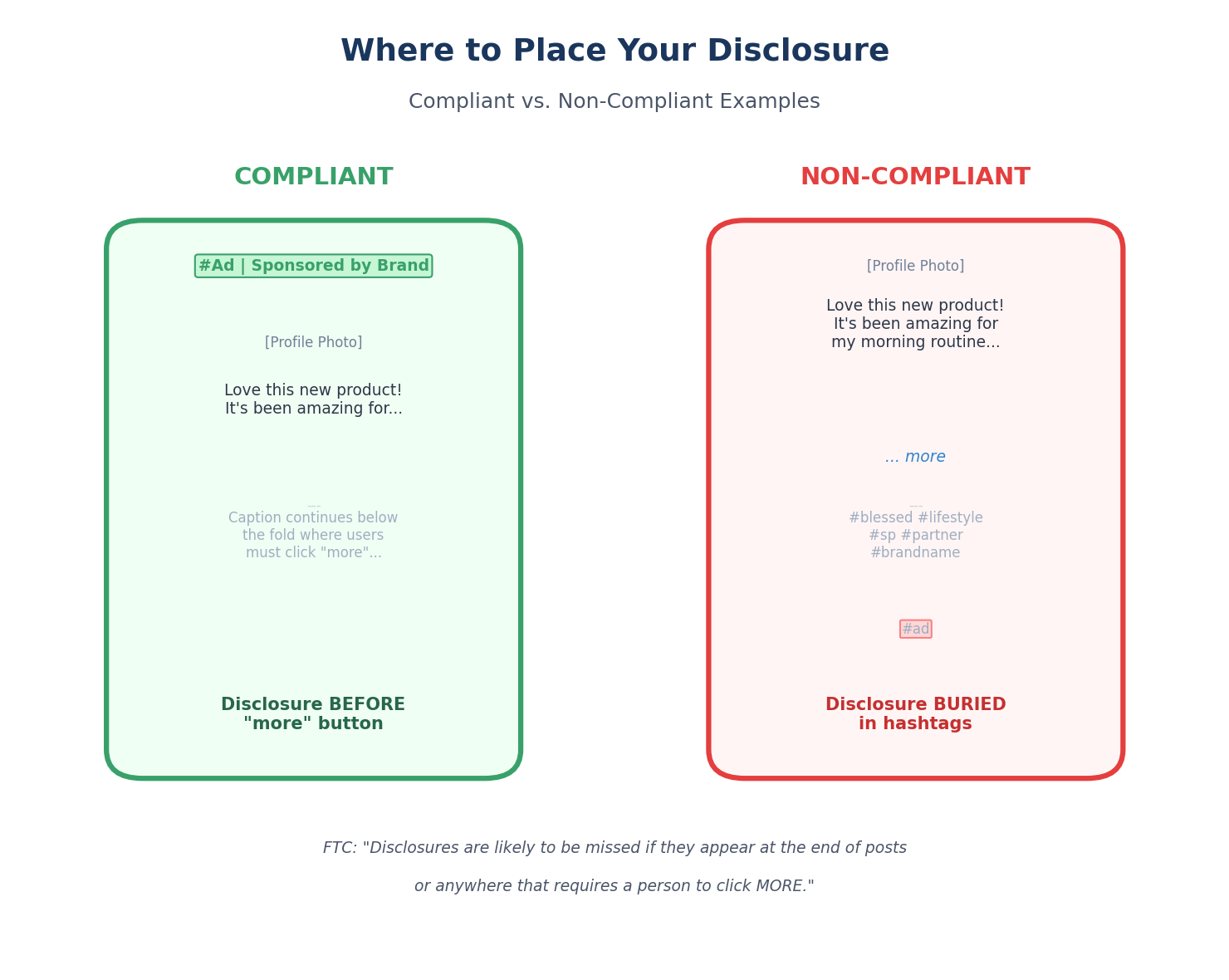
The 2023 revised Endorsement Guides introduced a formal definition of "clear and conspicuous" disclosure, requiring that disclosures be "difficult to miss" and "easily understandable by ordinary consumers." In practice, this means disclosures about sensitive information cannot be hidden in hashtag clusters, buried at the end of lengthy captions, or placed where users must click "more" to view them.
How you disclose varies by platform:
| Platform | Disclosure Placement | Recommended Language |
|---|---|---|
| Beginning of caption, before "more" cutoff | #Ad, #Sponsored, "Paid partnership with [Brand]" | |
| TikTok | On-screen text visible throughout video, verbal mention at the beginning of a post | "This video is sponsored by [Brand]" |
| YouTube | Verbal disclosure at video start, on-screen label | "This video is sponsored by [Brand]" |
| Podcasts | Verbal disclosure at beginning and before sponsored segments | "This segment is brought to you by [Brand]" |
| Live Streams | Repeated disclosure throughout for new viewers | Verbal reminders every few minutes |
Here's where many influencers get tripped up.
One of the most significant clarifications in the 2023 updated definition of the revised Endorsement Guides addresses the limitations of built-in platform disclosure tools. Instagram's "Paid Partnership" label, YouTube's "Includes paid promotion" checkbox, and similar features are helpful. But the FTC explicitly states that these tools may not be adequate standing alone.
The FTC's guidance on this point is unambiguous: "The big-picture point is that the ultimate responsibility for clearly and conspicuously disclosing a material connection rests with the influencer and the brand, not the platform."
So why aren't platform tools enough? They vary wildly in visibility, placement, and clarity. A "Paid Partnership" tag at the top of an Instagram post may be easily overlooked by users scrolling through their feeds, particularly on mobile devices where screen real estate is limited. The safest approach is to treat platform tools as complementary rather than comprehensive solutions. Use the platform's built-in disclosure, then add your own manual disclosure as well.
Rule 3: Ensure Honesty in All Endorsement Claims
Disclosure is only half the equation. In this blog post, FTC guidelines also mandate that all claims made in endorsements must be truthful and substantiated.
What does that mean in practice? Influencers cannot promote products they haven't actually used or experienced. They cannot make false or exaggerated claims about product performance. Suggesting atypical results are typical without proper qualification violates the guidelines. And endorsing products that would require specific expertise the influencer doesn't possess is also problematic.
The 2023 revised Guides clarified that expert endorsements must be "supported by an actual exercise of the expertise that the expert is represented as possessing." Consider a medical doctor endorsing a health supplement. That endorsement must be based on the type of scientific evidence that professionals in their field would consider adequate, not merely on consumer testimonials or insufficient studies.
When endorsements feature results that aren't representative of what typical consumers can expect, advertisers must "clearly and conspicuously disclose the generally expected performance results." Vague disclaimers don't cut it. "Results not typical" or "individual results may vary" are insufficient. Disclosures must specifically describe what ordinary consumers can realistically expect to experience.
Rule 4: Understand Shared Liability Between Brands and Influencers
The FTC's enforcement approach holds both advertisers and endorsers accountable for compliance failures, reinforcing the importance of following best practices. The revised Endorsement Guides explicitly state that advertisers, endorsers, and intermediaries (including advertising agencies, PR firms, and influencer marketing platforms) can all face liability for violations.
What does this mean for brands? They can't simply hire influencers and wash their hands of responsibility.
The FTC expects brands to provide clear written guidance to influencers on disclosure requirements, monitor influencer content for compliance, take corrective action when violations are identified, and maintain documentation of their compliance efforts. According to FTC guidance, "if concerns about possible violations of the FTC Act come to our attention, we evaluate them case by case. If law enforcement becomes necessary, our focus usually will be on advertisers or their ad agencies and public relations firms. However, action against an individual endorser might be appropriate in certain circumstances."
This shared liability model has real consequences. For enterprise businesses, it means building robust compliance processes into influencer marketing programs. Proactive compliance reduces legal exposure and potential penalties, strengthens brand reputation and consumer trust, protects influencer relationships, and creates defensible documentation if questions arise. On the flip side, reactive or minimal compliance exposes companies to penalties exceeding $53,000 per violation, reputational damage from public enforcement actions, potential loss of influencer partnerships due to legal concerns, and increased scrutiny from regulators on future campaigns.
Rule 5: Navigate the New Consumer Reviews Rule
August 2024 marked a significant shift in FTC enforcement capability.
The FTC finalized its Rule on the Use of Consumer Reviews and Testimonials, which became effective October 21, 2024. This rule transformed previously voluntary Endorsement Guide principles into enforceable regulations with civil penalty authority.
The Consumer Reviews Rule draws hard lines. Creating, selling, or purchasing fake consumer reviews or testimonials is now explicitly prohibited. So are reviews by individuals who misrepresent their experience with a product or service. AI-generated fake reviews fall under the ban. Purchasing positive or negative reviews violates the rule, as do insider reviews without clear disclosure of the relationship. Company-controlled review websites that appear independent are prohibited. Suppressing negative reviews through threats or intimidation is banned. And misusing fake social media indicators like purchased followers, likes, or views is now enforceable.
The rule authorizes courts to impose civil penalties for knowing violations, currently set at approximately $53,088 per violation. In December 2025, the FTC sent warning letters to 10 companies for potential violations. This marked the first enforcement sweep under the new rule and signals increased regulatory activity ahead.
For influencers, the message is clear. Any attempt to artificially inflate engagement metrics or participate in fake review schemes now carries serious legal consequences beyond reputational damage.
Rule 6: Apply Special Care with Sensitive Categories
Not all content carries equal regulatory risk. The revised Endorsement Guides highlight several areas requiring heightened attention.
Content directed at children demands extra care. The FTC notes that advertising directed to children "may be of special concern" and that "practices that would not ordinarily be questioned in advertisements addressed to adults may be questioned when addressed to children." Influencers creating content for younger audiences must ensure disclosures are appropriate and understandable for that demographic.
Health and financial claims face additional scrutiny. Endorsements involving health products, financial services, or other regulated industries attract more FTC attention. The November 2023 warning letters sent to health influencers and trade associations promoting aspartame and sugar demonstrated the FTC's willingness to target specific sectors with enforcement attention.
International reach doesn't provide protection. The FTC's guidelines apply to any content that reaches U.S. consumers, regardless of where the influencer or brand is located. International influencers marketing to American audiences must comply with U.S. disclosure laws.
Common Misconceptions About FTC Influencer Compliance
Misconception 1: Small Influencers Don't Need to Worry About FTC Rules
Wrong.
Many micro-influencers and content creators with smaller followings assume FTC guidelines only apply to celebrities and major influencers. The FTC's disclosure requirements apply to anyone with a material connection to a brand they're promoting, regardless of follower count, engagement rate, or compensation level.
The agency's guidance materials make this clear: receiving any benefit, even a free product or discount code, triggers disclosure obligations. The November 2023 warning letters targeted registered dietitians and health influencers, not household names. The FTC monitors compliance across the entire influencer spectrum.
Misconception 2: Affiliate Links Don't Require Disclosure
Also wrong.
Some influencers believe that affiliate relationships somehow differ from direct sponsorships. They don't. Affiliate commissions constitute a material connection that must be disclosed. When an influencer earns money each time a follower purchases through their unique link on social networks, that financial incentive could affect the weight or credibility consumers give to the recommendation.
The FTC specifically addresses this in their guidance: a blogger reviewing coffee makers who receives a portion of sales through affiliate links must "clearly and conspicuously disclose" that relationship. Simply embedding affiliate links without explanation fails to meet compliance standards.
Misconception 3: One Disclosure Per Partnership Is Enough
Still wrong.
The FTC requires disclosure in each and every post that endorses a product, not just once per brand relationship. As the agency states: "An influencer can't assume that followers will read more than one of their posts and associate them with each other."
Think about what this means in practice. An influencer working with a brand over several months must include appropriate disclosures in every piece of sponsored content, even if they've disclosed the relationship in previous posts. Someone discovering your TikTok today has no way of knowing you disclosed the relationship in an Instagram post three weeks ago. Followers viewing any individual piece of content should immediately understand the commercial relationship.
Real-World FTC Enforcement: Cases and Consequences
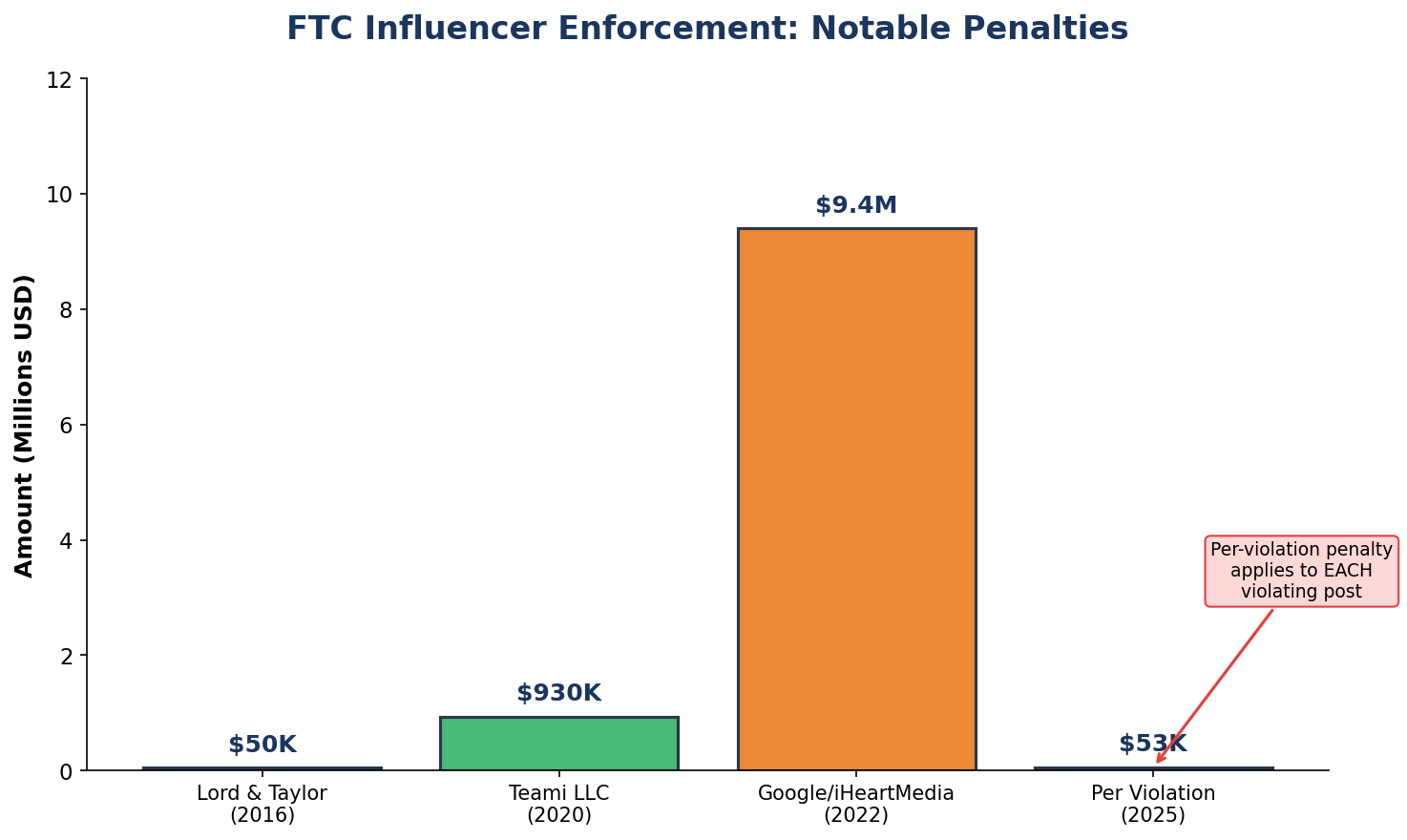
In 2016, the FTC settled charges against Lord & Taylor for deceiving consumers through paid Instagram posts by 50 fashion influencers. The retailer paid influencers between $1,000 and $4,000 each, plus provided free dresses, to post pictures wearing the same paisley design, which affected their online reviews.
None of the posts disclosed the compensation arrangement.
The settlement prohibited Lord & Taylor from misrepresenting paid advertising as independent content and required the company to establish monitoring programs for future influencer campaigns. This case established a critical precedent: brands bear responsibility for ensuring influencer compliance, not just for their own advertising.
Teami LLC: Health Claims and Disclosure Failures
In March 2020, the FTC sued Teami LLC for deceptive advertising involving both false health claims and inadequate influencer disclosures. The company promoted detox teas with unsubstantiated statements and claims about weight loss and treatment of medical conditions, using influencers who failed to properly disclose their paid relationships.
The case resulted in Teami returning over $930,000 to consumers who were misled.
Beyond the financial penalty, this enforcement action demonstrated something important: disclosure violations often accompany and compound other advertising law violations like unsubstantiated health claims. When brands cut corners on disclosure, they're often cutting corners elsewhere too.
Google and iHeartMedia: Authentic Experience Requirements
In 2022, the FTC reached a $9.4 million settlement with Google and iHeartMedia over radio endorsements, including verbal statements promoting the Google Pixel 4 smartphone. The endorsers described personal experiences with the phone despite never having used it, violating both truthfulness and disclosure requirements.
This case underscored that FTC guidelines extend beyond social media to traditional media channels. Claims about personal experience must be genuine, not scripted promotional copy.
Frequently Asked Questions
What happens if I accidentally post without a disclosure?
Fix it immediately. If you realize a post lacks proper required disclosure after publication, add the disclosure right away rather than deleting the post. Document the correction and timing. For ongoing brand relationships, notify your brand partner about the oversight and the corrective action taken.
A single accidental omission doesn't automatically trigger FTC action. But patterns of non-compliance or refusal to correct identified violations significantly increase enforcement risk, especially if the information is submitted through a federal government site. The FTC typically sends warning letters before pursuing penalties, giving businesses and influencers opportunity to correct practices.
Do I need to disclose if a brand sent me a product but I'm giving a negative review?
Yes. The disclosure requirement applies regardless of whether your review is positive or negative.
The material connection exists because you received something of value (the free product) which could affect how consumers perceive your opinion's credibility. Even a negative review funded by a competitor would require disclosure because the financial relationship is material to how audiences should evaluate the content.
How do disclosure requirements apply to TikTok and short-form video content?
For short-form video platforms like TikTok, disclosures must appear within the video itself, not just in the caption or description. The FTC recommends verbal disclosure at the start of videos combined with on-screen text visible throughout the content, in accordance with the updated guidelines.
For very short videos where this proves challenging, the conspicuous disclosure should still be as prominent as possible. Using hashtags like #ad in captions is acceptable as supplementary disclosure but insufficient as the sole disclosure method for video content.
Can I use abbreviations like "sp" or "spon" instead of "ad" or "sponsored"?
No. The FTC explicitly advises against vague or unfamiliar abbreviations.
Their guidance states: "Don't use vague or confusing terms like 'sp,' 'spon,' or 'collab,' or stand-alone terms like 'thanks' or 'ambassador.'" Acceptable disclosure language includes "ad," "advertisement," "sponsored," or clear phrases like "Paid partnership with [Brand]" or "Thanks to [Brand] for sponsoring this post."
The key test is whether ordinary consumers will understand they're viewing paid advertising. If the average person wouldn't recognize your disclosure as indicating a paid relationship, it's not good enough.
What are the penalties for individual influencers versus brands?
Civil penalties for FTC Act violations can reach $53,088 per violation as of 2025, adjusted annually for inflation. Both influencers and brands face potential liability in their employment relationship.
Historically, the FTC has focused enforcement resources on advertisers and their agencies while sending warning letters to individual influencers. But the agency has explicitly stated it will pursue action against individual endorsers in appropriate circumstances, particularly for repeat violations or cases causing significant consumer harm.
Beyond monetary penalties, enforcement actions can result in consent orders requiring ongoing compliance monitoring and reporting. These consent orders can restrict how a brand operates for years.
Web Tonic works across SEO, paid search, paid social and growth marketing, and you can book a consultation to talk through your own plan.