



Table of contents

Key Takeaways
- Prioritize content marketing and SEO as foundational strategies, recognizing that these channels cost significantly less while generating more qualified leads than paid alternatives.
- Build referral mechanics into your product experience, since peer recommendations drive trust and dramatically reduce acquisition costs compared to paid channels.
- Invest in trust-building activities including security certifications, transparent pricing, and customer review cultivation to address the primary barrier to fintech adoption.
- Balance paid and organic channels strategically, using paid advertising for immediate results while building long-term organic traffic that compounds over time.
- Measure and optimize customer acquisition costs rigorously, ensuring marketing investments generate returns that support sustainable business growth.
- Consider partnering with specialized fintech marketing professionals who understand both the growth opportunities and regulatory requirements unique to financial technology.
What Are Fintech Marketing Strategies?
Fintech marketing strategies encompass the specialized tactics financial technology companies use to acquire customers, build brand awareness, and establish trust. But here's the catch: fintech marketing plays by different rules than other industries. You're asking people to trust you with their money through an app they downloaded five minutes ago.
Here's something most fintech marketing guides won't tell you directly: your biggest competitor isn't another app. It's the local bank branch that's been on Main Street for 40 years. Only 37% of consumers trust fintech companies with their money. Compare that to 66% who trust traditional banks. That 29-point gap? Every marketing dollar you spend is fighting against it. The fintechs winning right now aren't the ones with the biggest ad budgets. They're the ones who figured out that trust-building IS marketing.

McKinsey's research on fintech growth projects that fintech industry revenues will grow nearly three times faster than traditional banks between 2023 and 2028, reaching more than $400 billion globally. The opportunity is massive. But so is the competition.
The industry has entered what researchers call a "new paradigm of growth." Translation: the days of burning investor cash to acquire users at any cost are over. The F-Prime 2024 State of Fintech Report warns of "a high probability of significant shutdowns in 2024 and 2025." Investors now want to see sustainable unit economics, not hockey-stick user charts. Companies that master marketing fundamentals—reducing customer acquisition costs, improving lifetime value ratios—will survive. The rest won't.
12 Proven Fintech Marketing Strategies for Growth
1. Content Marketing and Educational Resources
Content marketing remains the most cost-effective strategy for fintech companies. The numbers are compelling: 62% less cost than traditional marketing, three times more leads generated. For an industry where acquiring a customer averages $1,450, that math matters.
Why does content work so well in fintech? Because people don't impulse-buy financial products. They research. They compare. They read reviews at 2am while worrying about their retirement. Fintech industry analysis shows that approximately 96% of the top 100 fintech companies report content marketing as a key part of their strategy.
Look at what's actually working. Stripe built an empire partly on documentation so good that developers share it with each other. Robinhood's "Learn" platform turns confused retail investors into confident users. Chime's blog addresses the specific money anxieties their target customers face. None of this is fancy. It's useful content that solves real problems.
The content types that perform best include educational blogs that address customer pain points, comprehensive guides and documentation that establish authority, interactive calculators and tools that demonstrate value while capturing leads, case studies featuring specific metrics, and video content—95% of customers watch video before purchasing financial products.
2. Search Engine Optimization (SEO) for YMYL Compliance
Fintech websites fall under Google's "Your Money or Your Life" (YMYL) category, which means they face heightened scrutiny for expertise, authoritativeness, and trustworthiness (E-E-A-T) signals. A robust SEO strategy is essential because organic search drives 19.3% of all website visits to fintech companies.
Effective fintech SEO requires more than basic optimization. The competitive nature of the fintech industry means companies must create in-depth, expert content that addresses specific user queries. This includes targeting long-tail keywords that capture users closer to purchase decisions, such as "best app for budget tracking" or "how does online banking work."
Pros of fintech SEO:
- Sustainable, cost-efficient traffic that compounds over time
- Builds credibility and authority with search engines and users
- Reduces reliance on expensive paid advertising channels
- Supports other marketing efforts by improving domain authority
Cons of fintech SEO:
- Requires significant upfront investment before results appear
- YMYL standards demand exceptional content quality
- Technical SEO complexity increases with regulatory requirements
- Competitive keywords require substantial resources to rank
3. Social Media and Community Building
Social media has become a battleground for fintech customer acquisition, particularly among younger demographics. Research from The Payments Association found that 85% of young investors regard social media platforms like YouTube, TikTok, and Instagram as highly influential in their investment decisions, with 43% using these platforms as their primary research tool.
The key to social media success in fintech lies in balancing educational value with entertainment. Companies like Chime have built substantial followings by creating relatable content targeting millennial and Gen Z users, including memes, educational posts, and behind-the-scenes content. Revolut's social media efforts have similarly captured attention among younger audiences through consistent, engaging content.
Financial influencer accounts on Instagram recorded nearly 15% median follower growth between April 2023 and April 2024, significantly outpacing other categories. This growth presents opportunities for fintech brands to partner with trusted voices while building their own community presence.
4. Influencer Partnerships and Financial Creators
The influencer marketing industry reached $24 billion in 2024, with fintech companies increasingly participating through partnerships with "finfluencers," creators who specialize in financial education content. This strategy works because 69% of consumers trust recommendations from influencers they follow, and the average ROI for influencer marketing reaches $5.78 for every $1 spent.
Fintech influencer marketing requires careful execution though. The Financial Conduct Authority (FCA) issued 38 alerts against social media accounts operated by finfluencers in 2024 due to concerns about promotional compliance. Successful fintech influencer partnerships focus on educational content rather than direct product promotion, ensuring all required disclaimers are included.
Platforms matter significantly for fintech influencer campaigns. TikTok nano-influencers (1,000-10,000 followers) achieve average engagement rates of 10.3%, compared to just 1.73% for similarly-sized Instagram accounts. This higher engagement often translates to better conversion rates, though the audience demographics and regulatory considerations vary by platform.
5. Referral Programs and Viral Growth Mechanics
Fintech has the highest customer acquisition cost of any industry. $1,450 per customer. Let that sink in. Meanwhile, Nubank in Brazil acquires customers for under $5. Cash App built viral loops that brought users in for $5-10 each. The difference isn't the budget. It's strategy.
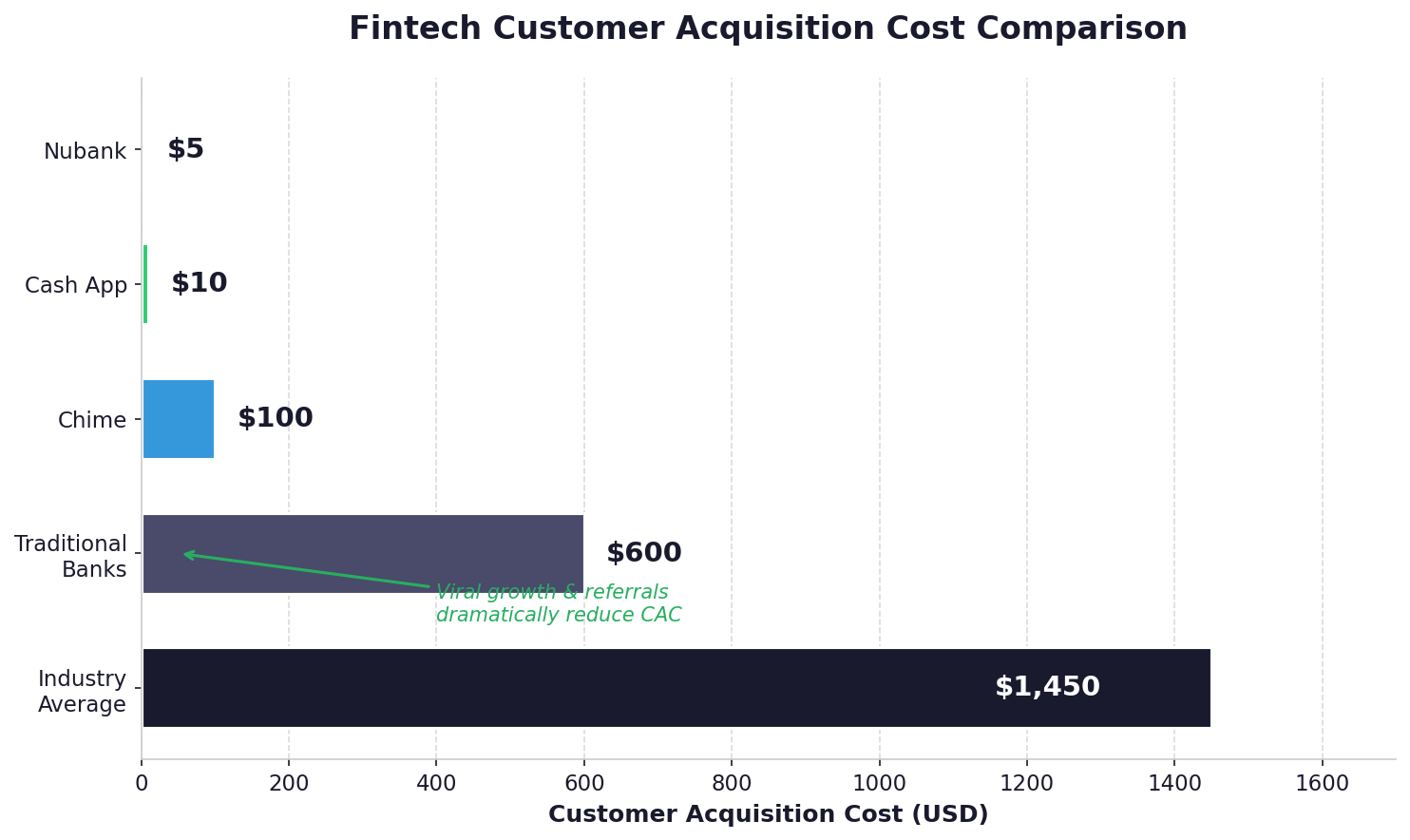
Referral programs have powered some of fintech's greatest growth stories. Chime's referral program, which offers cash incentives for successful referrals, helped the company acquire users at approximately $100 per customer compared to $600+ for traditional banks relying on branches and paid ads. Most fintechs pour money into paid ads chasing the same keywords as everyone else. The winners invest in product experiences worth talking about, then build referral mechanics that turn happy customers into a marketing engine.
The mechanics work because fintech products naturally generate word-of-mouth when they solve real financial pain points. People tell friends about services that save them money, and referral programs formalize and incentivize this organic behaviour. Nubank achieved a blended customer acquisition cost of less than $5 per customer by relying primarily on organic referral channels, demonstrating the potential of this approach when executed well.
Key elements of successful fintech referral programs:
- Clear, meaningful incentives for both referrer and referred user
- Simple sharing mechanics integrated into the product experience
- Requirements that align incentives with valuable behaviours (such as direct deposit setup)
- Tracking and optimization capabilities to measure program effectiveness
- Compliance with regulations around financial incentive promotions
6. Personalization and AI-Driven Marketing
Personalization has become a baseline expectation in fintech marketing. Research from Plaid and Harris Poll shows that 77% of consumers insist their bank integrate with their preferred apps, indicating expectations for seamless, personalized experiences.
AI-powered personalization enables fintech companies to analyze customer spending patterns, identify those most likely to disengage, and trigger automated campaigns with personalized messaging. The AI segment in fintech is valued at approximately $17 billion in 2024 and is expected to grow to $70.1 billion by 2033. McKinsey reports that by 2024, 70% of marketing leaders planned to use AI-powered lead scoring as a key acquisition strategy.
7. Paid Advertising and Performance Marketing
While organic channels offer better long-term economics, paid advertising remains important for fintech companies seeking immediate results and specific audience targeting. The average cost-per-install for finance apps is approximately $2.33, though this varies significantly by platform and target audience.
Effective fintech paid advertising requires balancing multiple channels. Google Ads delivers immediate search traffic for users actively seeking solutions, while Facebook and Instagram enable precise demographic and interest targeting. LinkedIn has become particularly valuable for B2B fintech companies, with 39% of B2B ad spend now going to the platform.
| Channel | Average CAC | Best Use Case |
|---|---|---|
| Google Search Ads | Varies by keyword competitiveness | High-intent customer capture |
| Meta (Facebook/Instagram) | 6:1 average ROAS | Awareness and consideration |
| Higher CPL, higher quality | B2B and professional audiences | |
| Programmatic Display | Lower CPM, lower conversion | Retargeting and brand awareness |
| TikTok | Growing efficiency | Gen Z and millennial acquisition |
The key insight for fintech marketers is that paid and organic strategies work best together. SEO builds long-term traffic while PPC provides immediate results, and coordination between channels improves overall visibility and conversion rates.
8. Email Marketing and Nurture Campaigns
Email marketing delivers exceptional ROI for fintech companies through its ability to nurture prospects through lengthy consideration periods. Financial decisions require trust and education, making email sequences that progressively build understanding highly effective.
Successful strategies segment audiences based on engagement level and product interest. Automated sequences deliver educational content to new subscribers, re-engagement campaigns to inactive users, and personalized offers to high-intent prospects. Integration with other channels amplifies effectiveness through consistent messaging.
9. Strategic Partnerships and Co-Marketing
Partnerships between fintechs and established brands have expanded significantly, with embedded finance growing 25% over two years to reach $185 billion. These partnerships create marketing opportunities by providing access to established audiences and credibility through association.
Stripe's partnerships with platforms like Shopify and WooCommerce demonstrate how integration partnerships drive awareness without traditional marketing costs. Co-marketing arrangements allow fintech companies to share costs while reaching complementary audiences.
10. Event Marketing and Industry Presence
Industry conferences provide fintech companies opportunities to demonstrate expertise, network with potential partners, and generate leads from qualified audiences. Participating in events like Money20/20 positions companies within industry conversations and provides content opportunities.
Virtual events have expanded access while reducing costs. Webinars and educational workshops allow companies to demonstrate expertise while capturing leads, and the content can be repurposed across other marketing channels. Focusing on events where target customers and decision-makers gather delivers better ROI than broad industry presence.
11. Product-Led Growth and Onboarding Optimization
Product-led growth strategies treat the product itself as the primary marketing channel. Free tiers and freemium models allow potential customers to experience value before committing. Many successful fintechs, including Robinhood with commission-free trading and Chime with no-fee banking, built growth engines around compelling free products.
Onboarding optimization directly impacts acquisition efficiency. Research indicates one-click forms achieve 40% higher completion rates, while abandoned signups across digital industries reach 79.17%. Streamlining the path from interest to active use dramatically improves the efficiency of all marketing investments.
12. Trust-Building and Compliance Marketing
Trust remains the fundamental barrier to fintech adoption. The 2024 Edelman Trust Barometer found that 62% of respondents globally trust financial services companies to "do the right thing," up 4 percentage points from the prior year. That said, traditional banks still maintain trust advantages in some areas, with 66% of U.S. adults trusting banks compared to 37% trusting fintechs.
Building trust requires consistent demonstration of security, transparency, and customer commitment. Security certifications, compliance badges, and clear communication about data protection address core consumer concerns. Transparent pricing, eliminating hidden fees, and proactive communication differentiate fintechs from traditional providers that consumers associate with complexity and opacity.
User reviews and social proof play critical roles in trust-building. Wise maintains over 200,000 customer reviews on Trustpilot with an average rating of 4.3 out of 5, providing concrete evidence of customer satisfaction that influences prospect decisions.
Common Misconceptions About Fintech Marketing
"Growth-at-all-costs still works"
It doesn't. Not anymore. The fintech industry has fundamentally shifted from prioritizing growth to emphasizing sustainable unit economics. Following the market correction of 2022, investors now scrutinize customer acquisition costs, payback periods, and path to profitability rather than simply celebrating user growth. McKinsey research indicates that fintechs must abandon the growth-at-all-costs mindset and switch to data-driven optimization focused on long-term profitability. Companies that continue pursuing expensive customer acquisition without corresponding lifetime value improvements face significant funding challenges and operational pressures.
"Traditional marketing channels don't work for fintech"
This one's more nuanced than people think. Yes, digital channels dominate fintech marketing. But traditional approaches remain valuable in specific contexts. Television advertising can build awareness among demographics less reachable through digital channels, and direct mail campaigns continue generating qualified leads for mortgage and lending products. Channel selection should follow customer research rather than assumptions about what "fintech companies should do."
"Compliance restricts marketing creativity"
Flip this thinking around. Regulatory requirements create constraints, but successful fintech marketers view compliance as a foundation for trust rather than a limitation, especially when compared to traditional banking. Clear disclosure requirements actually help differentiate reputable fintechs from questionable operators. Creative campaigns that incorporate compliance naturally, rather than treating it as an afterthought, build credibility while achieving marketing objectives. The companies that excel understand that transparency and regulatory adherence are marketing assets in an industry where consumer trust remains a primary acquisition barrier.
Real-World Examples and Case Studies
Chime: Building a $25 Billion Challenger Bank
Chime didn't become a $25 billion company by running clever ads. They did it by eliminating the fees that made people hate banks in the first place, then letting customers spread the word.
The company invested in marketing from day one—launching with a 2014 appearance on Dr. Phil of all places. But the real engine was product-market fit combined with smart distribution. Their feature-first SEO strategy targets keywords like "no fee checking account" and "early direct deposit," capturing users actively searching for solutions, including those related to natural language queries. The referral program, offering meaningful cash incentives, reduced customer acquisition costs to approximately $100 compared to $600+ for traditional banks.
Revenue hit $1.67 billion in 2024. Quarterly profitability came in Q1 2025. The playbook works.
Nubank: $5 CAC in a Market Where Banks Charged Hidden Fees on Everything
Brazilian digital bank Nubank grew to over 100 million customers. Their secret? They didn't really have a marketing budget in the traditional sense. Instead, they reallocated advertising spend to customer service improvements, focusing on evolving consumer expectations, including increasing financial literacy among their users. When your product eliminates the hidden fees that frustrate everyone, customers do the marketing for you.
The result: customer acquisition costs under $5 through organic channels and word-of-mouth alone.
Stripe
Stripe proves that documentation can be a growth strategy in digital payments. The company built a $65+ billion valuation largely on developer resources so comprehensive that engineers share them with each other. No traditional advertising. Just API documentation, tutorials, and industry reports that established thought leadership. Developers who loved the product advocated for Stripe adoption within their organizations. Bottom-up enterprise growth, powered by content.
Frequently Asked Questions
What is the average customer acquisition cost for fintech companies?
$1,450 per customer—the highest of any industry. But that number hides massive variation. Digital banks leveraging viral growth spend around $100 per customer. Nubank? Under $5 through organic channels. The gap comes down to strategy: referral programs, content marketing, and conversion optimization versus throwing money at paid ads.
How do fintech companies build trust with potential customers?
Security certifications. Transparent pricing. Positive reviews on third-party platforms. Responsive customer support. It sounds simple because it is. The hard part is doing it consistently. Worth noting: In recent years, 37% of consumers now identify fintech companies as their most-trusted financial brand, so the industry is making progress and creating new opportunities for growth.
What social media platforms work best for fintech marketing?
Depends entirely on who you're trying to reach. TikTok delivers 10.3% engagement rates for nano-influencers and dominates with younger demographics. LinkedIn has become essential for B2B fintech—39% of B2B ad spend goes there now. Instagram works for influencer partnerships, making it a crucial platform for any marketing team. YouTube handles the detailed educational content that complex financial topics require.
How important is content marketing for fintech companies?
96% of top fintech companies report it as a key strategy to meet customer financial needs and enhance customer experience. It costs 62% less than traditional marketing while generating three times more leads. But beyond the efficiency metrics, content marketing builds the expertise and authority signals that search engines and consumers require before trusting anyone with their money.
What regulations affect fintech marketing strategies?
Financial promotion rules, disclosure requirements, data protection regulations, and regulatory compliance in real time—the list is long. Social media faces particular scrutiny. The FCA issued 38 alerts against finfluencer accounts in 2024 alone. Smart fintech marketers build compliance into campaign development from the start rather than treating it as a legal review at the end.
Web Tonic works across paid social and growth marketing, and you can book a consultation to talk through your own plan.


