Table of contents
Key Takeaways
- Facebook Touch and mbasic.facebook.com are official Meta services providing lightweight alternatives to the standard Facebook experience, designed for users with limited connectivity, older devices, or preferences for simplified interfaces.
- The mbasic version (mbasic.facebook.com) uses no JavaScript and works on virtually any device with a browser, consuming 50-80% less data than standard Facebook while maintaining core functionality including posting, messaging, and feed browsing.
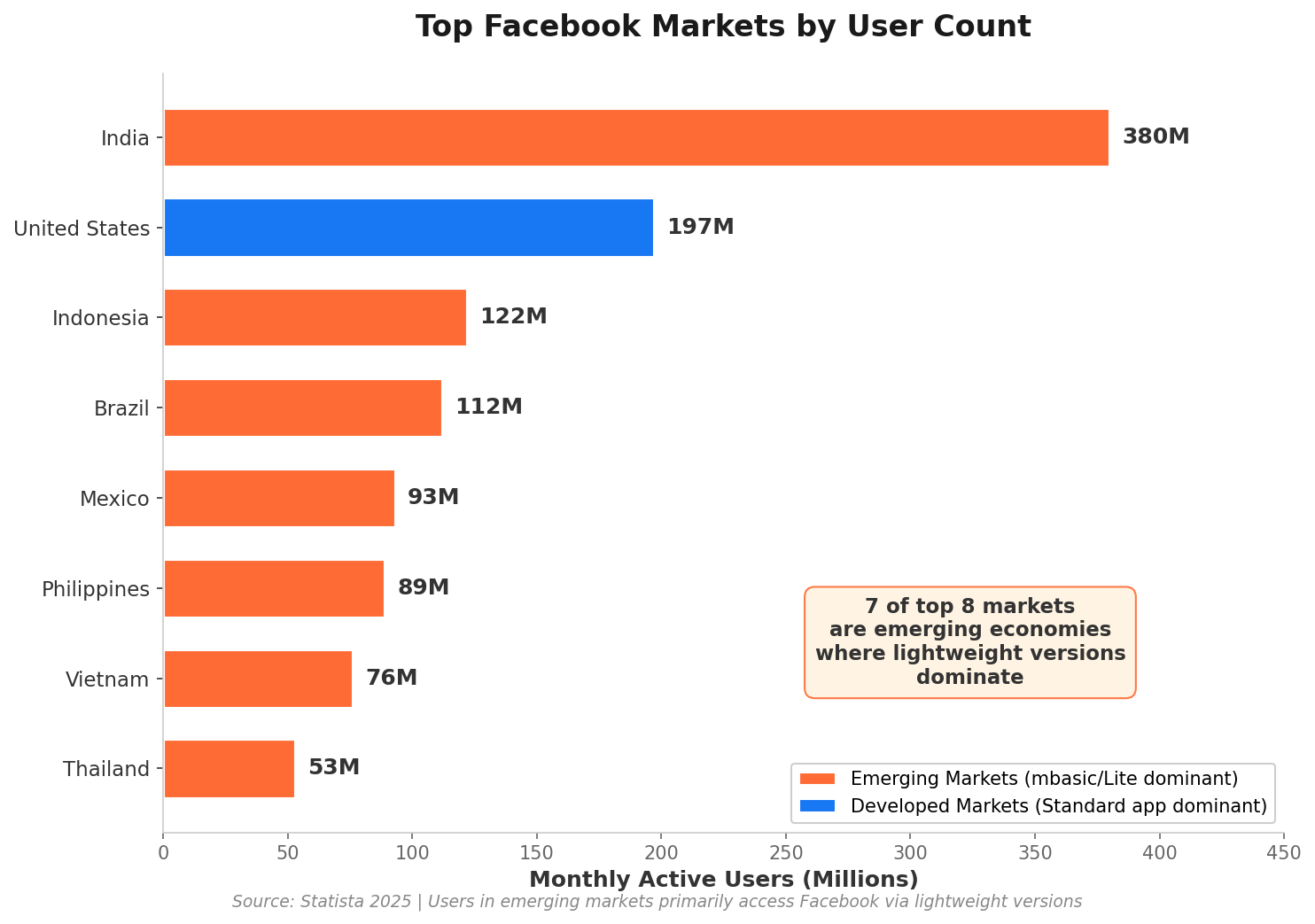
- Nearly 98% of Facebook's 3+ billion users access the platform via mobile devices, with emerging markets like India (380+ million users) representing the largest audience segments where lightweight versions dominate.
- Businesses targeting international audiences should consider optimizing content for lightweight delivery and testing campaigns across both standard and lite Facebook versions to maximize global reach.
- For organizations managing distributed teams or serving customers in low-connectivity regions, understanding and leveraging lightweight Facebook alternatives can provide critical communication reliability that feature-rich applications cannot match.
What Is Facebook Touch?
Facebook Touch refers to a family of lightweight, mobile-optimized versions of Facebook built for users who can't rely on fast, unlimited internet. The original "Facebook Touch" launched in 2009 as a touchscreen-optimized interface at touch.facebook.com. Today, the term has expanded to include mbasic.facebook.com, the standard mobile site (m.facebook.com), and the Facebook Lite app.
Why does this matter for businesses and marketers?
According to United Nations Development Programme research, more than one in six people in least developed countries live without mobile broadband coverage. Only 28% of rural populations in these regions use the internet. And the average smartphone costs 53% of monthly income in these areas. These aren't edge cases — this is reality for billions of potential Facebook users.
Statista data shows nearly 98% of Facebook's 3+ billion users access the platform via mobile devices. In emerging markets where Facebook Lite and mbasic dominate, content either works on lightweight versions or it simply doesn't reach these audiences.
Understanding Facebook's Mobile Versions: A Complete Comparison
Facebook offers several mobile-optimized versions. Picking the right one depends on your situation, your audience, and your connectivity constraints. Here's how they stack up:
Feature Comparison: Facebook Mobile Versions
| Feature | Standard Facebook App | Facebook Lite | mbasic.facebook.com | touch.facebook.com |
|---|---|---|---|---|
| App Size | 200+ MB | ~2 MB | Browser-based (0 MB) | Browser-based (0 MB) |
| Data Usage | High | Low (30-40% less) | Very Low | Moderate |
| Works on 2G Networks | Limited | Yes | Yes | Partial |
| Video Autoplay | Yes | Optional | No | No |
| Stories Feature | Yes | Limited | No | No |
| Marketplace | Yes | Yes | No | Limited |
| Live Video | Yes | No | No | No |
| High-Resolution Images | Yes | Compressed | No | Yes |
| JavaScript Required | Yes | Yes | No | Yes |
| Offline Features | Limited | Yes | No | No |
| Device Requirements | Modern smartphones | Low-end devices | Any browser | Touch-enabled devices |
How to Access Each Version
mbasic.facebook.com works in any browser, mobile or desktop. No JavaScript required. No fancy system requirements. Even outdated browsers handle it without issue. Just navigate to https://mbasic.facebook.com and log in.
touch.facebook.com offers better graphics than mbasic while remaining lighter than the standard site. Think of it as the middle ground for touchscreen devices with decent connectivity.
Facebook Lite is a downloadable app for Android only. At roughly 2 MB, it's about 100 times smaller than the standard app. And it runs smoothly even on 2G networks.
m.facebook.com is the default when visiting facebook.com from a mobile browser. More features than mbasic, but higher data and processing requirements come with it.
What You Gain and What You Lose
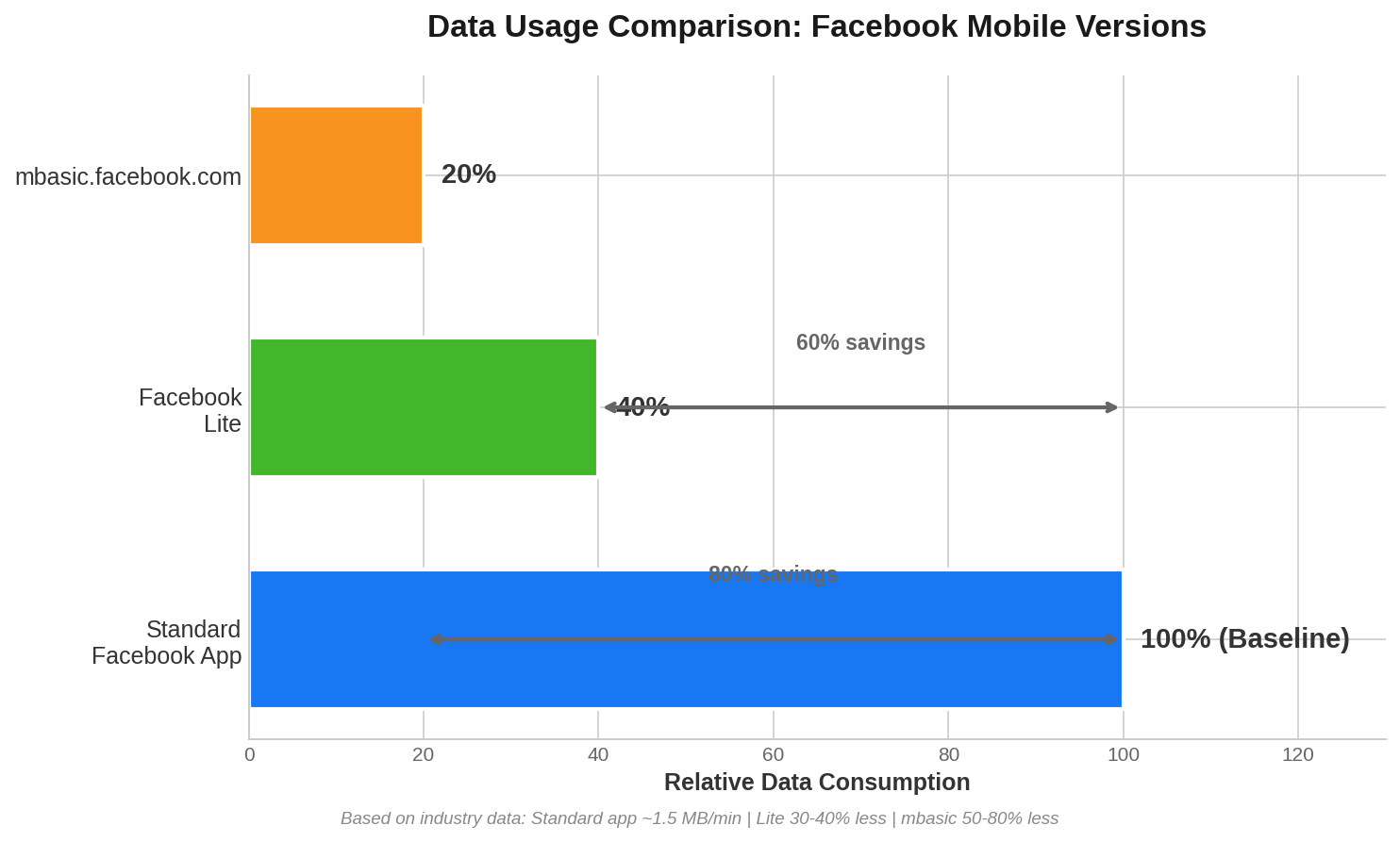
The data savings are substantial. Facebook Lite and mbasic cut consumption by 50-80% compared to standard versions. Pages load in under two seconds even on 2G connections. Older browsers and devices work without compatibility headaches. Battery life improves since simplified interfaces require less background processing. And network instability becomes less problematic because lightweight pages finish loading before connections drop.
But tradeoffs exist.
Stories don't appear on mbasic. Marketplace is unavailable. Live video streaming isn't an option. Browser-based versions lack push notifications, so checking updates requires manual refresh. And ad campaign management tools? Those require the full version.
Common Misconceptions
Misconception 1: mbasic.facebook.com Is Abandonware
A common assumption holds that mbasic.facebook.com is something Meta forgot about years ago and never bothered to shut down.
Wrong.
Meta actively maintains the basic version because over 200 million people use Facebook Lite every month. That's not a legacy product. That's a user base larger than most apps will ever achieve. The mbasic version handles posting updates, messaging, and feed browsing without issue. It simply lacks the advanced features.
Misconception 2: Facebook Touch and mbasic Are the Same Thing
These serve completely different purposes.
Facebook Touch (touch.facebook.com) was built for touchscreen smartphones with enhanced graphics and responsive design. It looks polished and works smoothly on modern touch devices.
Mbasic strips away everything. No JavaScript. No complex visuals. Nothing but the essentials. It functions on literally any device with a basic web browser, including feature phones that predate smartphones entirely. Touch provides higher image quality and visual appeal. Mbasic provides pure functionality with minimal data usage.
Misconception 3: These Alternative URLs Are Security Risks
Concern about accessing Facebook through URLs other than www.facebook.com is understandable. But both mbasic.facebook.com and touch.facebook.com are official Meta properties with identical security infrastructure.
Two-factor authentication works. All standard security features work. The only real security consideration is ensuring the correct URL is entered directly rather than clicking modified links from unknown sources.
Why Emerging Markets Should Shape Your Mobile Strategy
The geographic distribution of Facebook users tells a clear story.
India leads with over 380 million users — more than the entire U.S. population. The United States follows, then Brazil and Indonesia. All mobile-dominant markets. And all markets where lightweight Facebook versions see heavy usage.
Brookings Institution research puts the opportunity in stark terms: 2-4 billion people in India and China alone lack internet access. That's a massive audience reachable only through lightweight platforms.
Here's what most marketers miss: the data consumption gap isn't just about affordability — it's about behaviour. Standard Facebook app usage burns approximately 1.5 MB per minute during normal browsing. Video jumps to 2.6 MB per minute at standard quality and climbs to 20 MB per minute for HD content. For users on metered plans — the majority outside North America and Western Europe — those rates force a choice. They either ration their Facebook time severely or switch to mbasic and browse freely.
Most switch. And when they do, your video ads, your carousel posts, your Stories — none of it reaches them. The brands winning in these markets aren't the ones with the best video content. They're the ones whose text posts actually say something worth reading.
The Surprising Case for Simpler Interfaces
Here's something that challenges common assumptions: simplified interfaces often drive higher engagement among specific user segments. This runs counter to the belief that everyone prefers feature-rich applications.
United Nations Conference on Trade and Development data reveals that network coverage in least developed countries averages a score of 54, compared to 83 in developed regions. Data costs remain significantly higher relative to income.
What does this mean practically?
For a substantial portion of global internet users, lightweight applications aren't a compromise. They're the optimal experience. Users in these contexts consistently report higher satisfaction with fast-loading, reliable interfaces than with feature-heavy applications that stall, buffer, and fail to load entirely. And reduced cognitive load from simpler interfaces benefits even users with excellent connectivity who prefer distraction-free browsing.
But here's the counterintuitive part that rarely gets discussed: mbasic users often show higher engagement rates per session than standard app users. Why? No algorithmic distractions. No autoplay videos pulling attention. No Stories disappearing in 24 hours creating artificial urgency. When someone opens mbasic, they're there to do something specific — check messages, read updates, post content. That intent-driven behaviour translates to higher quality interactions for brands that know how to leverage it.
For marketers, content designed for lightweight delivery — text-focused posts, compressed images — may outperform multimedia-heavy content in emerging market campaigns. Testing content across both standard and lite Facebook versions can reveal engagement patterns that standard analytics miss entirely.
How to Access and Use mbasic.facebook.com
Getting to mbasic takes about 10 seconds. No app download. No account setup. No permission requests. Just a URL.
On Mobile
Open any mobile browser — Chrome, Safari, Firefox, or whatever came pre-installed on the device. Type mbasic.facebook.com in the address bar. Log in with standard Facebook credentials. Done. The simplified interface displays news feed, friend requests, messages, and notifications through text links instead of graphical icons.
On Desktop
The process is identical. Any web browser works. Navigate to https://mbasic.facebook.com and log in. The interface appears as a mobile site on the larger screen, but functionality remains the same. Some users actually prefer this for reduced distractions during work.
Creating a Shortcut
For regular mbasic users, bookmarking or adding to the home screen eliminates typing the URL repeatedly.
On Android using Chrome: navigate to mbasic.facebook.com, tap the three-dot menu, select "Add to Home screen."
On iOS using Safari: tap the Share button, select "Add to Home Screen."
One-tap access from that point forward.
Navigating the Interface
The mbasic interface uses text-based navigation. After logging in, links at the top of the page provide access to News Feed, requests, messages, notifications, and profile. The three-line menu reveals settings, help resources, and logout options.
Posting, commenting, and messaging work identically to standard Facebook — just without rich formatting or automatic media previews. Image loading happens only when explicitly selected.
Real-World Results
A Fashion Brand in Vietnam
A small fashion brand in Vietnam documented results after shifting strategy to embrace lightweight Facebook access. They recommended Facebook Lite to customers and optimized content for low-bandwidth viewing.
The results: 25% reduction in marketing data costs. And 15% increase in engagement from young customers in suburban areas.
Their approach involved text-forward posts with minimal image sizes, timing posts for peak connectivity hours, and active engagement through Messenger Lite. The takeaway? Effective social media marketing doesn't require bandwidth-heavy content when the target audience primarily uses lightweight platforms.
Enterprise Communication Solutions
Global enterprises increasingly leverage mbasic.facebook.com for internal communications in regions with limited connectivity. Field teams operating in rural areas of Africa, Southeast Asia, and Latin America report that browser-based mbasic access provides more reliable communication than app-based solutions during connectivity fluctuations.
One multinational agricultural company trained their remote workforce to use mbasic as a backup communication channel. When primary systems experienced connectivity issues, teams maintained coordination through the text-based platform. They avoided operational disruptions that previously caused significant delays and costs.
Content Creator Strategies
Digital content creators targeting global audiences find success with dual content strategies.
Rich multimedia goes to developed market audiences accessing standard Facebook. Simplified, text-forward content targets emerging market engagement through lightweight versions. This segmented approach maximizes reach without sacrificing engagement quality in either segment.
The most successful creators use analytics to identify which audience segments access content through different Facebook versions, then tailor delivery accordingly. Posts for lightweight version users feature compelling text, smaller image files, and calls-to-action that function without multimedia engagement.
Optimizing Content for Lightweight Users
If a significant portion of the audience accesses Facebook through lightweight versions, content strategy needs to reflect that reality.
Lead with text. Users on mbasic must explicitly choose to load images. Text needs to stand alone as engaging content rather than serving as caption for visuals.
Compress images aggressively. When including images, smaller file sizes help rather than hurt engagement for bandwidth-limited users.
Don't depend on video. Lightweight version users often can't or won't view video content. Core messages need to work without it.
Make calls-to-action text-based. Interactive buttons and multimedia elements may not render on basic versions. Plain text works everywhere.
Test across platforms. Regularly accessing posts through mbasic.facebook.com verifies that messages communicate effectively without rich media. This testing reveals optimization opportunities that analytics alone miss.
Frequently Asked Questions
What's the difference between mbasic.facebook.com and the regular mobile site?
The core difference is resource requirements. Mbasic uses no JavaScript and loads as simple HTML, making it compatible with any browser including outdated versions on feature phones. It consumes minimal data and loads quickly even on 2G. The regular mobile site (m.facebook.com) offers more features including Stories and richer media, but demands more data, processing power, and JavaScript support.
Is logging into mbasic.facebook.com safe?
Yes. It's an official Meta property with the same security infrastructure as the main site. Credentials are protected by identical encryption. Two-factor authentication works. All standard security features work. The key is typing the correct URL — https://mbasic.facebook.com — rather than clicking modified links from unknown sources.
Can iPhone users access Facebook Lite?
No. Facebook Lite is Android-only through the Google Play Store. iOS users wanting a lightweight experience should use mbasic.facebook.com through their mobile browser. It provides similar data-saving benefits and works on any device with internet access.
Does using mbasic affect my account or data?
Not at all. The same Facebook account and content are accessed through a different interface. Posts, messages, friends, and all account information stay synchronized across all access methods.
How much data does mbasic actually save?
Typically 50-80% less than the standard app. Exact savings depend on usage patterns, but eliminating auto-playing videos, high-resolution images, and JavaScript dramatically reduces consumption. Users on limited plans often browse mbasic for hours using data that the standard app would consume in minutes.
Web Tonic works across SEO, paid search and paid social, and you can book a consultation to talk through your own plan.