



Table of contents
Key Takeaways
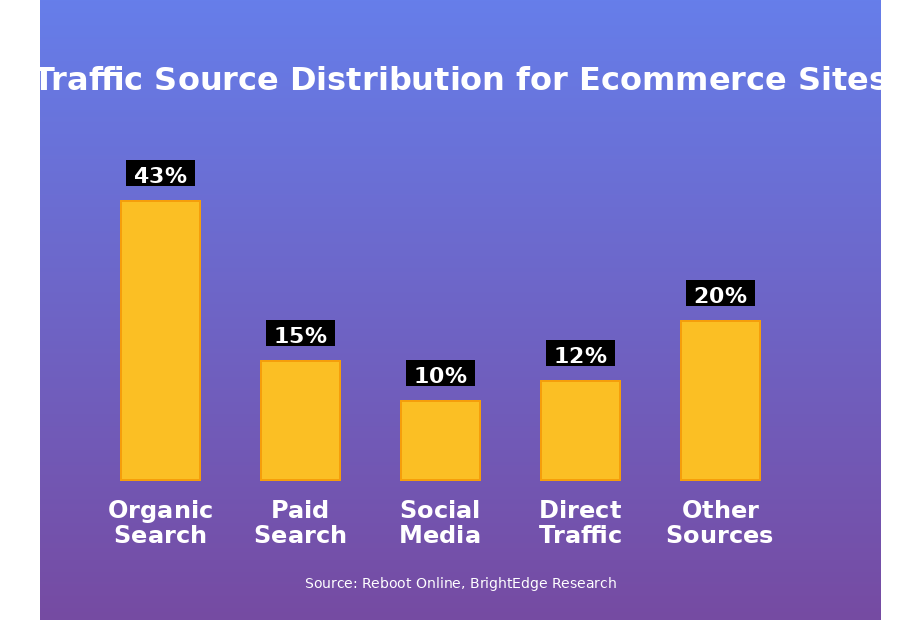
- Organic search drives 43% of all ecommerce traffic and generates 23.6% of online orders, making it the most sustainable acquisition channel for online retail businesses. The average value of this organic traffic equals £11,790 per month in paid advertising costs.
- Technical SEO excellence provides the foundation for ecommerce visibility. Sites loading in one second achieve 3x higher conversion rates, while 70.5% of ecommerce sites receive "needs improvement" ratings on performance, creating opportunity for brands investing in speed optimization and technical infrastructure.
- Strategic backlink acquisition to commercial pages amplifies rankings more effectively than accumulating homepage links. Top-ranking ecommerce pages average 3.8x more backlinks and 2.72x more referring domains than lower positions, with quality and relevance outweighing volume.
- AI Overview integration reshapes ecommerce search strategy, with brands cited in AI-generated responses capturing 35% more organic clicks and 91% more paid clicks. Schema markup implementation and comprehensive product content positioning brands as authoritative sources AI systems reference.
- Results materialize faster than commonly believed, with properly executed ecommerce SEO delivering measurable traffic and revenue improvements within 3-6 months. Case studies demonstrate 300%+ traffic growth, 3,403% keyword ranking increases, and 299% sales improvements through systematic optimization addressing technical, content, and authority factors simultaneously.
- Consider partnering with specialists who understand the unique challenges of ecommerce SEO—from technical architecture and content strategy to link building and conversion optimization. The compounding returns from organic visibility make professional expertise a high-ROI investment for growing online retail businesses.
What Is Ecommerce SEO?
Ecommerce SEO optimizes online stores to rank higher in search engine results pages, driving qualified organic traffic that converts into sales. Traditional SEO focuses on content marketing and informational queries. Ecommerce SEO tackles different problems: product catalogues with thousands of URLs, category hierarchies, transactional search intent, and the technical complexities of managing inventory at scale.
McKinsey projects that agentic commerce could generate between $3 trillion and $5 trillion in economic opportunity by 2030, fundamentally transforming how consumers discover and purchase products online. For mid-market and enterprise ecommerce businesses, organic search is the most sustainable acquisition channel. 43% of all ecommerce traffic comes from organic Google search, making it the single largest traffic source for online retail operations.
The financial numbers matter.
The average ecommerce brand ranks for approximately 1,783 organic keywords, driving an estimated 9,625 monthly visits. This traffic would cost £11,790 per month if acquired through paid search advertising, a compounding return on investment that keeps working without ongoing media spend. Organic search drives 23.6% of all ecommerce orders, converting at rates between 2.4% and 3.75% industry-wide. For enterprise operations processing millions in annual revenue, these percentages translate into substantial bottom-line impact.
The Strategic Foundation: Technical SEO Excellence
Technical infrastructure determines whether search engines can efficiently crawl, index, and understand your product catalog. Many ecommerce platforms struggle with fundamental issues that limit organic visibility, regardless of content quality or backlink profile strength.
Critical Technical Elements for Ecommerce Success
| Technical Element | Impact on Performance | Implementation Priority |
|---|---|---|
| Site Speed Optimization | Sites loading in 1 second achieve 3x higher conversion rates | Critical - Immediate Revenue Impact |
| Mobile Responsiveness | 57% of global ecommerce sales occur on mobile devices | Critical - Primary Commerce Channel |
| Canonical Tag Implementation | 53% of ecommerce sites have missing canonical tags affecting 40% of pages | High - Prevents Duplicate Content Issues |
| Internal Link Structure | 86% of ecommerce brands lack optimized internal linking | High - Distributes Authority & Crawl Equity |
| Schema Markup | Rich results achieve 82% higher CTR compared to standard snippets | Medium - Enhances SERP Visibility |
The average ecommerce website achieves only a 67/100 Google Lighthouse performance score, with 70.5% of sites rated as "needs improvement." This widespread underperformance creates opportunity. Brands that invest in proper infrastructure optimization gain immediate advantages. A one-second improvement in page load time increases retail conversion rates by 8.4% and average order value by 9.2%, translating technical improvements directly into revenue gains.
Addressing Duplicate Content and URL Management
Product variants, filter parameters, pagination, and multi-category listings create duplicate content challenges unique to ecommerce. Even among high-visibility sites, 38.78% struggle with duplicate content problems.
Canonical tag implementation, parameter handling in Google Search Console, and strategic noindex directives for filter pages prevent ranking signal dilution across similar pages. Running a crawl with Screaming Frog or similar tools quickly identifies which pages need canonical tags and which parameters should be excluded from indexing.
But there's another problem. 62.4% of ecommerce websites contain broken links, which leads to higher bounce rates and lost crawl equity. Regular technical audits identify and resolve 404 errors. Proper 301 redirects for discontinued products maintain link equity. Clean URL structures ensure search engines efficiently allocate crawl budget to high-value pages.
Content Optimization: Beyond Product Descriptions
Technical excellence provides the foundation. Content quality determines whether your optimized pages actually rank and convert.
Here's the thing: most ecommerce businesses dramatically underinvest in content depth and quality, leaving them vulnerable to competitors who understand what search engines prioritize.
On-Page Content Benchmarks and Best Practices
The average ecommerce page title contains only 39 characters, well below the recommended 50-60 characters. Meta descriptions average just 96 characters compared to the optimal 155-160 character range. These shortened elements fail to communicate value propositions and targeted keywords effectively, reducing click-through rates from search results.
Content depth matters. Category pages should contain 800-1,200 words of unique, keyword-optimized content, while product pages benefit from 300-500 word descriptions that address customer questions and use cases. 92% of lowest-performing sites have thin content issues, with content depth directly correlating to rankings.
User-generated content separates top performers from average stores. 73% of top ecommerce brands leverage user-generated content, compared to only 28% of mid-sized brands. The impact is substantial: product pages with customer reviews receive 18% more traffic, and products featuring 50+ reviews convert 4.6 times better than products without reviews.
Readability remains critical. Only 3% of ecommerce pages are considered hard to read, with 52% rated as either very easy or fairly easy to read. Short, punchy sentences and simple language improve both user experience and search engine understanding of page content.
Common Misconceptions About Ecommerce SEO
Misconception 1: Ecommerce SEO Results Take Years to Materialize
Many business leaders delay SEO investment because they believe meaningful results require 12-24 months of sustained effort.
The reality is different.
Comprehensive ecommerce SEO builds value over time, but properly executed strategies deliver measurable improvements within 3-6 months. Case studies demonstrate brands achieving over 1,300 featured snippets within five months of structured content optimization.
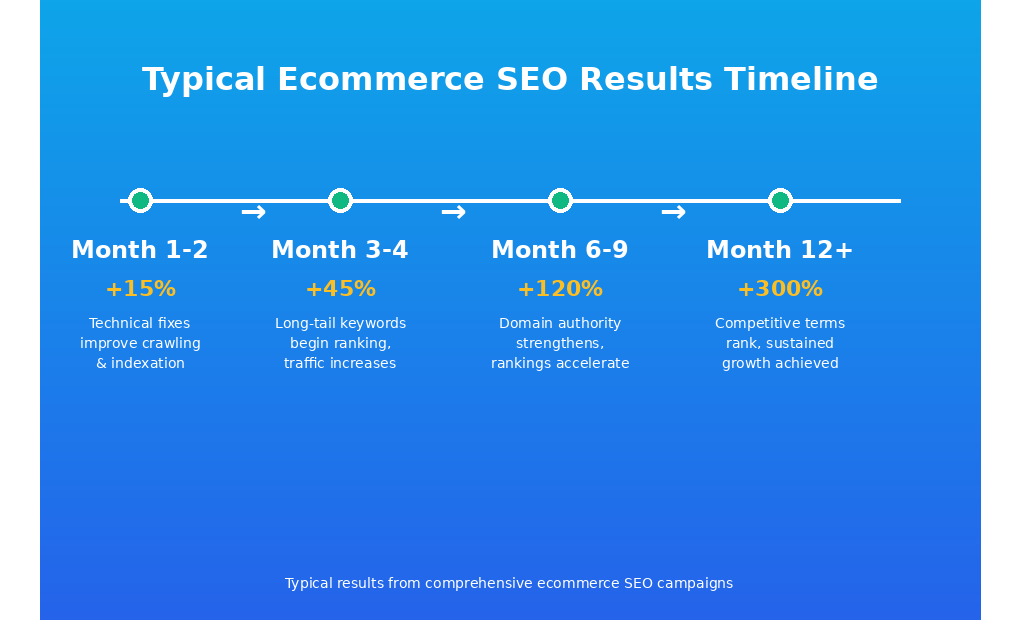
There's a distinction between "seeing some results" and "achieving full potential." Technical fixes often produce immediate improvements in crawlability and indexation. Content optimization targeting low-competition, long-tail keywords can drive incremental traffic within weeks. Link building campaigns compound authority over time, with most brands experiencing accelerating returns between months 6-18 as domain authority strengthens and rankings improve for competitive commercial keywords.
Misconception 2: Product Pages Can't Compete With Content-Heavy Sites
Why do ecommerce managers believe product pages inherently disadvantage them against content publishers and review sites? It reflects a misunderstanding of search intent and keyword targeting strategy. Product pages should target transactional keywords where purchase intent is explicit, not compete for informational queries where users seek education rather than products.
Product-focused pages perform extremely well for commercial keywords. Retailers optimizing meta titles and product descriptions see 32% increases in organic sales. The strategy involves comprehensive keyword research identifying transactional variations of core product terms, then building supporting content through buying guides, comparison articles, and category pages that funnel users toward product pages when purchase intent crystallizes.
Misconception 3: High Domain Authority Guarantees Ecommerce Rankings
Domain authority influences rankings, but it's neither sufficient nor the primary determinant of ecommerce visibility. 96.55% of all indexed pages receive no organic traffic from Google, including pages on high-authority domains.
Successful ecommerce SEO requires multiple ranking factors working together: technical excellence, content relevance, user experience signals, proper internal linking, and targeted backlinks to commercial pages rather than just the homepage.
The enterprise brands dominating ecommerce SERPs succeed through comprehensive optimization addressing every ranking factor systematically. Smaller ecommerce brands can compete effectively by identifying keyword opportunities where competition is manageable, building topical authority within specific product categories, and executing technical optimization that larger sites with legacy platforms struggle to implement.
Why Backlink Quality Matters More Than Quantity
The top-ranking organic result on Google averages 3.8x more backlinks than positions 2-10, but the distribution and quality of those links determines their ranking impact. Ecommerce sites achieving dominant organic visibility demonstrate one consistent factor: strategic backlink profiles emphasizing relevance and authority over volume.
Effective ecommerce link building targets category pages and high-value product collections rather than accumulating homepage links. Each backlink serves as both a ranking signal and a potential traffic source. Relevance is critical. Links from industry publications, product review sites, and complementary businesses in related niches deliver substantially more value than directory listings or low-relevance blog comments.
Product pages in the top two positions average 2.72x more referring domains than lower-ranking pages. This concentration of authority on the highest-ranking pages reflects search engines' evaluation of which pages deserve visibility based on external validation through quality backlinks.
The Evolving Impact of AI on Ecommerce Search
AI Overview results in Google search represent the most significant shift in search behaviour since mobile adoption. Research tracking 3,119 informational queries shows organic CTR dropped from 1.76% to 0.61% for queries with AI Overviews—a 61% decline.
But there's opportunity here.
When brands earn citations within AI Overview results, they capture 35% more organic clicks and 91% more paid clicks compared to brands absent from AI-generated responses. Optimization must now target not just traditional rankings but also becoming the authoritative source that AI systems reference when answering product-related queries.
Pages must demonstrate clear expertise, use structured data that AI systems can parse efficiently, and establish topical authority through comprehensive coverage of product categories rather than isolated product pages. Websites implementing schema markup see 30% improvements in AI visibility, making structured data implementation essential for maintaining organic visibility as AI-powered search features expand.
Real-World Examples and Case Studies
Filter King: From Zero to $460,000+ in Organic Revenue
On The Map Marketing documented their comprehensive ecommerce SEO strategy building Filter King from a newly launched site to over $460,000 in annual revenue driven primarily by organic search. The campaign focused on establishing topical authority within the air filter replacement market through strategic content development and targeted link building.
The approach began with foundational technical optimization and low-competition keyword targeting. They built 39 backlinks in the first year from home improvement, architecture, and real estate publications. This established baseline domain authority. The site could then rank for increasingly competitive keywords. By the second year, indexed keywords jumped from under 100 to several thousand, driving 447 organic sessions monthly and accelerating thereafter.
Strategic ecommerce SEO delivers measurable revenue within 12-18 months even in competitive product categories.
Surfer SEO Client: 3,403% Keyword Ranking Growth in 9 Months
A mid-sized ecommerce client working with SEO consultant Peter Rota achieved extraordinary growth through systematic content optimization using data-driven tools. The site started with only 157 keyword rankings and virtually no blog content. Nine months later? Nearly 5,500 keyword rankings—representing 3,403% growth.
Organic traffic surged from approximately 30 clicks daily to over 200, translating directly into the client's best sales year ever. The methodology emphasized comprehensive keyword research, content gap analysis, and continuous optimization of existing pages rather than solely creating new content. Ecommerce sites can achieve rapid visibility improvements through strategic content development even without extensive backlink acquisition.
The Deck Store: 299% Sales Increase Through Technical and Content Optimization
Digital Neighbor's work with The Deck Store demonstrates how combining technical SEO with strategic paid media creates compounding growth. The ecommerce platform redesign addressed navigation issues, product organization, and backend operational efficiency. At the same time, they implemented comprehensive on-page optimization.
The results over four months? A 299% increase in total sales and a 46% increase in average order value. Technical excellence, content optimization, and strategic promotion deliver maximum impact when working together rather than as isolated initiatives.
Fashion Marketplace: 100% Traffic Growth Through Targeted Link Building
The HOTH's case study of a fashion marketplace curating independent vendor products demonstrates backlink strategy's impact on competitive ecommerce visibility. Despite high-quality products and strong site design, the store struggled with minimal organic traffic in the saturated fashion vertical.
The targeted link building campaign focused on establishing topical authority and domain credibility rather than accumulating link volume. By securing relevant backlinks from fashion, lifestyle, and shopping publications, the site achieved 100% traffic growth within seven months, reaching its target audience. Monthly organic visitors increased from 100 to over 2,300, with sales growth tracking proportionally.
Backlink quality and relevance outweigh quantity, particularly in highly competitive ecommerce categories.
Frequently Asked Questions
How long does it take to see results from ecommerce SEO?
Most ecommerce sites experience measurable improvements within 3-6 months of implementing comprehensive SEO strategies.
Technical fixes often produce immediate benefits in crawlability and indexation. Content optimization targeting less competitive keywords can drive incremental traffic within 4-8 weeks. Achieving dominant visibility for high-value commercial keywords typically requires 6-12 months of sustained optimization, content development, and link building as domain authority strengthens and trust signals accumulate. Tools like Ahrefs and SEMrush make it easier to track keyword rankings and traffic improvements over time, showing exactly which optimizations drive the most impact.
What's the difference between ecommerce SEO and traditional SEO?
The challenges are completely different. Ecommerce SEO, particularly in the ecommerce market, means managing massive URL structures with thousands or millions of product pages, optimizing for transactional rather than informational search intent, and handling duplicate content from product variants and filters. You're also implementing product schema markup, building links to commercial pages rather than blog content, and continuously optimizing as inventory changes.
Should ecommerce businesses prioritize product pages or blog content?
Both matter, but they serve different purposes. Product and category pages should target transactional keywords where user intent for purchase is explicit—terms like "buy running shoes" or "Nike Air Max price." Blog content captures informational queries earlier in the customer journey, building awareness and authority while providing link-worthy assets that attract natural backlinks. The optimal approach targets commercial keywords through optimized product pages while using blog content to address questions, comparisons, and educational queries that precede purchase decisions. A store selling outdoor gear might rank product pages for "waterproof hiking boots" while using blog posts to rank for "how to choose hiking boots" or "best trails in Colorado."
How important are customer reviews for ecommerce SEO?
Critical. Reviews generate fresh, user-generated content that search engines value, naturally incorporate long-tail keyword variations customers use, and provide trust signals that influence rankings and lead to the desired action. Products with 50+ reviews convert 4.6 times better than products without reviews, while pages displaying reviews experience conversion increases up to 270%.
Can small ecommerce businesses compete with Amazon and major retailers?
Small and mid-sized ecommerce businesses can compete effectively by focusing on niche product categories, long-tail keywords, and differentiated value propositions rather than attempting to match Amazon's breadth. Success requires identifying keyword opportunities where major retailers have weak content, building topical authority within specific product niches, and optimizing for mid-funnel keywords where users seek specialized products rather than commodity items. Superior product information, expert content, and exceptional user experience allow smaller brands to capture qualified traffic that converts at higher rates than traffic from generic searches dominated by marketplace platforms.


