



Table of contents

Key Takeaways
- Prioritize SEO as your foundation because organic search delivers 53% of real estate website traffic and converts at more than double the rate of paid channels
- Embrace video marketing and 3D virtual tours once you have sufficient volume, as they increase qualified leads by 49% and can reduce time on market by up to 31%
- Build an integrated multi-channel strategy that combines social media (particularly Facebook), email marketing, and content marketing for comprehensive market coverage
- Invest in mobile optimization since 50% of homebuyers search on mobile devices and 80% of real estate website traffic comes from mobile
- Implement measurement and analytics to track conversion rates, cost per lead, and ROI across all channels because data-driven optimization separates top performers from the average
- Consider partnering with a specialized real estate digital marketing agency to accelerate results and access expertise across all these disciplines
What Is Digital Marketing in Real Estate?
Digital marketing in real estate encompasses all online strategies and channels that agents, brokers, and property companies use to attract, engage, and convert buyers, sellers, and investors. Unlike traditional marketing approaches like print advertising, signage, and direct mail, a strong online presence in digital marketing leverages websites, search engines, social media platforms, email campaigns, and multimedia content to reach prospects where they spend most of their time: online.
The shift is undeniable. According to the National Association of REALTORS® (NAR), 97% of homebuyers now use the internet to search for properties, with 41% of recent purchasers starting their house hunt online. This digital-first behaviour has transformed how real estate professionals must approach marketing. The NAR's Technology Survey reveals that social media remains the top lead-generating technology for agents at 39%, followed by Customer Relationship Management systems at 23% and local MLS platforms at 17%.
For mid-market brokerages and enterprise-level real estate firms, digital marketing represents both an opportunity and a necessity. The global real estate market is projected to reach $637.80 trillion by 2024 according to Statista, and that scale demands sophisticated marketing strategies that can reach across markets while maintaining local relevance. Digital channels provide the targeting precision, measurement capabilities, and cost efficiency that traditional marketing simply cannot match.
The 15-Step Digital Marketing Framework for Real Estate Success
Step 1: Build a High-Converting Real Estate Website
Your website serves as the digital storefront for your real estate business. And the performance gap between average and excellent is stark. According to industry benchmarks from Promodo, the average conversion rate for real estate websites sits at 2%, while top performers like Zillow consistently achieve conversion rates exceeding 5%.
What separates them? Mobile optimization matters most since 80% of real estate website traffic comes from mobile devices, and fast-loading mobile pages lead to 30% higher conversion rates. IDX integration enables visitors to browse listings directly on your site rather than bouncing to Zillow or Realtor.com. Lead capture forms placed strategically throughout the site convert passive browsers into contacts. Area guides and neighbourhood content establish local expertise while improving SEO. And agent profiles build trust because 94% of first impressions are design-related.
Step 2: Master Search Engine Optimization (SEO)
SEO accounts for 53% of website traffic for real estate agents. That makes it the single most important source of organic visibility.
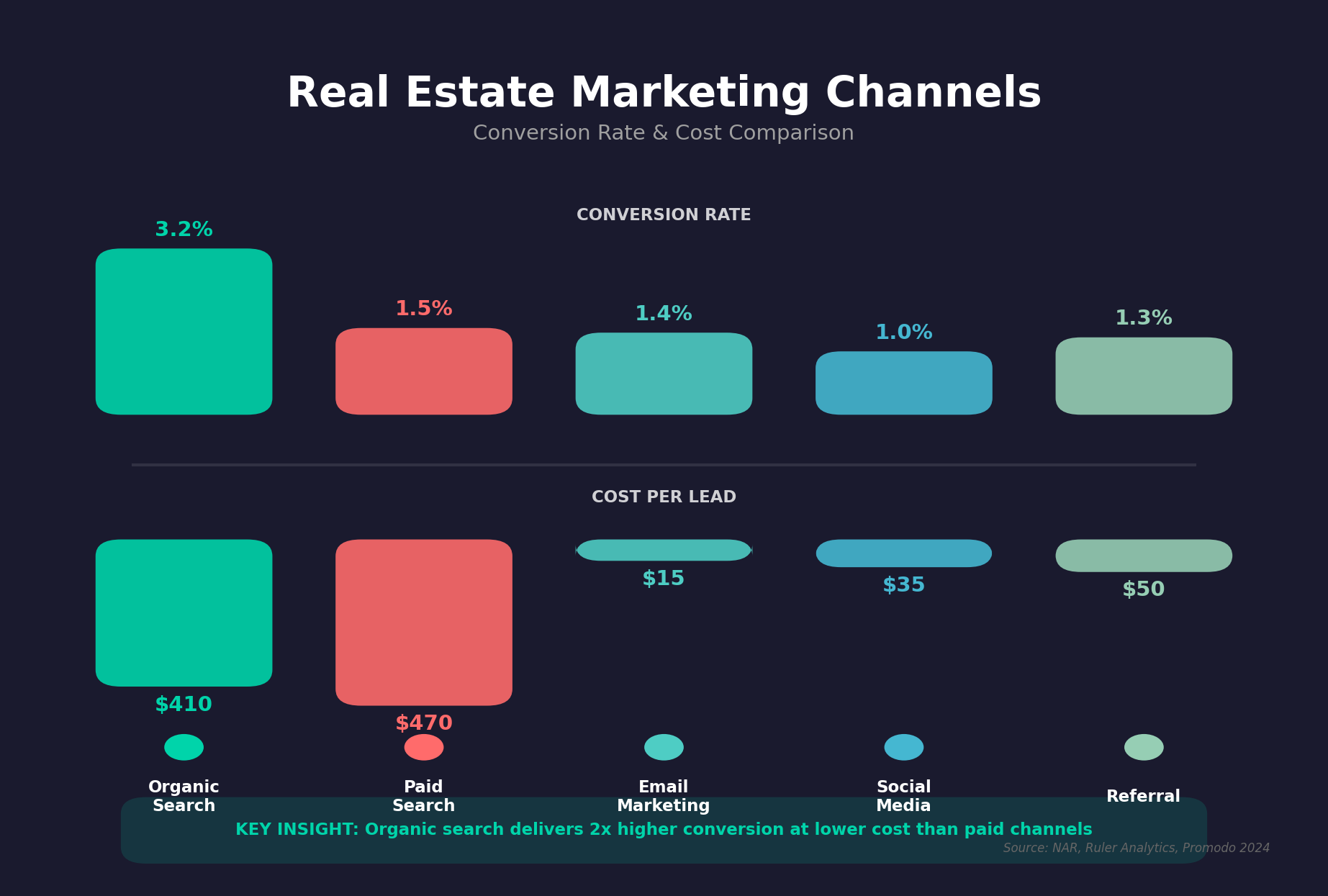
The conversion rate advantage tells the real story. Organic search converts at 3.2% compared to just 1.5% for paid search, according to Ruler Analytics. That's more than double the effectiveness per visitor.
Local SEO deserves special attention. Local and organic searches contribute to 69% of overall digital traffic in real estate, and 76% of real estate searches include location-specific terms. Focus on optimizing your Google Business Profile, building local citations, generating reviews (88% of consumers trust online reviews as much as personal recommendations), and creating neighbourhood-specific content. Long-tail keywords like "homes for sale near me" have seen a 250% increase in search volume since 2019, according to Google Trends. That's not a trend. That's a fundamental shift in how buyers search.
Step 3: Develop a Content Marketing Strategy
Only 23.1% of U.S. real estate agents utilize content marketing strategies.
That's a massive opportunity for differentiation. Content marketing serves multiple purposes at once: establishing expertise, improving SEO rankings, and providing value that builds trust with prospects long before they're ready to transact.
High-performing content types include local market reports and analysis, homebuyer and seller guides, neighbourhood spotlights, first-time homebuyer resources (blogs targeting these keywords rank 42% higher), investment property analysis, and market trend updates. Real estate websites with regular content updates rank 33% more consistently on search engine results pages, and evergreen content generates 38% of ongoing SEO traffic. The compounding effect makes content one of the best long-term investments you can make.
Step 4: Leverage Video Marketing
Video now drives most leads for agents who use it well. According to NAR research, 73% of homeowners say they prefer to list with an agent who uses video as an easy way to market their property. Yet only 26% of real estate agents actively use YouTube despite it being the second most visited website globally.
The numbers are compelling. Listings with video receive 49% more qualified leads and generate 403% more inquiries than listings without video. Video walkthroughs increase buyer confidence by 28%. Social media posts with videos generate 1,200% more shares than text and images combined.
But here's the nuance most articles won't tell you: video quality matters more than video quantity. A poorly lit iPhone walkthrough can actually hurt your brand. For agents handling fewer than 15-20 listings annually, the $300-500 per professional video may not pay off. Start with market update videos where production value matters less, then graduate to property videos once you've built the volume to justify the investment.
Step 5: Implement 3D Virtual Tours
The virtual tour market has experienced explosive growth. The global market is projected to reach $74.36 billion by 2030, according to Grand View Research.
For real estate specifically, the results are measurable. According to research from Matterport, listings with 3D virtual tours close up to 31% faster and sell for up to 9% more than comparable properties without tours. Properties with virtual tours receive 87% more views. And 62% of buyers actively seek listings that offer immersive 3D tours.
A Redfin survey of approximately 2,000 homebuyers across 32 major markets found that 63% of participants made an offer on a house they hadn't visited in person, relying solely on virtual tours and online information. That number would have seemed impossible a decade ago. Now it's standard practice for out-of-state buyers and investors.
Step 6: Build a Social Media Presence
Social media has become non-negotiable for real estate professionals. According to NAR's 2024 Technology Survey, 70% of agents consider social media either very impactful or somewhat impactful in their business, and 52% believe social media provides the highest number of quality leads among all technology tools.
| Platform | Adoption Rate | Best Use |
|---|---|---|
| 87-90% | Lead generation, advertising, community building | |
| 52-62% | Visual property showcasing, lifestyle content | |
| 48% | Professional networking, B2B relationships | |
| YouTube | 25-26% | Video tours, educational content |
| TikTok | 12% | Reaching younger buyers |
Research from RE/MAX indicates that 41% of Gen Z and millennials use social media to learn about real estate, and two-thirds of these consumers say agents on social media make finding properties easier.
So what does this mean for your business? Pick two platforms maximum and do them well. Most agents spread themselves too thin across five platforms and build meaningful presence on none.
Step 7: Execute Targeted Paid Advertising
Paid search and social advertising provide immediate visibility and precise targeting capabilities. The real estate industry sees favorable PPC performance, with a click-through rate of 9.09%, which is above the all-industry median of 6.11%, according to Promodo benchmarks.
| Metric | Benchmark |
|---|---|
| Average cost per click | $0.50 to $4.00 |
| Average cost per lead | $30-$50 |
| Organic customer acquisition cost | $660 |
| Paid customer acquisition cost | $1,185 |
| Facebook ads click-through rate | 1.59% |
While paid search has a lower conversion rate (1.5%) than organic search (3.2%), it provides immediate visibility and works effectively for competitive markets and time-sensitive campaigns. The real power comes from combining both: use paid to generate leads now while building organic presence for sustainable long-term growth.
Step 8: Develop Email Marketing Campaigns
Email marketing delivers exceptional ROI in real estate, with returns estimated between $36-$40 for every $1 spent. That's among the highest of any marketing channel. Real estate emails achieve open rates of approximately 23-33%, which exceeds the all-industry average.
Personalized emails generate 6x higher transaction rates than non-personalized communications. Email drip campaigns improve conversion rates by 25%, and automated campaigns increase lead conversion by 30%. The key is segmenting your audience by behaviour, interest level, and stage in the buying or selling journey, which is a great way to maximize engagement.
Effective real estate email types include property alerts and new listings, market updates and reports, just-sold announcements, homeowner tips and seasonal maintenance guides, and personalized property recommendations based on saved search criteria.
Step 9: Optimize for Mobile Users
Mobile devices account for 50% of homebuyer searches, and mobile-first design influences 80% of real estate website traffic.
This isn't optional anymore.
According to industry data, 73% of homebuyers used mobile devices to search for properties. Fast-loading pages (under 2 seconds) see 30% lower bounce rates. Every element of your digital presence, including your website, emails, landing pages, and forms, must work seamlessly on smartphones and tablets. Test your site on your phone right now. If filling out a contact form feels clunky, you're losing leads.
Step 10: Leverage Professional Photography
Visual quality directly impacts buyer interest and sale velocity. Listings with professional photography sell 32% faster than those without, according to REsimpli research.
The data backs this up across every metric. 89% of all generations find photos essential in their home search. Homebuyers spend 60% of their time viewing listing photos compared to just 20% on descriptions. Homes featuring aerial photos sell 68% faster. High-quality professional photography can boost sales by 50% and increase internet views by 118%.
Drone photography has become particularly valuable, with about 80% of active listing agents now using aerial photography and videography to market their listings. For properties with acreage, waterfront access, or notable surrounding amenities, aerial shots have moved from nice-to-have to expected.
Step 11: Implement CRM and Marketing Automation
Customer Relationship Management systems ranked as the second-highest lead-generating technology for realtors at 23%, according to NAR data.
Marketing automation amplifies these results. Marketing automation software can produce a 451% increase in qualified leads. Personalization improves sales by up to 20%. Automated email campaigns increase lead conversion by 30%. The combination enables agents to nurture leads at scale while maintaining personalized communication.
Step 12: Build and Manage Online Reviews
Online reputation directly influences consumer decisions. According to BrightLocal, 88% of consumers trust online reviews as much as personal recommendations, and 72% of customers say positive testimonies and reviews increase a company's credibility.
For real estate specifically, 97% of homebuyers read online reviews. That makes reputation management non-negotiable.
The strategy is straightforward: actively solicit reviews from satisfied clients immediately after closing, respond professionally to all reviews including negative ones, feature testimonials prominently on your website, and monitor review platforms regularly.
Step 13: Develop Strategic Partnerships and Referral Programs
Referral marketing maintains a 1.3% conversion rate in real estate, which is lower than organic search but meaningful when combined with the trust factor inherent in personal recommendations.
Digital tools can amplify referral programs through shareable content, referral tracking systems, and co-marketing partnerships with complementary businesses like mortgage lenders, home inspectors, and title companies. Each partnership expands your reach to a pre-qualified audience.
Step 14: Measure and Analyze Performance
Data-driven decision-making separates top performers from average agents.
The recommended visitor-to-lead conversion benchmark in real estate is 2.2%. Top-performing agents achieve conversion rates exceeding 12%, while the average sits at 4.7%. That gap represents millions of dollars in commission over a career.
| Metric | Benchmark | Significance |
|---|---|---|
| Website conversion rate | 2-5% | Overall marketing effectiveness |
| Cost per lead (organic) | $410 | Channel efficiency |
| Cost per lead (paid) | $470 | Advertising ROI |
| Email open rate | 23-33% | Audience engagement |
| Email click-through rate | 2.5-3.6% | Content relevance |
Track these numbers monthly. If you're not measuring, you're guessing.
Step 15: Integrate AI and Emerging Technologies
AI adoption in real estate marketing is accelerating. According to NAR, 33% of respondents found AI to have a moderately positive impact on their real estate business. Meanwhile, 44% of marketers currently use AI to help agents be more efficient, and 48% of marketing teams planned to increase AI adoption in 2024.
Practical AI applications include chatbots for 24/7 lead engagement, predictive analytics for lead scoring, automated content generation for listing descriptions, smart email personalization, and market trend analysis. The agents who learn to leverage these tools will have a significant productivity advantage.
Common Misconceptions
Misconception 1: Digital Marketing Replaces the Need for Personal Relationships
Many agents believe digital marketing creates distance between them and clients. The opposite is true. Digital tools enhance relationship-building by enabling more touchpoints and personalized communication, contributing to a strong personal brand. The NAR Technology Survey found that 57% of Realtors believe social media helps maintain client relationships. Email marketing, with its 54% usage rate for nurturing long-term relationships, exemplifies how digital channels complement rather than replace personal connections.
The best agents use digital to stay top-of-mind between transactions, then convert that awareness into face-to-face relationships when it matters.
Misconception 2: Paid Advertising Delivers Better Results Than Organic Marketing
While paid advertising provides immediate visibility, the data tells a different story about long-term value.
Organic search delivers a 3.2% conversion rate compared to 1.5% for paid search. The customer acquisition cost for organic marketing ($660) is significantly lower than paid ($1,185). Organic channels consistently yield superior long-term ROI compared to paid options.
The most effective strategies integrate both channels: use paid for immediate needs and competitive markets, organic for sustainable growth. But if you have to choose one to invest in first, organic wins on ROI every time.
Misconception 3: Video and Virtual Tours Are Only for Luxury Properties
Some agents reserve video and 3D tours for high-end listings, assuming standard properties don't warrant the investment.
The statistics don't support this thinking. Listings with video receive 49% more qualified leads regardless of price tier. Buyers aged 18 to 34 are 130% more likely to book a showing if there's a virtual tour. The technology has become affordable enough that even mid-range listings benefit from immersive marketing.
That said, there's a volume threshold. If you're closing fewer than 10 deals per year, focus on photography first. Video and virtual tours make more sense once you have the transaction volume to spread the fixed costs.
Real-World Examples and Case Studies
Zillow's Digital Dominance
Zillow has established itself as the most visited real estate website in the United States, averaging approximately 310-365 million monthly visits. The platform's success demonstrates the power of comprehensive digital strategy.
What can individual agents learn? Robust SEO that ranks for local search terms. User-generated content, including social media content in the form of reviews and saved homes. Mobile-first design. Data-driven features that provide unique value to users.
While individual agents cannot replicate Zillow's scale, the principles apply: comprehensive content, mobile optimization, and data-driven value creation.
REsimpli's Direct Mail Integration
REsimpli's platform data reveals how traditional and digital marketing can work together effectively. In 2024, direct mail generated $26.67 million in revenue for real estate investors using their platform.
The key insight: direct mail campaigns drove prospects online, where digital assets converted them. Postcards included QR codes linking to property pages, and follow-up happened via email automation. This integrated approach represents a best practice that many agents overlook.
Frequently Asked Questions
What percentage of real estate marketing budgets should go to digital?
Real estate agents currently allocate 54.2% of their marketing budgets to digital marketing. Most U.S. agents spend between $100 and $499 monthly, though enterprise-level firms invest significantly more. The optimal allocation depends on your market, target audience, and existing brand recognition.
Which social media platform generates the most real estate leads?
Facebook generates the most leads, with 90% of realtors using the platform. According to NAR, 46% of realtors consider social media their best source of high-quality leads. Instagram is gaining ground for visual property showcasing, and LinkedIn performs well for commercial real estate, making these some of the most effective real estate marketing ideas.
How important is SEO for real estate agents?
SEO accounts for 53% of website traffic for real estate agents and helps improve your website rank on search engines. Organic search delivers a 3.2% conversion rate, more than double the 1.5% rate of paid search. Local SEO is particularly valuable since 76% of real estate searches include location-specific terms.
Do virtual tours actually help sell properties faster?
Yes. Properties with 3D virtual tours, as well as detailed floor plans, close up to 31% faster and sell for up to 9% more on average. Listings with virtual tours receive 87% more views, and 62% of buyers actively seek listings with 3D tours.
What's the best ROI marketing channel for real estate?
Email marketing delivers the highest ROI, with returns of $36-$40 for every $1 spent, making it a great strategy for acquiring new business. Organic search follows with lower customer acquisition costs ($660 vs $1,185 for paid). Direct mail also performs well at $42 ROI per dollar spent when integrated with digital follow-up.


