Table of contents
Key Takeaways
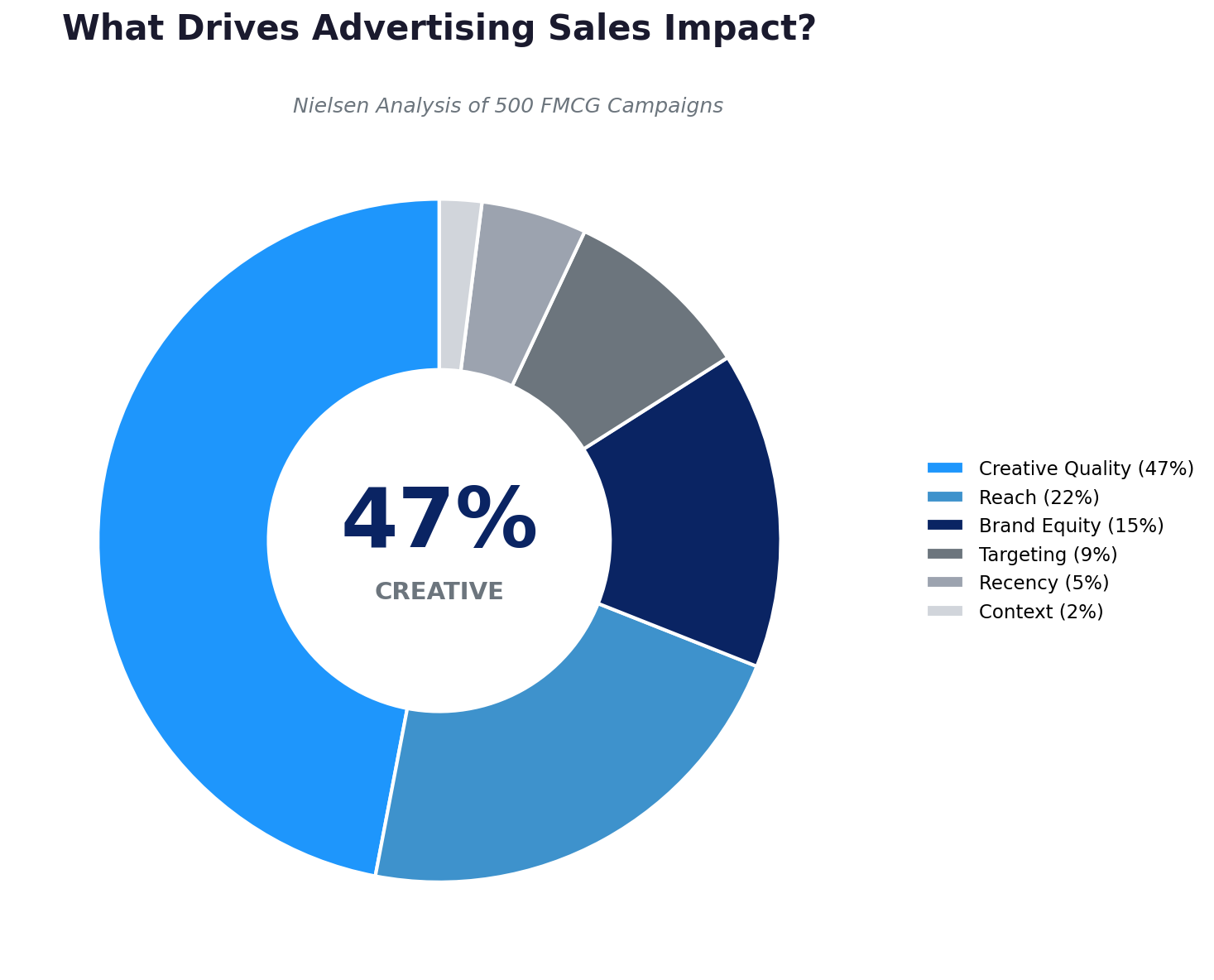
- Creative quality drives 47% of advertising sales impact according to Nielsen's analysis of 500 campaigns. That's nearly 3x more than targeting, which most marketers overestimate.
- Systematic testing frameworks reduce guesswork through clear hypotheses, statistical rigour (minimum 1,000 conversions), and continuous iteration rather than one-off experiments.
- Multiple testing methods suit different business needs: A/B testing for clear attribution, multivariate for combination effects, sequential for budget-conscious optimization, and AI-powered for scale, leveraging a scientific approach to enhance results.
- Platform-specific creative optimization matters more than universal approaches. TikTok rewards authentic native content while LinkedIn prioritizes professional educational formats with different performance benchmarks.
- Pre-launch concept validation prevents costly production mistakes, but post-launch performance testing drives the majority of optimization gains by measuring actual business outcomes, providing valuable insights for brands to refine their strategies.
- Creative testing is essential for competitive advantage. Peer-reviewed research confirms advertising creativity significantly impacts consumer responses across affect, processing, brand perception, and purchase behaviour.
- Partner with experienced digital marketing agencies that integrate creative testing systematically across strategy, production, and media execution to accelerate time-to-insight and scale winning variations.
What Is Creative Testing? A Research-Backed Definition
Creative testing is the systematic evaluation of advertising assets (images, videos, copy, and design elements) to identify which combinations drive better results and optimal performance against defined business objectives. Where subjective creative reviews rely on gut feeling, ad creative testing uses empirical data from controlled experiments to determine what actually resonates with target audiences.
Research published in the Journal of Advertising Research shows that advertising creativity enhances both brand interest and perceived brand quality by signaling greater effort and ability to consumers. The experimental findings demonstrate that consumer-perceived creativity, along with qualitative data, mediates these effects. Your audience judges creative effectiveness, not your team.
A comprehensive meta-analysis in the Journal of Marketing synthesized 878 effect sizes from 93 data sets across 67 studies, providing the first quantitative empirical overview of how advertising creativity impacts 19 different consumer responses. The research confirms that creative testing is foundational to campaign effectiveness across immediate responses (affect, processing, signals) and lasting outcomes (ad recall, brand perception, purchase intent).
For mid-market and enterprise businesses investing millions in advertising, creative testing replaces guesswork with evidence. The methodology applies across all digital channels (Meta, Google, TikTok, LinkedIn) and encompasses every creative element from hook variations to call-to-action buttons.
The Business Case: Why Creative Testing Matters More Than Targeting
The 47% Rule: Creative Dominates Campaign Performance
Nielsen Catalina Solutions' study analyzing 500 FMCG campaigns found that creative quality contributes 47% of total sales impact. That's nearly three times higher than what most marketers estimate. The research, conducted across TV, digital video, mobile, magazines, and radio, revealed that creative outweighs reach (22%), brand equity (15%), targeting (9%), recency (5%), and context (2%) combined.
When Westwood One commissioned Advertiser Perceptions to survey 305 brands and agencies, respondents believed targeting contributed 22% to sales (the highest of any factor). They estimated creative's contribution at just 17%. Reality proved them wrong by nearly 3x.
The Cost of Poor Creative
Media targeting has become increasingly sophisticated, but creative quality varies wildly, especially in digital channels. Nielsen's research found that for digital campaigns (video, display, mobile), creative accounts for 56% of sales lift because quality inconsistency remains high. TV creative has achieved greater consistency, reducing creative's contribution to 37% as media planning becomes the differentiator.
This performance gap translates directly to wasted ad spend. According to research by Econsultancy, 74% of companies that personalize their website experience through creative optimization see conversion rate increases. Those that don't leave money on the table.
9 Data-Driven Methods to Optimize Ad Performance
1. Classic A/B Testing (Split Testing)
A/B testing compares two creative variations differing by a single variable to determine which performs better. This method provides the clearest attribution because only one element changes between variants.
To implement effectively, isolate one variable (headline, image, CTA, color, layout, or offer), split your audience randomly into equal groups, and run both variants simultaneously to eliminate temporal bias. Require minimum 1,000 conversions for statistical significance and set your confidence threshold at 95% or higher.
Start by testing hook variations (first 3 seconds for video), primary value proposition messaging, call-to-action button text and placement, visual style (UGC vs. polished vs. illustration), and problem-focused vs. solution-focused framing.
Performance Benchmarks:
| Element Tested | Typical Impact Range | Sample Win |
|---|---|---|
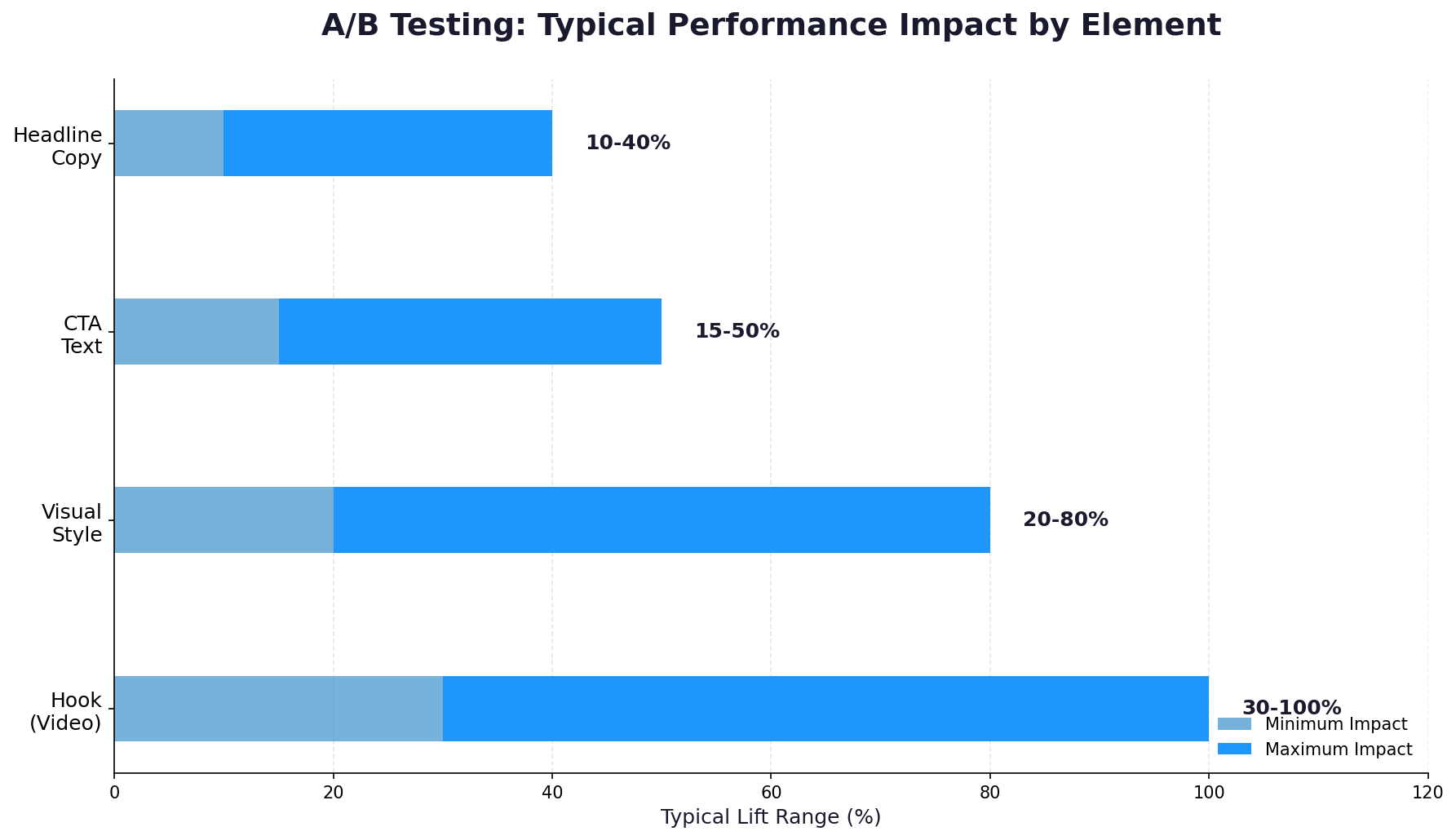
| Headline copy | 10-40% lift | 73% CTR increase (headline specificity) |
| CTA text | 15-50% lift | 121% CTR increase (CTA clarity) |
| Visual style | 20-80% lift | 2x engagement (authentic UGC vs. stock) |
| Hook (video) | 30-100% lift | 59% watch time increase (pattern interrupt) |
According to a HubSpot case study, simply changing the call-to-action in an email campaign delivered a 121% increase in click-through rate. Small creative decisions drive outsized performance impact.
2. Multivariate Testing (MVT)
Multivariate testing evaluates multiple variables simultaneously to understand how different elements interact. More complex than A/B tests, MVT reveals which combinations produce optimal results.
Use MVT when you have high-traffic accounts with substantial conversion volume, when testing landing pages or full ad concepts, when you need to understand element interactions (how headline + image combinations perform together), and when you have sufficient budget to reach statistical significance across variants. You'll need minimum 10,000+ monthly conversions, and testing 2-3 variables with 2-3 variations each results in 8-27 unique combinations. Expect extended testing periods of 2-4 weeks.
For a landing page test with three variables (headline, image, CTA), you might test headlines like "Save 30% Today" vs. "Join 50,000 Happy Customers" vs. "Try Risk-Free for 30 Days," images showing product shots vs. customer testimonials vs. lifestyle scenes, and CTAs reading "Start Free Trial" vs. "Get Started Now" vs. "See Pricing." This produces 27 unique combinations (3 × 3 × 3), revealing not just which individual elements work but which specific combinations drive peak performance.
3. Sequential Testing (Iterative Optimization)
Sequential testing builds knowledge progressively through testing cycles rather than attempting to identify winners in single experiments. This method suits businesses with moderate budgets seeking continuous improvement.
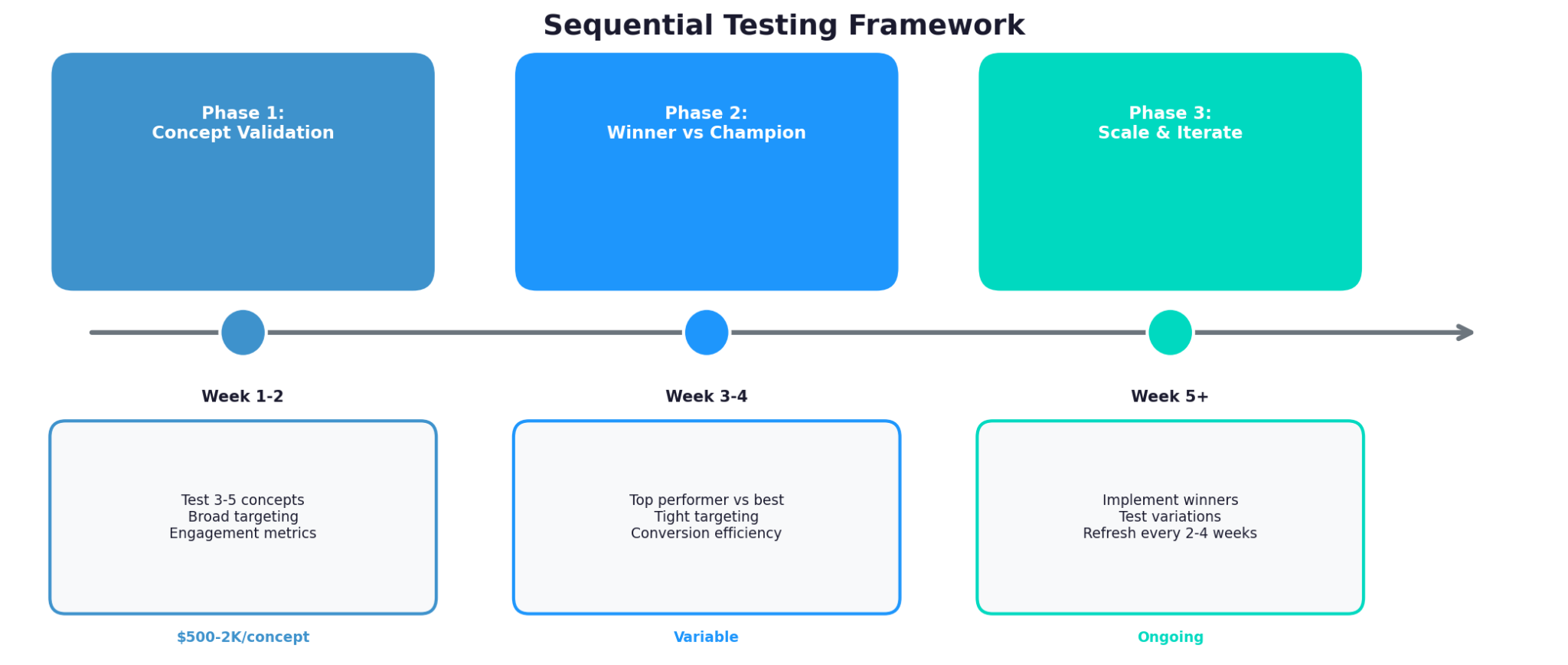
Phase 1: Concept Validation (Week 1-2). Test 3-5 fundamentally different creative concepts with broad targeting to gather diverse signals. Focus on engagement metrics like CTR, video completion rate, and dwell time. Budget $500-2,000 per concept minimum.
Phase 2: Winner vs. Champion (Week 3-4). Pit your top-performing new creative against your current best performer. Use tighter targeting aligned with buyer personas and focus on conversion efficiency metrics like CPA, ROAS, and conversion rate. Validate that new creative matches or exceeds champion performance.
Phase 3: Scale and Iterate (Week 5+). Implement winning creative across campaigns, test variations of winning elements, and refresh creative every 2-4 weeks to prevent fatigue. Monitor frequency metrics and engagement drop-offs.
According to data from performance agencies, a strong ROAS benchmark in 2025 sits around 2.87:1, though this varies by industry. New creatives don't always need to beat legacy ads. If they deliver comparable performance at similar CPA or ROAS, they provide diversification that prevents creative fatigue.
4. Dynamic Creative Optimization (DCO)
Dynamic Creative Optimization uses algorithmic testing to automatically assemble and serve the best-performing combinations of creative elements in real-time. Platforms like Meta and Google employ machine learning to identify winning combinations without manual intervention.
Upload multiple assets (5 headlines, 5 descriptions, 10 images or videos, 3 CTAs) and the platform's algorithm tests hundreds of combinations, automatically allocating budget to top performers. According to Meta Ads research, DCO enables continuous, precise testing by personalizing ads dynamically based on user behaviour and attributes.
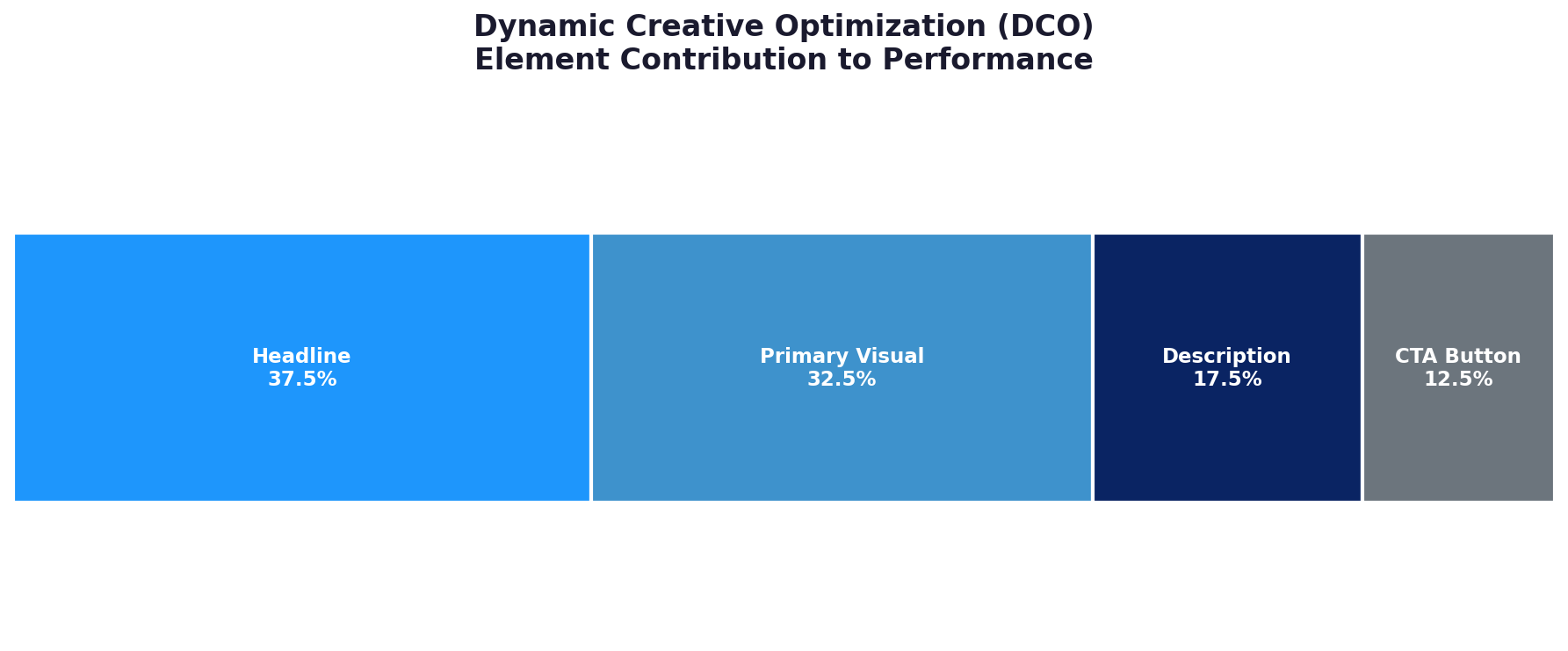
Headlines typically contribute 35-40% to performance, primary visuals 30-35%, description copy 15-20%, and CTA buttons 10-15%.
In 2024, digital marketing agency Fjuz helped C-Optikk improve CTR and lower CPM by personalizing ads dynamically based on store locations. Testing location-specific messaging, visuals, and offers through DCO achieved measurable performance gains while reducing manual creative production workload.
5. Holdout Group Testing (Conversion Lift Studies)
Holdout testing measures true incremental impact by comparing exposed audiences against unexposed control groups. This method isolates creative effectiveness from other variables like brand awareness or seasonal trends.
Randomly split your target audience (90% test group, 10% holdout group), expose only the test group to new creative, measure the conversion rate difference between groups, and calculate incremental lift: (Test Conversion % - Control Conversion %) / Control Conversion %.
Meaningful lift typically ranges from 5-20% depending on product category maturity, baseline conversion rates, creative differentiation strength, and campaign objectives (awareness vs. direct response).
Meta, Google, and LinkedIn offer built-in conversion lift study tools that automate random audience splitting, exposure control, and statistical significance calculations. These tools eliminate selection bias and provide confidence intervals around lift estimates.
6. Creative Concept Testing (Pre-Launch Validation)
Test creative concepts before production to validate strategic direction and prevent costly mistakes. This method leverages consumer feedback early in the development process.
For qualitative research, run focus groups (8-12 participants per session) or one-on-one interviews with target customers. Show concept boards with rough executions and gather open-ended feedback on messaging, tone, and visual direction.
For quantitative validation, survey 300+ respondents from your target audience, test 3-5 concepts against key metrics (uniqueness, relevance, appeal, clarity, purchase intent), and compare against category benchmarks.
According to Zappi's advertising development system, which has optimized over 6,000 ads, their effectiveness score is 60% more predictive of sales impact than legacy testing solutions. Christian Niederauer, Global Head of Insights at Colgate-Palmolive, reports: "We tested Zappi Amplify against our existing approaches and found it was much better at predicting in-market results from market mix modelling."
PepsiCo's Chief Insights and Analytics Officer Stephan Gans notes: "Since partnering with Zappi, we have seen our creative effectiveness improve by almost a third across all our advertising. This equates to PepsiCo gaining hundreds of millions in value from greater creative effectiveness this year."
7. Platform-Specific Native Testing
Different platforms reward different creative approaches. Platform-native testing optimizes for each channel's unique algorithm, audience behaviour, and format requirements.
Platform-Specific Benchmarks (2025):
| Platform | CTR Range | Optimal Video Length | Top Format |
|---|---|---|---|
| Meta (Feed) | 0.90-1.60% | 6-15 seconds | UGC-style, authentic |
| TikTok | 1.5-3.0% | 9-15 seconds | Native, entertaining |
| 0.40-0.80% | 30-90 seconds | Professional, educational | |
| Google Display | 0.35-0.70% | 15-30 seconds | Clear value prop, CTA |
| YouTube | 0.50-1.20% | 15 sec skippable, 6 sec bumper | Story-driven, branded |
Creative that feels native to TikTok (authentic, unpolished, entertaining) dramatically outperforms traditional advertising. Research by System1 analyzing TikTok-style creative found that authenticity drives engagement metrics more effectively than production quality.
According to 2025 Meta advertising research, healthy CTR ranges from 0.90-1.60%. ThruPlays and 3-second views are critical for video creatives. Engagement (likes, comments, shares) signals strong intent. Pixel events like "View Content" and "Add to Cart" are early conversion indicators.
Test hook variations specifically for each platform's content consumption patterns. A TikTok hook requiring pattern interruption within 0.8 seconds differs fundamentally from a LinkedIn hook that can take 3-4 seconds to establish credibility.
8. AI-Powered Predictive Testing
Artificial intelligence tools now predict creative performance before campaigns launch, analyzing historical data patterns to forecast which elements will succeed.
AI platforms analyze visual elements (colours, composition, faces, text density), copy attributes (length, sentiment, reading level, power words), historical performance data across similar campaigns, competitor creative benchmarks, and platform-specific success patterns.
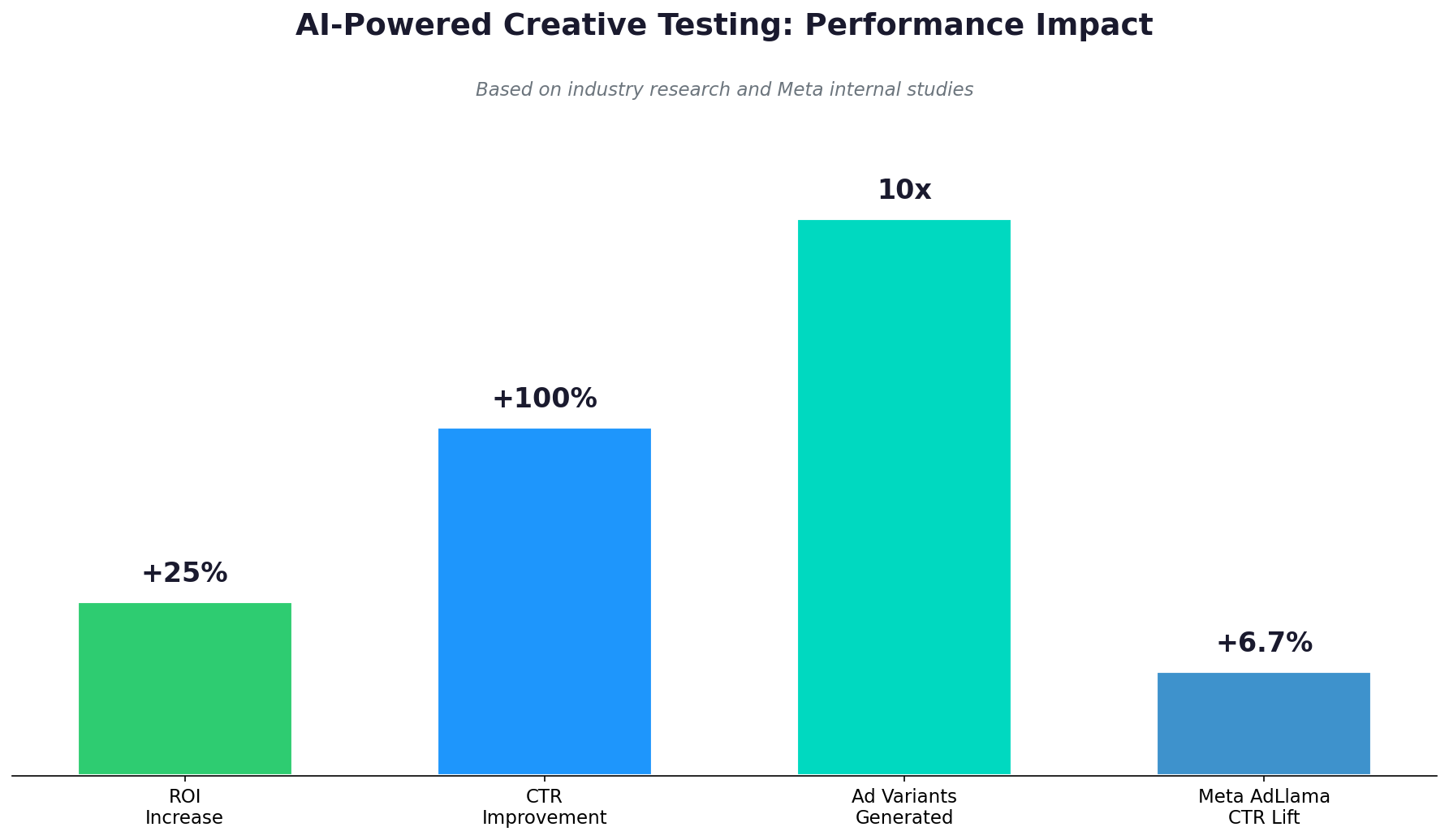
Recent AI advertising research reveals that companies using AI in marketing campaigns see 20-30% higher ROI. AI-optimized creatives deliver up to 2x higher click-through rates versus manually designed versions. Meta's reinforcement-learned LLM "AdLlama" improved CTR by 6.7% across 640,000 ad versions. Brands using AI creative tools generate 10x more ad variants, enabling hyper-personalization at scale.
System1 and Jellyfish research testing 18 AI-produced brand ads found they scored significantly better than average traditionally made ads. Coca-Cola's 2025 AI-generated "Holidays are Coming" film scored System1's maximum 5.9 stars, with 71% of emotional response being happiness versus the category average of 36%.
While AI enables efficiency and scale, research shows ads perceived as AI-generated may reduce trust metrics: 17% drop in premium rating, 19% decline in inspiration, and 14% fall in purchase intent. The solution: blend AI efficiency with human storytelling and brand authenticity oversight.
9. Modular Creative Testing (Component-Based Testing)
Modular testing involves creating interchangeable creative components (hooks, body content, CTAs, B-roll) that can be mixed and matched to generate dozens of variants from limited source material.
Build component categories including hooks (5-7 variations: problem-focused, solution-focused, shock value, curiosity gap, social proof), body segments (3-5 variations: product demo, testimonial, comparison, transformation, education), CTAs (3-4 variations: direct ask, soft ask, value-driven, scarcity-driven), and B-roll/visuals (10-15 clips: product shots, lifestyle scenes, close-ups, use cases).
With 5 hooks × 3 body segments × 3 CTAs = 45 unique ad combinations from 11 source components. This approach maximizes testing velocity while controlling production costs.
According to performance marketing agencies using modular UGC, the process follows this pattern: form a clear hypothesis ("Videos with strong hooks in first 3 seconds will outperform product-led ads by stopping scroll faster"), brief creators for multiple variations of target components, test hooks in isolation to identify winners, measure thumb-stop rate, watch time, and CTR, then remix winning components into new combinations.
A DTC brand testing 7 unique UGC videos with different hooks, scripts, and framing used performance data (CTR, scroll-stopping power, conversions) to identify top performers. Best creatives stayed in rotation while underperformers were retired, creating a repeatable system that continuously improves.
Common Misconceptions About Creative Testing
Misconception 1: "Creative Testing Is Too Expensive for Mid-Market Businesses"
Many marketers believe systematic creative testing requires enterprise-level budgets. This assumption stems from outdated methodologies requiring large sample sizes and extended testing periods.
Modern platform tools and AI-powered testing have changed this. Testing best practices recommend starting with organic social content to validate concepts at zero cost before allocating paid budget. For A/B tests requiring statistical significance, budgets as low as $2,000-5,000 per test (assuming $2 CPA and 1,000 conversion target) yield actionable insights.
The initial investment in testing infrastructure (briefing templates, naming conventions, performance tracking) appears resource-intensive. Once established, the system becomes a repeatable growth lever. One agency reports: "The initial time investment can seem like a lot but, over time, it'll help you build a repeatable system that you can learn from. This eventually leads to an incredibly slick ad process that performs well every time."
Misconception 2: "More Creative Variants Always Improve Performance"
The assumption that flooding campaigns with creative variations improves results overlooks algorithm learning dynamics and creative fatigue patterns.
Research published in the Journal of Advertising on measuring uniqueness and consistency in advertising found that effectiveness stems not from variant quantity but from strategic uniqueness. Advertisements perform best when they're unique from earlier ads for all brands but also consistent with ads for the same brand from prior periods.
The study analyzing 10 years of Super Bowl advertisements demonstrated that successful creative maintains brand consistency while introducing novel elements. Too many disparate variations confuse audiences and prevent brand-building momentum. Too few variations lead to creative fatigue.
According to performance marketing best practices, refresh 5-10 individual creatives per month to maintain conversion rates while preventing fatigue. Monitor frequency metrics. When users see the same ad 3-4+ times and engagement drops 30%+, creative fatigue has set in.
Misconception 3: "Subjective Expert Opinion Predicts Creative Performance"
Creative professionals and experienced marketers often believe their judgment reliably predicts which ads will succeed. Academic research on copy testing challenges this assumption.
A study comparing expert judgment against systematic copy testing found copy testing accuracy at 59%, expert judgment accuracy at 55%, and random guessing at 50%. The marginal improvement of expert opinion over random chance underscores the value of data-driven testing.
The Journal of Marketing meta-analysis concluded that combining multiple measurement approaches (qualitative feedback, quantitative metrics, and in-market performance) substantially improves prediction accuracy.
Rather than relying solely on subjective judgment, successful creative strategies integrate strategic frameworks based on validated ideation methods (templates, consumer insights, creative principles), systematic testing of variations, data analysis revealing performance drivers, and expert interpretation connecting insights to future strategy.
Real-World Examples and Case Studies
Dose: Structured UGC Testing Framework
Dose implemented systematic creative testing for their supplement brand featuring NBA player Derek Fisher. Rather than producing one hero video, they tested over seven unique UGC videos, each using different hooks, scripts, and camera framing.
They varied hook approaches (problem-focused vs. endorsement-led), script styles (educational vs. testimonial), and visual framing (product-focused vs. lifestyle-focused).
By analyzing performance data (CTR, scroll-stopping power, and conversions), Dose identified top performers and retired underperformers. The structured approach turned creative from guesswork into a repeatable growth system, with winning creatives generating measurably higher ROAS than initial attempts.
Sprout Social: Organic-to-Paid Testing Pipeline
Sprout Social's marketing team developed a testing methodology that validates concepts through organic social before allocating paid budget. Their process demonstrates how limited testing budgets can be stretched through strategic sequencing.
First, they run an organic testing phase, testing static photography vs. illustrations vs. video content through organic posts. Then they analyze metrics, with impressions as primary KPI for awareness goals. Video consistently drove the highest metrics. They share data with the creative team to secure buy-in for resource allocation. Finally, they allocate a paid budget to validated formats (video) rather than untested hypotheses.
According to Sprout's published case study, testing creative assets and sharing results helped secure buy-in from creative teams for new asset types. The data-driven approach strengthened collaboration between paid, organic, and creative teams while improving efficiency. Designers no longer completed projects for organic only to have paid teams request revisions afterward.
Babbel: Language Learning App Optimization
Language-learning app Babbel conducted split-cell testing comparing different value propositions and visual approaches. Their test examined Variant A ("Learn a Language in 3 Weeks" with lifestyle imagery showing travel experiences), Variant B ("Master Real Conversations Fast" with close-up shots of app interface demonstrating speaking exercises), and Variant C ("Join 10 Million Learners" with social proof testimonials and user statistics).
Rather than testing superficial elements (button color, minor copy tweaks), Babbel focused on fundamental creative concepts: different value propositions, proof types, and visual storytelling approaches. This "test the big things first" philosophy aligns with performance advertising best practices emphasizing that creative concepts matter more than background color variants.
Meta AI: Large-Scale Creative Testing Infrastructure
Meta's internal advertising team developed "AdLlama," a reinforcement-learned large language model that tests creative variations at unprecedented scale. The system analyzed 640,000 ad versions, achieving 6.7% CTR improvement.
A 6.7% lift may appear modest. At Meta's scale, this translates to enormous revenue impact. The case demonstrates how continuous, automated testing combined with machine learning creates performance improvements that manual testing cannot match.
Reinforcement learning allows AI systems to improve through continuous feedback loops. As the system tests more variations and observes outcomes, prediction accuracy increases. This establishes a cycle where testing capacity and performance both improve over time.
Frequently Asked Questions
What sample size do I need for statistically significant creative tests?
For A/B tests comparing two variants, aim for minimum 1,000 conversions total (500 per variant) to achieve statistical significance at 95% confidence level. This requirement stems from statistical power calculations ensuring observed differences reflect true performance gaps rather than random variation.
Budget calculation: Multiply your cost per acquisition by required conversion volume. If your CPA is $2 and you need 1,000 conversions, budget $2,000 for the test, as a higher conversion rates goal. For multivariate tests with multiple variants, increase conversion requirements proportionally. Three variants require 1,500+ conversions (500 each) to reach significance.
Platforms like Meta and Google provide built-in statistical significance calculators that account for your specific conversion volumes, confidence thresholds, and expected lift magnitudes. Don't declare winners prematurely. Tests reaching only 85% confidence may produce false positives that fail when scaled.
How long should I run creative tests?
Test duration depends on conversion volume, not calendar days. Run tests until reaching statistical significance (minimum 1,000 conversions) or until budget is exhausted. For most campaigns, this requires 1-4 weeks depending on daily spend and conversion rates.
Avoid testing during atypical periods (major holidays, product launches, flash sales) that introduce confounding variables. If you must test during these periods, note the timing when interpreting results. A winning creative during Black Friday may not perform identically during normal periods.
Monitor tests daily but resist the urge to declare winners after 2-3 days. Early performance can mislead as algorithms optimize delivery and audiences respond to novelty. According to Meta testing best practices, allow 5-7 days minimum even when statistical significance is reached earlier to ensure performance stabilizes.
Should I test creative before or after campaign launch?
Both.
Pre-launch concept testing validates strategic direction before production investment. Survey your target audience with rough concepts or storyboards, identify which directions resonate before full production, test 3-5 fundamentally different approaches. Investment runs $2,000-10,000 for research over 1-2 weeks.
Post-launch performance testing optimizes live campaigns and informs future creative development. Test live ad variations with real budget and audiences, measure actual business outcomes (conversions, ROAS, CAC), and iterate based on performance data. This is an ongoing percentage of your media budget running continuously.
According to Nielsen research, 47% of advertising sales impact comes from creative quality, yet optimization opportunities diminish once ads are live. Pre-launch testing maximizes the window for impactful creative improvements before production investment.
What metrics should I track for creative testing?
Prioritize metrics aligned with campaign objectives and funnel stage. For awareness campaigns, track top-of-funnel engagement metrics. For conversion campaigns, focus on efficiency and return metrics.
For upper funnel (awareness/consideration), track click-through rate, video completion rate/ThruPlays, engagement rate (likes, comments, shares), cost per thousand impressions, and brand lift survey results.
For mid funnel (interest/evaluation), track landing page visit rate, time on site/page depth, scroll depth on landing pages, add-to-cart rate, and lead form completion rate.
For lower funnel (conversion/purchase), track conversion rate, cost per acquisition, return on ad spend, customer acquisition cost, and average order value.
According to Meta advertising testing frameworks, healthy CTR benchmarks for 2025 range from 0.90-1.60%, with early indicators like "View Content" and "Add to Cart" pixel events signaling strong conversion intent before final purchase.
How do I prevent creative fatigue in ongoing campaigns?
Creative fatigue occurs when audience overexposure to identical ads causes performance degradation. Watch for frequency exceeding 3-4 impressions per user, CTR declining 30%+ from peak, CPM increasing 25%+, engagement rate dropping substantially, and rising CPA despite stable conversion rate.
Maintain a creative pipeline producing 5-10 new variants monthly. Performance marketing agencies recommend refreshing creative every 2-4 weeks depending on different audiences, audience size, and budget scale. For campaigns spending $50,000+ monthly, weekly creative refreshes may be necessary.
Build variant libraries organized by winning elements (hooks, body content, CTAs). When fatigue occurs, remix proven components rather than starting from scratch. A 3-second hook that converted well can be paired with new body content to create fresh variants while maintaining performance characteristics.
Use platform rotation settings to automatically cycle between variants. Meta's campaign budget optimization (CBO) and Google's responsive display ads enable algorithmic rotation favoring top performers while controlling exposure frequency.