Table of contents
Key Takeaways
- Corporate animation encompasses motion graphics, explainer videos, and animated content used for marketing, training, and internal communications. Currently, 91% of businesses use video as a marketing tool
- Production costs have become accessible for mid-market organizations, with professional explainer videos typically ranging from $1,500-$7,000 for 60-second content
- Short-form content dramatically outperforms long-form, with videos under one minute achieving 50% engagement rates compared to 17% for videos over 60 minutes
- Internal applications, including onboarding, training, and support documentation, often deliver ROI through operational efficiency gains that exceed marketing metrics
- Successful corporate animation requires clear messaging and strategic scripting; the production process itself forces organizational clarity that delivers independent value
- For organizations ready to take their video strategy to the next level, finding an ideal partner ensures strategic alignment between business goals and creative execution
What Is Corporate Animation?
Corporate animation refers to the strategic use of animated visual content (including motion graphics, explainer videos, and animated infographics) to communicate business messages, train employees, market products, and engage stakeholders. Unlike traditional video production, corporate animation leverages design elements, typography, and visual effects to transform complex ideas into compelling, easily digestible content. Whether reinforcing brand identity or explaining technical processes, animation video gives businesses complete creative control over their messaging.
The adoption numbers tell the story.
According to Wyzowl's 2026 State of Video Marketing Report, 91% of businesses now use video as a marketing tool, with explainer videos ranking as the second most popular format created by marketers. That number has grown steadily since 2016, when only 61% of businesses used video. The origins of motion graphics trace back to film title sequences, but today's corporate applications extend far beyond entertainment.
For mid-market and enterprise businesses, corporate animation offers distinct advantages over live-action video. Animation provides complete creative control. It eliminates the logistical headaches of coordinating shoots with employees or customers. Updates happen easily as products and messaging evolve.
And unlike live-action footage featuring specific employees or dated interfaces, animated content doesn't age out when someone leaves the company or software gets updated. Whether demonstrating software workflows, explaining financial services, or onboarding new employees, animation maintains consistency across global operations.
Types of Corporate Animation and Their Business Applications
Understanding the different animation techniques available helps organizations choose the right format for their communication goals. But which style fits which situation? Each approach offers unique strengths depending on target audience, message complexity, and brand positioning.
Animation Styles Comparison
| Animation Type | Best For | Typical Length | Production Timeline | Cost Range |
|---|---|---|---|---|
| 2D Motion Graphics | Product videos, data visualization, social content | 30-90 seconds | 3-6 weeks | $3,000-$10,000 |
| Whiteboard Animation | Educational content, process explanations | 60-180 seconds | 2-4 weeks | $2,500-$7,000 |
| 3D Animation | Product demonstrations, technical visualizations | 60-120 seconds | 6-12 weeks | $10,000-$25,000+ |
| Kinetic Typography | Brand messaging, announcements, social media | 15-60 seconds | 2-3 weeks | $2,000-$4,000 |
| Character Animation | Training, brand story videos, creative storytelling | 60-120 seconds | 4-8 weeks | $5,000-$15,000 |

Explainer Animation for Marketing
Explainer videos represent the most common application of corporate animation. These short-form videos typically run 60-90 seconds and focus on communicating a product's value proposition or solving a customer pain point. They work. According to video marketing research, 91% of consumers have watched an explainer video to learn more about a product or service, and 82% report being more likely to purchase after watching one. The best corporate video examples create an emotional connection that text alone can't match.
Pros of Animated Explainers:
- Simplify complex ideas through visual metaphors
- Create consistent brand messaging across all customer touchpoints
- Remain evergreen longer than live-action featuring real employees or dated technology
- Allow easy localization for international markets through voiceover swaps
- Improve viewing experience with smooth transitions and bold colours
Cons of Animated Explainers:
- May lack the personal connection of seeing real people
- Require more upfront planning and scripting than some live-action approaches
- Updates require working with the original production files and creative team
Internal Communications and Training Animation
Enterprise organizations increasingly deploy animated content for employee training, compliance education, and internal communications. According to TechClass research, 72% of employees report that video-based training improves their onboarding experience. Yet only 23% of organizations currently use video in their hiring and onboarding processes.
That gap? It's huge.
Animation proves particularly effective for compliance and safety training. Dry regulatory content becomes an engaging visual narrative with seamless transitions and well-timed sound effects. HR policies that nobody reads become three-minute videos that people actually watch. Organizations using animated training modules report higher completion rates and improved knowledge retention compared to traditional documentation or slide-based training.
Common Misconceptions
Misconception 1: Corporate Animation Is Too Expensive for Mid-Market Companies
Not anymore.
Many business leaders still assume professional animation requires enterprise-level budgets. That made sense a decade ago. But production costs have dropped significantly due to improved animation software and remote collaboration capabilities. According to industry surveys of production agencies, a professional corporate explainer video typically costs between $1,500 and $7,000 for a one-minute video. A wide range of options exists at every budget level. Small business owners commonly invest $1,200-$3,500 for effective animated content, while enterprise organizations seeking premium production quality typically budget $4,700-$8,200.
Misconception 2: Animation Looks "Cartoonish" and Lacks Professionalism
This one comes up constantly. And it's based on outdated assumptions about what corporate video production looks like in 2025.
Modern motion graphics encompass a vast spectrum of visual approaches. Sophisticated data visualization. Sleek product demonstrations. Cinematic creative storytelling. The corporate video examples from brands like Slack, Salesforce, and HubSpot demonstrate how animation can project authority and expertise while remaining visually engaging. According to consumer research, 91% of consumers say video quality impacts their trust in a brand. Well-executed animation actually enhances perceived professionalism.
Misconception 3: Viewers Prefer Live-Action Video Over Animation
The data doesn't support this. At all.
Wyzowl's research indicates that 63% of people prefer to learn about products through short video content regardless of format, with animated explainers performing comparably to live-action in engagement metrics. What actually matters is whether the content clearly communicates value to the viewer.
Here's the thing: for abstract concepts, software demonstrations, and data-heavy presentations, animation is a great way to reach a broad audience. Live-action struggles to visualize things like data flows, system architectures, or process sequences. Static graphics can't show movement or change over time. Animation handles these naturally. The format should match the content, not the other way around.
Why Short-Form Animation Outperforms Long-Form Content
The prevailing wisdom that "shorter is better" in content marketing receives strong empirical support. According to HubSpot's marketing research, videos under one minute achieve approximately 50% average engagement rates, while videos exceeding 60 minutes drop to 17% engagement. That's a threefold difference. And it should shape how businesses approach corporate animation strategy.
Cognitive science explains why. Working memory has limits. Research in multimedia learning, including foundational work by psychologist Richard E. Mayer published through Cambridge University Press, shows that learners process visual and verbal information through separate channels, each with finite capacity. Overload either channel with excessive length, dense information, or competing visual elements, and retention tanks.
Most articles stop there. But there's a counterintuitive implication worth considering.
The 60-90 second "ideal length" isn't really about attention spans. It's about forcing clarity. A two-minute constraint means every second must earn its place. Teams can't hide behind length. They can't include "nice to have" information. They have to decide what actually matters. The entire video must communicate one clear idea. Companies that struggle to create short explainers usually have a messaging problem, not a video problem. Good animation improves user experience by respecting people's time.
For explainer videos specifically, research suggests the optimal length falls between 60-90 seconds. Industry data shows that 73% of people consider videos between 30 seconds and 2 minutes most effective for learning about products and services. This finding has shifted average video length from 168 seconds in 2016 to just 76 seconds today, with projections suggesting further reduction to 39 seconds by 2026.
The Hidden ROI Beyond Marketing Metrics
While most discussions of corporate animation ROI focus on marketing conversion rates and brand awareness, some of the most significant returns come from internal applications that rarely receive measurement attention. Corporate video content serves purposes far beyond content marketing.
According to corporate training research, organizations report that people retain 95% of a message when watching video compared to just 10% when reading text. That retention gap changes the math on training efficiency entirely. Organizations using animated training content report reduced onboarding time, fewer support queries, and improved compliance rates.
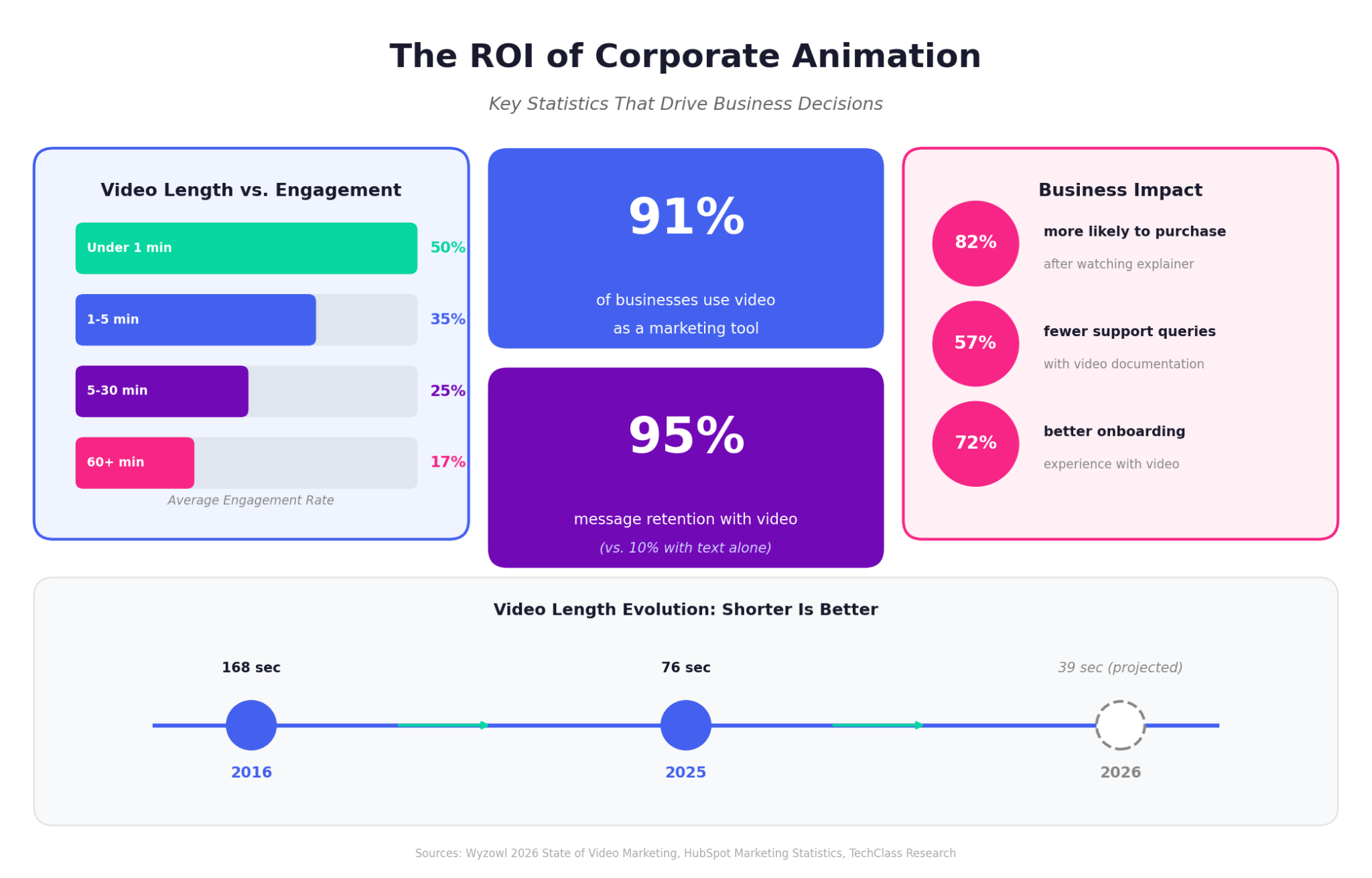
Consider a common scenario: a SaaS company launches a new feature. Without video, the support team fields hundreds of "how do I..." tickets over the following weeks. With a 90-second animated walkthrough embedded in the product and linked in the release notes, those tickets drop dramatically. Wyzowl's data confirms this pattern broadly. Some 57% of video marketers report video has decreased the number of support queries they receive. For organizations handling thousands of customer or employee inquiries, well-designed animated explainers addressing common questions represent significant operational savings.
There's another benefit that gets overlooked. Animated content serves as a forcing function for organizational clarity. The content creation process, particularly scripting, requires teams to distill complex offerings into clear, sequential explanations. Many organizations report that the strategic clarity gained during animation development delivers value independent of the final video output. The video becomes almost secondary to the thinking it forces. Some companies even use animation for investor relations presentations, finding that animated data visualization communicates financial performance more effectively than static slides.
Real-World Examples and Case Studies
Theory is useful. Results are better. Here's how specific companies have used corporate animation to drive measurable business outcomes.
Dropbox
This one gets cited constantly, for good reason. It's a great example of animation ROI. During Dropbox's startup phase, traditional paid search advertising proved prohibitively expensive. Customer acquisition costs ran $233-$388 for a $99 product. The math didn't work. According to case study documentation, Dropbox's animated explainer video, a whiteboard-style animation produced by Common Craft that cost less than $50,000, drove a 10% increase in conversion rates, resulting in 10 million additional customers and an estimated $48 million in extra revenue. The video made a lasting impression by simplifying the then-novel concept of cloud storage into an accessible narrative that non-technical users could understand.
Dollar Shave Club
While Dollar Shave Club's famous launch video featured live action rather than animation, its explosive success demonstrated the power of clear video messaging and helped establish video as a crucial startup marketing tool. The numbers? 12,000 new orders within 48 hours of launch on a $4,500 production budget. The company's subsequent acquisition by Unilever for $1 billion in 2016 validated video-first marketing strategy. The video succeeded because of sharp messaging that identified customer pain points and communicated value proposition within seconds.
Slack
Slack took a different route. Their customer testimonial and animated corporate video content combines live-action elements with motion graphics to demonstrate product capabilities. Real customers tell their stories. Animation illustrates key features and workflows. The hybrid creates authenticity while maintaining visual interest. Enterprise SaaS companies increasingly adopt this approach when they need both credibility and engagement.
HubSpot
HubSpot went all-in on product explainer videos across their platform. Complex marketing automation workflows? Animated. The result, according to industry case studies: more qualified leads, lower bounce rates, fewer customer service requests. Animated content educated prospects and customers without requiring human intervention. Documentation that actually gets used.
Frequently Asked Questions
How long should a corporate explainer video be?
60-90 seconds for marketing. That's the sweet spot. Research consistently supports this range because it maintains viewer attention while providing sufficient time to communicate a clear value proposition. Corporate animation videos serve a specific purpose, and length should match that purpose. For training applications, slightly longer formats of 2-5 minutes work, though breaking content into modular segments improves completion rates and allows for targeted viewing. Longer than five minutes? Rarely worth it unless the content is genuinely complex and the audience is already invested.
What is the difference between motion graphics and animation?
Motion graphics = animated graphic design. Typography, shapes, data visualizations, brand elements that move and transform on screen. Animation is broader, encompassing character animation, 3D rendering, traditional frame-by-frame techniques, and yes, motion graphics too. Most corporate video falls under motion graphics because it's a smart way to use brand assets and information design rather than character-driven storytelling.
How much does corporate animation production typically cost?
It varies. A lot. Professional animated video production ranges from approximately $1,500 to $25,000+ depending on style, length, and complexity. A standard 60-second 2D motion graphics explainer typically costs $3,000-$10,000 from a reputable video production company. 3D animation commands premium pricing starting around $10,000 due to specialized technical requirements. Many organizations find that a $5,000-$8,000 investment delivers professional results suitable for both marketing and internal communications.
Can existing brand assets be used in animated videos?
Absolutely. Logos, color palettes, typography, visual systems. All of it strengthens brand consistency and can reduce production costs. Production teams typically request brand guidelines, logo files in vector format, and any existing visual assets during project kickoff. The more established your brand foundations, the faster the animated content integrates with other marketing materials.
How do businesses measure ROI from corporate animation?
Mix quantitative with qualitative. On the numbers side: video view counts, engagement rates (completion percentage, likes, shares), website traffic from video sources, conversion rates on pages with embedded video, support ticket reduction. Tools like Wistia, Vidyard, and YouTube Analytics track viewer behaviour in granular detail.
Qualitative matters too. Sales team feedback on prospect understanding. Customer comments about content helpfulness. Internal stakeholder perception of communication clarity. Set baseline measurements before video deployment so you can run accurate before-and-after comparisons.
Web Tonic works across SEO and paid search, and you can book a consultation to talk through your own plan.