



Table of contents
Key Takeaways
- Page speed improvements of just 0.1 seconds can increase conversion rates by 8-10%, making performance optimization the highest-leverage starting point for most ecommerce operations.
- Cart abandonment averaging 70% represents recoverable revenue through checkout optimization and abandonment recovery programs—focus on eliminating surprise costs and reducing form friction.
- Personalization drives 10-15% revenue lift according to McKinsey research, with leading companies generating 40% more revenue from personalization efforts than average performers.
- Mobile optimization requires purpose-built approaches rather than responsive scaling of desktop experiences, as mobile generates the majority of traffic but lags in conversion rates.
- Systematic A/B testing and continuous measurement transform optimization from guesswork into a sustainable competitive advantage—partner with experienced specialists if internal resources are limited.
What Is Ecommerce Optimization?
Ecommerce optimization is the systematic process of improving every element of an online store to increase the percentage of visitors who complete a purchase. Traditional retail converts foot traffic through personal interaction. Online stores have no such luxury. They must engineer every pixel, every click, every moment of the digital environment to guide visitors from discovery to checkout.
What does this actually involve? Analyzing user behaviour. Identifying friction points. Implementing data-driven changes that encourage purchase decisions. This spans everything from site architecture and page speed to product presentation and checkout flow. Baymard Institute's analysis of 49 different studies puts the average cart abandonment rate at 70.19%, which translates to enormous opportunity for businesses willing to invest in optimization.
For mid-market and enterprise businesses, ecommerce optimization delivers competitive advantages that smaller retailers simply cannot match. While a boutique shop might survive on a compelling product alone, larger operations require sophisticated conversion rate optimization strategies to maintain profitability at scale. Baymard Institute estimates that $260 billion in recoverable sales disappear annually in the US and EU markets due to poor checkout user experience. That's money left on the table, recoverable through better design.
15 Proven Ecommerce CRO Strategies
These strategies move from foundational elements to advanced techniques.
1. Prioritize Site Speed Above All Else
Page load time correlates directly with conversion rates. A collaborative study by Google and Deloitte analyzed 37 leading European and American brand sites and found that a mere 0.1-second improvement in load time increased retail conversions by 8.4% and average order value by 9.2%.
The research examined over 30 million user sessions. Speed improvements positively influenced every step of the purchase funnel. Travel sites saw conversion rates jump 10.1% with the same 0.1-second improvement. Luxury brands recorded an 8.6% increase in page views per session.
So what should development teams focus on? Compressing images without sacrificing quality, implementing browser caching and CDN distribution, minimizing HTTP requests by combining CSS and JavaScript files, using lazy loading for below-the-fold content, and monitoring Core Web Vitals through Google Search Console. These aren't optional improvements. They're baseline requirements.
2. Streamline the Checkout Process
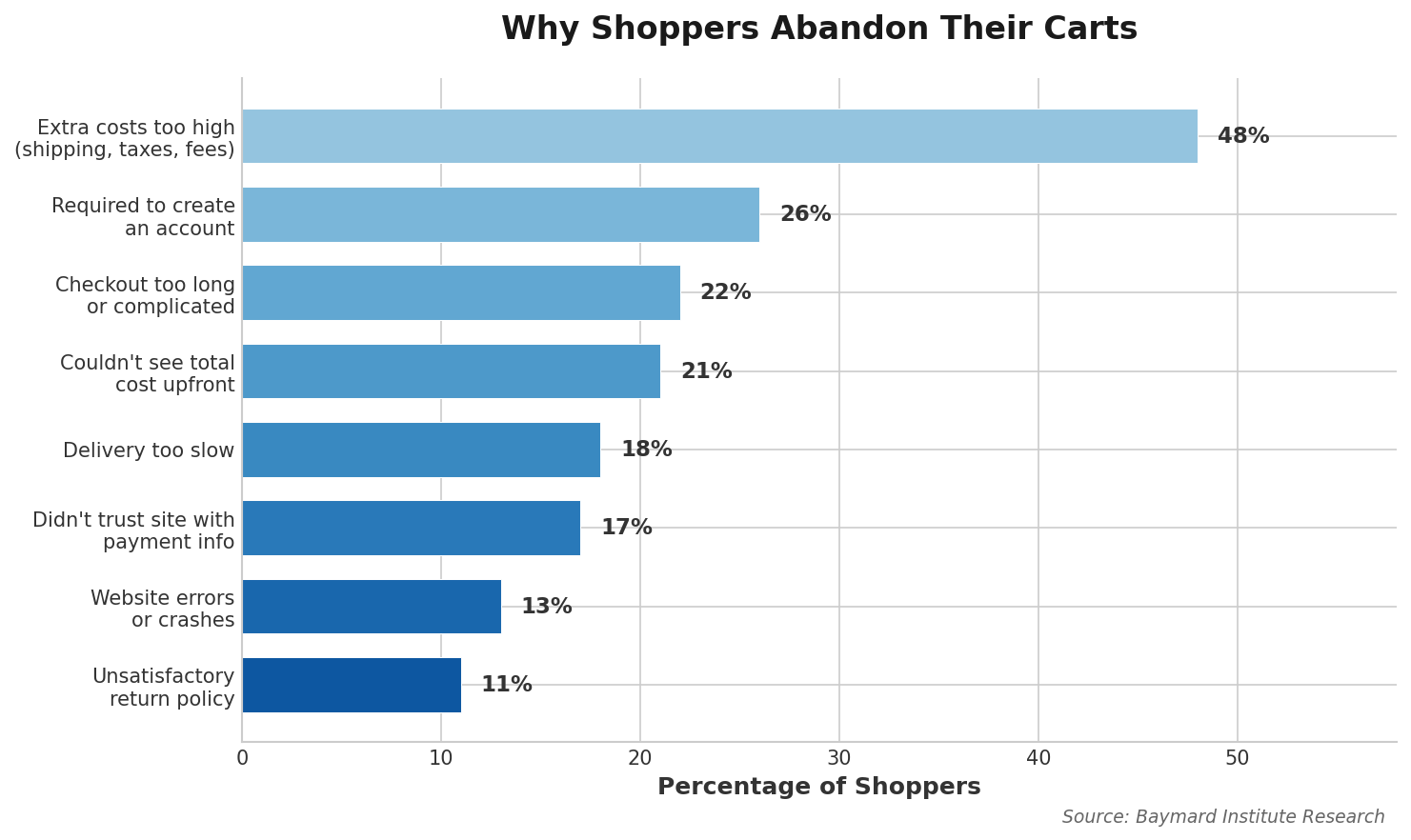
Checkout complexity kills conversions. Baymard Institute's research reveals that 22% of US online shoppers have abandoned an order because the checkout process was too long or complicated. The average checkout flow contains 23.48 form elements. Optimal checkout can be as short as 12-14 form elements.
| Checkout Element | Current Average | Best Practice | Impact on Conversion |
|---|---|---|---|
| Form Fields | 23.48 elements | 12-14 elements | 20-60% reduction possible |
| Checkout Steps | 5.1 steps | 3-4 steps | Reduces abandonment |
| Guest Checkout | Often hidden | Prominently displayed | 26% abandonment reduction |
| Payment Options | 2-3 methods | 5-6 methods | Captures more buyers |
Baymard Institute calculates that the average large ecommerce site can achieve a 35.26% increase in conversion rate through better checkout design alone. No traffic increase required.
3. Implement Strategic Product Personalization
Personalization has shifted from competitive advantage to baseline expectation. McKinsey research shows that companies excelling at personalization generate 40% more revenue from those activities than average performers, with typical revenue lifts of 10-15% across industries.
Consumer expectations have shifted dramatically. 71% of consumers now expect personalized interactions. 76% become frustrated when this doesn't happen. And three-quarters of consumers switched to new stores, products, or buying methods when their expectations weren't met.
The benefits are clear: higher conversion rates from matching products to customer intent, improved customer lifetime value through relevant recommendations, and acquisition cost reductions of up to 50%. But personalization requires significant data infrastructure investment, privacy regulations add complexity to data collection, and poor implementation can feel intrusive rather than helpful. The payoff justifies the investment for most mid-market and enterprise operations.
4. Eliminate Surprise Costs
Extra costs appearing at checkout drive more abandonment than any other factor within a business's direct control. Baymard Institute's quantitative research found that 48% of shoppers who abandoned carts cited extra costs (shipping, taxes, fees) as their primary reason for leaving.
Free shipping alone won't solve this. Transparency throughout the shopping journey ensures customers know what to expect before reaching checkout. Display shipping costs on product pages. Offer shipping calculators. Clearly communicate any thresholds for free shipping early in the browsing experience. The goal is zero surprises at checkout.
5. Optimize for Mobile Conversion
Mobile commerce dominates traffic but lags in conversion rates. Mobile devices generate 59.57% of global ecommerce traffic, yet desktop conversion rates sit at approximately 3.2% compared to mobile's 2.8%. That gap is money.
Mobile optimization requires more than responsive design. Touch targets must be appropriately sized. Forms must be streamlined for thumb typing. And payment options like Apple Pay and Google Pay should be prominently featured.
6. Leverage Social Proof and Reviews
Product reviews have become non-negotiable. Research indicates that 99.9% of consumers read reviews when shopping online. Products with 11-30 reviews convert approximately 68% higher than those without any reviews. The optimal range appears to be 26-50 reviews, balancing sufficient social proof with perceived authenticity.
Beyond quantity, review quality and recency matter significantly. Products with recent reviews convert better than those with only older reviews. Displaying verified purchase badges, responding to negative reviews professionally, and featuring user-generated content all strengthen trust signals.
7. Simplify Navigation and Site Search
Site search is an overlooked conversion opportunity. Forrester research shows that 74% of consumers use search engines to research and compare purchase options before completing a transaction. Visitors who use site search demonstrate higher purchase intent.
Effective implementation includes autocomplete suggestions that anticipate user needs, typo tolerance and synonym matching, faceted filtering for refinement, recent and popular search suggestions, and zero-results page optimization with alternative recommendations.
8. Build Trust Through Transparency
Trust barriers prevent 25% of online shoppers from completing purchases, according to Baymard Institute. In an era of increasing online fraud concerns, explicit trust signals have become essential.
Display security badges prominently near payment forms. Clearly state return policies before checkout. Show payment method icons to confirm acceptance. Provide easy access to customer service. Even the presence of a chat option can increase perceived trustworthiness.
9. Create Urgency Without Manipulation
Legitimate scarcity and urgency can accelerate purchase decisions. Low stock indicators that reflect actual inventory, limited-time promotions with clear end dates, and seasonal availability all create genuine reasons for customers to act promptly.
One documented case showed a 27% increase in orders simply by adding a clock with the message indicating cutoff times for same-day delivery. Real value for customers, real urgency for conversions.
But avoid manufactured scarcity. Fake countdown timers and constantly "almost sold out" products train customers to ignore urgency signals entirely.
10. Optimize Product Pages for Decision-Making
Product pages serve as the primary conversion point. Every element must support the purchase decision: high-quality images from multiple angles with zoom functionality, detailed specifications, clear pricing and availability, prominent add-to-cart buttons, and shipping information.
Research shows 67% of consumers cite high-quality images as the biggest influence when purchasing a product. For clothing and fashion items especially, showing products on models of different body types and in context significantly increases conversion rates.
11. Recover Abandoned Carts Systematically
With 70% of carts abandoned, even modest recovery rates translate to significant revenue. Automated abandonment emails achieve 42% click-to-purchase rates when customers engage with them.
A tiered approach works best. The first email (sent within 1 hour) reminds customers of their abandoned items. The second email (24 hours later) addresses common concerns. The third email (48-72 hours) may include a modest incentive to complete the purchase.
12. Offer Multiple Payment Options
If a customer's preferred payment method isn't available, they'll likely leave. Modern ecommerce stores should support at least five to six payment methods: credit cards, PayPal, Apple Pay, Google Pay, and buy-now-pay-later options like Klarna or Afterpay.
Buy-now-pay-later options have proven particularly effective for higher-priced items.
13. Implement A/B Testing Rigorously
Data-driven optimization requires systematic testing rather than assumption-based changes. A/B testing validates hypotheses before rolling out changes site-wide.
Test priorities for maximum impact: headlines and value propositions, product page layouts, checkout flow modifications, call-to-action button copy and design, pricing presentation, and trust signal placement. Each test should run until reaching statistical significance.
14. Enhance Product Discovery
AI-powered recommendation engines can drive up to 31% of ecommerce revenues for sessions where customers engage with them. Sessions with recommendation engagement show a 369% increase in average order value.
Implement recommendations throughout the customer journey: trending and personalized picks on the homepage, "customers also viewed" suggestions on category pages, "frequently bought together" bundles on product pages, cross-sell and upsell recommendations in the cart, and complementary product emails post-purchase.
15. Monitor and Respond to Customer Feedback
Continuous optimization requires ongoing customer insight. Implement post-purchase surveys. Analyze customer service interactions for common friction points. Monitor review content for recurring themes. This qualitative data reveals the "why" behind the numbers that analytics alone cannot identify.
Common Misconceptions
Misconception 1: More Traffic Automatically Means More Sales
Many businesses focus disproportionately on driving traffic without addressing conversion fundamentals. Increasing traffic to a poorly converting site simply magnifies the underlying problems.
Here's the math. A 1% improvement in conversion rate often delivers more revenue than equivalent spending on traffic acquisition. And optimization investments continue paying dividends indefinitely. Doubling your conversion rate has the same effect as doubling your traffic, but only one of those improvements is permanent.
Misconception 2: Discounting Is the Primary Conversion Lever
Promotions can drive short-term conversion increases. But over-reliance on discounting trains customers to wait for sales and erodes brand value.
Optimization focused on reducing friction, building trust, and improving user experience creates sustainable conversion improvements without margin erosion. Research consistently shows that addressing checkout friction and eliminating surprise costs drives more conversions than discount offers alone.
Misconception 3: Desktop Optimization Transfers to Mobile
Mobile users behave fundamentally differently than desktop users. Designs that convert on desktop often fail on mobile.
Mobile requires purpose-built optimization: smaller screens, touch interactions, shorter attention spans, frequently interrupted browsing sessions. Mobile generates over half of traffic but converts at lower rates. That's not a mobile problem. That's an optimization opportunity.
Why the First Five Seconds Determine Your Success
The critical window for ecommerce conversion is remarkably short. Users form first impressions within 50 milliseconds. Decisions about whether to engage or abandon happen within seconds. Initial load time and above-the-fold content carry disproportionate weight.
The Google and Deloitte "Milliseconds Make Millions" study demonstrates that if a website takes more than three seconds to load, 53% of mobile visitors will abandon before the page renders. They never see your products. They never see your value propositions. They never see your trust signals. They're gone.
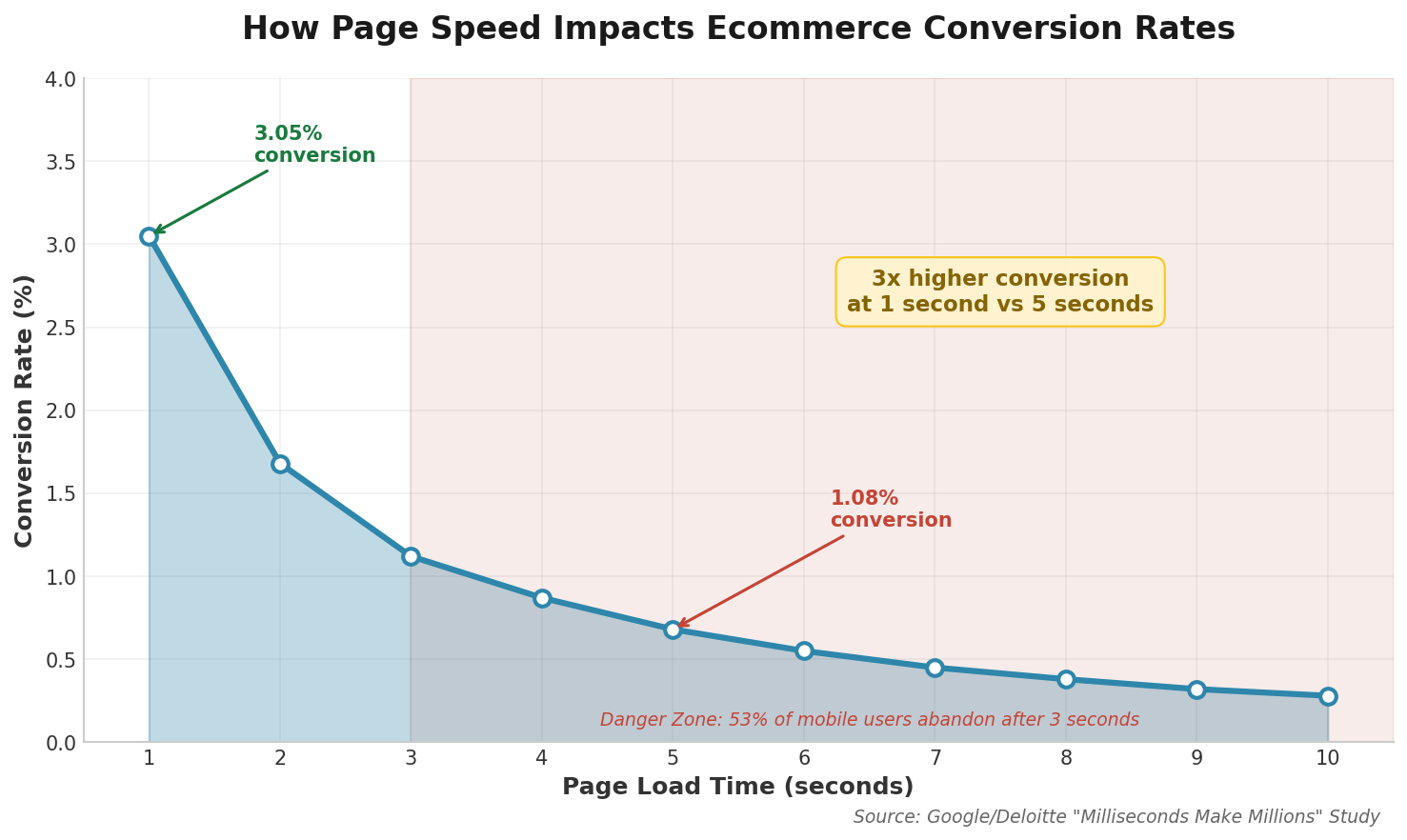
Page speed optimization should be treated as foundational rather than incremental. The research found that speed on product pages is particularly vital, with a 9.1% increase in add-to-basket progression when key speed metrics improved by just 0.1 seconds.
And here's what most teams miss: technical debt accumulates over time. New feature additions, third-party scripts, and content management changes can gradually degrade performance without any single change appearing problematic. Regular speed audits using tools like Google PageSpeed Insights catch these issues before they compound.
The Hidden Cost of Checkout Friction
Beyond explicit abandonment, checkout friction creates invisible conversion losses through what researchers call "checkout fatigue." Users who complete purchases despite encountering friction are less likely to return, recommend the store, or complete additional purchases during the session. The checkout experience shapes overall brand perception far beyond the immediate transaction.
Baymard Institute's decade of checkout usability research has documented 140 specific causes of checkout usability issues across more than 14 years of testing. The most impactful improvements often involve seemingly minor details: inline validation that prevents errors before submission, smart address autofill that reduces typing, and clear error messages that explain how to resolve issues rather than simply stating that problems exist.
Account creation requirements deserve particular attention. Forced account creation causes 26% of cart abandonments. Guest checkout should always be available and prominently presented. Account creation can be encouraged post-purchase when trust has been established and the customer has already demonstrated purchase intent.
The numbers are staggering. Combined ecommerce sales of $738 billion in the US and EU, multiplied by the 35.26% conversion increase possible through better checkout design, equals $260 billion in recoverable orders. Annually.
Real-World Examples and Case Studies
Walmart
Walmart discovered that for every one-second improvement in page load time, their conversion rate increased by 2%. This finding drove a comprehensive mobile optimization initiative that prioritized performance as a key metric for all development decisions.
The compounding effect across their massive traffic volume translated to significant revenue gains. Page speed became a core business metric rather than a technical consideration.
Vodafone
Vodafone conducted rigorous A/B testing to measure the impact of optimized Core Web Vitals on business outcomes. A 31% improvement in Largest Contentful Paint (LCP) led to a 15% improvement in their lead-to-visit rate, an 11% improvement in cart-to-visit rate, and 8% more sales.
Performance optimization delivers measurable business outcomes beyond improved user experience metrics. Clear ROI justification for technical investments.
NuFACE
Beauty brand NuFACE implemented a free shipping threshold strategy that increased orders by 90%. Rather than offering blanket free shipping that could erode margins, they set a threshold slightly above their average order value.
The result? Simultaneously increased conversion rates and average order value. Profitability improved rather than declined. Addressing the primary cart abandonment driver (unexpected shipping costs) doesn't have to hurt margins.
Frequently Asked Questions
What is a good conversion rate for ecommerce?
The global average hovers around 1.65-2%, though this varies significantly by industry. Food and beverage leads at approximately 6%, while luxury goods convert at around 1%. Rather than targeting a universal benchmark, measure your site performance against industry-specific averages and focus on continuous improvement from your current baseline. Use keyword research to understand search intent and align your landing page content with what potential buyers are actually looking for.
How long does it take to see results from ecommerce optimization?
Some changes show results within days. Fixing broken checkout flows or improving website performance can have immediate impact on your ecommerce business. More comprehensive optimization programs typically require 2-4 months to demonstrate statistically significant improvements, as sufficient data must accumulate to validate changes. Sustainable marketing strategy is ongoing, not a one-time project—track your search engine rankings and organic traffic over time to measure progress.
Should I prioritize mobile or desktop optimization?
Prioritize the platform generating the majority of your revenue, but don't neglect either channel. For most retailers, this means ensuring mobile provides a functional, fast online shopping experience while desktop captures high-intent purchasers. Customers often research on mobile and purchase on desktop, making both touchpoints part of a single conversion journey. Consider adding live chat to assist customers on both platforms and boost conversions.
How much should I invest in conversion rate optimization?
Investment should be proportional to the revenue opportunity. A reasonable starting point is 5-10% of customer acquisition spend. Improving conversion rates delivers compounding returns on all marketing efforts, including email marketing campaigns and content marketing initiatives. Organizations with significant ecommerce revenue often dedicate full-time resources to CRO as a distinct function—it's a great way to maximize the value of existing traffic.
What tools do I need for ecommerce optimization?
Essential tools include analytics platforms (Google Analytics or equivalent), heatmap and session recording tools (Hotjar, FullStory), A/B testing platforms (VWO, Optimizely, or platform-native options), and customer feedback tools like customer reviews analysis. The specific toolset matters less than consistent implementation and analysis. Start with free or low-cost options and upgrade as your program matures. Don't forget optimization tips like improving product images and product descriptions—these directly impact how your ecommerce website performs in search results and with your target audience.


