



Table of contents

How we vet every listicle
Every agency featured on Web Tonic passes our 84-point editorial review before a single listicle goes live. This is how we vet each pick:
Verified client outcomes: We require real case studies with measurable KPIs — revenue, ROAS, CPA, retention — tied to the exact category being ranked. No cherry-picked wins, no unverifiable numbers.
Independent reputation: We cross-check Clutch, Google, G2, and Trustpilot ratings, and screen for review-bombing or suspicious patterns. Only operators with a consistent, verifiable track record make the cut.
Beyond that, every listing goes through a quarterly re-audit. We check 84 criteria across 6 pillars to make sure it still holds up — here are some of the checks we run:
Key Takeaways
- Mobile attribution platforms connect ad spend to actual revenue and user engagement. Without them, you're guessing.
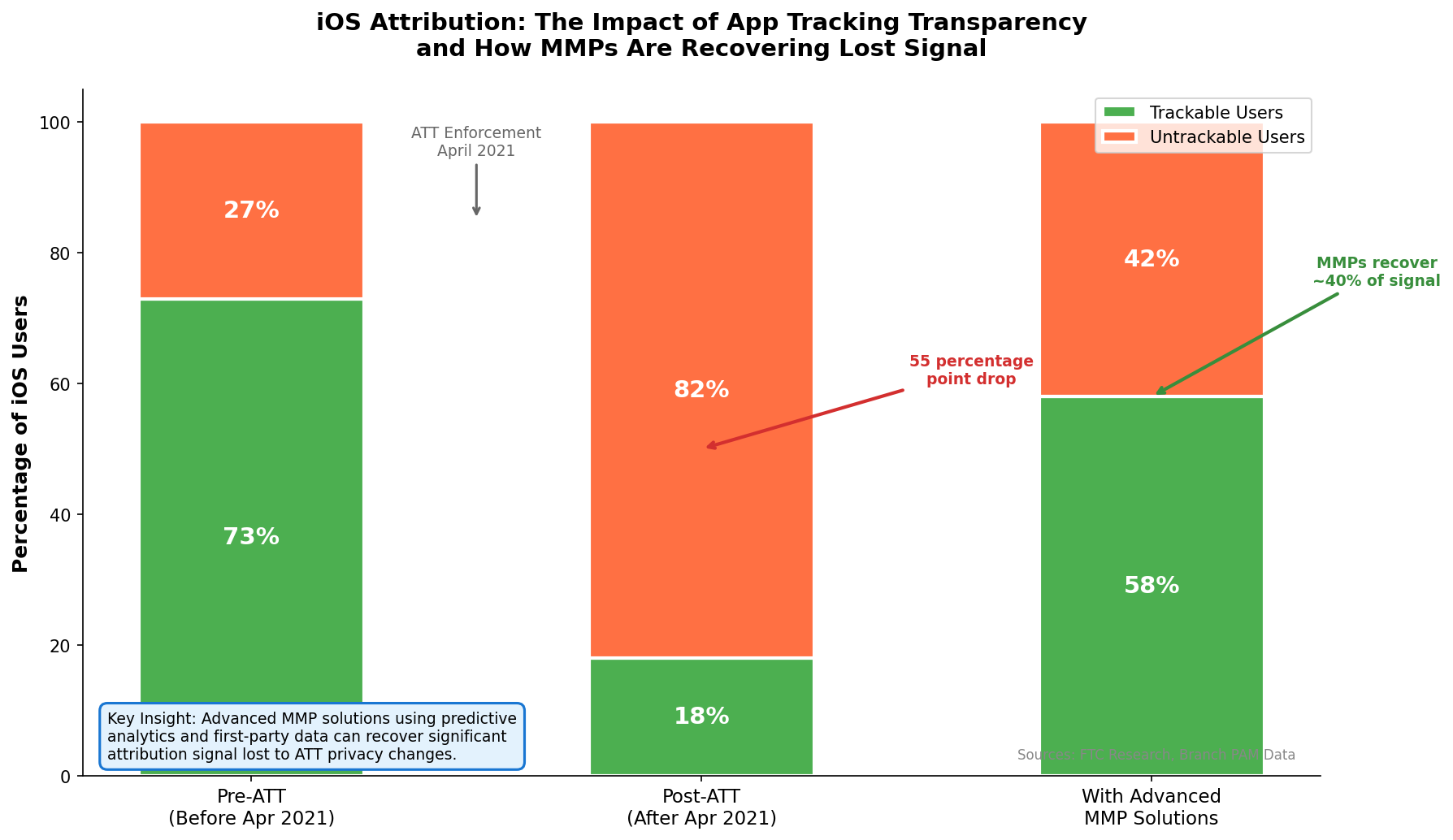
- ATT changed everything. Trackable iOS users dropped from 73% to 18%. Plan accordingly.
- Match platform to need: AppsFlyer for enterprise scale, Adjust for fraud prevention, Branch for web-to-app, Tenjin for gaming.
- Multi-touch attribution improves ROI by 19% on average in year one.
- Don't overpay for features you won't use. Start with free tiers, scale when needed.
What Are Mobile Attribution Platforms?
Mobile attribution platforms track where your app installs come from, including social media. That's the simple version.
The complete picture is more nuanced. These tools, also called mobile measurement partners (MMPs), connect your advertising spend to actual outcomes by identifying which campaigns, channels, and strategies drive users to download and engage with your app. They sit between your ad networks and your analytics, capturing the critical moment when a user transitions from prospect to install.
According to Market Intelo's 2024 analysis, this market was valued at $1.7 billion in 2024 and will reach $6.2 billion by 2033, growing at 15.4% CAGR. North America controls 38% of the market, driven by the concentration of digital-first businesses and mature advertising infrastructure. The growth reflects a hard reality: mobile advertising now represents over 73% of total digital ad spend worldwide, and without precise measurement, you're essentially guessing where to allocate budget.
For mid-market and enterprise businesses, these platforms connect advertising dollars to revenue. They collect user activity data, trace it back to specific touchpoints, and help optimize acquisition and retention efforts. Miss this step, and you'll struggle to answer the most basic question your CFO will ask: which channels actually work?
Comparing 15 Leading Mobile Attribution Platforms
The landscape includes established enterprise players and specialized tools for specific verticals. Here's how they stack up.
Platform Comparison Overview
| Platform | Best For | Key Strength | Pricing Model |
|---|---|---|---|
| AppsFlyer | Enterprise-scale marketing analytics | Multi-touch attribution, extensive integrations | MAU-based with free Essential tier |
| Adjust | Fraud-conscious organizations | Industry-leading fraud prevention | MAU-based with free plan |
| Deep linking and web-to-app attribution related to a marketing campaign | Cross-platform user experiences | Deep linking and web-to-app attribution | MAU-based, no free plan |
| Kochava | Flexible deployment options | Growth teams and marketing teams needing consolidated reporting | Usage-based with free tier |
| Singular | Growth teams needing consolidated reporting | Unified ROI analytics and cost aggregation with web analytics tools for better insights. | Custom tiers with 30-day trial |
| Budget-conscious teams including small businesses | Game developers and publishers | Gaming-focused attribution with DataVault | Pay-as-you-go and all-inclusive |
| Airbridge | Cross-platform measurement | Web-to-app attribution strength | Custom pricing with free trial |
| AppMetrica | Budget-conscious teams | Free full-featured attribution | Free up to 100M events/month with an intuitive user interface |
| Firebase | Google ecosystem users | Seamless Google Ads integration | Free |
| Mixpanel | Product-focused teams | Behavioural analytics and segmentation | Free plan up to 50K MTUs |
| Localytics | Predictive analytics needs and key metrics | Communication strategy optimization | Enterprise pricing |
| Amplitude | Predictive analytics needs | Behavioural forecasting | Free plan available |
| RevenueCat | Subscription apps | Subscription revenue tracking | Tiered pricing |
| Funnel | Non-technical teams | User-friendly interface | Annual contracts |
| Trackier | Campaign optimization | Performance marketing focus | Custom pricing |
Detailed Platform Analysis
AppsFlyer processes attribution for apps you use daily. Spotify, eBay, and HBO Max rely on it. Their strength lies in multi-touch attribution and an integration ecosystem that connects to virtually every ad network—Google, Meta, Twitter, TikTok, and hundreds more, effectively managing different touchpoints. For enterprises running complex, multi-channel campaigns across dozens of partners, this breadth matters. Real-time dashboards and fraud detection round out the offering, though smaller teams may find the feature set overwhelming for their needs.
Fraud is expensive. Adjust built its entire reputation around stopping it. Their deterministic, real-time fraud prevention catches invalid traffic before it hits your attribution reports, using customizable rules and SDK-level protection. Beyond fraud, Adjust offers unified measurement across mobile, web, CTV, PC, and console, providing a clear view of performance metrics. Recent additions include an AI-powered Growth Copilot for natural language queries and InSight for incrementality measurement. Their Pulse automation suite handles bid and budget adjustments automatically—useful when you're managing campaigns across time zones.
Branch solves a specific problem exceptionally well: getting users from web to app without friction, understanding user behaviour in the process. Deep linking is their specialty, and it shows. When someone clicks an ad, Branch ensures they land exactly where they should inside your app, not some generic home screen. Their Privacy Attribution Measurement (PAM) reduces missing iOS attribution claims by roughly 40%—a significant edge post-ATT. Over 3.5 billion users interact with Branch links, and the top 200 apps use their infrastructure. If cross-platform journeys matter to your business, Branch deserves serious consideration.
What if you need raw data access without enterprise pricing? Kochava provides it, even on their free tier. Their Marketers Operating System (m/OS) extends beyond basic attribution into omnichannel measurement covering impressions, clicks, installs, and marketing activities events, allowing for smarter decisions. Attribution uses device identifiers when available, falling back to fingerprinting logic with 90% accuracy when they're not. Organizations with data science teams who want to build custom models appreciate this level of access.
Singular aggregates data from over 1,000 integrated partners, normalizing spend and performance metrics automatically across the entire customer journey. Their value proposition is simple: one dashboard showing ROI across your entire marketing mix, with fraud prevention included at no extra cost. For growth teams tired of stitching together reports from multiple sources, Singular eliminates that headache by providing comprehensive data collection. The direct connection between attribution and cost data enables precise ROAS calculations without spreadsheet gymnastics.
Gaming has its own rules. Tenjin understands them. Voodoo, SayGames, and Ruby Games use Tenjin because it addresses gaming-specific challenges: complex in-app economies, long optimization windows, and the need to balance user acquisition costs against ad monetization revenue. DataVault provides raw user-level data access for custom analysis, including various attribution models for better insights. Pricing starts at free, scaling with usage—indie developers can access enterprise-grade attribution without upfront commitment.
Airbridge excels at cross-platform tracking, supporting Android, iOS, SKAdNetwork, web, PC, and console from a single dashboard. , ensuring accurate attribution. Google recognized them as an official App Attribution Partner. Their strength in web-to-app measurement helps businesses with significant web traffic understand the full conversion path, providing valuable insights. Cohort analysis covers creatives, funnels, retention, revenue, and predictive LTV.
When NOT to Use Each Platform
Choosing the wrong MMP wastes money and creates integration headaches. Here's when to look elsewhere:
Skip AppsFlyer if you're an early-stage startup with limited budget—their enterprise features come with enterprise complexity. Simpler tools with reliable customer support will serve you better until you're spending significantly on user acquisition.
Skip Adjust if fraud isn't a major concern for your vertical. You'll pay for protection you don't need. B2B apps and subscription services with organic-heavy acquisition often fall into this category.
Skip Branch if you don't have meaningful web-to-app traffic. Their deep linking strength becomes irrelevant when users come directly from app stores or in-app ads and other marketing channels.
Skip Kochava if you don't have data science resources to leverage raw data access. You'll end up with capabilities you can't use.
Skip Tenjin if you're not into gaming. The platform's specialization means non-gaming apps miss features other MMPs include by default.
Understanding Privacy Changes and Their Impact
Apple's App Tracking Transparency Framework
Apple's ATT framework, launched with iOS 14.5 in April 2021, disrupted mobile attribution overnight.
The mechanics are straightforward: apps must now request explicit permission through a popup before tracking user activity across other companies' apps and websites. According to Apple's developer documentation, this opt-in requirement applies universally.
The impact was severe. Before ATT, roughly 70% of users remained trackable by default—they simply never bothered opting out. Research published by the FTC shows ATT reduced trackable Apple traffic in the US by 55 percentage points, from 73% to just 18%. Given the 51% premium advertisers paid for trackable impressions, this translated directly into revenue loss for publishers.
SKAdNetwork: Apple's Privacy-Preserving Solution
SKAdNetwork (SKAN) is Apple's answer to attribution in a privacy-first world.
First introduced in 2018 and expanded significantly alongside ATT, SKAN provides aggregated attribution data without revealing individual user information. Apple's servers handle the attribution process and digitally sign the results—no user data leaves the device in identifiable form.
Key limitations marketers must understand:
Conversion values are restrictive. SKAN uses a 6-bit system allowing only 64 possible values (0-63) to represent all post-install behaviour. Mapping complex in-app events to these limited options requires careful planning.
Postbacks arrive late, impacting marketing efforts. Minimum delay is 3-4 days for SKAN 4.0's first postback, with randomized timing to prevent user identification. Real-time optimization becomes impossible.
Volume thresholds hide data. Crowd anonymity rules may mask conversion values and source identifiers when install volumes don't meet Apple's thresholds. Low-volume campaigns suffer most.
SKAN 4 improved matters somewhat, offering three measurement windows (0-48 hours, 3-7 days, 8-35 days) instead of one, but significant gaps remain compared to pre-ATT measurement capabilities.
Adapting Attribution Strategy for Privacy
Smart marketers aren't waiting for the old world to return. It won't.
Effective post-ATT strategies combine SKAN data with predictive analytics that forecast user lifetime value from limited early signals, probabilistic modelling for attribution when deterministic methods fail, and first-party data strategies that maximize insights from owned properties. Relying solely on SKAdNetwork leaves you with an incomplete picture—often missing 30-40% of your iOS campaign performance.
Common Misconceptions About Mobile Attribution
Misconception 1: All Platforms Provide Identical Data
Switching MMPs doesn't mean your numbers stay consistent. Each platform uses different attribution methodologies, integration approaches, and data processing techniques. AppsFlyer's multi-touch attribution will show different results than Adjust's last-click model. Branch's cross-platform tracking captures journeys across various touchpoints that Tenjin's gaming-focused approach might miss entirely, impacting your mobile marketing strategy. Understand your provider's methodology before making decisions based on their reports.
Misconception 2: Attribution Is Only for Paid Campaigns
Limiting attribution tools to paid channels misses the bigger picture. Organic installs, referral programs, owned media performance, and customer interactions as well as interaction effects between paid and organic growth all matter. Content marketing, social presence, and word-of-mouth contribute to overall growth in ways you can't measure without proper attribution. Some of your best users may come from channels you're not tracking.
Misconception 3: SKAdNetwork Provides Sufficient iOS Measurement
SKAN enables privacy-compliant attribution. It doesn't enable complete measurement.
Restricted conversion values, delayed postbacks, and crowd anonymity thresholds that mask data from low-volume campaigns all create gaps. Sophisticated marketers supplement SKAN with predictive models, first-party data analysis, and modeled attribution to fill these holes. Treating SKAN as your only iOS data source means flying partially blind.
Real-World Implementation Examples
Gaming Industry Applications
Mobile games represent the largest vertical for attribution platforms. Voodoo, King, Ubisoft, and Playtika all rely on specialized measurement solutions because gaming attribution involves unique challenges: high user acquisition costs, complex in-app economies with multiple currency types, and optimization for long-term engagement rather than one-time purchases, including insights from ad campaigns and tools like Google Analytics.
Tenjin built its platform around these requirements, emphasizing customer service and data privacy. DataVault provides raw user-level data for custom analysis while ensuring compliance. Pay-as-you-go pricing lets indie developers access enterprise-grade attribution while scaling costs alongside revenue. Publishers use these insights to optimize creative performance across dozens of ad networks simultaneously, identifying which combinations of creative, placement, and audience deliver players with the highest lifetime value.
E-Commerce and Retail Applications
Retail apps face different challenges centered on web-to-app journeys.
Branch dominates this vertical because deep linking solves the core problem: ensuring users who click ads land in the correct app location rather than a generic home screen. When someone researches a product on mobile web, downloads the app, and completes purchase three days later on a tablet, Branch tracks that entire journey. Retailers attribute revenue to the channels that initiated engagement, even when conversion happens on a different device days later.
Subscription App Applications
Subscription businesses need attribution tied to long-term revenue, not one-time installs. RevenueCat integrates with major MMPs specifically to bridge this gap, connecting acquisition source to customer lifetime value.
This enables optimization based on metrics that matter: trial-to-paid conversion rates, subscription duration, and long-term revenue contribution. A channel delivering cheap installs that churn after the trial is worse than an expensive channel delivering committed subscribers. Without this integration, you'd never know the difference.
Frequently Asked Questions
What is the difference between a mobile attribution platform and a mobile analytics platform?
Attribution platforms (MMPs) track where installs come from—which ads, campaigns, and different channels drove users to download your app. Analytics platforms like Mixpanel or Amplitude track what users do after installation: feature usage, retention patterns, engagement metrics. Most organizations use both, feeding acquisition source marketing data from the MMP into the analytics platform for complete user journey analysis.
How do mobile attribution platforms handle iOS users who opt out of tracking?
When users decline ATT permission, platforms lose access to the Identifier for Advertisers (IDFA) and must rely on Apple's SKAdNetwork framework. MMPs have developed workarounds including conversion value optimization, actionable insights through predictive analytics modelling likely outcomes from limited signals, and privacy-preserving measurement techniques that comply with privacy regulations. Some platforms report reducing missing attribution claims by 40% or more through these approaches compared to basic SKAdNetwork implementation.
What pricing model do most mobile attribution platforms use?
Most MMPs charge based on Monthly Active Users (MAU) or tracked events, including user actions. AppsFlyer, Adjust, and Branch use MAU-based pricing with custom plans for high-volume users. Kochava charges per conversion starting at $100/month for 10,000 conversions. Tenjin offers pay-as-you-go with free attribution available. With an ease of use that combines functionality and accessibility, AppsFlyer, Adjust, and Tenjin all have free tiers suitable for early-stage apps or testing.
How long does it take to implement a mobile attribution platform?
Basic implementation runs 1-2 weeks: software development kit (SDK) integration, event configuration, and ad partner setup. Complex implementations with custom attribution windows, advanced features like advanced fraud rules, data warehouse connections, or multiple app properties take 4-8 weeks. Most MMPs provide dedicated onboarding support for enterprise customers.
Can mobile attribution platforms detect and prevent ad fraud?
Yes. Leading MMPs use IP filtering, distribution modelling, device-level anomaly detection, and machine learning to identify fraudulent activity while ensuring privacy compliance. Adjust is known for real-time fraud blocking. Singular includes fraud prevention at no extra cost. Kochava offers configurable detection with detailed reporting. Industry estimates suggest fraud detection protects 10-30% of advertising budgets.
Web Tonic works across SEO and paid search, and you can book a consultation to talk through your own plan.


