



Table of contents
Key Takeaways
- B2B public relations builds the credibility and visibility that influences purchasing decisions involving multiple stakeholders and extended evaluation periods.
- Effective B2B PR strategy integrates media relations, thought leadership, and content marketing to establish consistent authority across buyer touchpoints.
- Trade publication coverage and industry analyst relationships provide third-party validation that business buyers require during vendor evaluation.
- Measurement must connect PR activities to business outcomes including share of voice, website traffic, lead generation, and sales cycle influence.
- Executive thought leadership directly impacts purchasing decisions and should be prioritized within comprehensive B2B communications programs.
- Organizations evaluating PR investments should plan for sustained effort over 12+ months to build relationships, establish presence, and demonstrate measurable business impact.
What Is B2B PR?
B2B public relations refers to strategic communication practices designed to build and maintain relationships between businesses. Unlike B2C PR, which often focuses on mass-market appeal and emotional connection, B2B public relations targets specific industries, professional audiences, and organizational decision-makers who evaluate purchases based on technical capabilities and long-term partnership potential.
So why do most companies still treat PR as an afterthought?
According to research published in the Public Relations Review, corporate communications in B2B contexts function differently than consumer-facing efforts because the purchasing process involves higher stakes, longer consideration periods, and multiple stakeholders who must reach consensus. The Gartner Group notes that the typical B2B buying group includes 6-10 decision-makers, each consuming different information sources during evaluation. That's six to ten people you need to reach, convince, and keep engaged throughout a sales cycle that can stretch across months. And they're all reading different publications, attending different conferences, and trusting different voices in their industry.
For mid-market and enterprise organizations, B2B PR serves as a critical component of the marketing ecosystem. It establishes the credibility that enables sales conversations, supports account-based marketing initiatives, and positions companies as industry authorities. PR professionals develop communication strategies that align with business goals, crafting key messages that resonate with potential clients and protect brand reputation. Paid advertising can generate awareness. But earned media coverage and thought leadership provide the third-party validation that business buyers require before committing to significant investments.
Core Components of a B2B PR Strategy
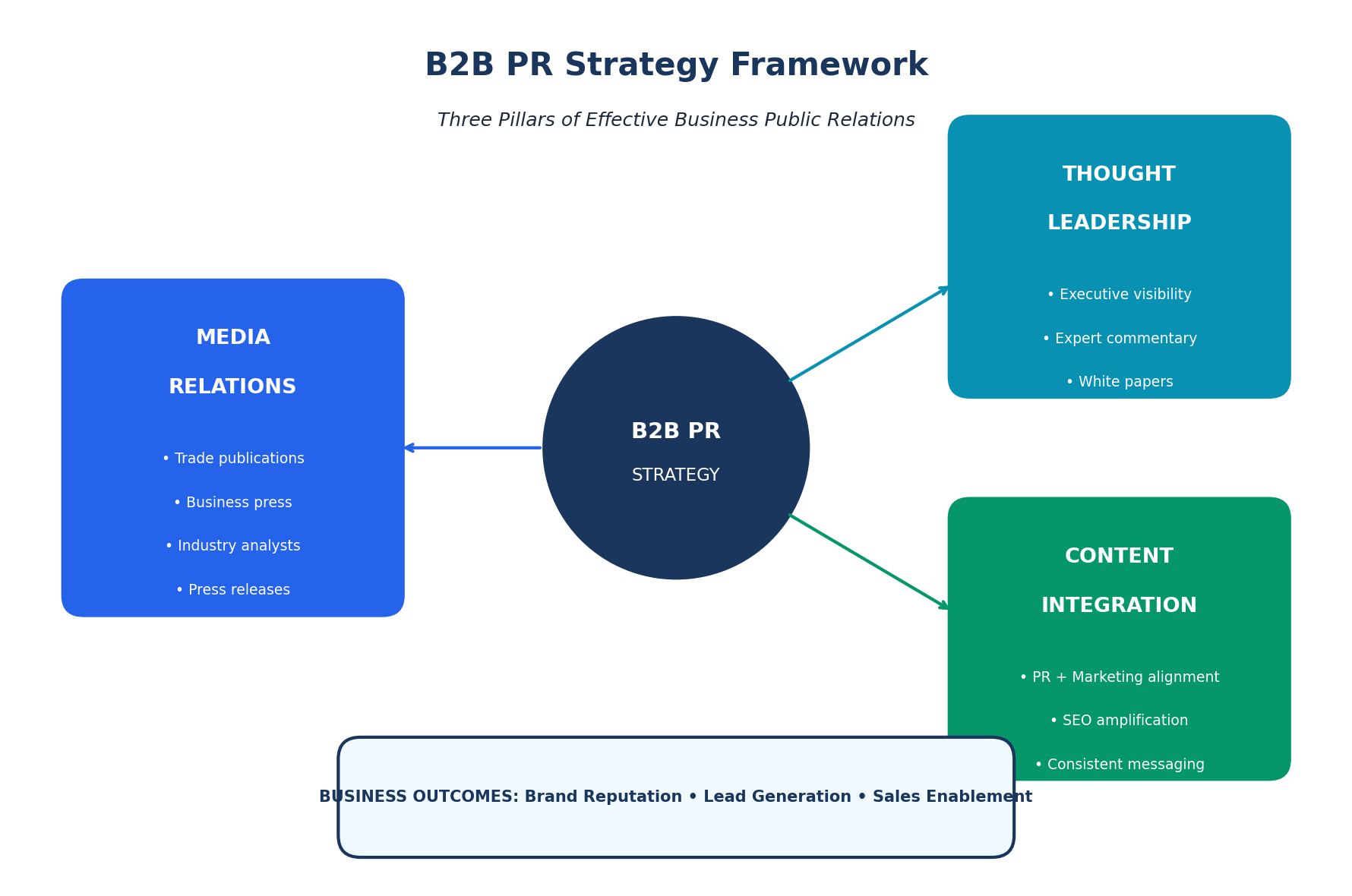
Developing an effective B2B public relations program requires coordinating multiple communication channels and tactics. Unlike transactional marketing approaches, B2B PR builds cumulative value over time by establishing expertise, trust, and visibility among target audiences.
Media Relations for Trade and Business Publications
Trade publications remain the cornerstone of B2B media relations because they reach concentrated audiences of industry professionals actively seeking solutions.
Coverage in respected industry outlets signals credibility to potential buyers who already trust these sources for technical guidance and market intelligence. When a prospect sees your company featured in their go-to trade publication, that third-party endorsement carries weight that no amount of advertising can match. These media mentions reach the right audience at the right time, making them one of the most effective PR tactics available to B2B organizations.
| Media Type | Audience | Best For | Timeline |
|---|---|---|---|
| Trade Publications | Industry specialists, technical buyers | Product launches, technical thought leadership | 2-4 weeks lead time |
| Business Press | C-suite, investors, broad business audience | Company milestones, executive profiles | 3-6 weeks lead time |
| Vertical-Specific Podcasts | Engaged niche professionals | In-depth expertise, personality-driven content | 4-8 weeks lead time |
| Industry Analysts | Technology evaluators, enterprise buyers | Product positioning, market validation | Ongoing relationship |
Effective media relations in B2B contexts requires understanding the editorial calendars, reporting beats, and technical knowledge of target journalists. According to Cision's State of the Media Report, journalists at trade publications receive an average of 50+ pitches daily, meaning relevance and newsworthiness determine coverage success more than relationship alone.
Thought Leadership and Executive Visibility
Thought leadership positions company executives as authoritative voices on industry trends, challenges, and innovations. Unlike promotional content, genuine thought leadership offers original perspectives backed by data, experience, or proprietary research that audiences cannot find elsewhere.
Effective Thought Leadership Channels:
- Bylined articles in industry publications
- Speaking engagements at trade shows and conferences
- Podcast guest appearances
- LinkedIn publishing and engagement
- White papers and contributed research reports
- Webinar presentations
Positioning subject matter experts for expert commentary opportunities builds credibility that generic corporate messaging cannot achieve. Research from Edelman and LinkedIn on B2B thought leadership found that 64% of decision-makers say thought leadership content has directly led them to award business to an organization. But here's the problem: the same research shows 71% of decision-makers say less than half the thought leadership they consume provides valuable insights. Quality matters more than quantity. Most companies miss this.
Content Marketing Integration
B2B PR and content marketing overlap significantly. PR-generated coverage and thought leadership feed content programs, while original content creation provides substance for media pitches and executive positioning.
When these functions work together, the results compound. Media coverage amplifies PR content reach beyond owned channels, and those content assets give journalists something substantive to reference in their pitches. The SEO benefits alone can be substantial: earned media backlinks from respected publications boost organic visibility in ways that paid links never could. And consistent messaging across PR and marketing reinforces brand positioning at every touchpoint.
But when PR and marketing operate in silos? Missed opportunities pile up. Messages conflict. Teams duplicate effort. Worst of all, external coverage sometimes contradicts what your marketing team is saying on your own website. That credibility gap is hard to close.
Building Your B2B Media Relations Program
Successful B2B media relations requires systematic processes for identifying opportunities, developing relationships, and delivering newsworthy content to journalists and editors who serve your target audiences.
Developing a Target Media List
Building a comprehensive media list begins with understanding where your target buyers consume industry information. For B2B organizations, this typically includes trade publications, business media, industry analyst firms, and influential podcasts or newsletters within your vertical.
The Institute for Public Relations recommends auditing competitor coverage to identify publications and journalists who cover your industry segment. This competitive intelligence reveals not only which outlets matter but also what story angles resonate with editorial teams.
Creating Newsworthy Content
Business journalists evaluate pitches based on newsworthiness criteria that differ from consumer media. Technical publications prioritize accuracy, depth, and practical applicability, while business media focuses on market impact, competitive dynamics, and leadership insights.
Elements That Make B2B Stories Newsworthy:
- Original research or data not available elsewhere
- Trend analysis with supporting evidence
- Customer success stories with quantifiable outcomes
- Product innovations that solve documented industry problems
- Executive perspectives on timely industry developments
- Partnership announcements that signal market direction
Measuring Media Relations Effectiveness
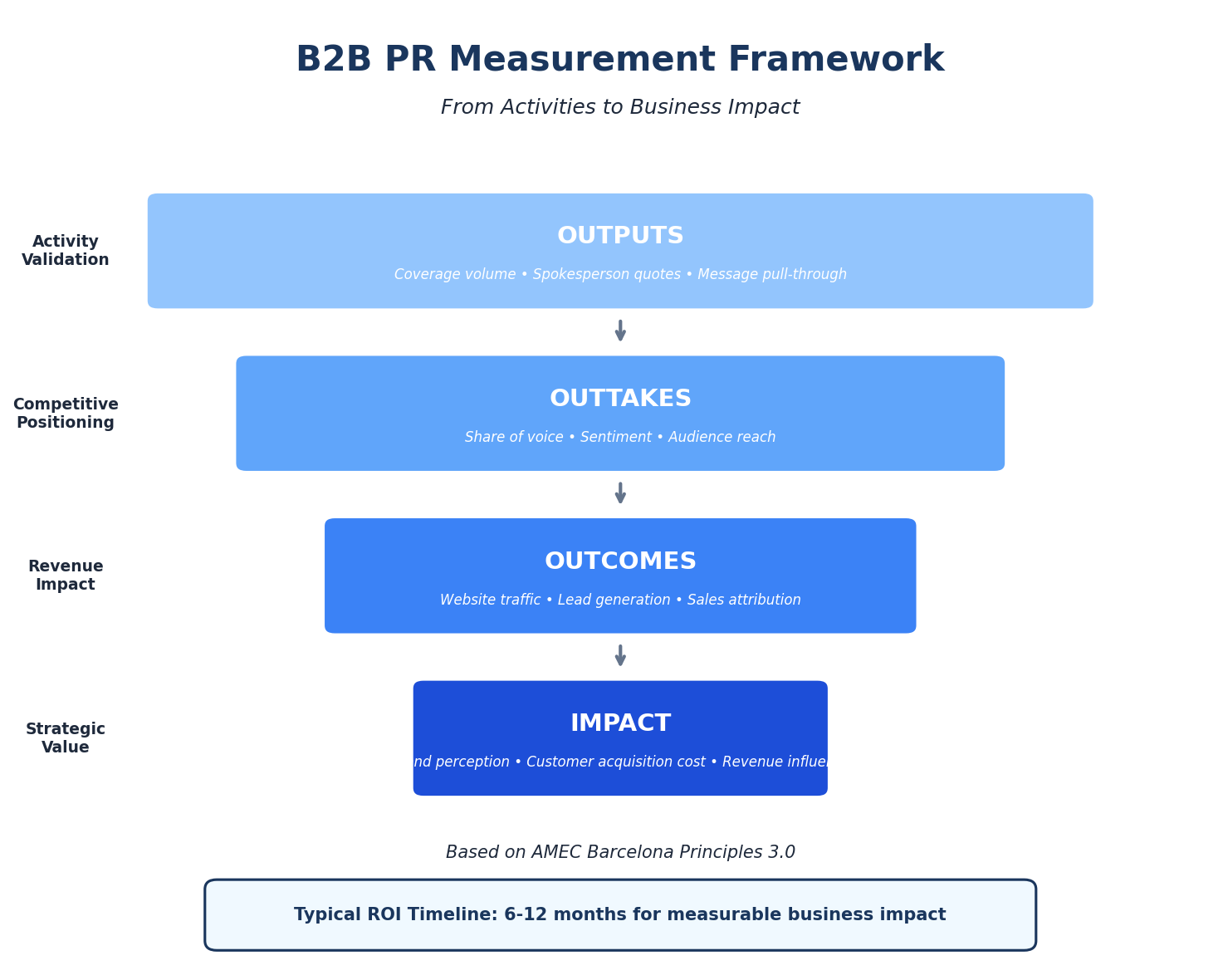
Measuring B2B PR outcomes requires metrics aligned with business objectives rather than vanity metrics like impression counts. According to the International Association for Measurement and Evaluation of Communications (AMEC), the Barcelona Principles 3.0 establish that PR measurement should tie communications outcomes to organizational goals.
| Metric Category | Specific Measures | Business Connection |
|---|---|---|
| Output | Coverage volume, message pull-through, spokesperson quotes | Activity validation |
| Outtake | Share of voice, sentiment, audience reach | Competitive positioning |
| Outcome | Website traffic from coverage, lead generation, sales attribution | Revenue impact |
| Impact | Brand perception shifts, customer acquisition cost changes | Strategic value |
Common Misconceptions About B2B PR
Misconception 1: PR Is Only for Crisis Management
Many B2B organizations engage PR agencies or build internal communications teams only after experiencing negative publicity or operational crises. This reactive approach misses the primary value of public relations: building the positive reputation and industry visibility that make organizations resilient when challenges arise.
Research on corporate reputation from Harvard Business Review indicates that companies with strong reputations recover from crises faster and maintain stakeholder confidence during difficult periods. But you can't build that credibility overnight. Proactive PR campaigns establish positive relationships with external audiences and protect your company's reputation long before any crisis emerges. Wait until the crisis hits, and you're starting from zero.
Misconception 2: B2B Buyers Don't Care About Media Coverage
Some organizations assume that sophisticated business buyers make decisions purely on technical specifications and pricing, rendering PR irrelevant. However, McKinsey & Company research on B2B buying behaviour demonstrates that brand strength and reputation significantly influence vendor selection, particularly during early consideration stages when buyers create shortlists.
Business buyers conduct extensive research before engaging sales teams, and media coverage shapes their perception of which vendors merit further evaluation. Companies with consistent, positive industry visibility enter more sales conversations than competitors operating in obscurity. PR success translates directly to lead gen when strong relationships with journalists keep your brand visible to potential clients.
Misconception 3: Social Media Has Replaced Traditional Media Relations
While LinkedIn and other professional platforms play important roles in B2B marketing, trade publication coverage and earned media retain distinct value that social content cannot replicate. Third-party validation from respected industry journalists carries credibility that company-generated content lacks, regardless of distribution channel.
Effective B2B PR programs integrate social media as amplification and engagement channels while maintaining relationships with traditional media outlets whose coverage provides the authority signals business buyers trust. Influencer partnerships with industry analysts and respected commentators can bridge both worlds, but they complement rather than replace traditional media relations.
Real-World Examples and Case Studies
Salesforce: Building a Category Through PR
Salesforce provides a textbook example of B2B PR driving market category creation. In its early years, the company's "No Software" campaign combined aggressive media relations with attention-grabbing tactics that positioned the company as a disruptive challenger to established enterprise software vendors. The stunts were deliberate and theatrical: Benioff hired actors to stage fake protests outside Siebel Systems' user conference, complete with "No Software" signs and mock picket lines. The press coverage was immediate and extensive.
Beyond provocative stunts, Salesforce invested heavily in thought leadership around cloud computing benefits, positioning CEO Marc Benioff as an industry visionary. This sustained PR effort contributed to market education that expanded the entire CRM category while establishing Salesforce as the defining brand. According to company filings, Salesforce has grown from startup to over $30 billion in annual revenue. Brand recognition and thought leadership remain consistent competitive advantages throughout its trajectory.
HubSpot: Inbound Marketing Category Creation
HubSpot demonstrates how B2B PR and content marketing integration creates market categories. The company coined the term "inbound marketing" and invested substantially in research reports, educational content, and media relations that established the concept as an industry standard.
The company's annual State of Marketing reports generate consistent media coverage while providing valuable data for journalists covering marketing technology trends. This research-driven PR approach positions HubSpot executives as primary sources for trend commentary. And that sustained visibility directly supports business development. HubSpot has grown to over $2 billion in annual revenue while maintaining a strong share of voice in marketing technology conversations.
Slack: Press-Driven Growth Strategy
Slack's growth from startup to $27.7 billion acquisition by Salesforce benefited substantially from strategic PR that made the company synonymous with workplace transformation. The communications team prioritized human-interest angles around how teams use the platform rather than product feature announcements, generating coverage in business media that reached decision-makers beyond IT departments.
CEO Stewart Butterfield's accessible communication style and willingness to discuss company challenges authentically made him a sought-after interview subject, amplifying Slack's visibility through executive thought leadership.
Frequently Asked Questions
How does B2B PR differ from B2C public relations?
B2B public relations targets professional audiences making organizational purchasing decisions rather than individual consumers making personal purchases. This distinction affects message complexity, media channel selection, and success metrics. B2B PR typically emphasizes thought leadership, industry expertise, and technical credibility over emotional appeal and brand awareness. The longer B2B sales cycles mean PR must sustain visibility across multiple touchpoints rather than driving immediate action.
What is the typical ROI timeline for B2B PR investments?
B2B PR programs generally require 6-12 months to demonstrate measurable business impact because earned media influence accumulates over time and aligns with lengthy B2B sales cycles. Initial months focus on relationship building, message development, and establishing media presence. Visible results, including consistent coverage, share of voice improvements, and detectable pipeline influence, typically emerge after sustained effort. Organizations should plan for minimum 12-month commitments when evaluating PR investments.
How should B2B companies measure PR effectiveness?
Effective B2B PR measurement connects communications activities to business outcomes through metrics including share of voice against competitors, message pull-through in coverage, website traffic from earned media, lead generation from PR-sourced content, and sales cycle influence for covered accounts. The AMEC Barcelona Principles provide frameworks for measurement that avoid vanity metrics while demonstrating strategic value. Organizations should establish baseline measurements before launching programs to enable meaningful comparison.
Should B2B companies hire in-house PR teams or agencies?
The optimal approach depends on organizational maturity, budget, and strategic objectives. Agencies offer specialized expertise, media relationships, and scalable resources that benefit organizations without established communications functions. In-house teams provide deeper company knowledge, faster response capability, and continuous availability that external partners cannot match. Many mid-market and enterprise organizations employ hybrid models with internal communications leadership supplemented by agency support for media relations, content development, or specific initiatives.
How important is executive thought leadership for B2B PR?
Executive thought leadership serves as a cornerstone of effective B2B PR because business buyers evaluate vendors partly based on leadership credibility and vision. Decision-makers want confidence that partner companies will navigate industry changes successfully, and executive visibility provides evidence of strategic thinking. Research indicates that thought leadership directly influences purchasing decisions for the majority of B2B buyers, making executive positioning a priority for organizations pursuing enterprise accounts.
Web Tonic works across paid search, paid social and growth marketing, and you can book a consultation to talk through your own plan.


