



Table of contents
Key Takeaways
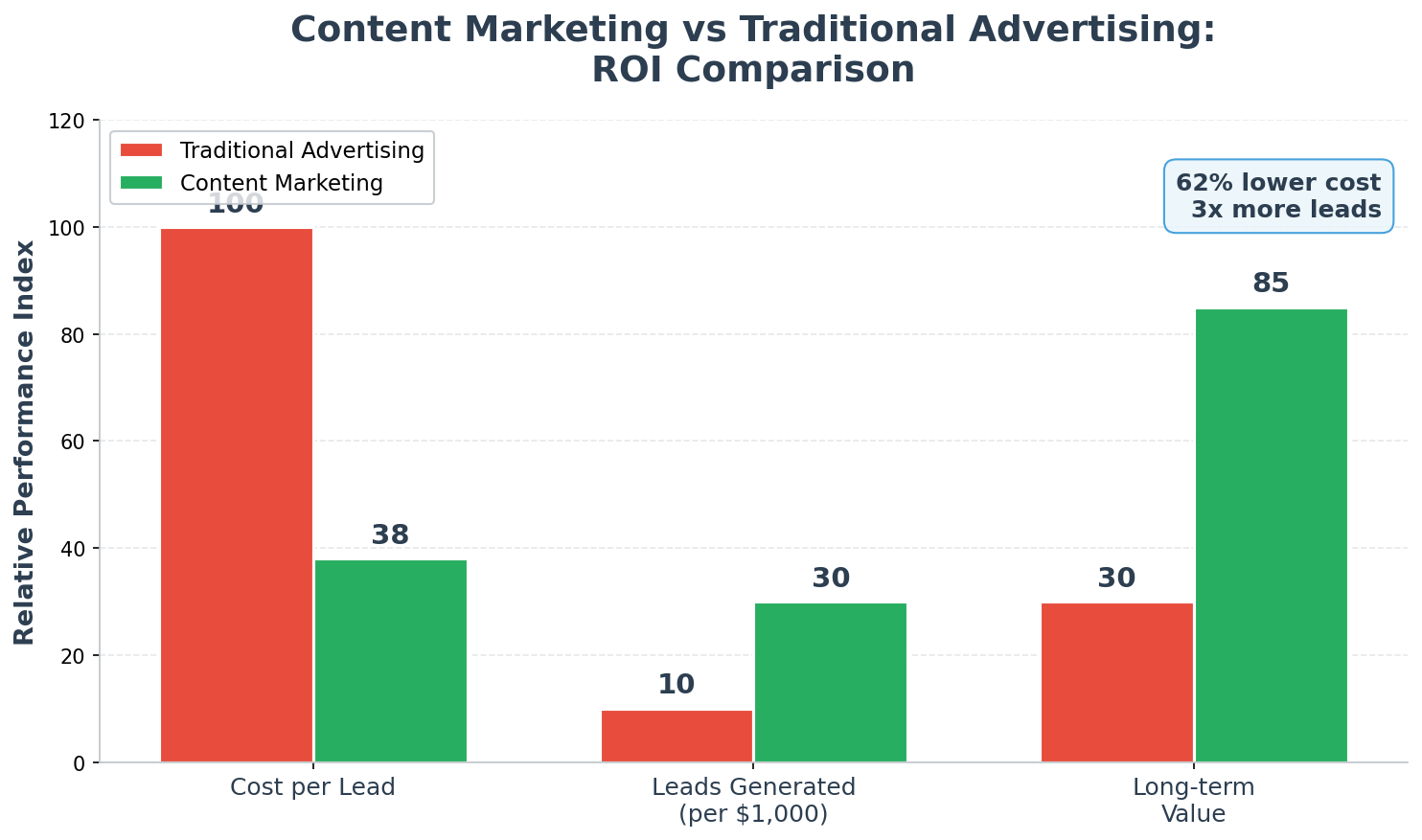
- Content marketing generates three times more leads than traditional advertising at 62% lower cost, but results require patience—expect three to six months before seeing substantial returns.
- Documented content strategy dramatically improves outcomes, yet only 40% of B2B marketers have documented their approach despite nearly 75% having some strategy in place.
- User-generated content and brand storytelling create authentic connections that traditional advertising cannot match, as demonstrated by GoPro's Million Dollar Challenge and Airbnb's host stories.
- Quality consistently outperforms quantity—bloggers spending six or more hours per article report significantly stronger results than those prioritizing volume.
- The most successful content marketers repurpose and update existing content rather than constantly creating from scratch, with refreshed posts seeing up to 106% organic traffic growth.
- Purpose-driven content that aligns with audience values drives both social impact and commercial success, as Dove's twenty-year Real Beauty campaign demonstrates with its growth from $2.5 billion to over $4 billion in sales.
- Organizations ready to elevate their content marketing results should consider partnering with experienced strategists who understand both creative execution and measurable business outcomes.
What Is Content Marketing?
Content marketing is the strategic practice of creating and distributing valuable, relevant content to attract and retain a clearly defined target audience, ultimately driving profitable customer action. Unlike traditional advertising that interrupts audiences with promotional messages, content marketing earns attention by providing genuine value through education, entertainment, or inspiration. An effective content marketing strategy helps potential customers find answers through search engines before they ever talk to sales.
Why does this distinction matter? Because today's consumers actively seek information before making purchasing decisions. According to Content Marketing Institute research, 84% of B2B marketers report that content marketing has proven effective for generating brand awareness, while 58% credit content marketing directly with increased sales and revenue. Effective content builds trust before asking for the sale.
For mid-market and enterprise businesses, content marketing has become central to growth strategy. Organizations that consistently produce valuable content are significantly more likely to achieve positive ROI compared to those that don't prioritize content creation. Content marketing generates three times more leads per dollar spent than traditional advertising while costing 62% less to execute.
Types of Content Marketing That Drive Results
Content marketing encompasses a broad spectrum of formats, each serving different stages of the buyer journey and audience preferences. Understanding which content marketing strategy examples align with your business objectives is the first step toward strategic planning.
Comparison of Content Marketing Formats
| Content Format | Primary Benefit | Best For | Average Engagement |
|---|---|---|---|
| Blog Posts & Articles | SEO visibility, thought leadership | Top-of-funnel awareness | 43% of readers skim content |
| Video Content | Higher engagement, faster comprehension | Product demonstrations, storytelling | 92% report positive ROI |
| Case Studies | Social proof, conversion | Bottom-of-funnel decisions | 78% of B2B marketers use them |
| User-Generated Content | Authenticity, community building | Brand awareness, trust | 29% increase in conversions |
| Interactive Content | Engagement, data collection | Lead generation | 53% more engagement than static |
| Email Newsletters | Direct communication, nurturing | Retention, relationship building | $36 ROI per $1 spent |
| Podcasts & Audio | Intimate connection, accessibility | Brand building, thought leadership | Projected $2B+ market |
Pros and Cons of Content Marketing Investment
Content marketing costs 62% less than traditional marketing while generating three times more leads. That's exceptionally cost-efficient for organizations with limited budgets. And unlike paid advertising that stops producing results when spending stops, great content continues generating organic traffic and leads indefinitely. The compounding returns over time represent one of content marketing's biggest advantages.
Content also establishes thought leadership and builds trust. Your brand becomes a credible industry leader that potential customers turn to when they're ready to purchase.
Common Misconceptions About Content Marketing
Misconception 1: More Content Equals Better Results
Many organizations fall into the trap of prioritizing quantity over quality, believing that publishing more content automatically drives better outcomes. The data tells a different story.
Bloggers who spend more than six hours per article are significantly more likely to report strong results compared to those rushing content production. The most-shared online articles average around 550 words, but comprehensive guides and in-depth resources consistently outperform thin content for SEO rankings and audience value. Strategic, well-researched content outperforms high-volume, low-effort publishing every time. In today's digital landscape, the right content beats more content.
Misconception 2: Content Marketing Is Just Blogging
While blogs remain valuable (79% of content marketers maintain active blogs according to Content Marketing Institute), reducing content strategy to blogging alone misses enormous opportunities.
Successful content marketing strategies deploy content across multiple channels and formats. Video and visual content delivers ROI 49% faster than text-based content. Podcast advertising continues growing rapidly. Interactive content generates two times more conversions than passive formats. Top-performing content marketers repurpose single pieces across social channels and formats. They extend reach without proportionally increasing production costs.
Misconception 3: AI Will Replace Content Marketing Teams
With 85% of B2B marketers now using generative AI tools and large language models, some assume automation will replace human content creators. The reality is more nuanced.
Organizations using AI see increased efficiency, with 68% reporting improved content marketing ROI when incorporating AI tools. But AI currently excels at research, outline creation, and draft generation. Original insights, authentic storytelling, and strategic thinking remain human strengths. Winning content teams use AI as a content marketing tool to amplify human creativity. That frees strategists to focus on differentiation and genuine expertise that algorithms can't replicate.
Why Documented Strategy Separates Winners from Also-Rans
Organizations that document their content strategy dramatically outperform those operating without clear direction. But here's what's surprising: only 40% of B2B marketers have documented their content marketing strategy, even though nearly three-quarters have some strategy in place. The gap between intention and execution reveals an opportunity for organizations willing to invest in strategic planning.
Research consistently shows that marketers who set clear goals are 429% more likely to report success than those who don't. A documented strategy forces alignment across teams, clarifies key performance indicators, and creates accountability for execution. Among B2B marketers who rate their content strategy as moderately effective or worse, 42% attribute the underperformance to a lack of clear goals. Proper documentation solves that problem.
Top content marketers dedicate resources proportionally. Industry patterns suggest that investing 10% to 70% of marketing budgets in content marketing correlates with higher success rates. Organizations that ramp blogging frequency to over 16 posts monthly see nearly 3.5 times more traffic than those publishing less frequently. But the key insight is consistency and strategic intent, not arbitrary volume targets.

The Compounding Power of Evergreen Content
One of content marketing's biggest but least understood advantages is the compounding nature of quality content. Unlike paid advertising that stops working when budget runs out, well-crafted content continues generating returns indefinitely. According to HubSpot research, companies that blog attract 55% more website visitors than those that don't. That traffic compounds over time as content accumulates visibility in search results.
Smart content marketers invest heavily in updating and republishing existing content. Organic traffic can grow by up to 106% after refreshing old posts. The strategy capitalizes on established search authority while ensuring information remains accurate and valuable. Leading organizations audit their content libraries and systematically improve underperforming pieces. They don't constantly create from scratch.
What separates content strategy examples that deliver sustainable results from campaigns that flame out quickly? Long-term orientation. Building a content library is like building any valuable asset: the returns accelerate over time as individual pieces support and reinforce each other.
Real-World Examples and Case Studies
Red Bull: Building a Media Empire
Red Bull has executed perhaps the most ambitious content marketing strategy in corporate history. The company transformed from an energy drink brand into a full-fledged media house. Instead of traditional product advertising, Red Bull produces high-quality content across extreme sports, music, and youth culture through Red Bull Media House, established in 2007.
The strategy reached its peak with Red Bull Stratos, where Felix Baumgartner jumped from the edge of space in 2012. The event generated massive global attention without mentioning products. And yet sales of Red Bull rose 7% within six months. Red Bull sponsors over 500 extreme sporting events and owns entire sports franchises, from Formula 1 teams to professional soccer clubs. The brand also maintains a YouTube channel with millions of subscribers. Brands can transcend traditional advertising by becoming content creators audiences actively seek out.
GoPro: User-Generated Content at Scale
GoPro turned customers into brand ambassadors through its innovative user-generated content strategy, culminating in the annual Million Dollar Challenge. The campaign invites users to submit footage captured with GoPro cameras for a chance to share a $1 million prize. According to Campaign US, the challenge generated more than 43,000 submissions in a recent year, totaling approximately 72 hours of footage.
The genius? Creating a self-sustaining content engine. Submissions fuel 12 months of social media content across TV ads and retail displays. GoPro's strategy proves that user-generated content can match or exceed professional production quality when the right incentives and community engagement exist. The campaign reached over 857 million people and generated 70 million engagements with an 8.1% engagement rate. Exceptional by any standard.
Spotify Wrapped: Data Becomes Shareable Content
Spotify Wrapped shows how personalization transforms data into viral content. The annual campaign turns user listening data into shareable graphics optimized for social media posts. According to analytics, the 2024 Wrapped generated roughly 2.1 million social media mentions within 48 hours and over 400 million TikTok views in three days.
Why does it work so well? Because it makes users the story. Every shared Wrapped graphic becomes free advertising reaching audiences far beyond Spotify's owned channels. In 2020, Wrapped boosted Spotify app downloads by 21% in the first week of December. Content designed for sharing can drive measurable business outcomes.
HubSpot: Inbound Marketing Pioneer
HubSpot built its business on content marketing. The company established itself as the definitive resource for marketing, sales, and customer service professionals through comprehensive blog content, free tools and templates, online courses through HubSpot Academy, and extensive research reports. Every piece of content drives visitors toward a landing page or resource. All of it positions HubSpot as a trusted advisor, not just a software vendor.
B2B companies can use educational content to attract and nurture leads throughout extended buying cycles. By giving away valuable resources freely, HubSpot builds the trust and credibility that converts prospects when they're ready to purchase. The strategy proves especially effective for companies with complex products that require significant buyer education.
Airbnb: Storytelling Creates Connection
Airbnb's content strategy centers on storytelling that highlights the human connections made possible through travel. The brand's magazine features host stories and destination highlights that emphasize authentic user experience over transactional listings. Campaigns like "Belong Anywhere" and "Made Possible by Hosts" showcase real guest experiences through user-generated content.
The "Live There" campaign encouraged travellers to immerse themselves in local communities, not tourist traps, with the hashtag #LiveThere driving organic social sharing. Airbnb also created the experiential "Night At" series, offering once-in-a-lifetime stays like spending a night in the Louvre. The series generated massive media coverage and social buzz, transforming accommodations booking into aspirational lifestyle content.
Dove: Twenty Years of Purpose-Driven Marketing
Dove's Real Beauty campaign, launched in 2004, stands as one of the most successful purpose-driven content marketing efforts in history. It began with research revealing that only 2% of women globally describe themselves as beautiful. That insight provided the foundation for content featuring real people and challenging unrealistic beauty standards.
According to Science of Retail, sales surged from $2.5 billion to over $4 billion within a decade. The Real Beauty Sketches video amassed 50 million views within 12 days, becoming one of the most-shared ads in history. The campaign earned multiple Cannes Lions awards while the Dove Self-Esteem Project has reached over 82 million young people globally. Social impact and commercial success can coexist.
Nike: Finding Greatness in Everyone
Nike's "Find Your Greatness" campaign during the 2012 London Olympics shows content marketing at its most creative. Having lost the Olympic sponsorship to Adidas, Nike couldn't use Olympic imagery or athlete endorsements. So the brand featured everyday people striving for personal excellence, filmed in locations named "London" around the world.
The campaign gained 57,000 new social media followers compared to 12,000 for Adidas during the Olympics, despite Adidas being the official sponsor. It resonated because it made greatness accessible. Not reserved for elite athletes. The campaign's success was so significant that Nike's headquarters named a meeting room after it.
John Deere: The Original Content Marketer
John Deere's The Furrow magazine represents content marketing before the term existed. First published in 1895, the agricultural magazine has provided valuable information to farmers for over 125 years. Today it reaches approximately 2 million global readers in the United States and beyond, covering diverse agricultural topics from beef industry trends to gourmet chocolate production.
The Furrow shows that content marketing's principles (providing genuine value to a defined audience) transcend digital marketing channels and modern marketing jargon. John Deere understood over a century ago that helping customers succeed builds lasting relationships and brand loyalty.
Frequently Asked Questions
What makes content marketing different from traditional advertising?
Content marketing earns audience attention by providing genuine value through education, entertainment, or problem-solving. Traditional advertising interrupts audiences with promotional messages. The key distinction is pull versus push: content marketing attracts the right people actively seeking information, whereas advertising pushes messages to audiences who may not want them.
How long does content marketing take to show results?
Most organizations should expect meaningful content marketing results within three to six months, though some benefits compound over longer timeframes. Initial visibility improvements often appear within weeks. But substantial traffic, lead generation, and revenue impact typically require consistent effort over months. Organizations that prioritize blogging efforts can see a 13 times increase in positive ROI, but you'll need patience and sustained investment.
What content formats deliver the highest ROI?
Email marketing consistently delivers the highest measurable ROI at approximately $36 for every $1 spent. Video content delivers ROI 49% faster than text-based content and generates 66% more qualified leads per year. But best practices suggest combining multiple formats: blog posts drive SEO visibility, video increases engagement, and email nurtures relationships.
How much should organizations invest in content marketing?
Industry patterns suggest that organizations dedicating between 10% and 70% of their total marketing budget to content marketing tend to classify themselves as "very successful." The average business invests between a quarter and nearly a third of its marketing budget in content marketing. Investment levels should align with business goals, competitive landscape, and existing content assets. Not arbitrary benchmarks.
Should content marketing be managed in-house or outsourced?
The optimal approach often combines internal strategic direction with external execution support. Internal teams understand brand voice, customer needs, and business context best. But 48% of B2B marketers cite "not enough content repurposing" as a top scaling challenge, and external resources can help organizations maintain consistency without overwhelming internal teams. For the first time, many companies are finding that hybrid models deliver deeper insights and better results.


